
Hey there everyone! Welcome back to Movie Soapbox, the little corner of the internet that only you and I and that guy sleeping in the corner over there know about. This is the place where we find underappreciated films and actually make sense of them, not just react to them. Today we are doing a full deep dive on A Cure for Wellness, a movie so operatically weird, so stubbornly committed to its own gothic fever dream, that the studio that released it reportedly had no idea how to sell it and priced the marketing budget accordingly, which is to say they didn’t.
Fair warning: everything from here on out is spoilers. Not the soft kind, not the “I’ll hint around the edges” kind. We are going scene by scene through this thing, because a movie this architecturally strange does not yield to anything less than total autopsy. If you haven’t seen it, go watch it and come back. I’ll be here.
Before we walk through what actually happens in this film, you need to understand something about the conditions under which a movie like this gets made and, more importantly, gets released. Gore Verbinski had just come off the catastrophic commercial failure of The Lone Ranger, a $250 million lesson in what happens when a studio bets big on a director’s idiosyncratic instincts and the audience doesn’t show up. Studios have long memories for that kind of money. So when Verbinski comes back with a two-and-a-half-hour gothic horror film set in a Swiss sanitarium, starring a lead whose biggest prior credit was Chronicle, with a story involving eel-based immortality and incest eugenics among the 19th century European aristocracy, the question worth asking is not “why did this movie turn out so strange,” it’s “how did this movie get made at all.” The answer is usually that somebody at the top of the greenlight chain owed somebody something, or believed in a director enough to let him cash in whatever credibility chips he had left. You can feel that tension in every frame of this film, the sensation of a filmmaker spending money he knows he won’t be given again, making exactly the movie he wanted to make and daring the suits to stop him. They didn’t stop him. They just didn’t tell anyone the movie existed.
A Cure For Wellness Movie Walkthrough
Right. The film. A random American corporation that looks, as the source material correctly notes, like Enron with better art direction, is quietly cooking its books while simultaneously chasing a merger that would make everyone involved disgustingly rich. The one problem is that their CEO, Pembroke, has gone to a wellness resort in Switzerland and sent back a letter full of the kind of enlightened-man-on-the-mountain language that means either he’s had a genuine spiritual awakening or someone has gotten to him. The board can’t afford either scenario. So they reach down the ladder and grab Lockhart, played by Dane DeHaan, young and hungry and ethically flexible, and they send him to Switzerland to retrieve Pembroke or else he’s the one who goes down for the book-cooking. Classic setup. Classic leverage.
Lockhart arrives at Volmer’s Institute for Wellness and immediately nothing works the way it should. Visiting hours are over. Pembroke is unavailable. Every administrative courtesy is extended to Lockhart in a way that somehow adds up to total stonewalling. The place is beautiful in the specific way that very expensive traps are beautiful. Patients play croquet. Patients sip water from branded bottles. Patients chat pleasantly on the veranda and seem constitutionally unable to articulate a reason to leave, not because they’re being held at gunpoint but because the question doesn’t quite seem to compute for them. You can see the filmmaker’s interest here: Verbinski is more fascinated by what voluntary captivity looks like than by the mechanics of the cage itself. That’s where the film earns its runtime, in those early, slow, creeping scenes where something is obviously wrong and nobody will confirm it.
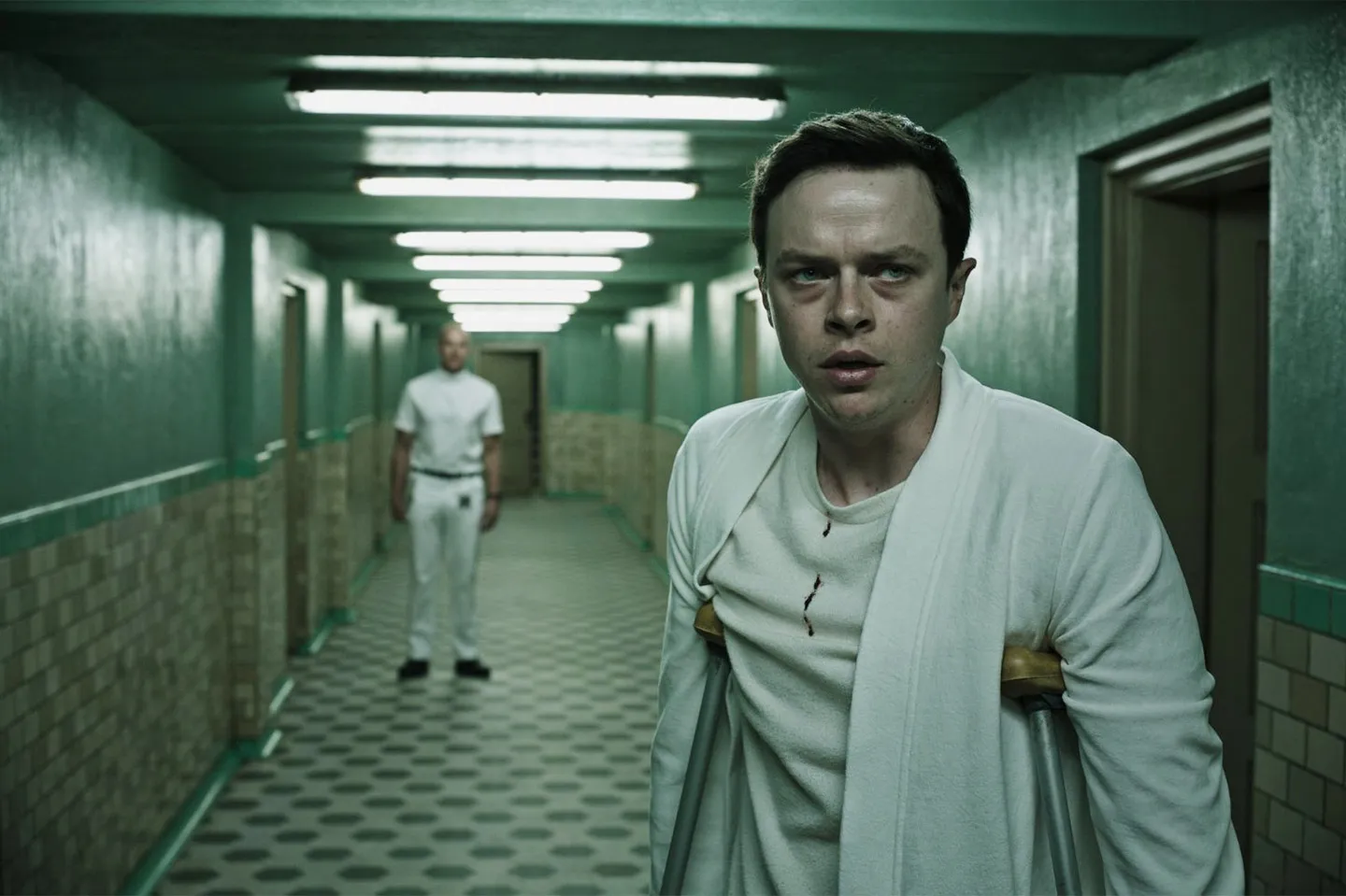
Then Lockhart’s car crashes on the way back down the mountain, his leg gets broken, and suddenly he’s a patient. Which is, of course, the only way any of the real information is going to come to him. Pembroke is still his nominal goal but the film is smart enough to know that Pembroke was never the real story. Lockhart shadows Pembroke at his treatments, sits with him in the sauna, and Pembroke keeps assuring him, with the calm of a man who has genuinely stopped wanting things, that he won’t be coming back. That calm is more unsettling than any amount of screaming would be.
Then Lockhart meets Hannah, and the film’s second engine turns over. She seems young and ancient at the same time, which is a hard note for an actress to play and Mia Goth plays it precisely right. She’s a patient, apparently, but she moves through the institute with a kind of latitude that patients don’t get. Volmer, the director of the institute, has her photo on his desk. He calls her a very important patient. Every alarm bell Lockhart has goes off, and the film trusts you to hear them too without underlining them in red.
The treatments begin for Lockhart. The isolation chamber. The water. The eels. Verbinski apparently considered using real eels for that tank sequence and then thought better of it, which is one of the more merciful decisions made in this production. The scene is suffocating and wrong in the specific way that involuntary medical procedures in horror films are always wrong, you are being helped, the help is killing you, and the man administering it believes completely in what he’s doing. That’s Volmer. He explains to Lockhart, with perfect clinical sincerity, that what Lockhart is experiencing is toxins leaving his body. The pain is the cure working. You know that note. Every cult leader in history has given that note.
The iron lung contraption is where the mechanism finally gets named. The waters of the castle have properties. Long life. The distillation process requires human subjects, people go in, oil comes out, and that oil, consumed by others, extends their lives considerably. The institute is not curing its patients. The patients are the medicine. The wellness retreat is a farm. The spa treatments are the harvesting process. And Volmer has been running this operation for, depending on how you count, about two centuries.
Which brings us to the backstory, delivered in fragments across the middle of the film. Two hundred years ago, the Baron of this estate wanted a pure heir. He married his sister. When she turned out to be infertile, he began experimenting on the local peasants, using the waters he’d discovered beneath the castle in increasingly monstrous ways. The town eventually rose up, attacked the castle, got to the Baroness, and found her pregnant. They cut the baby from her womb, threw it into the aqueduct, burned the Baroness at the stake. The baby was presumed dead.
The baby was Hannah.
She survived. More than survived: something about her biology, presumably the product of the Baron’s experiments and the castle waters and whatever the inbreeding introduced into her genetics, arrested her development. She has been moving toward puberty for two hundred years. And Volmer, who is the Baron, preserved through the same distillation process that fuels the institute, has been waiting. His plan for Hannah has always been that she would become his wife and produce the male heir he has spent two centuries trying to create. When Hannah, on an excursion outside the castle grounds with Lockhart, gets her first period, Volmer’s timeline accelerates. We are watching a man who has kept his daughter alive for two hundred years in order to marry her. The film commits to this completely and without apology, which is either the mark of a filmmaker with genuine gothic convictions or a filmmaker who has nothing left to lose. Possibly both.
The Ending of A Cure For Wellness Explained
The finale: Volmer moves to complete his plan. Lockhart, having pieced together enough of what’s happening, gets to Hannah first. There’s a fight. Volmer’s face, which turns out to be a series of medically applied prosthetics over the hideously burned original face of the Baron, comes apart in the struggle. Hannah drives a shovel into his skull. He goes into the eel tank. The eels, which have been subsisting on the bodies of Volmer’s patients for who knows how long, take care of the rest. Lockhart and Hannah get out. Now. The grin.
The competing reads on the final thirty seconds of this film:
The first read explaining A Cure For Wellness is the most straightforward and the most bleak: Lockhart, having seen what Volmer had, has decided to continue it. He takes Hannah, he takes the knowledge of the waters and the distillation process, and he sets himself up as the next iteration of this centuries-old con. The grin is the grin of a man who has found his angle. This reading has the advantage of being internally consistent with what the film has shown us about Lockhart, he was already morally compromised before he got on the plane to Switzerland, and the film never really completes his redemption arc so much as it interrupts it. The problem with this reading is that it requires Lockhart to be planning something specific in a moment where he seems to be reacting, not calculating.
The second read explaining A Cure For Wellness is vaguer and more in the sequel-bait tradition: Lockhart has Hannah, a woman who has existed for over two centuries and whose biology is unlike anything medicine has encountered, and he has some plan for her that the film doesn’t specify. Revenge on the corporation. Something else entirely. The grin is a door left open. This is the reading that exists to justify a follow-up that was never going to get made given the box office performance, so I’m going to file it under “aspirational” and move on.
The third read explaining A Cure For Wellness is the one that earns the film its title. The whole film has been structured as a con within a con: the wellness institute sells the idea that modern life is what makes us sick, and the cure is coming here, to this beautiful mountain, and drinking this beautiful water, and submitting to these beautiful treatments. The con underneath that con is that the patients are the treatment. But the film’s title isn’t ironic in one direction, it’s ironic in two. What is the cure for the kind of wellness that the institute is selling? The institute’s version of wellness is the same lie that every luxury product, every self-improvement industry, every “come find yourself” retreat has always been selling: comfort as the meaning of life. Lockhart came to Switzerland as a man who believed in nothing except advancement, which is just another version of the same lie. What he found instead was Hannah, a person he chose to risk everything for with no angle and no upside. The grin in this reading is the grin of a man who has, possibly for the first time, done something that wasn’t in his own interest and found that it felt better than anything the pursuit of his own interest ever produced. The cure for wellness is love, or at least the willingness to be changed by someone else. Verbinski buries this reading under two and a half hours of gothic body horror and operatic production design, which is his right. A movie that earns this kind of thematic payoff through the back end of an eel-tank sequence has done the work.
That third reading is where Moviesoapbox is definitely going to plant our flag. The grin is not sinister. The grin is a man who has just figured something out, and the joke is on us for spending the whole film waiting for the other shoe to drop. Lockhart was the twist. He didn’t become the monster. He just learned to smile.
A Cure for Wellness died at the box office in the specific, clean way that original studio films die when the studio puts them out without conviction, they open on a Friday, they gross something polite, and by Monday the conversation has moved on. There is no sequel. Verbinski has not made a studio film since. Somewhere in a development office, there is a version of this movie with a tighter third act and a less committed eel sequence and a lead who tested better with the 18-to-34 demo, and it is invisible and it deserves to be. The version we got, this weird, expensive, stubbornly gothic nightmare, survived.
🎬 If You Liked This…
- They Look Like People — a man who cannot trust what he’s seeing, the horror sitting right at the border between something genuinely out there and something happening inside his own head that nobody around him can help him locate
- The Ritual — men trapped inside an environment that is ancient and hostile and entirely indifferent to whether they understand what is happening to them, same Gothic dread in a different landscape
- Borgman — something monstrous hiding underneath the surface of a comfortable civilized life, the wellness and the order were always covering something up, and the horror is that it was always there waiting