
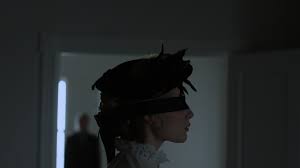
Hey there everyone! Welcome back to Movie Soapbox, the little corner of the internet that only you and I and that guy sleeping in the corner over there know about. This is the place where we find underappreciated indie films and we make sense of them. Today? We are doing a deep dive on I Am The Pretty Thing That Lives In The House, a movie so quietly, relentlessly terrifying that it probably got passed over by every algorithm that has ever tried to figure out what audiences actually want, and thank god for that, because the thing that audiences actually want, according to the people who decide what audiences want, is nothing like this film.
Fair warning before we go any further: everything from this point on is a spoiler. Every last thing. And of all the films in the world you want to walk into clean, without a single frame pre-loaded in your head, it is this one. So if you haven’t seen it, go watch it, come back, and we’ll be here. The rest of you, follow me in.
I Am the Pretty Thing That Lives In The House Walk Through
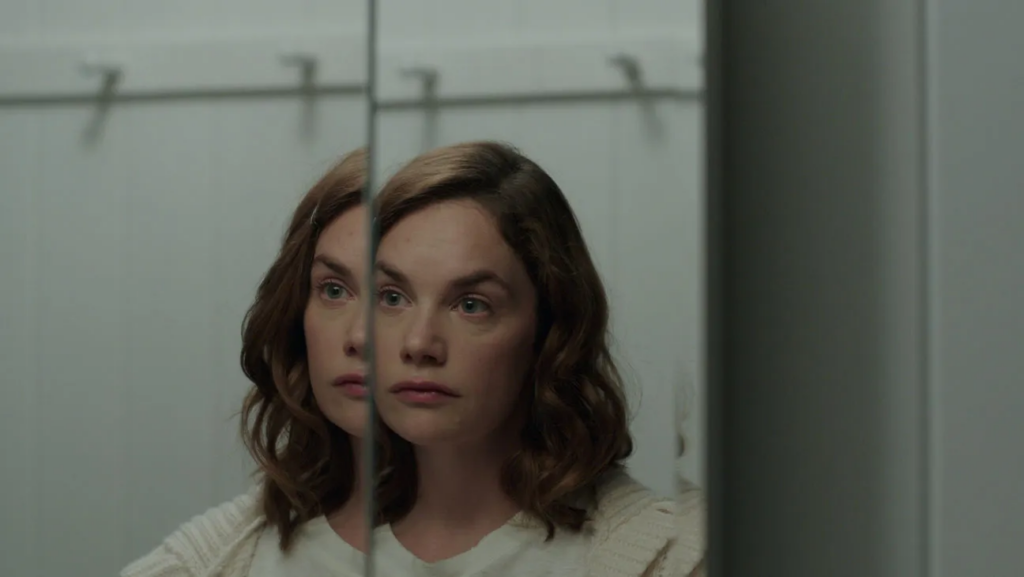
The film opens and Lily Saylor is already dead. She tells you this herself, in that low, unhurried voice that the whole film breathes through. “I will never be 29 years old.” You are not waiting for a twist. You are watching a woman walk toward something she cannot turn away from, and you know it before she does, and that gap, that distance between what you know and what she knows, is where Oz Perkins plants every single scare in this film. Ruth Wilson plays Lily as a woman made entirely of sensitivity and dread, a hospice nurse who is afraid of scary things, which is a beautiful and terrible irony when you understand what her job actually is. She has been hired to care for Iris Blum, a retired horror novelist now far gone into dementia, in a house that hasn’t been properly lit since approximately the Taft administration.
Now, before we go scene by scene, let me tell you what this film reads like from the outside, which is to say, from the part of the industry that processes films like this as product categories. This is a Netflix original, which in the mid-2010s meant it landed without theatrical release, without a marketing campaign that could be measured in anything resembling real money, and without the kind of press infrastructure that would have gotten it in front of the people who would have loved it most. You can tell from every frame that Perkins was not handed a blank check, you can tell from the sound design doing the work that a larger budget would have handed to visual effects, you can tell from the absence of any conventional scare mechanics that nobody upstream was given a meaningful opportunity to add them. A film like this, with this pacing, with this commitment to atmosphere over event, at a mid-tier budget with a name cast, usually surfaces from development with at least three sequences added to prove something happened. This one didn’t. That is either a miracle of low-budget invisibility or a director who moved fast enough that there was nothing left to note. Either way, you should feel the luck embedded in its existence every time the film refuses to give you what a lesser version of itself would have given you.
So: the house. 1812, dark as a confession, and full of nested stories. Iris Blum wrote one novel, The Lady in the Walls, and her most famous character is a woman named Polly. The estate manager, Waxcap, a precise and slightly bloodless Bob Balaban, explains this to Lily with the mild helpfulness of a man filing a report. Polly is a character in a book. That’s all he knows. That is all his vantage point allows him to know. But the film has already begun doing what it does, which is layer story inside story inside house inside book, and the layers don’t symbolize each other, they ARE each other.
The mold on the wall is the tell. Lily notices it early, that spreading dark patch near the baseboard, and the film lets you sit with what you already suspect while Lily convinces herself it’s a maintenance issue. And it is a maintenance issue. Polly is the maintenance issue. She’s been in the wall since her husband bludgeoned her to death in this house, buried her in the bones of it, and the house has been exhaling her ever since. Ms. Blum didn’t make up Polly. She transcribed her. She sat in this house and Polly told her the story of her own death, and Blum wrote it down as fiction, and she never wrote an ending for it because you don’t write an ending for a story that hasn’t finished yet.
I Am the Pretty Thing That Lives In The House Explained
Now, the question the film circles and the question every forum thread on this movie eventually arrives at: who is the pretty thing? Lily opens the film claiming the title for herself, and Ms. Blum spends the entire film calling Lily by Polly’s name, and the film is clearly setting you up to believe there’s a convergence coming, that Lily IS Polly in some meaningful sense, that the ghost story has folded back on itself. It’s a genuinely elegant trap. The film earns it. And then it doesn’t spring it, because Perkins is more interested in something sadder and stranger than a closed loop.
Lily is not Polly. They are two separate women, separated by roughly a century and a half, with nothing in common except beauty and bad luck and the wrong house at the wrong time. When Polly finally comes down the hallway, moving backwards in that way the film has been warning you about since the first frame, she isn’t malevolent. She’s just there. She’s been there the whole time. And Lily, who has spent the entire film flinching away from the edges of the thing, finally sees it whole, and her heart stops. Polly does not mean to kill her. There is no villain in this house except the husband who is a century gone, and the only crime happening in the present tense is proximity. The curse, if you want to call it that, is architectural. It lives in the walls. You are borrowing the house from the dead, and sometimes the dead come to collect.
After Lily dies, the film keeps moving, and this is the section that rewards a second watch. Lily becomes what Polly was, a presence in the house, unmoored from linear time, watching the events that preceded her own arrival. She watches Blum write. She watches Blum sense her and call out for Polly, because of course she does, because Blum has only ever known one ghost in this house and she doesn’t have the framework to distinguish between them. And in that moment the whole architecture of the film locks into place. Blum’s novel isn’t a ghost story. It’s a transcript. Polly gave her the only story she had, and Blum had the decency not to invent an ending.
Are Lily and Polly the Same Person in I Am the Pretty Thing That Lives In the House?
The theory that Lily and Polly are the same person, that this is a closed temporal loop, is seductive and wrong. It would require a ghost to be frightened to death by herself, which is a kind of narrative elegance that would feel clever in a lesser film and feels cheap in this one. What Perkins is actually doing is more uncomfortable: he’s saying the house accumulates. It doesn’t loop. It layers. Polly is not Lily. Lily is the next Polly. The house will have another one after her. Ms. Blum sensed this, which is why she told Lily her beauty wouldn’t last, that she’d rot like a flower, and she wasn’t being cruel, she was being accurate, she’d watched it happen once already.
The sin-passing-down reading, that the original violence of the husband has inscribed itself into the property and keeps collecting innocent women, is legitimate and the film supports it. What the film doesn’t do is moralize about it. There’s no confrontation, no exorcism, no final girl moment. Lily dies at the front door, Blum dies upstairs, and Waxcap arrives days later to find them both, and the house continues. The house always continues.
What Oz Perkins made here is a film that works entirely in atmosphere and dread and the slow-building horror of inevitability, and it works because he was either not supervised closely enough or supervised by people who understood what they had. It has no third-act action sequence. It has no jump scare that you could clip out and put in a trailer. It has a woman walking toward her own death in a dark house while a ghost watches from inside the wall, and it is scarier than most horror films with ten times the budget and a hundred times the noise. That’s the thing about the machine: it cannot manufacture this, it can only fail to destroy it. This one got through. Most don’t.
Thanks for hanging out at Movie Soapbox. We’ll be back with another one soon. But in the meantime, maybe try out one of these other similar films…
🎬 If You Liked This…
- The Ritual — dread that builds through landscape and silence before anything actually happens, the horror is in what you sense coming
- Audition — Miike’s masterpiece of patience, forty minutes of domestic unease before the film reveals exactly what it is
- Amulet — a crumbling house, a woman with a secret, and a third act that earns every slow minute that came before it