
Hey there everyone! Welcome back to Movie Soapbox, the little corner of the internet that only you and I and that guy sleeping in the corner over there know about. This is the place where we find underappreciated indie films and we make sense of them. Today? We are doing a deep dive on Never Here, a movie so quietly, stubbornly, specifically confused about its own reality that even a thoughtful second viewing leaves you holding a handful of threads that don’t quite connect to anything, and that is entirely on purpose, and also possibly a little bit the point.
Before we get into it, check out the trailer below.
Alright. From this point forward we are going deep into the guts of this film, every beat, every theory, every weird scarf and every moment Miranda stares into an apartment that might be hers. If you have not seen Never Here yet, close this tab, find the film, watch it, then come back. You need to have experienced this one cold. What follows is not for the uninitiated.
Still here? Good. You asked for it.
Never Here the Making Of
So understand something about the space this film was made in. Writer-director Camille Thoman is herself a performance artist, which means she came into this project with a specific, rigorous, deliberately uncomfortable idea about what the film should do to the viewer, and no studio note in the world was going to sand that down into something friendlier, because there was no studio note. This is the kind of film that gets made at a budget level where the director’s vision either survives completely intact or the film does not get made at all, there is no middle negotiation, no VP of development suggesting you clarify the third act, no test screening in Burbank where forty-two people tick a box that says “I was confused by the ending.” The film that exists is the film Thoman wanted to make. Whether that turns out to be a feature or a liability is exactly what we are here to figure out.
Never Here the Movie Deep Dive Walkthrough
The film opens at a gallery exhibit. Miranda Fall, a performance artist with a name that is doing so much thematic work it is almost embarrassing, has built an entire show around the stolen private life of a man named Arthur Anderton, someone who lost his phone and whose photos, contacts, and personal data ended up on gallery walls without his knowledge or consent. That is the inciting provocation, and the film is smart enough to present it with zero editorial judgment. You are not told how to feel about Miranda at the outset. You are simply shown what she does.
Arthur shows up at the opening. The room holds its breath. He tells her, “You’ve done a very bad thing,” and leaves. That sentence is the moral center of the entire film and the movie never returns to it directly, which is either a sophisticated artistic choice or an evasion, and the difference between those two things is what the three theories below are really arguing about.
After the opening, Miranda is interviewed by a journalist named Margaret Lockwood. Miranda’s agent and lover, Paul Stark, played by the late Sam Shepard in what reads as the film’s one casting decision that guaranteed at least some critical attention, is at her apartment when Paul witnesses what appears to be a violent attack on Margaret through Miranda’s phone. Paul is married. He cannot be there officially. So Miranda goes to the police herself and reports what Paul saw, describing a perpetrator she never actually saw. She is already, in the film’s first act, performing a version of herself that is not real. This is important. File it.
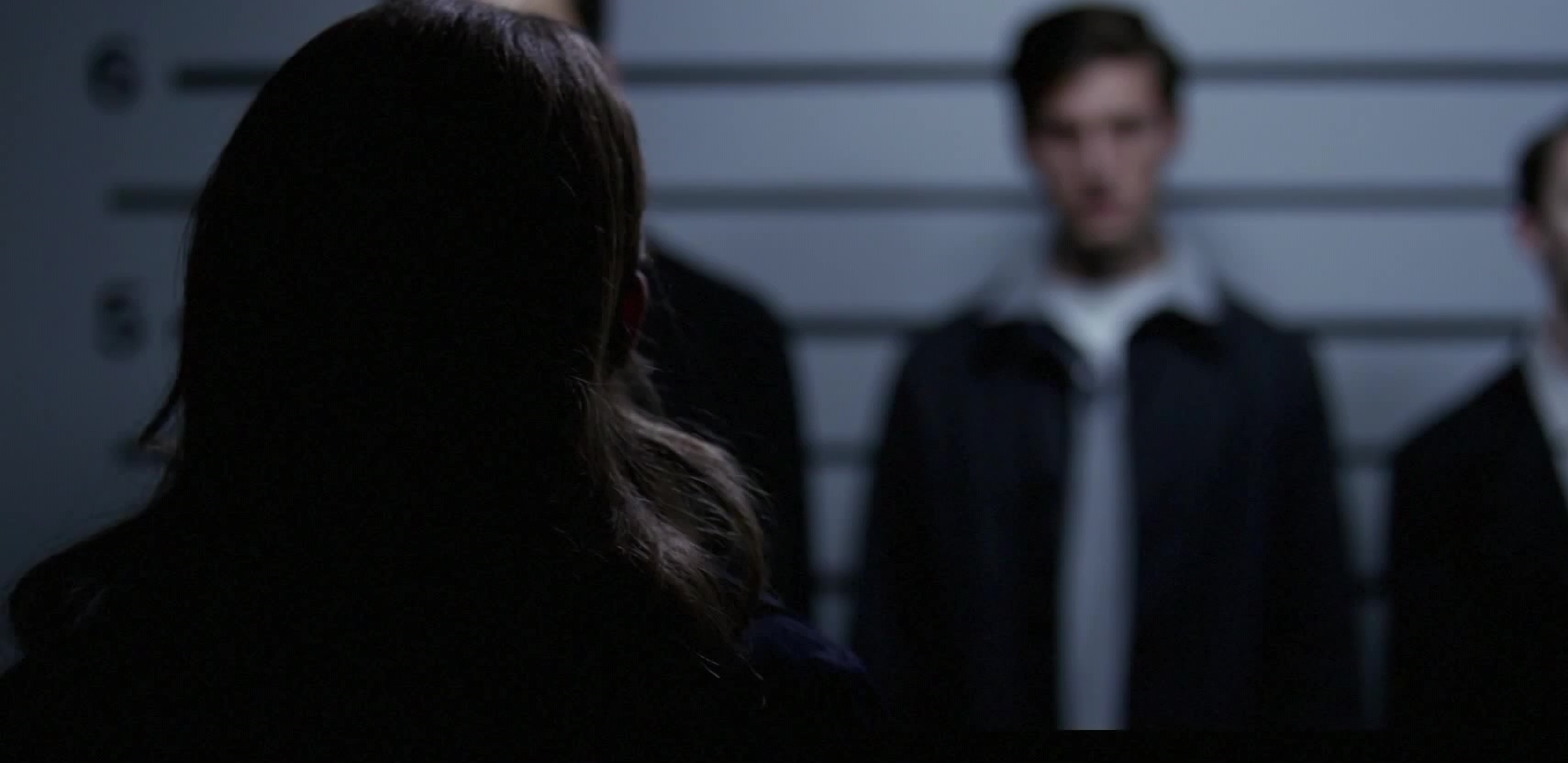
The echoing starts here and does not stop. Miranda helps police sketch a suspect from a description she received secondhand. That sketch, other people later mistake for her. She goes to a lineup and fixates on Man Number Five, not because she recognizes him from the attack, but because he is “familiar.” The gallery gets vandalized. Arthur is assumed responsible. Miranda decides to keep the vandalized gallery open as a new exhibit, art inside art, damage as statement, which is either a genuinely interesting creative response or the act of someone whose relationship to reality is becoming untethered, and again the film refuses to tell you which.
Miranda begins following Man Number Five. She names him S. She tracks his movements. She finds his apartment. She goes inside. And then she discovers that S keeps a key under his mat, just like she does. The film does not score this moment. It just sits there and lets you sit with it.
Meanwhile an old friend from law enforcement, Andy Williams, surfaces and reconnects with Miranda. Things accumulate. Paul goes missing. Margaret is abducted. Arthur attempts suicide. Andy tells Miranda the original confession in the Margaret attack was coerced. And through all of this Miranda is losing time, losing track of hours, noticing that a gun from a previous exhibit may have been fired, finding a scarf in her dresser that she watched S buy days earlier.
She finally enters S’s apartment and is caught. S turns out to be a cop. She cracks him and runs. She gets in a cab to the airport.
That is the film. Now here is where it gets interesting.
Theory One: Miranda Is Simply Coming Apart
The cleanest read, and the one that requires the fewest moving parts, is that Miranda is experiencing a genuine psychological unraveling that the film depicts from the inside without labeling it. She is a voyeuristic artist whose entire practice is built around observing other people’s lives without consent, and that practice has hollowed out her own sense of self to the point where she can no longer reliably tell what she has done from what she imagined doing. The scarf appearing in her dresser, the lost hours, the fired gun, all symptoms, not supernatural events. S exists. Arthur existed. The attack happened. Miranda’s brain is simply no longer filing any of it correctly.
The problem with this theory, and it is a real problem, is that it makes the film’s deliberate structural opacity feel like a bug rather than a feature. If Miranda is just dissociating, the film’s refusal to anchor us in objective reality is a stylistic choice masquerading as thematic depth. You can make that film. It is a lesser film than the one Theory Two suggests.
Theory Two: Miranda Is S
This is the one the film seems to be most actively inviting, through imagery rather than plot, which is why it is also the most contested. The key under the mat. The “familiar” quality of S that Miranda cannot place. The masculine clothing she is wearing when she enters his apartment. The echo structure of the film’s entire first act, where Miranda witnesses herself being observed the same way she observes others, just one step removed from direct confrontation with the mirror.
If Miranda is S, or if S is a projection of Miranda’s own fractured self-image, a kind of externalized doppelganger she has constructed out of her own voyeuristic obsession and then started chasing, then the cop who catches her at the end is not catching a stalker. He is catching someone who broke into a fiction she built. The airport ending stops being an escape and starts being the only possible exit from a loop she created.
This theory does not require S to literally not exist. It only requires that Miranda’s relationship to S is a relationship to herself, and the film has handed you every piece of that argument if you are willing to assemble it.
Theory Three: It Is a Morality Tale, and the Chaos Is the Point
The third option is the most structurally tidy and the least satisfying to sit with. What if nothing conspiratorial is actually happening? What if the gallery vandalism is just someone who hated what Miranda did to Arthur? What if the attack on Margaret is random urban violence? What if Paul just left, the way Andy says people sometimes do, just buy a ticket and disappear, and what if Miranda’s paranoia about S is simply the inevitable result of a woman who has spent her career invading other people’s privacy finally having the mechanism turned around on her?
In this reading the film is a warning. Specifically a warning about the particular narcissism of the performance artist, and by extension the particular narcissism of anyone who mistakes surveillance of others for genuine human connection. The Instagram logic. The accumulation of observed lives as a substitute for living one. Miranda does not go mad because something sinister is hunting her. She goes mad because she has spent so long watching other people that she has forgotten what it feels like to be seen herself, and when she finally feels seen, by S, real or imagined, she cannot tell the difference between intimacy and threat.
Moviesoapbox’s Reading of the Film Never Here
Theory Three is correct and I resent it for being correct, because a morality tale this clean and this allegorical about social media narcissism should not work as well as it does when filtered through a film this genuinely strange. Camille Thoman is a performance artist making a film about a performance artist, and the film itself behaves like a performance piece, refusing resolution, implicating the audience in the voyeurism, leaving the final image as deliberately uncommitted as an exhibit that refuses to explain itself. That is a complete artistic intention carried out with discipline.
But inside that correct larger frame I think Theory Two is the specific mechanism Thoman chose to embody it. Miranda is chasing herself. S is the version of Miranda she constructed to be observed. The key under the mat is not a coincidence, it is the film catching her in the act of her own self-obsession. The masculine clothing, the “familiar but not from the attack” recognition, the apartment that feels like hers because it is hers in every way that matters to her fractured psychology. She built a subject to stalk because she could not stop. And the tragedy is that this is not pathology the film invented. You can describe it in five words that will feel uncomfortable if you have ever refreshed a feed looking for a number to go up.
Never Here is a film that existed because Thoman made it small enough that no one could ruin it. That is the only way this particular film survives. The version of this movie with more money, more development, a distributor with opinions about the third act, that version has an explanation. It has a scene where someone tells Miranda what is real. It has a resolution that scores itself with music so you know how to feel. That version gets made and then forgotten inside eighteen months. This version gets made and you are still turning it over three days later trying to figure out where the key under the mat was supposed to land. That is the whole difference. That is always the whole difference.
🎬 If You Liked This…
- Anon — surveillance as the architecture of horror, someone accessing and rewriting your subjective experience without consent, the same dread of being documented and watched by something that knows you better than you know yourself
- Clouds of Sils Maria — identity dissolving into obsessive work, a woman who can no longer locate the boundary between herself and what she’s performing, the same slow erasure of self through total immersion in something that was supposed to be external