
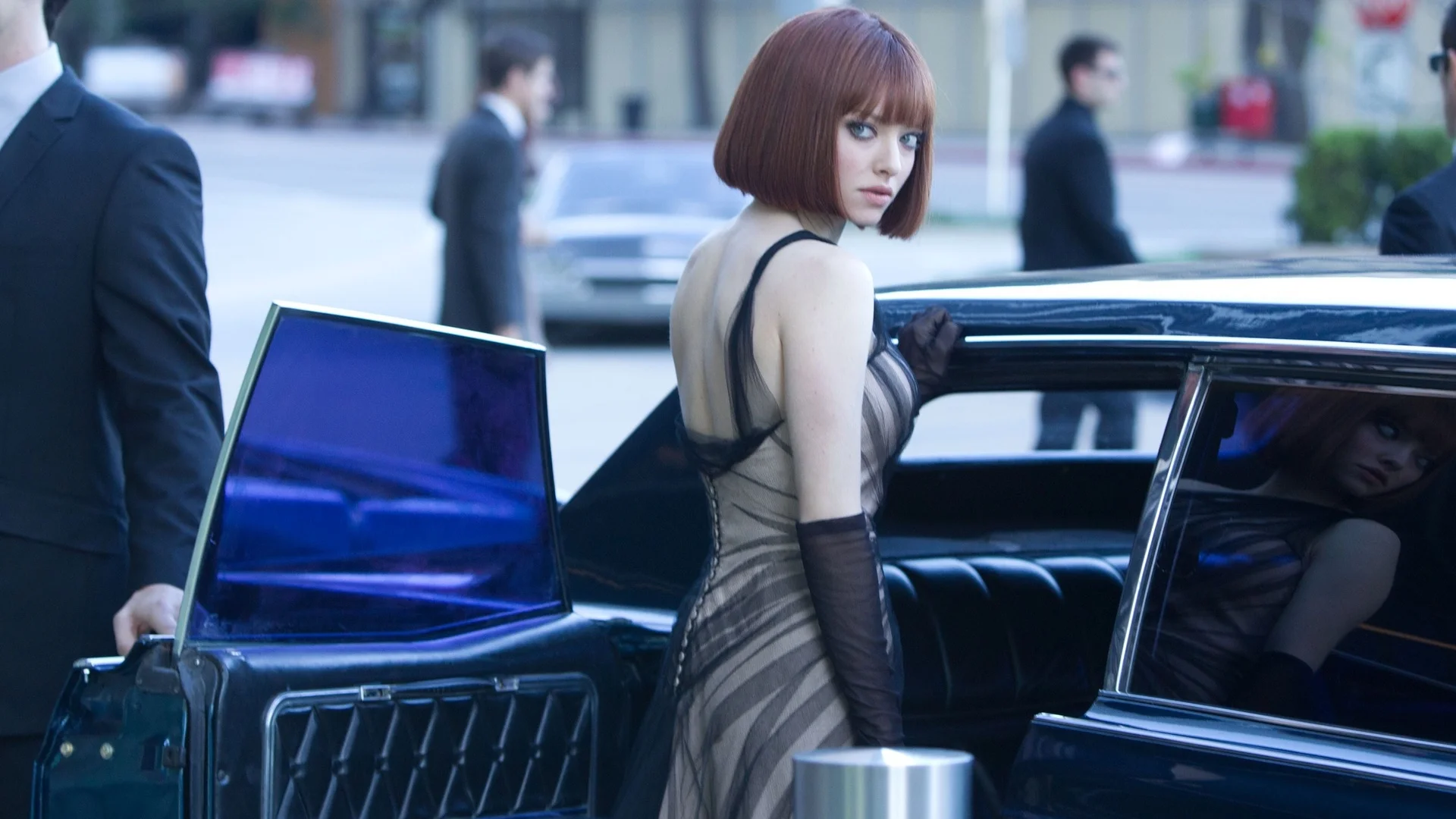
Hey there everyone! Welcome back to Movie Soapbox, the little corner of the internet that only you and I and that guy sleeping in the corner over there know about. This is the place where we find underappreciated indie films and we make sense of them. Today we are doing a deep dive on Anon, a Netflix sci-fi thriller so loaded with genuine potential and so thoroughly squandered in the execution that watching it is genuinely a little painful, the way it’s painful to watch someone hand a loaded weapon to a committee.
If you haven’t seen it yet, go watch it. It’s on Netflix, it’s ninety-some minutes, and you’ll want the full picture before we start pulling the thing apart. Come back when you’re done. Everything past this point is a spoiler, and I mean everything, the ending, the twist, the mechanism, all of it. You’ve been warned in plain language. Don’t write me a complaint.
Anon Movie Detailed Walkthrough
Still here? Good. Let’s work.
Andrew Niccol wrote and directed this thing, and that name should mean something to you, because this is the man who wrote The Truman Show and directed Gattaca, two films that took a single high-concept sci-fi premise and built something emotionally true and visually disciplined out of it. So when Niccol brings you a near-future world where everyone has ocular implants feeding them live metadata on every person, object, and location in their field of view, a system called God’s Eye, and where being off that grid is a criminal offense, you lean forward. You think: okay, he knows how to do this. He’s done it before. And then you watch the film sort of shuffle past every interesting thing it could have done with that world, one after another, until it deposits you at a thriller plot that would have been only moderately impressive in 2004.
What you’re watching, if you know the fingerprints, is a film that was probably a tighter and stranger thing at some earlier draft stage, something weirder and colder and more interested in the surveillance-state implications of its own premise, and then got walked back toward a procedural by someone, somewhere in the process, who needed a detective and a love interest and a third-act action beat. The story of how a Niccol film becomes a middling Netflix procedural is a story about what happens when a filmmaker’s budget tier and his distribution model quietly reroute his instincts. You can tell when a film’s been pressured toward genre resolution, there’s a particular flatness to the final twenty minutes, a sense that the movie has stopped asking questions and started answering them, not because the storytelling earned the resolution but because somebody needed the thing to end.
What the World of Anon Actually Is
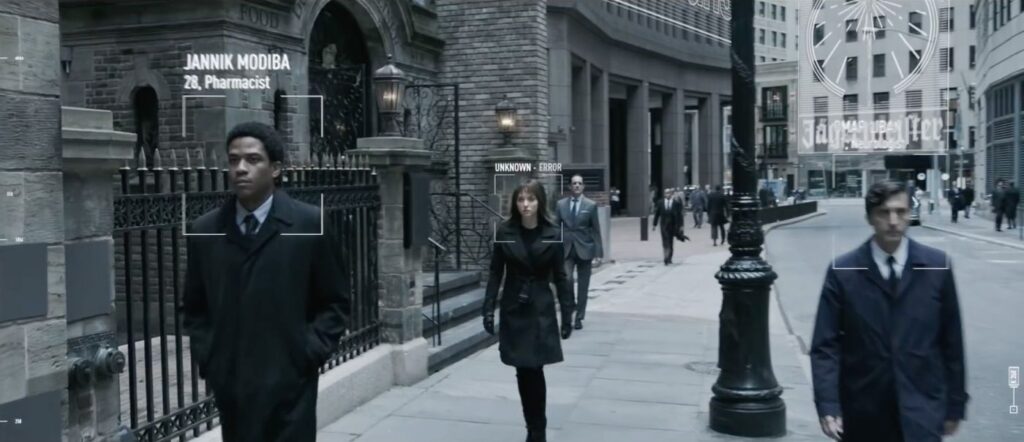
So the setup: Sal Frieland, detective, lives in a near-future city where biosyn implants give every registered citizen a constant augmented-reality overlay on their vision, a live metadata stream attached to every face, every surface, every moment. The system is called the Ether, and the visual record it generates for every citizen is stored in a central database that law enforcement can access, which means that in this world, crime is theoretically impossible, because every moment of every life is timestamped and retrievable.
Sal sees a woman whose data glitches, shows as an error, and keeps walking. That’s the film’s first beat, and it’s a good one, the kind of small wrong note that a sharp procedural knows how to let sit for a while before it pays off.
The murders that follow are clever in their mechanism. Someone is killing people by hacking their visual feed and replacing it with the killer’s own perspective, so the victim sees exactly what the killer sees, which means the victim sees themselves, sees the gun, sees nothing useful, can record nothing, can identify nothing. The killer commits the murder entirely inside the victim’s eyes. As a piece of sci-fi crime-fiction craft, that’s actually a strong idea. It’s the kind of idea that earns the world it’s set in.
The Girl, The Fixer, The Inevitable Bait-and-Switch
Sal’s investigation lands him on a woman credited only as The Girl, played by Amanda Seyfried, who is off the Ether entirely and has been for years. She’s a fixer, a contractor who deletes uncomfortable memories and records from the Ether for clients who have things they’d rather not have on file, affairs, crimes, mistakes. She’s anonymous by design, and in this world that makes her the most dangerous kind of person.
She’s also obviously not the killer, and the film knows you know this. The first-suspect-is-never-the-murderer convention is so load-bearing in the thriller genre that Niccol couldn’t have been under any illusion he was hiding the ball. The real question is whether the actual reveal is planted early enough and specifically enough to feel earned, or whether the script pulls the parachute at the last second and asks you to accept a solution you were never given the tools to find yourself.
The answer is: not great. The real killer turns out to be Kivel, a figure present in the film but not developed with the kind of weight you’d need to look back and feel the inevitability of it. The film introduces him but doesn’t invest in him, and so the reveal lands without the satisfying click of a well-constructed misdirect. It lands more like a shrug. Niccol knows how to build dread, Gattaca runs on dread, but dread requires patience, and this film keeps flinching away from its own slower, stranger impulses.
How the Tech Actually Works
Two pieces of the film’s mechanics deserve a clear explanation, because the movie gestures at them quickly and moves on.
The first is the proxy system. In this world, digital identity moves through a chain of proxies, intermediary nodes that obscure the origin point of any action in the Ether. A skilled operator doesn’t use one proxy, she uses a chain of them, and each one has to be walked back before you can get to the source. The Girl uses a chain deep enough that the investigators can’t work back to her location in real time. This is just how onion routing works in the real world, the film is using actual network architecture logic, which is one of the places where Niccol’s technical instincts are clearly doing the right thing.
The second, and more interesting, piece is how The Girl anonymized her own history. She distributed it. Taking a structural cue from BitTorrent, she fragmented her personal data record into slices so small, and distributed those slices across so many people’s implants without their knowledge, that no single node holds anything meaningful, and the only way to reassemble the full picture is through the algorithm she controls. You are, in this scenario, carrying one millisecond of a stranger’s life somewhere in your implant’s storage, and you will never know it, and it will never register as anything. It’s elegant, it’s technically grounded in something real, and it’s the film’s single best piece of world-specific problem-solving.
What the Ending of Anon Is Actually Saying
The third-act mechanics: Sal sets up an operation to draw out the real killer by making himself a target. The Fixer, now aligned with Sal and aware that the killer was originally hired to find and eliminate her, uses the trap to position herself for the shot. The killer moves on Sal, uses his standard method to blind him through his own feed, Sal takes a hit, the killer takes a hit from The Fixer, the op resolves. Kivel, the man behind the contract, is ultimately killed by Sal through a sequence the film rushes through with the particular energy of a script that has run out of time to be careful.
The final scene is the one Niccol actually wanted to make. Sal and The Fixer talk, and he can’t quite accept that anonymity could be a value in itself rather than a symptom of guilt. His entire professional existence is built on the premise that visibility equals innocence and disappearance equals culpability. She pushes back: the right to be unknown is its own thing, distinct from having something to hide. In a surveillance world, privacy is not the default, it is the radical act.
That argument is the film Niccol came to make. Everything around it, the murders, the detective procedural, the love story, is scaffolding. Some of it is decent scaffolding. Most of it is just scaffolding.
What This Film Was Trying to Be
The read that holds up best is the one where you treat Anon as a philosophical thriller that lost its nerve in the second act. The world-building is specific enough, and the central argument pointed enough, that Niccol was clearly not interested in making a murder mystery. He was interested in making a film about what a society that has voluntarily traded privacy for safety actually costs the people living in it. The Fixer is not just a character, she’s a proof of concept, evidence that anonymity can be chosen by someone who isn’t a criminal, who has simply decided that the state does not have a right to her interior life.
The film that keeps interrupting that argument is the genre procedural, with its suspects and its plot twists and its action beats, and that film is considerably less interesting. They coexist uncomfortably for ninety minutes and then the credits roll before either one fully wins.
The Anon Theory Worth Considering
The most defensible read is that Sal’s arc is the real subject of the film and the murders are just the mechanism that moves him through it. He starts as a man who believes visibility is virtue, who lives inside the Ether’s logic so completely that he cannot imagine why anyone would want to leave it. The Fixer cracks that open. By the end he’s killed the man who wanted her found, protected her ability to disappear, and is sitting with her in a conversation where he still doesn’t fully understand her but is no longer certain she’s wrong. That’s a character change. It’s quiet, it’s earned in the margins even when the plot isn’t earning anything, and it’s the most human thing the film does.
The thriller machinery around it is weak. The emotional core is real. You’re watching a film that survived its own genre requirements with that core mostly intact, which is more than a lot of films at this budget level manage to say.
Niccol had a real idea. The machine gave him a Netflix procedural budget, a release model that buries things in login-screen carousels, and a genre audience that needed bodies and a resolution. What exists is the compromise those pressures produce. There’s a version of this film that’s a lean eighty-minute mood piece about surveillance and selfhood with barely any plot at all, and that film is substantially better than the one you watched. That film didn’t get made. This one did. That’s the job.