
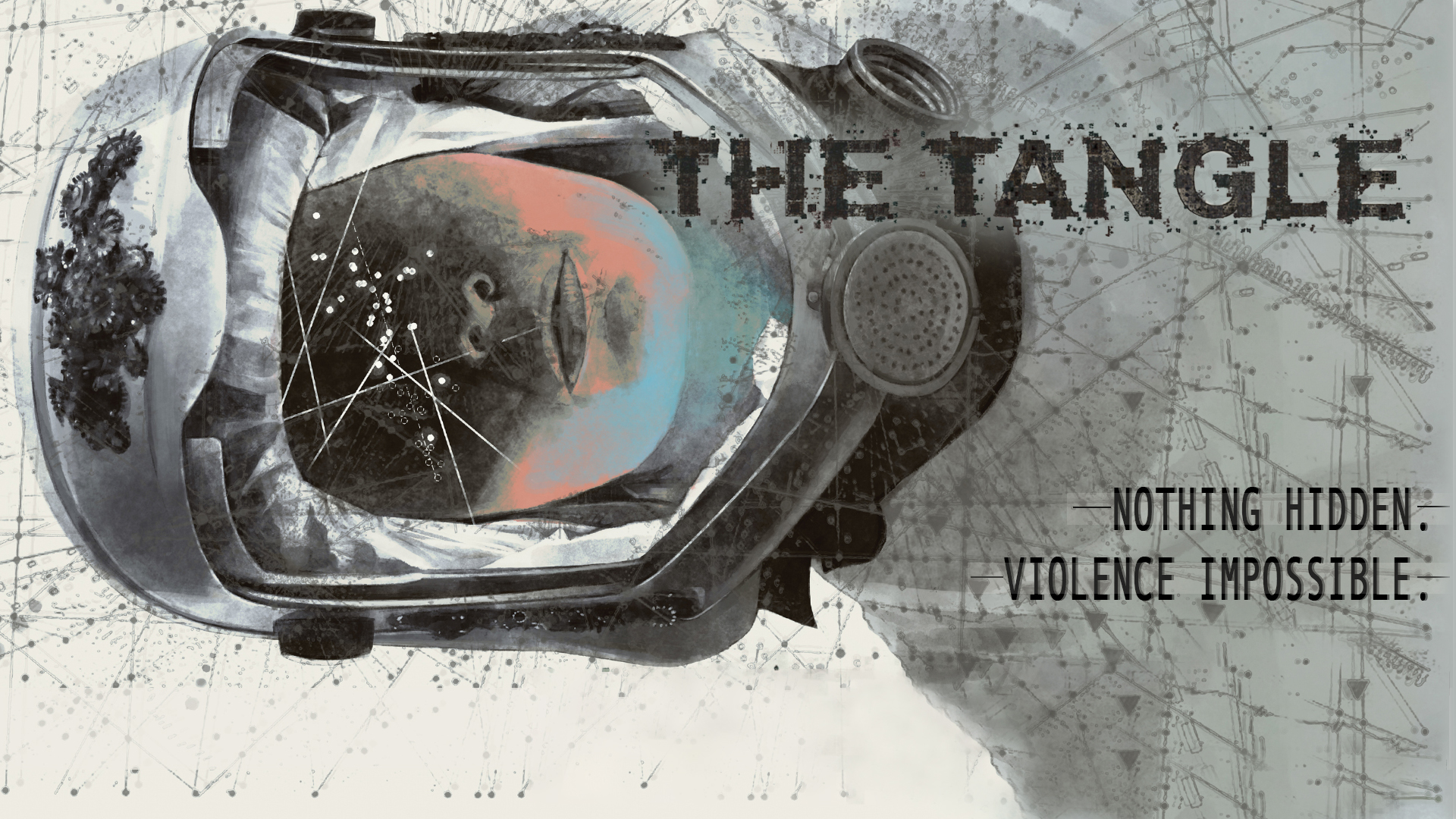
Hey there everyone! Welcome back to Movie Soapbox, the little corner of the internet that only you and I and that guy asleep in the corner over there know about. This is the place where we find underappreciated indie films and we make sense of them, beat by beat, the way they deserve. Today? We are doing a deep dive on The Tangle, a movie so lyrically dense and deliberately strange that the marketing department, had there been a real one, would have quietly retired rather than try to write the logline.
Fair warning before we go any further: everything past this paragraph is spoiler territory, wall to wall. The ending, the twist, the plaque on the wall, the voice in the dark, all of it. You want to go in clean, close the tab, watch the film, come back. It is on streaming right now and it costs you less than a cup of coffee that tastes like cardboard from a studio commissary. Go. The rest of us will wait.
Still here? Good. Let’s get into it.
The Tangle Movie Making Of
Before we touch a single frame of this film, you need to understand what Christopher Soren Kelly actually is in the ecosystem of independent film, because it matters for understanding what The Tangle cost to make and what it represents that it exists at all. Kelly is the guy Travis Milloy cast in Infinity Chamber because he needed one actor to hold a screen alone for most of a movie with no money, no catering, no air conditioning, and no support infrastructure of any kind. Milloy burned the man’s feet in the Mojave and froze him in the Rockies in a thin-layered spacesuit, and Kelly’s response, reportedly, was a smile and a nod. That tells you everything about the tier of filmmaker you are dealing with. Kelly has been a collaborator and a load-bearing wall in some of the most quietly essential indie genre films of the last fifteen years, Ink, The Frame, Infinity Chamber, and now with The Tangle he wrote the screenplay, directed the film, and led it. That triple threat, on a micro budget, in a genre that punishes ambition? Most people who attempt that end up with forty minutes of watchable footage and a hard drive full of regrets.
Now here is what the screenplay of The Tangle reads like it survived, and this is important context before you start interrogating why the film feels the way it does. Films with this budget tier and this much literary ambition, poetry citations, philosophical detours, a closed-box structure that refuses to open up for the audience’s comfort, they almost always get the note. You know the one. The note that says the third act needs more propulsion, more clarity, more resolution the audience can feel rather than think about. You can see where those notes could have landed on this script. The watchtower finale, the plaque, the voice in the dark, any producer looking at a greenlight decision would have wanted that sequence punched up, made more visceral, given a gun going off or a body falling or something a focus group could clock as an ending. Kelly held the line. The film ends the way it ends, elliptical and deliberate and slightly maddening, because nobody had enough leverage over him to flatten it. That is what micro-budget creative control actually looks like. It is not romantic. It is a guy who keeps final cut because nobody is writing a big enough check to take it from him.
The Tangle Movie Walkthrough
So. The world of the film. The Tangle is a technology, a swarm of molecular nanobots as numerous as the stars, circulating through the air, through our blood, jacked directly into human neural architecture. The stated purpose was nirvana. The actual product is total surveillance. No murder has occurred in three years since its deployment. Crime has been functionally abolished because the cost of committing one in a world where everything is observed and recorded in real time is simply too high. The tradeoff, privacy as a concept, gone, was apparently a deal most of humanity took without too much fuss, which is its own quiet horror the film does not stop to underline for you.
The agency that monitors the Tangle is called the ASP, the Army of Simple Purity, and their specific unit, operating from a safe room shielded from the nanobots, is the Cleopatra Squad. Named for the woman who built all of it. Cleopatra herself, the inventor of the nanobots and the architect of the entire system, exists somewhere above the machinery, possibly human, possibly something more and less than that, the film is deliberately vague on this point in a way that rewards patience.
A murder has occurred. The first in three years. The victim is Margot Foster. The suspect is Carter Carmine, a private detective who supports the ASP, who was surveilling Margot just before her death, and whose Tangle readout went dark during precisely the window when she was killed. Edward and Laurel, two ASP agents, haul Carter in. They surgically remove his Tangle implant to prevent him from transmitting, and they start working him for a confession, because they need this resolved quietly before the existence of a murder in a supposedly murder-free world becomes a fact the public can access.
The interrogation is most of the film. And this is where the theatrical DNA of The Tangle becomes impossible to ignore, because Kelly is not directing a thriller in the conventional sense, he is directing a play that has agreed to wear a film’s clothes. The pleasure-dome is made of language. The walls of that safe room are made of dialogue. If you came in expecting kinetic plot mechanics and you are still watching by the midpoint, that means something clicked for you, some register opened up, and the film has you.
What the interrogation slowly reveals is that Carter loved Margot. More specifically, Carter loved Cleopatra, and Margot was connected to Cleopatra in ways the film parcels out carefully. Harming either of them would have been the last thing Carter would do. So if the man with the motive and the means and the gap in his surveillance record did not do it, then the walls start closing in on the people doing the asking. Edward killed Margot. The agent running the investigation is the killer. And when that fact becomes impossible to deny, Edward does not fold, he grabs a gun and heads for the watchtower, heading up the mountain to find Cleopatra herself.
Why would Edward, a member of the Cleopatra Squad, want to kill the woman the squad was named for? The film’s answer is not a simple one. Edward and Margot had come to believe that Cleopatra had drifted into something close to despotism. Total surveillance, administered by one person, forever, with no meaningful check on that power, what does that become over time? Edward’s logic, broken as it is, runs something like this: if the world finds out a murder happened, and worse, that the murder was committed by someone inside the machine designed to prevent all murders, then the myth of the Tangle collapses, and with it, Cleopatra’s absolute authority. He was trying to break the pleasure-dome by putting a crack in its foundation. The fact that his method involved committing the exact crime the system was designed to prevent is the kind of irony the film earns rather than announces.
And now we need to talk about the plaque on the wall of the watchtower, because this is the film’s entire thesis rendered in four words and a citation.
Edward reaches the watchtower. Cleopatra is gone. He finds a plaque on the wall that reads: a miracle of rare device. That phrase is from Samuel Taylor Coleridge’s Kubla Khan, written in 1797 under the influence of opium, transcribed from a dream, interrupted mid-composition by a knock at the door, never finished. Coleridge always intended it to be part of a 300-line masterwork. It never happened. What survived is a fragment of extraordinary vision about Kubla Khan’s pleasure-dome in Xanadu, and the specific phrase on the plaque refers to the dome itself, a structure combining a sunny pleasure-dome with caves of ice, fire and cold, in impossible harmony. Two opposing forces held in perfect balance. A construction that should not be able to stand.
That is what the Tangle was supposed to be. Fire and ice. Technology and peace. Surveillance and freedom. A pleasure-dome of impossible equilibrium. And like Coleridge’s poem, it was a fragment, an interrupted vision, something that reached for a kind of perfection that the world, and the people inside it, could not actually sustain. Edward removing his helmet at the top of the watchtower is him stepping out of the protective shell that kept him separate from the Tangle’s reach, it is surrender, it is admission. He pulled the whole pleasure-dome down around his own ears because the pleasure-dome was never going to hold.
The Movie The Tangle’s Ending
The theories split at the ending. Edward removes his helmet. He breathes the open air. There is a flash, a distant figure, gone in a second. His eyes close. The screen goes black. And then, after a silence that runs long enough to make you think the film is over, a voice says: Hello, Edward.
Theories to Explain The Tangle’s Ending
The first read is mercy. Cleopatra, who can use the nanobots to transmit audio directly through human eardrums, is telling Edward the game is over, but she is also telling him something else. That this land exists. That the ideal the Tangle was built toward, harmony, connection, a life free of violence, is still available to him and to everyone, if they stop trying to administer it through force. She found him at the top of the mountain not to punish him but to offer him something he could not see from inside his own rage. It is a religious reading, and the film invites it, the language of gods and deities has been circling this story since the first act.
The second read is colder. The nanobots are in his blood now. He has no helmet. He has no shielding. Cleopatra does not need to throw him off the tower because she can reach inside his nervous system and handle it from wherever she is standing. Hello, Edward is the last thing you hear before the system reclaims you. It is the voice of total power identifying its problem and beginning to address it.
Both readings are available. The film does not choose between them, and that refusal to choose is a feature, not a flaw, it is the point. The pleasure-dome holds two opposing forces simultaneously. So does the ending.
Moviesoapbox’s Reading of the Movie The Tangle
My read? The film is about the impossibility of benevolent omnipotence. Not whether Cleopatra is good or evil, the film is genuinely ambiguous on that and it should be, but whether the structure she built can survive contact with human nature at all. Edward is not a monster. He is a man who looked at a system designed to perfect the world and found the seam where power had concentrated without check, and he broke it in the worst possible way. The Hello, Edward is Cleopatra confirming that even after all of that, even after the murder and the climb and the helmet coming off, the Tangle is still running. She is still there. The pleasure-dome did not fall. And that is the most unsettling possible ending. Not the violence, not the punishment, just the continuation. The machine keeps going. Edward just became part of it.
Christopher Soren Kelly made this film the way Kubla Khan was written, from inside a dream, all at once, without waiting for the right money or the right moment or the right number of VPs signing off. The fact that it exists in the form it exists, unflattened, unapologetically literary, ending on a whisper in the dark instead of an explosion, is its own kind of miracle of rare device. Most films like this get the note that kills them. This one didn’t.
🎬 If You Liked This…
- We’ve Forgotten More Than We Ever Knew — a couple in a post apocalyptic world encounter an impossible set of towers and an impossible visitor inside.
- Clouds of Sils Maria — the same blurring of performance and reality between two people in a contained location, identity and role becoming indistinguishable until neither person can locate where the character ends and they begin