
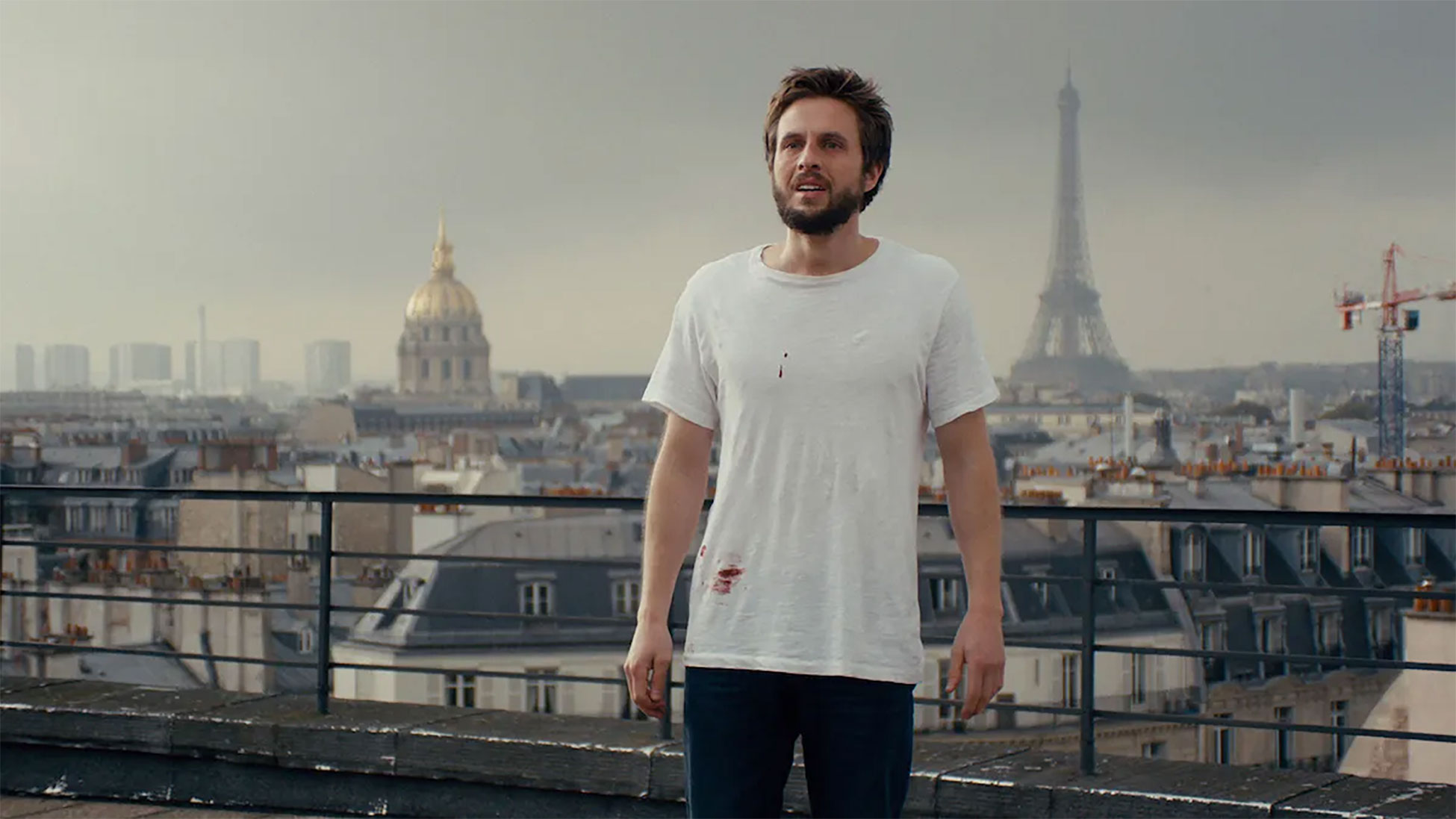
Hey there everyone! Welcome back to Movie Soapbox, the little corner of the internet that only you and I and that guy asleep in the back booth know about. This is the place where we dig up the films that factory Hollywood either wouldn’t greenlight in a million years or actively tried to flatten into something recognizable and safe, and we figure out what they were actually doing. Today we are doing a full deep dive on The Night Eats the World, a French zombie film so quietly, patiently devastating that the suits who passed on distributing it are probably still telling themselves it was too slow to market.
Full spoilers from here on out. And I mean full, the kind that detonate the whole thing. If you haven’t seen this film yet, go watch it, come back, and we’ll be right here waiting. It runs about ninety minutes and it will not waste a single one of them. Everyone else, let’s go.
Night Eats the World Movie Walkthrough
A man falls asleep at a party in Paris. He wakes up to the end of the world. That is the entire premise, and the reason this film almost certainly got passed over by every anglophone distributor who saw a screener and thought they were getting a French World War Z. They weren’t. What director Dominique Rocher built inside that single apartment block is a closed-box psychological study, the kind of thing that gets greenlit at the micro-budget level precisely because no studio would fund it, because there’s no third-act action sequence to test-screen, no ensemble cast to throw on a poster, no franchise hook to dangle in front of a sequel conversation. The budget tier this film operates at, roughly the kind of number where you shoot on location in a real building because you cannot afford to build sets, is also the tier where a director either gets to make exactly the film they intended or gets eaten alive by a distributor who panics in post and wants a different ending cut together. You can tell when that panic happens. The editing gets choppy around the turn, the score swells where it shouldn’t, the film stops trusting the audience. The Night Eats the World does not do any of that. Rocher trusted his cut, which means either he had final cut language in his deal or nobody with enough power cared enough to interfere. Either way, the film survived intact. That is rarer than it sounds.
Sam, played by Anders Danielsen Lie, shows up at his ex-girlfriend’s Paris apartment to collect some things she took when they split. She’s throwing a party. He doesn’t fit, he never fit, which the film establishes in about ninety seconds of body language before he drifts off into a back room to wait her out. When he wakes up, everyone at the party is dead or turned, the city outside has gone silent in the specific way cities go silent when there are no longer any people running them, and Sam is alone in a building full of zombies with a locked front door between him and the street.
What follows, for a long stretch, is almost purely behavioral. Sam secures the building floor by floor. He raids apartments for food, instruments, books, anything to fill the silence. He sets up a drum kit and plays. He talks to Alfred, a zombie he has trapped in the elevator, the way you might talk to a fish tank. He is managing, barely, but he is managing, and Rocher lets this section breathe at a length that will absolutely lose viewers who came for a genre film and will absolutely reward everyone else. Anders Danielsen Lie carries it without a net. Denis Lavant, playing Alfred, does more with nothing but a cage and a pair of dead eyes than most actors do with a full script. When the film was described to me as having Lavant in the cast, I understood immediately why it was worth watching. He is that specific kind of actor who makes everyone else around him sharper just by being present.
Then a woman shows up. Her name is Sarah. Sam hears someone at his door in the dark, shoots through the door without looking, and puts her on the floor with a shotgun blast. He drags her in, patches her up, and over the following days she recovers, tells him about the city, about other survivors she’s found, all single men living exactly like Sam, alone and slowly losing the thread. She describes a route across the rooftops, a way to keep moving, a reason to leave the building. Sam warms to her. They sing together. He starts to think about going with her.
Then he finds her dead in the bed where he originally laid her. She never got up. She died from the shotgun wound. The recovery, the conversations, the singing, the plans, all of it was Sam’s mind filling the silence with something it could not survive without. He needed her to exist so badly that he built her, complete with information she could not have given him, a route across the city that turns out to be real, a behavioral pattern for the zombies that turns out to be accurate, because somewhere underneath the hallucination his own mind was working the problem and needed a voice to put the answers in.
That is the mechanism the film has been constructing since minute one, and it does not announce itself, it does not give you a visual cue that Sarah is a ghost, it does not use a single trick of the horror grammar to signal what is happening. You are as inside Sam’s experience as Sam is. The sucker punch lands clean because Rocher never telegraphed the swing.
The Ending of The Night Eats the World Discussed
The practical question people get stuck on: how do we know what was real and what wasn’t? The answer is simpler than the Reddit threads make it. Everything we see Sam do alone is real. Every interaction with Sarah, from the moment he drags her inside to the moment he finds her body, is the hallucination. Alfred in the elevator is real. The zombies are real. The building is real. Sam’s solitude is real. Sarah was real only in the sense that she was a real woman who died on his landing, a woman whose existence his mind then colonized and expanded into a companion who could tell him what he needed to know to survive. The information she gave him, the rooftop route, the zombie behavioral patterns, he knew all of that already. He just couldn’t access it until he had someone to say it back to him.
Theories to Explained The Night Eats the World Movie
Three readings circulate around this film, and they’re all worth laying out straight.
Theory Number One from The Night Eats the World:
Our first run at this is a purely psychological reading: Sam is a man whose isolation broke him in a specific, functional way. His madness is not destructive, it is generative. His mind produced exactly the hallucination he needed to survive, gave him the information in a form he could receive, and then dissolved it when it had done its work. This reading makes Sam a figure of genuine resilience, damaged but not destroyed, and the ending, him alive on a rooftop, looking out at a city he now knows how to move through, carries real hope.
Theory Number Two from The Night Eats the World:
The second reading is lonelier. Sam was always someone who existed outside the group, not at the party, separate, watching. The zombie apocalypse didn’t create his isolation, it just removed the infrastructure that was papering over it. He was always going to end up alone in a room talking to a dead woman. The film title lands differently under this reading: the night was always eating the world, the zombies just made it visible.
Theory Number Three from The Night Eats the World:
The third reading is the one the film’s title seems to insist on, and it’s the most allegorical. The night is selfishness, consumption, the herd behavior of people who devour everything around them without thinking. Sam survived the zombie apocalypse because he was already not part of the herd. He was already living at a slight remove from the mass appetite. His survival is a consequence of his alienation, and the film asks you to sit with whether that’s a blessing or an indictment.
Moviesoapbox Preferred Movie Reading
I am 100% going all in on the first reading… the psychological reading of this film. And with a bit of seasoning, I’m going to layer in a bit of the second theory layered underneath it. Sam is genuinely broken by the end of this film, and he is also genuinely going to live, and those two things coexist without the film trying to resolve the tension between them. The hallucination of Sarah was not a sign of weakness. A weaker mind would have just stopped. Sam’s mind built a whole person to deliver the briefing he needed to escape. That is a particular kind of strength, and the film respects it without romanticizing the cost.
What this film had to survive to exist is the whole conversation. At the budget level where The Night Eats the World was made, you get exactly one chance to cut the film you intended, and if the distributor smells a marketing problem, which a ninety-minute French zombie movie with no action set pieces and a hallucination twist absolutely is, you can lose the ending, you can lose the pacing, you can lose the silence that makes the whole thing work. Rocher didn’t lose any of it. Whether by design or by luck or by sheer obscurity, this film made it to the screen the way it was supposed to. That is the win. Go watch it again.
🎬 If You Liked This…
- The Survivalist — the same lone survivor in a contained space, the threat outside almost less frightening than what the isolation is doing to the person on the inside, survival as a psychological condition as much as a physical one
- Die Wand — the same complete aloneness with no human contact, survival as the entire frame of existence, the silence itself becoming the subject as the months accumulate and the person inside starts to change
- Infinity Chamber — a man alone in a contained space with only an AI for company, the psychological cost of total isolation as the real horror, the question of what remains of a person when human contact is completely removed