
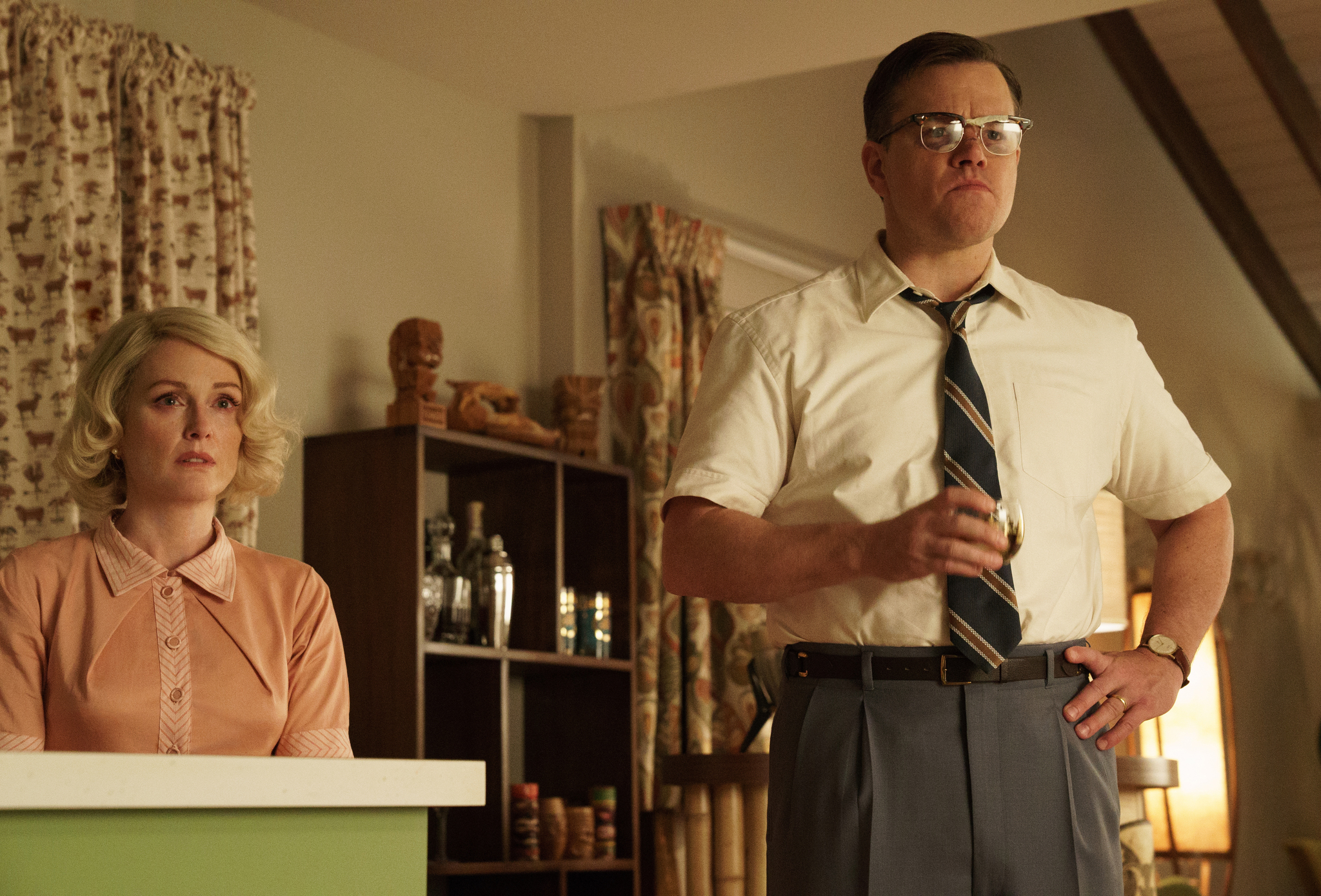
Hey there everyone! Welcome back to Movie Soapbox, the little corner of the internet that only you and I and that guy falling asleep in the back booth over there know about. This is the place where we find under-appreciated, difficult, frequently uncomfortable films and we figure out what they were actually trying to say. Today we are doing a deep dive on Suburbicon, a movie so deliberately unpleasant to watch, so committed to making you sit in it, that the studio suits who distributed it reportedly spent the entire opening weekend blinking at the box office numbers wondering what went wrong. What went wrong, gentlemen, is that you greenlit a film whose entire point is that comfortable people do not like being made uncomfortable, and then you were surprised when comfortable people did not go see it.
Before we get into it, here is the trailer.
Alright. Everything from here is the full movie. Every body, every twist, every ugly thing Clooney and Grant Heslov were trying to say out loud. If you have not seen Suburbicon and you want to go in clean, now is the time to walk away. I will be here when you get back. The film is uncomfortable but it is worth the discomfort. That is the whole point, and I will explain exactly why.
The Making of the Movie Suburbicon
Here is something you should understand before we go frame by frame into this thing. When a director takes a paycheck of fifty thousand dollars over two years on a studio picture, what that tells you, practically, mechanically, in terms of how the power actually flows through a development office, is that he was not there to make money. He was there to spend leverage. Clooney had a specific size of cultural capital, call it the Ocean’s franchise and two decades of goodwill, and he chose to spend it making a film that a mid-tier director without his marquee value would have watched die in turnaround after the first round of notes. You can always tell when a director brought a project through sheer force of personal currency, because the film has a weird, unbroken spine to it, a stubbornness in its structure that normal studio development would have rounded off. Suburbicon has that spine. The slow, airless, deliberately boring first act is not a flaw that survived the editing room. That is a choice that survived twelve conversations where someone in a conference room almost talked him out of it. The boredom is the mechanism. More on that in a moment.
The Coen Brothers and Suburbicon Movie
Now, the Coen Brothers byline. The Coens had a script set in a 1950s planned community that sat in a drawer for years, decades honestly, and what Clooney and Heslov did was essentially strip the setting and the era and then write their own film on top of it. Listing the Coens as writers on the final product is, at best, generous, and at worst the kind of marketing calculation that makes sense in a room full of people who think “Coen Brothers” is a four-quadrant brand. The film you are watching is a Clooney and Heslov film wearing a Coen Brothers jacket so the trades would write about it. File that away.
What Actually Happens in the Movie Suburbicon
The film runs two parallel storylines and does not rush to connect them, which is, again, the point and also the reason most audiences checked out before they could receive the point. Keep both threads in your head at once.
Thread One: The Mayers. An African American family moves into Suburbicon, a shining planned suburban community in 1959, and the town responds the way 1959 suburban communities responded, with escalating hostility that begins as cold-shoulder social exclusion and ends with a literal mob camped on their front lawn. The Mayers do not leave. They do not break. They absorb it. Their story is linear and constant and the escalation never stops. That is all their story does. It escalates and they endure.
Thread Two: The Lodges. Gardner and Rose Lodge, their son Nicky, and Rose’s sister Margaret are attacked in their home by two men hired to kill Rose. Rose dies. Gardner and Margaret were in on it. The insurance money is the motive. Margaret stays in the house as a surrogate mother to Nicky, which is the kind of ice-cold domestic move that should tell you everything about both of these people.
Then everything starts collapsing inward on Gardner and Margaret, which is the structure of most noir, except Clooney plays it for a kind of escalating absurdist horror rather than cool tension. Nicky is smart enough to know what happened. The police investigation moves faster than Gardner expected. And then Bud Cooper, an insurance claims investigator, shows up and tells Gardner he knows everything and wants the full payout or he goes to the police.
Gardner’s response to Bud’s blackmail is the sentence “if I killed Rose, why wouldn’t I have you killed too,” which is the kind of logic that sounds airtight until Margaret has already put lye in Bud’s coffee. Cooper is dead before Gardner finishes the sentence. One of the hired killers comes back and murders Margaret. Gardner disposes of two bodies. Nicky has already called his uncle, who shows up, kills the hitman, and then dies from a stab wound in the same altercation. The second hitman dies in a car crash caused by a fire engine racing to deal with a riot at the Mayers’ house next door. Gardner comes home, threatens Nicky, eats the boy’s peanut butter sandwich by mistake, and dies from the lye Nicky had put in it. Seven bodies. The house is full of dead idiots. Nicky walks outside and plays catch with the Mayer boy next door.
That is the ending. Hold it in your mind for a second.
The Movie Suburbicon Explained
The entire town of Suburbicon spent the runtime of this film staring at the Mayers. Organizing against the Mayers. Losing sleep over the Mayers. Thirty feet across the lawn, Gardner Lodge was murdering his way through his own family and collecting the insurance money and generating an actual body count of seven, and nobody in the town saw any of it because they were too busy being terrified of the Black family who had done nothing to anyone.
The Mayers are not a metaphor. They are the test. The film is showing you exactly where the town’s gaze goes under pressure, and the town’s gaze goes to the family who committed no crime, while the man committing all the crimes operates freely because he looks like the rest of the town and the town has trained itself not to look too hard at people who look like them.
Gardner and Margaret were not just passive in the racism around them either. Margaret personally participated in having Mrs. Mayer priced out of the local grocery store. They were active. The same people engineering a murder-for-insurance scheme found time and energy to participate in organized community harassment of their neighbors. That simultaneity is the whole movie. That is what Clooney spent his leverage to put on screen.
Racism in Suburbicon functions as a misdirection, a conjuring trick the community performs on itself to avoid looking at the actual rot in its own houses. Literally. The riots are happening at the house next door to where all the bodies are. The fire engine racing to the riot is what kills the last hitman. The two threads collide at the end because they were always the same story, which is that the most dangerous people in Suburbicon were never the ones getting screamed at through a window.
The Mechanism of the Boring First Act
The film is slow on purpose. The first hour-plus is airless and uncomfortable and deliberately draining. That is the medicine delivery system. You are made to feel the dull, grinding, ambient weight of what the Mayers are living through. There is no thriller energy to save you. The film refuses to let the Lodge storyline become fun until the very end, and even then the laughs are the kind that stop in your throat, because what you are laughing at is the self-destruction of people too consumed by their own privilege to notice they were building a trap for themselves. Clooney wanted you uncomfortable in your seat before the fireworks started. He wanted the discomfort to land before the punchline. Most audiences left before the punchline, which is, if you want to be darkly honest about it, kind of the point too.
A film that makes comfortable people leave the theater before it finishes its sentence is a film that just demonstrated its own thesis on a live audience.
Fifty thousand dollars. Two years. A Coen Brothers credit that meant more to the marketing department than to the actual film. George Clooney made this because he calculated that he was one of a very small number of people with the leverage to make it and have it reach a screen at all. He was right about that. He was also right that it wouldn’t be fun. Both of those things are true and neither of them is a flaw. Suburbicon is not the movie you wanted. It is the movie someone decided you needed, and had enough currency to make anyway. That is a rarer thing than it should be.
We will see you next time at Movie Soapbox. You know where to find us.
🎬 If You Liked This…
- Nocturnal Animals — the same beautiful surface covering something ugly and irreversible underneath, aesthetics deployed as a kind of violence, the rot always already there before anyone was willing to look at it
- Funny Games — domestic horror hiding in plain sight behind the facade of a normal suburban household, the violence so close to the surface of ordinary life that the surface was never really there
- Knives Out — the same dark comedy of a respectable family destroying itself from within while maintaining the performance of decency, murder as a natural extension of how these people have always treated each other