
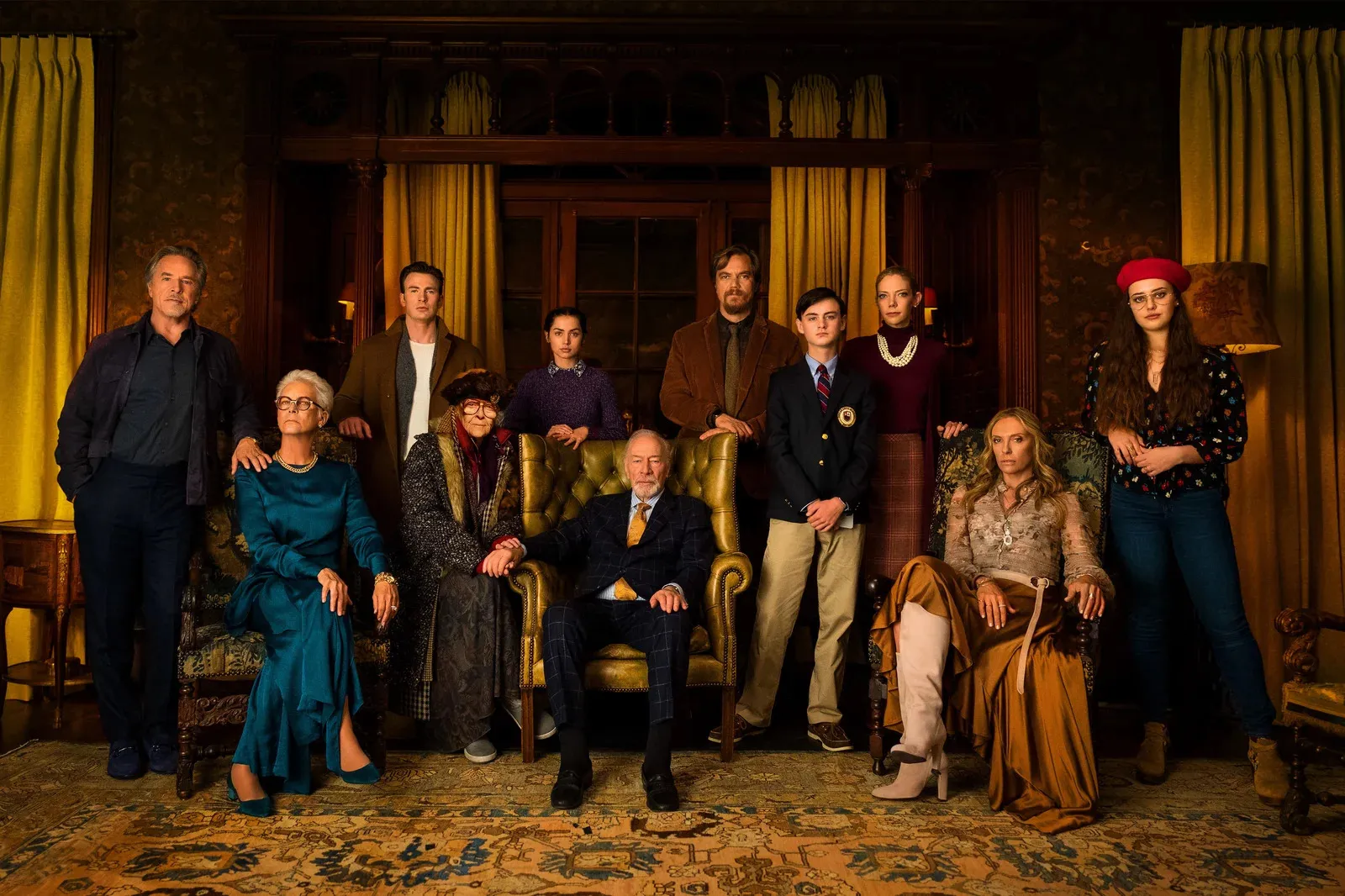
Hey there everyone! Welcome back to Movie Soapbox, the little corner of the internet that only you and I and that guy asleep in the corner over there actually know about. This is the place where we take films that deserve more than a star rating and a tweet, and we crack them open until they mean something. Today we are doing a full deep dive on Knives Out, a movie so gleefully, structurally confident in what it is that it almost makes you forget how easily it could have been flattened into something forgettable, something safe, something focus-grouped into a corpse and shipped to streaming with a 6.2 on Letterboxd and no one ever thinking about it again.
We are going scene by scene, we are doing the family tree, we are doing the ending, and we are doing the theory. Buckle up.
Before we go any further, a word: everything from this point forward assumes you have seen Knives Out in its entirety. If you have not, close this tab, go watch the movie, and come back. I am not going to hold your hand across the street on this one. The whole architecture of what makes this film work depends on you not knowing how the trick operates. Go. I’ll be here.
Still here? Good. Let’s get into it.
The Machine Behind the Movie Knives Out
Before you can understand why Knives Out feels the way it feels, the specific texture of a screenplay that seems almost impossibly confident about exactly what it wants to be, you need to understand what tier of film this actually was when it got made, and what that tier usually means. A mid-budget, non-franchise, non-IP, original screenplay murder mystery with a cast that costs more than most studio tentpoles, no safety net of source material brand recognition, and a director whose last credit was The Last Jedi, which is to say a man who had just survived one of the loudest fan-backlash events in modern film culture. Walk that into a studio greenlight meeting and see what comes back out. What usually comes back out is a third act full of fingerprints, a villain who gets a monologue that explains his feelings, and a final scene that tests well with audiences who wanted something warmer. The fact that Knives Out has the ending it actually has, the one where good wins not because of a clever twist but because of sustained moral character, the one that refuses to be ironic about goodness in a genre that has been ironic about everything for thirty years, tells you something about how tightly Rian Johnson held onto this thing. You can feel the absence of the notes that didn’t land.
The Knives Out Family (Because You Need the Scorecard)
Christopher Plummer plays Harlan Thrombey, the patriarch, 85 years old, a mystery novelist worth $60 million, and the dead man at the center of everything. Every other character in this film is defined almost entirely by their relationship to Harlan’s money, which is the most honest thing about how Johnson frames this family from the first frame.
Jamie Lee Curtis is Linda Drysdale, Harlan’s eldest daughter, real estate mogul, self-made in the sense that she will tell you she is self-made and neglect to mention the seed money. Don Johnson is Richard Drysdale, Linda’s husband, a man running an affair with the confidence of someone who has never been caught at anything. Chris Evans is Hugh “Ransom” Drysdale, their son, and the single most important casting decision in a film full of important casting decisions. Evans plays spoiled, entitled cruelty with the same easy charm he usually deploys as decency, and the cross-wiring of that audience expectation is load-bearing to the whole plot.
Toni Collette is Joni Thrombey, Harlan’s daughter-in-law, widow of his deceased son Neil, a lifestyle brand in human form, double-dipping on her daughter’s college tuition reimbursement because of course she is. Katherine Langford is Meg, Joni’s daughter, the one family member who almost gets to be sympathetic until the plot needs her not to be.
Michael Shannon is Walter Thrombey, Harlan’s youngest son, the one running the publishing company, the one who has spent his entire adult life mistaking proximity to the source of money for actual capability. Riki Lindhome is his wife Donna, and Jaeden Martell is their son Jacob, a troll in the most literal contemporary sense of the word, deployed in the film almost as a punchline about what this family produces.
Ana de Armas is Marta Cabrera, Harlan’s nurse and the film’s actual protagonist, the moral center of the whole structure, a woman with a physical inability to lie that functions as both a plot mechanic and a thesis statement. Daniel Craig is Benoit Blanc, the private detective, deployed with a Louisiana accent so specific and committed that it stops being a choice and becomes its own argument. Lakeith Stanfield is Detective Lieutenant Elliot, the local investigator who spends most of the film being professionally frustrated. Frank Oz is Alan Stevens, the lawyer who delivers the will reading that detonates the family.
And yes, Joseph Gordon-Levitt is in there. He is in every Rian Johnson film. This is law.
What Actually Happened in Knives Out: The Mechanism
The night of Harlan’s 85th birthday party, he had already decided to burn the whole arrangement down. Walt was fired as CEO of the publishing house. Richard was told Harlan was going to tell Linda about the affair. Joni was told the tuition double-billing was over. And one week prior, Harlan had already revised his will to leave everything, every dollar of the $60 million, the house, the publishing company, the entire estate, to Marta. Every single person in that family had a reason. That is the setup. That is the box Johnson builds before he starts taking it apart.
Hugh “Ransom” Drysdale, having found out about the will, swapped the labels on Marta’s medication kit so that when she administered Harlan’s nightly doses, she would give him a fatal overdose of morphine instead of his blood thinner. Ransom’s plan was elegant in the way that plans made by men who have never had consequences are elegant, which is to say completely, and built entirely on other people doing exactly what he expected.
Marta, through what is either extraordinary luck or the universe’s editorial comment on the whole situation, had memorized the dosages so thoroughly that she swapped the mislabeled drugs back without realizing it, giving Harlan the correct medications. She did not know she had done this. She believed, with complete certainty, that she had administered a fatal dose of morphine to a man who was also her friend.
Harlan knew his toxicology would look suspicious. He ran the math in the time he believed he had left, which was minutes, and he chose to cut his own throat to redirect the investigation away from Marta entirely, to make the timeline work in a way that would protect her. This is the act the film is actually about. A man who spent his whole life writing about murder chose, in the last minutes of his life, to engineer his own death as an act of protection for someone who had been genuinely kind to him. That is the hero and villain of this movie, located in a single decision by a man who is dead before the opening credits finish.
The Fran Problem and the Confession That Breaks Everything
Fran, the housekeeper, had found the toxicology report that proved Marta had not given Harlan the fatal dose he believed he’d received. Hugh, realizing this report could unravel everything, lured Marta by giving her the report Fran had found, which was designed to send Marta scrambling to recover and destroy it, which would make her look guilty, while Hugh simultaneously overdosed Fran at a laundromat to eliminate the witness entirely.
Marta, being Marta, called 911, performed CPR, and saved Fran’s life, a fact Hugh did not know when Blanc brought them both into the room for the confrontation. Blanc laid out what he knew. Hugh, calculating that a drug swap that got accidentally corrected is not murder, said as much. Then Blanc told him about Fran. Hugh, believing Fran was dead and that there was no living witness, confirmed he had overdosed her. On tape. In front of everyone. The confession arrived before Hugh understood that Fran had survived, and once the recording existed, the rest of the room understood exactly what had happened.
Blanc’s approach the whole film has been to let the architecture of what people believe they can get away with become the trap itself. He never actually had everything. He had enough, and the rest he let Hugh build for him.
Hugh grabbed the knife from the wall and got the decorative fake one. The house itself rejected him. That is the film’s last joke, and it lands because Johnson earned it.
The Linda Note and the Final Image
Before his death, Harlan had written Linda a note in invisible ink, instructions to hold it to a flame to read it. Richard, finding the envelope and seeing what appeared to be a blank note, left it for Linda, confident it was nothing. Linda burns it in the final scene and reads what Harlan left her, the confirmation that Richard had been having an affair, delivered from beyond the grave by a man who had already been three moves ahead of everyone in his life and managed one more from outside it.
The final image is Marta on the balcony of the estate that is now hers, looking down at the family assembled on the lawn below, holding the mug that reads “My House, My Rules, My Coffee.” The family looks up. That is the whole movie, in a single held shot.
The Knives Out Movie Competing Theories
A film this structurally deliberate generates a handful of serious interpretive arguments, and you should know them.
The first read is the pure genre subversion argument: Johnson built a whodunit where you know who did it by the end of the first act, and the entire second and third act are about something else entirely, whether an innocent person can survive the machinery of suspicion long enough to be vindicated. This reading treats the film as a technical exercise, a masterclass in misdirecting genre expectations, and it’s not wrong, it just stops short.
The second read is the class argument: every character in the Thrombey family, without exception, has mistaken inherited proximity to money and success for personal virtue, and the film is a systematic demonstration of what people who believe they deserve their wealth will do when it is threatened. Marta, the immigrant nurse who never claimed to deserve anything, is the only person in the building operating from actual earned relationship. This reading treats the film as political, and Johnson’s own public statements lean this direction pretty heavily.
The third read, the one that gets less attention, is the Harlan reading: that the real protagonist of this film is already dead when it starts, and the entire plot is his posthumous design working itself out, that Blanc is not a detective so much as the executor of a dead man’s last act of authorship, that Harlan the mystery novelist wrote one final mystery and cast Marta as the character who survives it.
Moviesoapbox’s Theory Solution
The class reading and the Harlan reading are both real, but they’re also both inside the third reading, which is the one I keep coming back to: this film is about what happens when someone is genuinely, stubbornly, inconveniently good in a room full of people who have decided goodness is a performance. Marta’s vomit reflex every time she tries to lie is not just a plot mechanic. It is Johnson refusing to let the film treat her virtue as something she can strategically deploy or set aside. She cannot lie. She cannot stop herself from calling 911. She cannot let Fran die in a laundromat even when her own freedom depends on it. The film’s argument is that this specific kind of person, the one who cannot stop doing the right thing even when it costs her, is the only one equipped to inherit anything worth having. The Thrombey family spent three generations performing goodness while practicing something else entirely. Marta just did the thing. That’s why she’s standing on the balcony at the end, and they’re on the lawn.
In a genre that has spent forty years telling you that everyone is compromised and cynicism is sophistication, Johnson made a film where the good person wins because she is good. The suits probably had notes on that ending. I’m glad they didn’t land.