
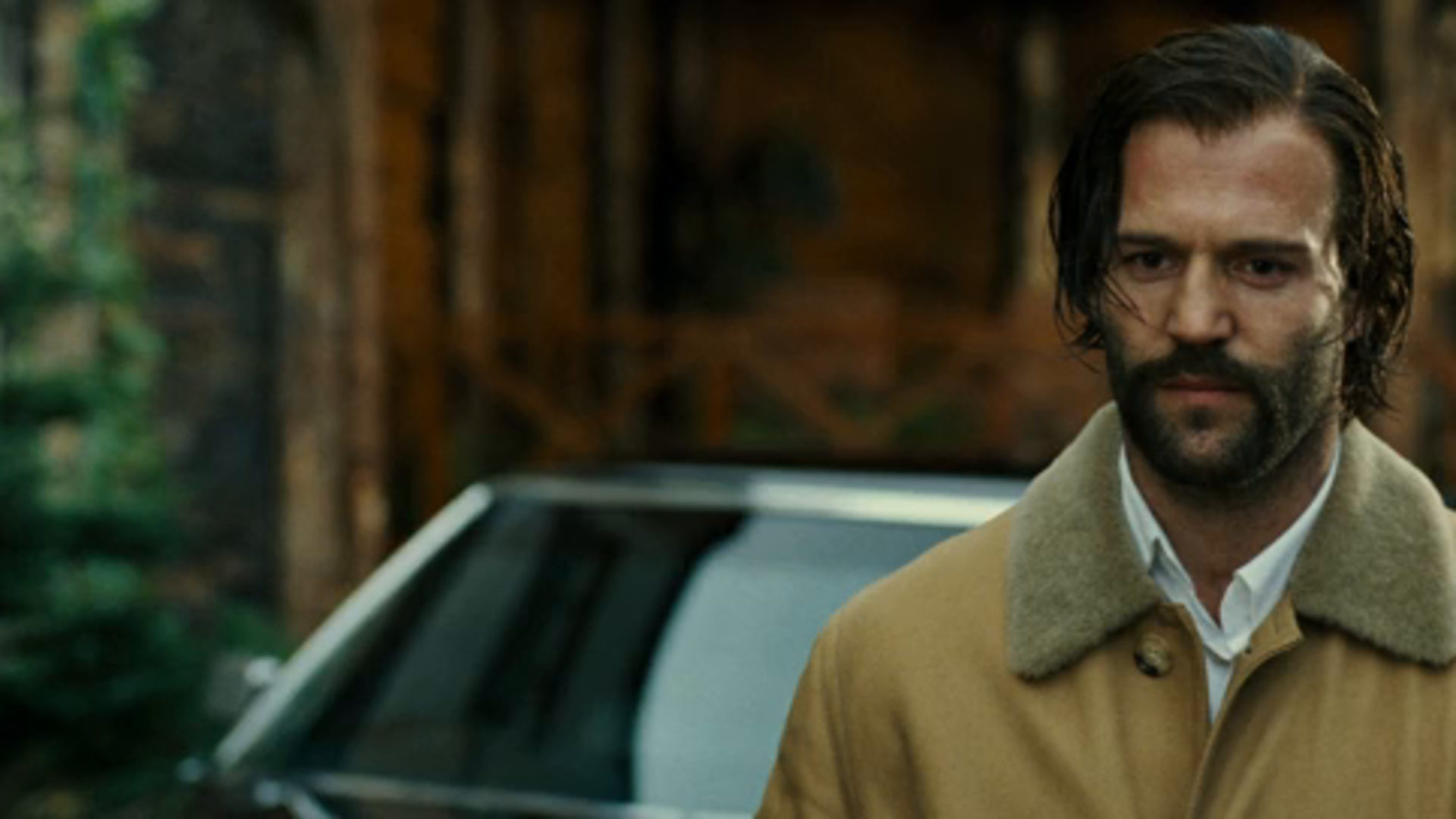
Hey there everyone! Welcome back to Movie Soapbox, the little corner of the internet that only you and I and that guy sleeping in the corner over there know about. This is the place where we find underappreciated, underseen, and generally misunderstood films and we make sense of them. Today? We are doing a full deep dive on Revolver, a movie so aggressively, defiantly weird that the studio that distributed it in North America reportedly re-cut it just to make it feel more like a movie they recognized, which tells you everything you need to know about the movie and everything you need to know about studios.
Fair warning before we go any further: everything that happens in this film gets discussed below, start to finish, cause and effect, including the ending, including the reveal, including the stuff that only makes sense on a second watch. If you have not seen Revolver, the only correct move right now is to close this tab, go find it, and come back. Everything below is a spoiler. Every single sentence.
Now. Let’s talk about what Guy Ritchie actually did here, and why almost nobody was ready for it.
A Note On the Movie Revolver
There is a particular kind of reshoot scar you learn to recognize after you have watched enough films get processed through a major pipeline, and Revolver doesn’t have it, which is somehow the most interesting thing about it. Films at this budget tier, with this cast, coming off a director with Ritchie’s commercial track record after Snatch and Lock, Stock, almost always get the third-act note: make it pay off like a genre film. Give them the confrontation. Give them the kill shot. Give them the catharsis they paid for. Somebody in a room full of people who had never finished a novel wanted this movie to end with Jason Statham putting a bullet in Ray Liotta. That note was coming, you can feel the shape of it in how the film was marketed, in how it was re-edited for American audiences into something that included Macha shooting himself because apparently a gangster boss suffering a psychological collapse was too abstract for a Friday night multiplex. What you are watching in the cut that ends on the chess game is a film that survived that room. Barely. But survived it.
Revolver Movie Walkthrough in Detail
So here is what actually happens in Revolver, walked through properly, because it absolutely requires it.
A mob boss named Dorothy Macha, played by Ray Liotta with every single nerve in his body exposed to open air, runs the games in his city. He needs a card man and leans on Jake Green, played by Statham, who says no, gets his family threatened by Macha’s crew called the three Eddies, says yes anyway, wins big, and ends up in prison for his trouble. Seven years in solitary confinement or fourteen in general population. He takes the seven in solitary. Pay attention to that choice. It matters.
In solitary, Green is sandwiched between two men. The one on his left is a chess master. The one on his right is a con man. Together, over seven years, they teach him something he comes to call the Formula. They also promise to take him with them when they escape. They do not take him. They disappear, and they take everything he has, and they leave him alone with the Formula and nothing else. This is not a betrayal. This is the lesson beginning.
Green gets out. Uses the Formula. Wins enormous amounts of money at every casino on the strip until every casino on the strip has blacklisted him. Walks into Macha’s casino, gets turned away from the table, gets invited upstairs by Macha himself, bets everything on a single coin toss, and wins. The specific affront that destroys Macha’s composure is not the money. The money is nothing. The affront is that Green does not appear to fear him at all. This is the engine of everything that follows.
Leaving the casino, a stranger hands Green a card. Get on the elevator, the card says. Green, who spent seven years in solitary and now cannot tolerate enclosed spaces, takes the stairs instead. He collapses on them. At the hospital, blood tests reveal a disorder nobody can immediately explain.
At home, Green survives a hit Macha ordered. He survives because a man named Zach, played by Vincent Pastore, hands him another card in time. Zach introduces Green to his partner Avi, played by André Benjamin, and they make an offer: they will protect Green from Macha, and in exchange they want every penny he owns. Also, they inform him, he has a blood disorder that will kill him in three days. Green recognizes this as a con. He agrees to it anyway. And this is the second place where you should feel the ground shift beneath you, because a man who recognizes a con and walks into it anyway is not being fooled. He is being pulled toward something.
Zach and Avi put Green’s money to work as loan shark fronts throughout the city. Meanwhile, Macha has been contacted by an entity named Sam Gold, the top of the entire criminal food chain, who wants an enormous supply of product delivered. Macha is ecstatic. Working with Gold means everything to a man like Macha, whose entire psychology is structured around the approval of something bigger than himself. Then Zach, Avi, and Green steal Macha’s supply. Then they steal his backup supply via a hotel-room sleeping gas operation. Macha begins to unravel. His gang trades violence with a rival outfit. An assassin disguised as a waitress takes off one of his fingers before being killed by Macha’s man Sorter, played by Mark Strong. When Macha then orders Sorter to kill Green’s brother Billy and Billy’s daughter, Sorter turns. Kills Macha’s men. Saves Billy and the girl. The architecture of Macha’s world is collapsing from every direction simultaneously, and none of it has the weight of reality behind it. No cops show up. No consequences land. The violence exists in a register that is slightly, persistently wrong, like something described rather than witnessed.
Green has had enough. He goes to Avi and Zach and demands the truth. The answer they give him is: you are your own worst enemy. Ego is the enemy. That is not a metaphor in this film. That is the literal thesis, stated plainly, and then the entire movie reorganizes itself around it.
Green goes to Macha’s bedroom. He asks for forgiveness. In a gangster film, in a film where Statham spent ninety minutes being harder than everyone in every room, he walks into the home of the man who has been trying to kill him and he asks for forgiveness. If you watched that scene and felt cheated, you were in the same headspace as the suits who wanted to put a bullet in the ending. What Ritchie is doing there is showing you what it looks like when a man steps entirely off the board.
Green gets in an elevator on the way out. It stops between floors, between 14 and 12, in a space that technically doesn’t exist on the building’s map. In that nowhere space, Green has an argument with himself. And he loses the argument on purpose. He rejects the voice. When the elevator opens, Macha is waiting with a gun pointed at his face, screaming “fear me, fear me,” and Green just walks past him, mumbling those same words back, a man watching a machine run with nobody inside it anymore.
And then: the reveal. Avi and Zach were Green’s neighbors in solitary. The chess master and the con man. Which means the two men who have been protecting him, running plays with him, forcing him through an elaborate process of losing everything he valued, are the same two men who robbed him the first time. Which means what they said is true, and should have been taken literally: “We didn’t do this because we like you. We did this because we are you.”
They are him. The protection, the disease diagnosis, the loans, the forced humiliation of giving his money away, all of it was a mechanism to produce one thing: a man who has experienced, in practice, not in theory, what it costs to detach from ego. You cannot read about this in a cell and understand it. You have to lose money and survive. You have to be publicly humiliated and continue. You have to ask forgiveness from your enemy and walk away.
Revolver Movie Ending Wrap Up
The film closes on Green’s voiceover, and it lands because everything before it earned it: “There is something about yourself that you don’t know. Something that you will deny even exists until it’s too late to do anything about it. It’s the only reason you get up in the morning, the only reason you suffer the shitty boss, the blood, the sweat and the tears. This is because you want people to know how good, attractive, generous, funny, wild and clever you really are. Fear or revere me, but please think I’m special. We share an addiction. We’re approval junkies. We’re all in it for the slap on the back and the gold watch. The hip, hip, hoo-fucking-rah. Look at the clever boy with the badge, polishing his trophy. Shine on, you crazy diamond. Cos we’re just monkeys wrapped in suits, begging for the approval of others.”
Revolver Movie Philosophical Ending
That is the movie. A philosophy lecture delivered through the body of a Guy Ritchie gangster film, aimed directly at the audience sitting there waiting for someone to get shot in a satisfying way. Now let’s untangle the pieces that trip people up.
Revolver Movie Details Explained
The money mechanics. Green leaves prison, discovers Zach and Avi took everything. Fine. He uses the Formula to earn it back over a couple of years. Still following? He then makes a deal with the three Eddies, the same men who threatened his family, offering to loan them money at four percent interest per month. That is over fifty percent annually. The Eddies think they have a sure thing. Green is simply paying their interest out of his own earnings and building their dependency. When the time is right, he takes the principal and disappears. The Eddies, unable to pay back Macha what they borrowed from him to cover what they thought was a locked bet, get tortured and killed by Macha. Green’s revenge for his sister-in-law’s death is not a bullet. It is a financial trap that closes slowly and completely, with Macha himself as the instrument.
Sam Gold, though. This is where the film asks you to do the hardest interpretive work. Gold never appears. Green never meets him. Macha never meets him. Every contact is through an intermediary, through a voice, through a layer of remove. Most readings stop at “Gold is a symbol of greed and avarice, a force that drives men like Macha to destroy themselves chasing approval from something that will never be satisfied.” That is a complete and defensible reading. Gold is the ego’s promise, the thing always slightly out of reach that justifies every compromise, every crime, every act of humiliation committed against others. Macha spends the entire film trying to deliver something to Gold, to be worthy of Gold, and Gold’s requirements keep expanding because they were never real requirements to begin with. They were just his own hunger wearing a different face.
The further reading, the one the film’s specific language points toward, is that Gold is something more actively malevolent, a prime mover who manipulates through pride and ego toward destruction, not passively but with purpose. The mechanism of theft and ruin that Gold sets in motion through Macha is too precise, too complete, to read as simple abstraction. Gold functions in this film the way a tempter functions in older literature: offering exactly what the subject most wants, in exchange for everything the subject actually is.
And then there is the question underneath all the other questions.
Did any of it happen outside the prison? Were Zach and Avi only ever projections, and was the entire post-prison narrative a construction of Green’s mind, a lesson he was teaching himself in the only classroom available to him, seven years of solitary silence? The film does not resolve this cleanly, and deliberately does not. The American theatrical cut, which appended Macha shooting himself, was an attempt to push the film toward one interpretation, a more externally verified reality, and it makes the movie worse in the process. The version that ends on the chess game leaves you in the space where the question lives, which is exactly where Ritchie wanted you. The practical impossibility of Zach and Avi as external figures, the fact that they are never seen with anyone else, the fact that they know things about Green’s internal state that no outside person could know, all of it points toward projection. But the film never closes the door. The uncertainty is the point. A man who is genuinely uncertain whether his liberation was real or imagined is a man who has to make the choice again, right now, today, without the safety net of a verified answer.
The Perspective Moviesoapbox Chooses to Go With
The theory I carry out of this film: Avi and Zach are fully internal, projections of the two halves of what Green learned in solitary, the chess mind and the con mind, working in concert as the architecture of a forced spiritual crisis. Sam Gold is not merely symbolic but functionally Satanic, a real presence in the film’s metaphysics who operates entirely through ego and pride as instruments. The whole post-prison narrative may or may not have external reality. Green’s liberation is real regardless, because the internal battle was real, and he lost it correctly.
Macha standing in that lobby with a gun screaming “fear me” is one of the most precise images Ritchie has ever put on screen. A man with total external power, completely enslaved to the need for someone to acknowledge it. Green walking past him is not heroism in the genre sense. Nobody gets shot. Nobody wins the fight. The board just stops mattering to one of the two players, and the other one is left screaming at an empty square.
Revolver is a film that should not exist. A Statham vehicle that ends with a voiceover about ego death, released in 2005 by a director the industry had decided was a slick genre craftsman and nothing more, surviving in the form Ritchie intended only because the British cut held long enough to become the version people actually remember. The American suits got their re-cut, their suicide ending, their tidy resolution. And we got the chess game. Somebody in that production fought for it. You can tell by the fact that it’s still there.
That’s all for today. Come back next time, same corner of the internet, same guy too tired to pretend factory product deserves the same conversation as this.
🎬 If You Liked This…
- Pi — another man being destroyed by his own obsessive mind, the pattern he’s convinced is real consuming everything around it, same feverish paranoia and same question of whether the enemy is out there or in here
- Memento — a man who cannot trust the story he’s telling himself about who he is and what he’s doing, the enemy living inside the narrative rather than outside it
- Enemy — a man whose double is the externalization of everything he cannot face about himself, same Jungian shadow territory as Revolver, same slow horror of realizing the thing you’ve been running from was always you