
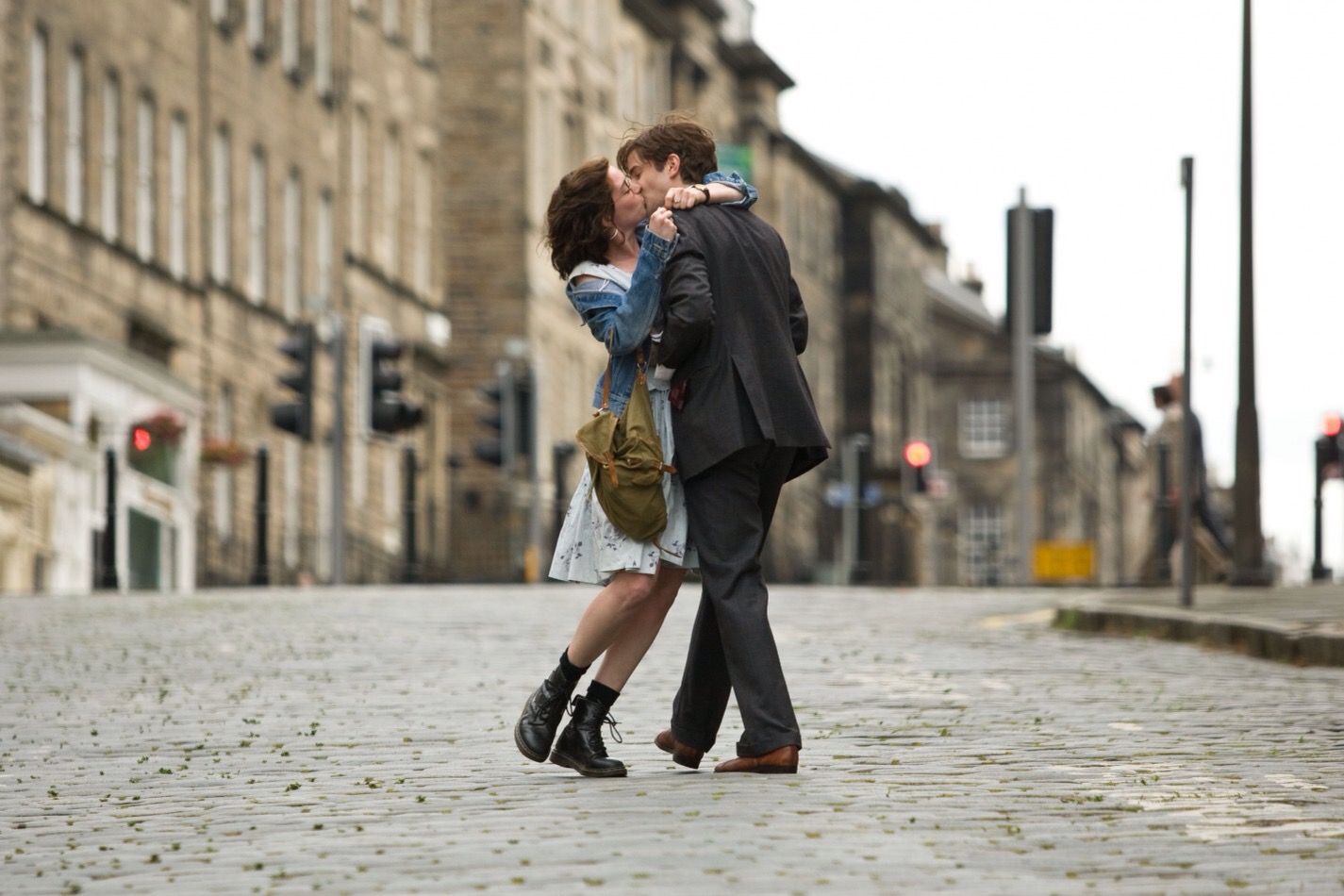
Hey there everyone! Welcome back to Movie Soapbox, the little corner of the internet that only you and I and that guy sleeping in the corner over there know about. This is the place where we find under-appreciated films and shows and we make sense of them, really make sense of them, the kind of sense that requires someone who has seen what happens when a studio or a streamer or a network gets their hands on something that was never supposed to be easy. Today? We are doing a deep dive on One Day, the Netflix adaptation so quietly, stubbornly well-constructed that you almost miss the entire point of it while you’re watching it, which is, as it turns out, completely intentional.
Before we get into it, let’s watch the trailer.
Fair warning before we go any further: everything that follows is going to be fully, aggressively spoiler-forward, including the ending, the death, the structural trick, all of it. If you haven’t watched the series yet, close this tab, go watch it, and come back. The thing I’m about to walk you through is one of the more elegant pieces of screenwriting architecture to land on any streaming platform in recent memory, and knowing the ending before you watch will genuinely cost you something real. You’ve been told.
Still here? Good. Let’s get into it.
One Day Movie Deep Dive
David Nicholls wrote the novel One Day. David Nicholls then watched someone else turn it into the 2011 Anne Hathaway film. David Nicholls then wrote this Netflix adaptation himself. And the distance between those two adaptations is the distance between a screenplay written by a committee working from a property they understand intellectually and a screenplay written by the person who invented the story’s central structural logic from scratch, who had spent years watching what happened when someone else missed the point of it, and who finally got a format and a platform that could actually hold what he was trying to do. Fourteen episodes, averaging somewhere around twenty-five minutes each, dropping as low as eighteen, climbing to maybe forty, with zero obligation to ad breaks or network runtime conventions. Netflix handed him the one thing that kind of story actually needed: a structure with no fixed shape. That is not a small thing. That is the whole game.
Now here is the industry read on why that matters, and why you should notice it. Shows at this tier, limited series adaptations of beloved literary properties with a modest but passionate readership, tend to arrive at the streamer pre-compromised. The negotiation for creative control usually happens long before a frame gets shot, and it usually happens in the form of a showrunner conversation that either does or does not include the original author. When the original author IS the primary screenwriter, you are watching one of two things: either a rare case of genuine creative latitude, or a very expensive lesson in why authors should not adapt their own work. The fact that Nicholls apparently got the episode-length variability through, the fact that the structure is as formally unusual as it is, the fact that nobody made him sand it down into eight equal forty-five-minute episodes with a mid-season hook, tells you something about how this one got made. You can feel when a distributor let someone work. This reads like one of those times.
So. The structure. Every episode is a July 15th. A different year, the same calendar date, and if you are like most people you will spend the first three or four episodes thinking you are watching a chronological story that just happens to skip large sections of time, because you are tracking the years and not the date. The date is printed right there on screen. The date is in the title of the book. And you still miss it, because the emotional pull of watching two people circle each other across decades is strong enough to make the formal mechanism invisible until it isn’t. That invisibility is load-bearing. The whole thing depends on it.
The reason it depends on it arrives in episode fourteen.
Early on, there is a scene where Emma reads Dickens aloud to Dex, a passage from Great Expectations: “That was a memorable day to me, for it made great changes in me. But, it is the same with any life. Imagine one selected day struck out of it, and think how different its course would have been. Pause you who read this, and think for a moment of the long chain of iron or gold, of thorns or flowers, that would never have bound you, but for the formation of the first link on one memorable day.” One selected day. The chain that forms from it. You register this as thematic texture, the kind of literary signposting that literary adaptations do because the source novel did it. You file it and move on.
What you do not clock in that moment, what the show carefully does not tell you, is that Nicholls built the entire architecture of this story from a different literary source entirely, a Thomas Hardy passage from Tess of the d’Urbervilles that goes like this: “She suddenly thought, one afternoon, that there was another date, of greater importance than all those; that of her own death; a day which lay sly and unseen among all the other days of the year, giving no sign or sound when she annually passed over it; but not the less surely there.” Sly and unseen.
Read that again slowly. You have been watching July 15th every episode. You have been watching Emma on July 15th across fifteen years of her life. And July 15th, 2002, is the day Emma dies on her bicycle, hit in the street, gone. Which means every episode prior to that was July 15th of a year Emma survived. The structure is not a clever gimmick layered onto a love story. The structure IS the argument. The show is asking you to sit with a person on the same day year after year, to learn her, to love her, to understand that this ordinary day in her life is ordinary until the year it isn’t. The day that kills her gives no sign or sound when she passes over it. Until she doesn’t pass over it.
One Day and the Director’s Thoughts
Nicholls said in interviews that Emma’s death was not the ending of the story, it was the starting point. The novel was never a love story that happened to end in tragedy. It was always a story about a death that had already happened, told backwards through the days that led to it, which is a structural choice so counterintuitive and so dependent on the reader or viewer not fully understanding what they’re watching that it almost certainly read as insane in a pitch room. You can imagine the note: “why does she have to die, what if they just get together and we see the relationship develop over time, can we test that version.” You can hear it. The fact that Emma dies, that the death is not cushioned or delayed or given a redemptive aftermath that softens it, the fact that the show commits fully to the structural logic Nicholls set up, that is the reshoot scar this show does not have, and its absence is the whole reason the thing works.
Now compare that to the 2011 film. Anne Hathaway, Jim Sturgess, a two-hour runtime, a screenplay that has to compress what is fundamentally a fourteen-episode structure into a format that cannot hold it. The film is not a failure because Anne Hathaway is wrong for the part, though there is a casting conversation to be had there. The film is a failure because you cannot execute this structural idea in two hours. The mechanism requires accumulation. It requires you to spend enough time on July 15th across enough years that the date starts to feel safe, familiar, inevitable, so that when it kills her it kills something in you too. A two-hour film cannot build that. The compression destroys the premise. Nicholls had to watch that happen to his own book, and then he had to sit down and write it again from scratch for a platform that could actually hold the weight of what he had invented. That’s the reps that made the difference, not inspiration, reps.
The Theories To Explain One Day
There are a few competing reads on what this show is ultimately about, and they are worth laying out fairly.
The first read is romantic: this is a story about two people who loved each other and wasted time getting there, and the tragedy of Emma’s death is the tragedy of time wasted, the cruelty of arriving at happiness right before it is taken. This is the read that makes the show a very good and very sad love story, and it is a legitimate interpretation that the text supports.
The second read is structural-philosophical: the Hardy read: this is a story about the hidden architecture of ordinary days, about the fact that one day among all your days is already marked with your death and you will spend your whole life walking past it not knowing, and the romance is the vehicle for that argument, not the argument itself. Nicholls has basically confirmed this is the intended read in every interview he has given about the project.
The third read is about witness, the one that lives in the gap between those two. The show asks you to be present for Emma on the same day across her entire adult life, to see her in the ordinary texture of a single recurring day, and the argument is that this is what it means to know someone. Not the highlights, not the milestones, not the wedding and the Christmas and the promotion, but the same Tuesday in July, repeated, with all its smallness. And when that day kills her, you have lost someone you actually know. That is the trick. That is the whole thing.
The Moviesoapbox Read: is the second one, stated plainly. David Nicholls built a death trap in the shape of a love story, the Hardy passage is not a thematic flourish, it is the blueprint, and the romance exists in service of the structural argument about time and the hidden day that carries your name. Everything else, the charm, the will-they-won’t-they, the Edinburgh locations, all of it, is the show being good enough at its cover identity to let you forget what it is actually doing until the moment it does it to you.
An author got two shots at his own material, the first time inside a format that crushed it, the second time inside a format built exactly right for it, and on the second pass he put Thomas Hardy’s death-day logic onto a streaming platform and made fourteen million people feel it in their chest. That does not happen often. The machine usually finds a way to prevent it. This one got through.
🎬 If You Liked This…
- Manchester by the Sea — the same portrait of two people and the specific gap between them that circumstance made and neither of them can close, grief and timing as the twin engines of everything that didn’t happen
- Columbus — two people in the wrong place at the wrong time having conversations that matter more than either of them is willing to say out loud, same bittersweet register of connection that almost becomes something more
- Fleabag — same British emotional devastation underneath sharp writing, a person who keeps almost having the life they want and keeps finding a way to be standing slightly to the left of it when it arrives