
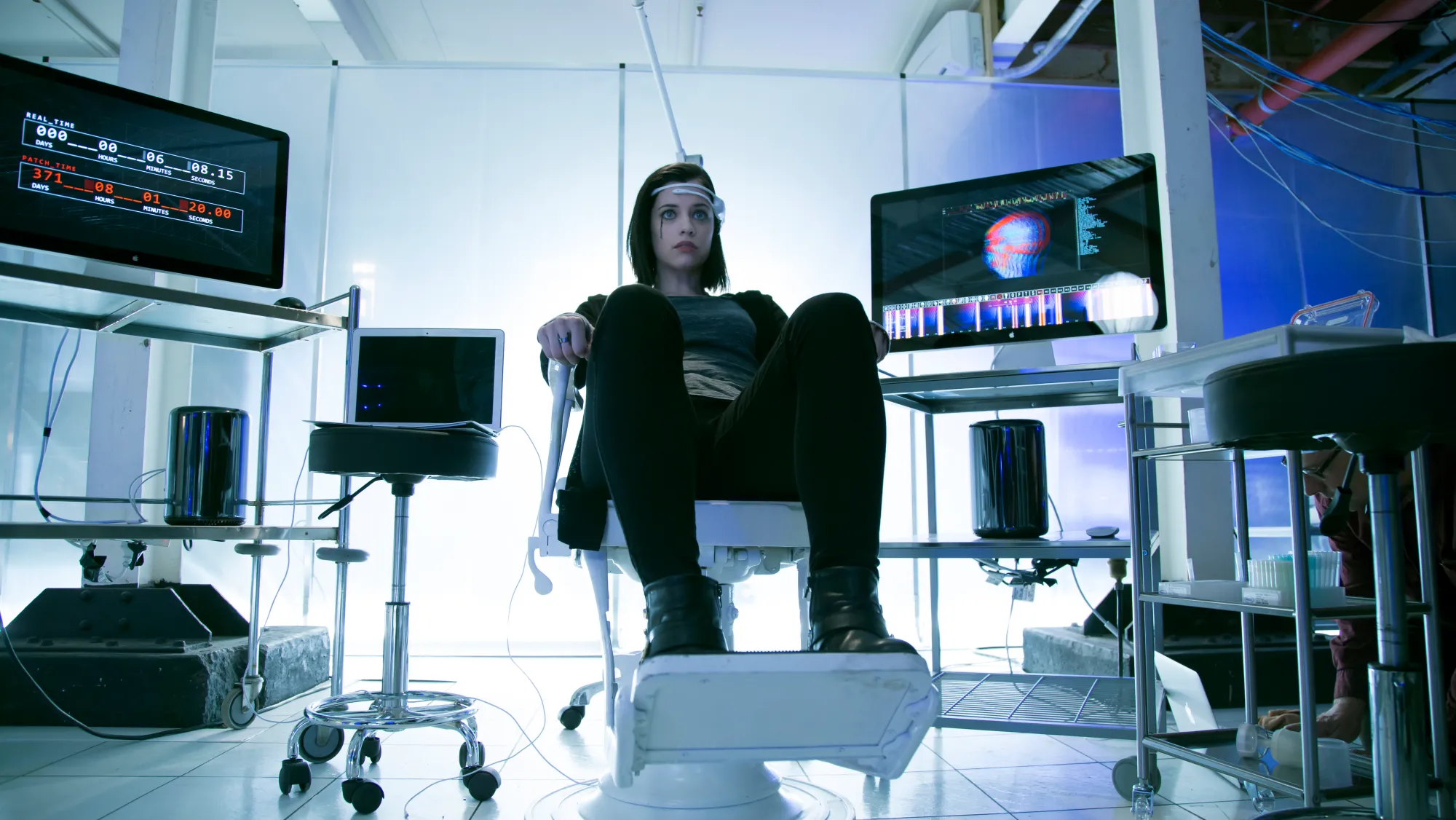
Hey there everyone! Welcome back to Movie Soapbox, the little corner of the internet that only you and I and that guy sleeping in the corner over there know about. This is the place where we find underappreciated indie films and we make sense of them. Today? We are doing a deep dive on OtherLife, a movie so quietly unhinged in its premise that even the people who greenlit it probably thought they were buying something else entirely.
Alright, before we go any further, you should know that everything from this point forward is a full-contact spoiler conversation. The ending, the twist about who’s actually awake, the moment where Ren wipes biological VR code into Sam’s eye like she’s a character from a Bruce Lee movie, all of it is on the table. If you haven’t seen OtherLife yet, it’s a compact little Australian sci-fi film that you can find on Netflix in about forty-five seconds, so go do that first and come back. The rest of you, stay with me.
Otherlife Movie Overview Explained
What you need to understand going in is that OtherLife is not a software story, it is not a hardware story, it is not a headset-and-haptics story. The VR here is biological. A drug you drop into your eye that hijacks your brain’s perception of time and simulates an entirely different lived experience, weeks or months of subjective reality compressed into minutes of clock time. That is a genuinely interesting premise, the kind of thing a mid-tier studio would have immediately tried to turn into an action franchise by attaching someone who just came off a Marvel picture and demanding three set pieces in the second act. The fact that this film stayed small enough to actually sit with the implications of that idea, a prison sentence you serve entirely inside your own skull, is the first thing worth paying attention to.
Films at this budget level, and the production design here punches well above what the numbers probably allowed, sit in a specific zone of creative control that is both a gift and a trap. The gift is that nobody with a greenlighting title is flying in from a coast to demand the third act be reconceived around a chase sequence. The trap is that there is also nobody to catch a structural wobble before it bakes in. OtherLife has one structural wobble that matters, and we will get to it. But the shape of this film, the restraint in how it deploys its concept, the decision to make the incarceration-in-your-own-mind storyline the horror rather than the spectacle, that reads like a director who was left alone long enough to make the film they actually wanted to make. At a bigger budget, with a more bankable lead, someone in a conference room would have found a way to turn the OtherLife drug into a weapon in the third act. It almost certainly would have ended with an explosion. It does not end with an explosion. That is not a small thing.
What Is Actually Happening in OtherLife
The setup is a classic two-person founding-team tension, Ren is the scientist who built the thing, Sam is the partner who wants to monetize the thing, and the thing they built is a biological VR drug that compresses subjective time so aggressively that a few minutes of real time can feel like a year of lived experience. Ren wants to use this to heal her brother, who is in a coma after a diving accident, her theory being that if his brain can be tricked into perceiving a healthy, functioning world, it will rewire itself back toward consciousness. Sam wants to sell it to the penal system. If you can serve a three-year sentence in what amounts to an afternoon of real time, the logic goes, you have solved prison overcrowding and made a fortune doing it. Both of these are completely coherent motivations, which is more than you can say for most films at this level, and the film has the good sense not to make Sam a cartoon villain about it. He is wrong and he is ruthless, but his logic is not incomprehensible.
The crisis arrives when Danny, a member of the team, accidentally takes an untested dose and dies. Or appears to die. The film will revisit this. Ren is legally exposed, Sam has leverage, and the penal system deal is suddenly very attractive to people who want this problem to go away quietly. Ren becomes the first test subject for the prison code. She is locked into a year of subjective incarceration, alone inside her own skull.
When that year ends, the exit routine fails to fire correctly, and the loop restarts. But Ren, because she is the person who wrote the underlying architecture, finds a seam. She hacks through a wall in her own mind and gets out. The film at this point does something genuinely interesting and slightly maddening at the same time, it presents her escape as an escape into reality, and the movie begins treating her as a waking, free person navigating the actual world. She reconnects with Danny, who is not dead after all. She tracks down her father, who turns out to have been a foundational figure in the original research. She refines the drug and gives it to her comatose brother, who wakes up briefly and then flatlines.
And then the eyelid visions start. The sense that the world has a layer over it. She is waking up from the loop, which means she was never awake to begin with. The entire section we watched as her real-world freedom was another layer of the simulation.
Back in actual reality, Danny is confirmed dead. Sam, confronted by a Ren who is more lucid and more dangerous than he expected, offers a version of peace that lasts about thirty seconds before he doses her eyes again with the prison code. And here is where the film makes its most audacious move, Ren breaks out a second time, catches some of the code dripping from her own eye, and wipes it directly into Sam’s eye, locking him into the full year she served, including the broken exit routine, so he can experience exactly what he built for other people. Then she walks out to the place where her brother’s accident happened, and the film ends.
The Mechanics of Otherlife, and Where They Get Slippery
The time compression ratio in this film is not consistent, and you should know that going in so it does not pull you out of the experience every time it shifts. At various points in the narrative, one real-world minute equals anywhere from a few days to a full year of subjective experience. The film is not trying to be rigorous about this in the way that, say, Coherence is rigorous about its rules. It is using the compression as a felt horror rather than a worked-out physics, and for most of the runtime that is a reasonable trade. Where it stops being reasonable is in the escape mechanics.
The first time Ren escapes the prison loop, she hacks a wall. She finds a seam in the architecture of the simulation and physically moves through it, the way you would brute-force a locked door. That is one method. The second time Sam doses her, she does something completely different: she accesses the underlying code directly, identifies the broken exit routine, and patches it from the inside. Those are not the same skill being applied twice. They are two separate capabilities that the film does not explain as related. The first escape looks like intuition and desperation. The second looks like deliberate software manipulation. If the film had given us one scene earlier in the runtime showing Ren working at that level of interaction with the drug’s architecture, the second escape would feel earned instead of convenient.
The other thing worth untangling is the question of whether Ren’s real-world sections are real. The original structure presents her first escape as an escape into an outer simulation layer, not into true reality, and the film confirms this with the eyelid visions. But her second escape, the one where she doses Sam and walks out to her brother’s accident site, is presented as genuine waking reality. The film is asking you to trust that the second escape is categorically different from the first. Given that the first was also presented as a genuine escape, this is a significant ask. The honest answer is that the film does not fully earn it, and the Inception comparison is not accidental. You are left holding the same question Nolan left you with, and the film does not have quite enough established machinery to resolve it cleanly.
The Otherlife Movie Theories
Three competing reads exist for how to leave this film.
Otherlife Theory #1 – This theory is really straightforward read: Ren’s second escape is real, she defeats Sam, she grieves her brother with her father, she walks to the dive site, the story is over. The eyelid visions were a signal that the first escape was still simulation, not a permanent feature of her perception, and once she fully surfaces they clear. This is what the film’s surface narrative presents, and it is a satisfying enough close if you accept it.
Otherlife Theory #2 – This particular theory goes fullon Inception: she never actually woke up. The second escape, the confrontation with Sam, the father reunion, all of it is a deeper layer of the prison loop, her mind generating a more elaborate and emotionally satisfying version of freedom because the first iteration gave her enough architecture to construct one. The eyelid visions are not clearing, they are the film briefly showing you the membrane before Ren’s brain paper-maches over it again. On this read the film is genuinely dark, a person trapped in recursive self-made imprisonment with no exit.
Otherlife Theory #3 – And this read is more forgiving to the film’s structural wobble: the two escapes represent two different modes of the drug’s failure that the film simply did not have the budget or the script development time to distinguish cleanly. This is less a theory about meaning and more a theory about production, the film intended the second escape to be real and differently mechanized than the first, but ran out of room to establish that distinction properly. The intent was read one, the execution left the door open for read two.
Moviesoapbox’s Otherlife Read
Read two is the more interesting film, but I do not think it is the film that was made. Here is why I land on going with read number one as the intended close, with full acknowledgment that the film does not stick the landing cleanly enough to demand it. The emotional architecture of the ending points outward. The grief over the brother, the walk to the accident site, these are closure gestures, not trap-door gestures. A director making the full recursive-nightmare version of this story would have ended on an image of confinement, not an image of open water and sky. The eyelid vision device is deployed specifically over the earlier false-freedom section and not over the final scene. That is a deliberate withholding that reads as the film differentiating the two states, even if the dialogue mechanics do not fully support it.
What I think happened is simpler and more common than any of this. The script needed one more pass on the escape mechanics, probably had notes to that effect from whoever gave notes, and those notes either did not land in time or did not get the budget to address them in the shoot. The wobble is a development scar, not a mystery box. The film meant to tell a clean story about a woman who built a prison and had to escape it twice to be free of the man who used it on her, and it very nearly does. Almost is not nothing. For a film made at this level, almost is often everything they had.
The Otherlife Movie Close
What OtherLife deserved was one more draft and six more weeks in development. What it got was not enough of either, and it still produced something genuinely worth watching, a film with a real idea at its center and the restraint to not blow that idea up in the third act just because someone in a room thought it would test better. The penal system using VR incarceration to warehouse human beings is not a background detail in this film, it is the horror. The film never loses sight of that. That is the thing factory product cannot manufacture no matter how many IP lawyers and VP notes you throw at it. A director who cares what the film is actually about. OtherLife has that. The seams show. It’s worth a second watch anyway.
🎬 If You Liked This…
- eXistenZ — manufactured experience layered inside manufactured experience until the question of what’s real stops having a useful answer, Cronenberg doing what only Cronenberg does
- Eternal Sunshine of the Spotless Mind — subjective time and memory as something that can be entered and rewritten by an outside party, same queasy intimacy of living inside an experience that isn’t entirely yours
- Anon — a near-future where subjective experience is fully accessible to authorities, and what happens when someone finds a way to edit what others see inside your own memories