
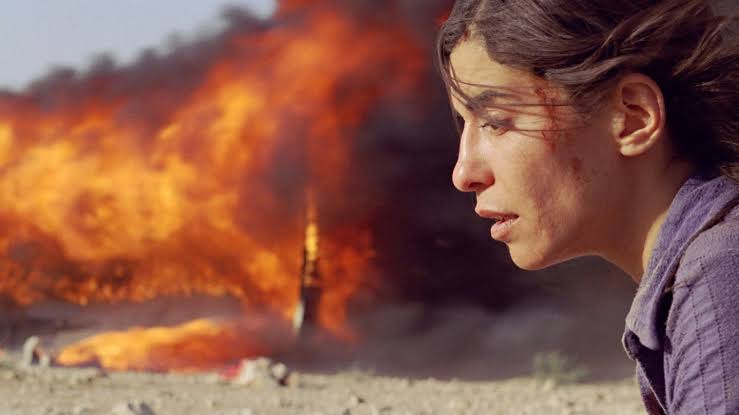
Hey there everyone! Welcome back to Movie Soapbox, the little corner of the internet that only you and I and that guy sleeping in the corner over there know about. This is the place where we find underappreciated films, foreign and domestic, and we make sense of them, really make sense of them, the way nobody else on the internet is bothering to. Today? We are doing a full deep dive on Incendies, a movie so quietly, methodically devastating that by the time the third act lands on you, you will not be okay, and Denis Villeneuve knew that, planned that, and didn’t lose a single night of sleep over it.
Before we go any further, a word: everything that follows is a complete, detailed, scene-by-scene spoiler. The ending, the revelation, the whole mechanism. If you haven’t watched Incendies yet, close this tab, find the film, watch it in one sitting in a dark room, and come back. I’m serious. Villeneuve is one of the greatest directors of all time – and this movie might be his best movie. It will hurt me physically to spoil this movie for you. So go watch it and come back.
Incendies and the Villeneuve’s Making of
A word about who made this thing and how, because the industry context matters here more than you might think. Denis Villeneuve directed Incendies in 2010 on a budget that, in Hollywood terms, is what they spend on catering for a mid-tier superhero film’s second unit. This was a Canadian production, partially funded by public arts grants, based on a stage play by Wajdi Mouawad, and it was made with the kind of creative control that only exists at the budget level where no studio executive has any real incentive to fly in and ruin your third act. You can feel that freedom in every cut. There’s no test-screening fingerprint on this film, no moment where you sense the studio pulling the story back from the edge because a focus group in Burbank got uncomfortable. The ending of Incendies is the ending because Villeneuve didn’t have twelve VPs in a room telling him audiences needed thirty more seconds of reassurance. This is what films look like when the machine doesn’t get to them. File that thought. You’ll want it later.
Incendies Walkthrough In the Order It Actually Happened
The movie doesn’t give you its events in the order they occurred, and that’s a deliberate structural choice, not a puzzle for puzzle’s sake. Villeneuve intercepts you at the middle of the story, runs forward, then doubles back to the beginning, and then races everything toward a convergence point that only becomes visible in the final minutes. If you tried to watch this film’s timeline the way it’s presented and track everything in real time, you’d be lost. So here is what actually happened, in the order it actually happened, laid out plainly so the full weight of it can land on you all at once.
A Christian Arab family in an unnamed Middle Eastern country. Nawal Marwan, young, falls in love with a Palestinian refugee. Her family murders him before they can flee together, though her grandmother intervenes and saves Nawal herself. The baby is born, a boy, tattooed on his heel with three small dots as a means of identification, and then surrendered to an orphanage.
Nawal goes to live with an uncle in Daresh, starts working at a newspaper, begins getting an education. Civil war ignites. Christian nationalists are attacking Muslim civilians and refugees. The orphanage where her son was placed is in the path of it.
A Muslim warlord named Wallat Chamseddine pulls the boy, Nihad, out of the orphanage before it burns. He turns him into a soldier. A child soldier, because that is what war does with children when no one with power decides to stop it.
Nihad grows into something terrible and precise. A trained killer. An assassin.
Nawal, unable to stop herself, joins the Muslim fighters and assassinates a Christian Nationalist leader. She is caught and imprisoned in Kfar Ryat, and what happens to her in that prison over the next fifteen years is the kind of sustained horror that the movie handles with restraint and controlled fury in equal measure. She is tortured. She is raped. Repeatedly. The man doing it calls himself Abou Tareq.
Abou Tareq is Nihad. Her son.
Nawal becomes pregnant from this. She gives birth to twins in the prison. A nurse, a single act of mercy in fifteen years of none, refuses the order to drown the infants in the river and instead arranges their survival.
Eventually Nawal is released. Wallat Chamseddine, the same warlord who turned her son into a weapon, helps her get the twins to Canada. She raises Jeanne and Simon there, never tells them the truth of their origin, and builds a life around the silence of everything she’s survived.
Then one day, years later, at a public pool, she sees a man. A tattoo on his heel. Three dots. She walks toward him and understands everything in an instant. Her son, her abuser, the father of her children, the man she has been looking for across a lifetime of wreckage, is standing in front of her in Canada.
She has a stroke on the spot and never fully recovers. Before she dies she dictates her will to her notaire, Jean Lebel, and the will contains two letters: one for the father, one for the brother. The twins don’t know their father is alive. They don’t know a brother exists. Those are the terms. Find them. Deliver the letters. Then and only then can she be given a headstone.
Incendies and What That Insane Movie Actually Means
Villeneuve adapted Wajdi Mouawad’s play closely enough that the bones of the thing are theatrical, and you feel that in the structural ruthlessness of how the revelation is withheld and then delivered. This is not a plot twist in the thriller sense, something designed to make you feel clever for not seeing it coming. The revelation in Incendies is the logical, inevitable, catastrophic endpoint of every terrible thing that war does to people who never asked to be in its path.
The play itself drew from the real story of Souha Béchara, a Lebanese resistance activist who was imprisoned and tortured at the Khiam Detention Center, run under Israeli-backed authority, endured six years in solitary confinement, one meal a day. Villeneuve deliberately fictionalized the geography and the names, invented the country, invented the towns, made the prison a symbol rather than a specific indictment. That abstraction is protective in one direction and universalizing in another. This isn’t a film about Lebanon specifically. It’s a film about what civil war does to every family it touches when nobody is watching.
Nawal’s two letters are the film’s moral core, and they are worth sitting with. To the father: you’ll become silent, because everyone is silent before the truth. To the brother: your story begins with a promise, to break the chains of anger, to wrap you, and console you, and sing a lullaby over you. These aren’t accusations. They are an attempt at reconciliation from a woman who spent her life doing things that required reconciliation too. Nawal murdered a man. She was not a passive victim of history. She was an actor in it, with blood on her hands alongside everything that was done to her. Villeneuve doesn’t let you flatten her into pure martyrdom, and that’s the right call, that moral complexity is the only thing that keeps the film from tipping into exploitation.
The Incendies Movie Explanation Theories
Most of the interpretive debate around Incendies lands in one of two places. The first reading is essentially Greek tragedy mechanics: this is a story about fate, inherited trauma, and the impossibility of escaping the consequences of choices made in war, with Nawal as a figure of almost mythological suffering who nonetheless chooses love as her final act. The second reading is more political and structural: the film is an argument that civil war itself is the author of these horrors, that the specific ideology (Christian nationalist or Muslim warlord, it doesn’t matter, Villeneuve is careful to implicate both) is irrelevant because the machinery of sectarian violence produces monsters out of children regardless of which side they’re on, and Nihad/Abou Tareq is the proof of that argument made flesh.
A smaller third read exists, focused less on the macro and more on Nawal’s psychology: that the will itself, the task she sets Jeanne and Simon, is simultaneously an act of love and a deeply complicated act of burden-transfer, that she is asking her children to carry the weight of a truth she could not deliver herself, and that whatever peace she hoped the letters would bring, she was also, on some level, unable to die without making sure someone else knew.
Which Read of Incendies Does Moviesoapbox Ascribe To?
The second and third reading collapse into each other if you look at them long enough, and that’s actually where the film lives. Nihad is not a monster because he was born wrong or because he chose evil abstractly. He is a monster because a warlord turned a child into a weapon and a war gave that weapon a prison to practice in. Nawal is not a saint who needed to forgive a monster. She is a woman who survived a war, committed a political assassination, and then spent decades searching for a son that the same war had already destroyed before she could find him. The letters are an attempt to put language around something that language was never designed to hold. And the reason the film breaks you isn’t the reveal itself, it’s the understanding that Nawal already knew, at that pool, and chose to die arranging love instead of arranging anything else. That’s the film. That’s all of it.
This is one of the greatest mindjob movies ever created – and an early glimpse of what a heavenly director is capable. Think about it – this is what Denis Villeneuve was capable of on a shoestring, before the studios got his number and started attaching nine-figure budgets to his name. Incendies got made because nobody important was paying close enough attention to stop it. Some films survive the machine. Some films get made before the machine notices them. This was the second kind, and you should be glad it was.
🎬 If You Liked This…
- Frailty — a family secret that keeps folding inward until the final revelation lands like something you can’t unknow, same structure of truth arriving too late to change anything
- Hidden — a film that builds toward a moment of violence so sudden and so final that the audience is left as disoriented as the characters, guilt buried so deep it destroys everything around it
- Big Bad Wolves — dark, morally inverted, the kind of film where you keep waiting for someone to make the right call and the film keeps refusing to let anyone off the hook