
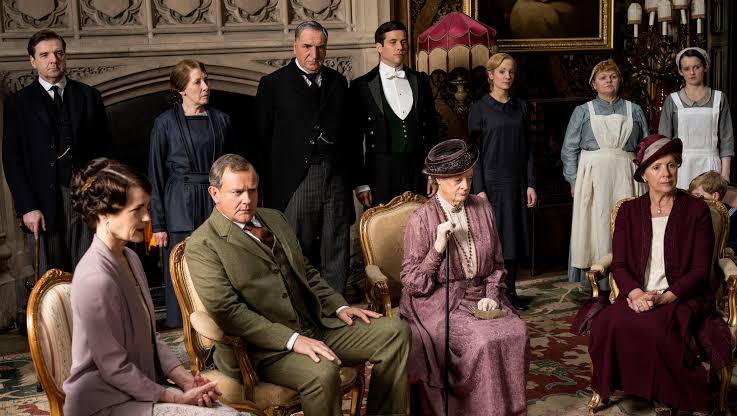
Hey there everyone! Welcome back to Movie Soapbox, the little corner of the internet that only you and I and that one guy who keeps rewinding the same Carson scene know about. This is where we find the under-appreciated, the misunderstood, the quietly great, and we make sense of them. Today we are doing a full deep dive on Downton Abbey, a show so relentlessly, almost pathologically committed to the idea that a building has more importance than any human being living inside it that once you see that engine running, you cannot look at a single scene the same way again.
Before we go any further, this entire post is a spoiler. All of it. We are going through Season 5, which means deaths, marriages, imprisonments, miscarriages, and at least one Turkish diplomat. If you have not finished the series, close this tab, go watch it, come back. I am not going to hold your hand through the caution tape on this one. You have been warned, and I mean it.
Now. Let us talk about what this show actually is, and why it survived the development process long enough to become the unlikely juggernaut it became.
Julian Fellowes wrote the original series for ITV at a budget tier that, in American terms, would make a mid-level network executive laugh and then quietly start asking questions about the catering. Period drama at that scale is a financial argument every single time, because costume, set, and production design costs are fixed before you shoot a frame, which means the pitch has to be airtight or you end up with something that looks like a school play with good hats. You can feel, watching the first season especially, the discipline of someone who knew exactly how much room he had and was not going to waste a single scene on anything that didn’t pull double or triple thematic weight. That’s not a luxury instinct, that’s a survival instinct. When a showrunner knows the money could evaporate, the scripts get tighter. The character work gets denser. Every dinner table scene has to carry plot, subtext, and class commentary simultaneously or it does not earn its place at the table, so to speak. What feels like restraint is a writer building a load-bearing wall inside every episode, because he knew that if the show worked, the house would need to hold.
What Downton Abbey Is Actually About
Every character on this show, servant or family, is in a relationship with a building, and the show’s central dramatic question, underneath all the romances and scandals and legal proceedings, is whether that building will survive them. Robert Crawley does not love Downton the way a man loves a home, he loves it the way a priest loves a parish, because the institution requires continuity and he has appointed himself the mechanism of that continuity, which is a profoundly sad thing to be if you think about it for more than thirty seconds. Cora is there to protect her children, but her children exist within the structure of the estate, which means even maternal love gets filtered through entailment law. Carson runs the servants’ hall the way Robert runs the family, which is to say with absolute certainty that hierarchy is not a social construct but a fact of nature, and any disruption of it is a form of violence against something sacred.
The infographics matter here, and I want to make sure you have them in your head before we go further. The family tree, pointed at the end of Season 2, shows you the Crawley family structure with the entailment problem built into its geometry. Robert and Cora have three daughters: Mary, Edith, and Sybil. Under the entailment rules governing the estate, none of them can inherit. The title and the property are bound together and travel through the male line, which means when Robert’s male heir and first cousin James dies on the Titanic in the first episode, the estate needs a new heir and the daughters need to marry strategically or the whole thing dissolves. Matthew Crawley, a distant cousin and practicing solicitor from Manchester, is the legal heir. He is also, by the show’s tidy contrivance, a decent, morally serious man who is genuinely uncomfortable with inherited wealth, which puts him in constant productive friction with almost everyone around him.
The servants’ hierarchy runs parallel and is nearly as rigid. Carson, the butler, sits at the top of the downstairs world with the same unquestioned authority that Robert holds upstairs. Mrs. Hughes runs the household staff beneath him. Below them the ranks descend through lady’s maid, valet, cook, footman, housemaid, kitchen maid, hall boy, in a structure so formalized that seating at the servants’ table literally maps your position, which is either charming or horrifying depending on your politics and probably both regardless.
What makes the show work is that Fellowes refuses to flatten either world into a caricature. The servants are not uniformly noble victims of the class system. Some of them, Thomas Barrow being the most sustained example, use the hierarchy as a weapon, exploiting it when it benefits them and resenting it when it doesn’t. O’Brien operates on pure defensive aggression, doing terrible things from a place of genuine, if twisted, loyalty. The family are not uniformly callous aristocrats. Robert is genuinely limited by his worldview but he is not cruel. Violet, the Dowager Countess, gets the best lines in the series because she is one of the few characters who is fully lucid about what the system is while being completely committed to maintaining it, and there is a comedic honesty in that combination that the show knows exactly how to use.
Downton Abby – The Historical Machinery
The series opens in 1912 with the Titanic and moves forward through World War One, the 1918 flu pandemic, the Irish War of Independence, and into the early 1920s by the end of what had aired through Season 5. The show uses real historical events as plot pressure, not as backdrop. The war doesn’t just provide uniforms and tragedy, it breaks the servant hierarchy in ways that don’t fully re-seal when the men come home. Women who drove ambulances and ran households alone don’t slot back into their previous positions without friction. Sybil’s marriage to Branson the chauffeur is the show dramatizing the class system under genuine stress, asking what the hierarchy actually means once the conditions that produced it start to shift.
The telephone, the gramophone, the automobile, these aren’t period set dressing. They are each a miniature argument about modernization playing out inside the walls of a house that represents the pre-modern order. Every new technology is a small threat to Downton’s organizing logic, and the show tracks each one with a precision that rewards the attentive viewer who is asking the structural questions rather than just the romantic ones.
The Bates Situation, Laid Out
Anna and Bates are the show’s most sustained exercise in patient, dignified suffering, which makes them beloved to a large portion of the audience and maddening to a different portion. Bates, Robert’s valet, arrives at Downton with a limp, a murky past, and an ex-wife named Vera who is, by any measure, one of the show’s most efficiently written antagonists. She is not on screen much. She doesn’t need to be. Her function is to be a threat to Bates’s dignity and to Anna’s happiness, and she performs that function efficiently before being found dead of rat poison at the end of Season 2, an event that lands Bates in prison for murder at the start of Season 3.
The competing reads on what actually happened break into roughly three positions, and they are worth laying out cleanly.
Downton Abbey Show Theories
Downton Abbey Theory Number One
The first theory is that Vera poisoned herself deliberately to frame Bates, a final act of control from a woman who had spent their entire relationship using his honor against him. Vera knew that Bates would accept unjust punishment before he would drag someone else’s name through a proceeding, and she built a frame around exactly that character trait. The poison being in her own stomach, the lack of external evidence pointing definitively elsewhere, the timing of her death all fit this read. It is also the most novelistically satisfying theory because it makes Vera’s malice intelligent rather than simply cruel.
Downton Abbey Theory Number Two
The second theory, and the one that circulates most persistently, is that Richard Carlisle, Mary’s newspaper-magnate fiance, arranged it. Richard had financial and social entanglements with Vera stemming from the Pamuk scandal, the Turkish diplomat who died in Mary’s bed in Season 1, which Richard had used as leverage over Mary. If Vera threatened to break that arrangement or expose it independently, Richard had both motive and the kind of pragmatic ruthlessness the show consistently associates with self-made men who operate outside the aristocratic code. He doesn’t do things because they are honorable. He does things because they are effective.
Downton Abbey Theory Number Three
The third theory is O’Brien, who originally brought Vera back into the picture by maliciously informing her of Bates’s location and circumstances, then appeared to regret the consequences when she realized how badly it could damage Cora’s household. O’Brien had already demonstrated, in the soap-and-the-bathtub scene that caused Cora’s miscarriage, that she was capable of genuinely terrible things from a place of self-protective panic. The theory here is that O’Brien, having created the Vera problem, resolved it the same way she creates most problems, impulsively and without a clean plan.
Moviesoapbox’s Take on Downton Abbey
Vera did it herself. I am confident in this. The show has been consistent throughout about Bates’s defining characteristic, which is that he will absorb punishment he doesn’t deserve rather than transfer it to someone he loves. Vera knew this. She had spent years weaponizing it. Killing herself and arranging the evidence to point at him is the logical endpoint of a character who had nothing left to lose and one last move available. It fits the show’s interest in how well people know each other’s weaknesses, and it makes her, perversely, one of the most competent characters in the series, because she read her target correctly and executed on it from beyond the available options most characters have. The Richard theory is tidier as a plot mechanism but it outsources the menace to a character who already has too much going on. The O’Brien theory is emotionally resonant but requires her to be significantly more organized than the show has ever depicted her being. Vera, acting alone, makes the most sense of the evidence and the characterization simultaneously. That’s where I am planting the flag.
What the Show Survived to Be This Good
Period drama at this level of craft, with this level of character density and historical seriousness, does not get made in America without someone fighting for it at every budget meeting. The version of this show that gets committee-noted into submission is a soap opera with better furniture. The version where twelve VPs weigh in on whether Bates is too passive a protagonist and whether the Dowager Countess needs a redemption arc and whether the servants’ storylines should be cut to streamline the family drama, that version is worse in every direction. What Fellowes built works because it holds the structure, because the house is the protagonist and everyone else is subject to the logic of the house, and that is an unusual enough organizing principle that it would not survive a round of aggressive notes from people who want a cleaner hero. The fact that it aired on ITV and then PBS rather than going through the American development machine is not incidental to its quality. Some things survive by not being in the room where the damage happens.