
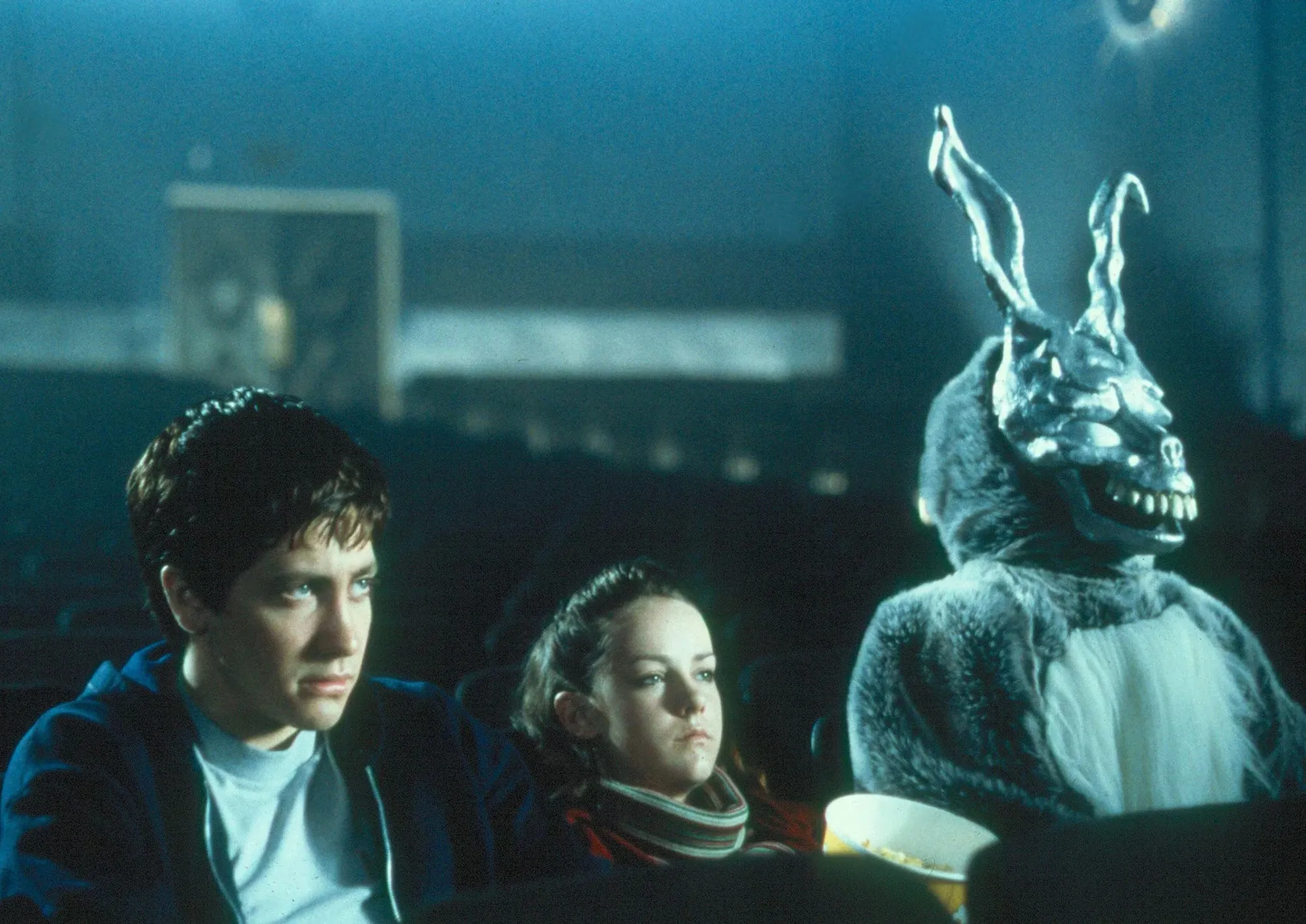
Hey there everyone! Welcome back to Movie Soapbox, the little corner of the internet that only you and I and that guy sleeping in the corner over there know about. This is the place where we find underappreciated films and make sense of them, the ones that got made against the odds or got mangled on the way to the screen or somehow, impossibly, survived intact. Today? We are doing a full, no-mercy deep dive on Donnie Darko, a movie so quietly, surgically confident in its own mythology that it makes most studio sci-fi look like a toddler explaining gravity. Richard Kelly made this thing for four and a half million dollars in 2001, and the suits who eventually touched it have spent twenty years pretending they understood it from the start.
First, the trailer. Watch it, or watch it again, because the way it was cut tells you almost nothing about what the movie actually is, which is either marketing malpractice or an act of mercy, depending on how you came to this film.
Alright. Full spoilers from here. Everything. The ending, the engine, the rabbit, the sacrifice, all of it. If you have not seen Donnie Darko and you somehow want to preserve that first-watch experience, close this tab, go watch the movie, come back. I will be here. The rest of you, let’s get into it.
Before we walk through what happens on screen, you need to understand something about what this film actually is in industry terms, because it matters for how you read everything Kelly put into it. A first-time feature director, twenty-six years old, working from a script that is essentially a philosophical treatise on temporal mechanics dressed up as a suburban teen movie, with a cast that includes Jake Gyllenhaal before anyone knew what Jake Gyllenhaal was going to become, plus Drew Barrymore, Patrick Swayze, Noah Wyle, and Mary McDonnell in what amounts to a $4.5 million ensemble. That budget-to-cast ratio tells you someone was cashing in favors, someone believed in this thing enough to work cheap, and someone at the top of the call sheet understood that the script was not a commercial proposition. It was a dare. At that budget level, with that level of conceptual ambiguity baked into the third act, a first-time director usually gets one of two outcomes: the studio panics in post and recuts toward clarity, or the film sits on a shelf. Donnie Darko got a theatrical release eleven days after September 11, 2001, with a plot that centers on a commercial jet engine falling from the sky. The film died at the box office. What you are watching now, the cult object, the film that actually exists in the culture, is the director’s cut that came out four years later. The version most people call the definitive one almost didn’t get a second chance. That reshoot scar, that near-death on the shelf, is part of what you’re watching every time you screen this.
Donnie Darko Movie Walkthrough
October 1988, Middlesex, Virginia. A jet engine falls through the roof of Donnie Darko’s bedroom in the middle of the night and kills him. Except it doesn’t, because Donnie isn’t in bed. He’s been called outside by Frank, a figure in a deteriorating rabbit costume, who tells him the world will end in 28 days, 6 hours, 42 minutes, and 12 seconds. Donnie wakes up on a golf course the next morning with no memory of how he got there, returns home to find the engine, the police tape, the wreckage of his room, and his family’s barely-contained terror, and from that point forward the movie runs on two simultaneous tracks: the mundane track, high school, a new girlfriend named Gretchen, a self-help grifter named Jim Cunningham who Donnie correctly identifies as a fraud, and the metaphysical track, Frank’s escalating instructions, Donnie’s visions, and his growing awareness that something has gone wrong with time itself.
The instrument that holds all of this together is a fictional text called The Philosophy of Time Travel, written by a retired science teacher named Roberta Sparrow, known to the neighborhood kids as Grandma Death, who shuffles to her mailbox and back every day waiting for a letter that never comes. Donnie gets his hands on this book, and what it describes is the operating system of the entire film.
The Framework: Primary Universe, Tangent Universe, and the Artifact
Sparrow’s book posits that the fourth dimension of time is stable but not impenetrable. Occasionally, and for reasons that are never fully explained, the fabric of time corrupts and a Tangent Universe splits off from the Primary Universe. The Tangent is inherently unstable. It can sustain itself for only a few weeks before it collapses inward, forming a black hole capable of destroying the Primary Universe along with it. The collapse is not optional. The timeline does not self-correct. Something has to correct it.
When a Tangent occurs, an Artifact manifests along with it. Always metal. In this film, the Artifact is the duplicate jet engine, a second engine that does not exist in the Primary Universe, conjured into being by the split and hurled toward Donnie’s bedroom. The engine is not just a plot device, it is the physical evidence of the rupture, the thing that has to be returned to the Primary Universe through a time portal in order to seal the Tangent and prevent the collapse. Until that happens, the clock Frank told Donnie about is literal. 28 days, 6 hours, 42 minutes, and 12 seconds is how long the Tangent has before it takes everything with it.
The Living Receiver, the Manipulated Living, and the Manipulated Dead
Sparrow’s book identifies several categories of people caught in a Tangent. The most important is the Living Receiver: one person, chosen by no mechanism anyone can identify, who has the power and the responsibility to guide the Artifact back to the Primary Universe. Donnie is the Living Receiver. With that designation comes a set of abilities he doesn’t ask for and doesn’t initially understand: increased strength, telekinesis, the ability to conjure fire and water. He doesn’t know he has these. He doesn’t know what any of this means. He just knows a man in a rabbit suit keeps showing up and telling him to do things.
The people around the Living Receiver are called the Manipulated Living. They behave irrationally, often violently, because they are being unconsciously steered toward actions that will assist the Receiver in completing his task. They don’t know this either. And the people who die within the Tangent Universe become the Manipulated Dead, which is where Frank comes in. Frank, the rabbit, is not a hallucination. He is a man named Frank Anderson who will die in this Tangent timeline, and whose dead self is reaching backward through what Sparrow’s book calls the Fourth Dimensional Construct, made of water, to communicate with Donnie and set the sequence of events in motion that will allow the Artifact to be returned. The Manipulated Dead are more powerful than the Living Receiver. Frank is not guiding Donnie out of altruism. The Manipulated Dead are trying to save themselves from Oblivion. If Donnie fails, they cease to exist along with everything else.
The mechanism for forcing Donnie to act is called the Ensurance Trap. The Manipulated Dead, through Frank, engineer a sequence of events that push Donnie into a corner where the only available action is the one that saves the universe. He doesn’t choose this freely. He gets maneuvered into it.
Donnie Darko Movie Ending, Untangled
Here is the sequence of events as they actually occur. Donnie floods the school, which destroys Jim Cunningham’s house, which reveals Cunningham’s child pornography operation, which causes Cunningham’s arrest, which causes the chain of events that leads Gretchen to be at Donnie’s house on Halloween, because her mother, who was involved with Cunningham, has gone missing and Gretchen has nowhere else to be. A man named Frank Anderson, drunk, driving the car that kills Gretchen on Halloween night, gets out of that car, and Donnie shoots him in the eye. Frank Anderson is now dead within the Tangent Universe. He is now the Manipulated Dead. He is now the Frank in the rabbit suit who has been guiding Donnie through the entire film.
Donnie, having just killed a man, having just watched Gretchen die, drives up a hill with his friends as the sky above his house tears open. A storm vortex forms, the Tangent Universe beginning its collapse. Up on that hill, Donnie pulls the jet engine off a plane flying overhead, the engine that contains Gretchen’s mother, which is why Gretchen never recognized the name Darko when she first met him, he was someone she only knew in the Primary Universe, not this one, and he fires it through a time portal back to October 2nd. The Tangent unwinds. The flashbacks you watch as the film ends are not stylistic, they are the timeline reversing. The Tangent dissolves back into the Primary Universe. October 2nd. Gretchen alive. Mrs. Darko on the plane. The engine falling toward a house where Donnie is asleep in his bed, and Donnie knows, and Donnie is not afraid, and the engine kills him, and the Primary Universe continues.
The Questions That Don’t Have Clean Answers
Why does the Tangent Universe occur in the first place? Sparrow’s book says the fourth dimension is occasionally corrupted. It does not say why. The film does not say why. Some people want to argue that Frank’s interference caused it, but Frank is operating within the Tangent after it already exists. Some want to argue the Artifact caused it, but the Artifact appears because the Tangent exists, the causality runs that direction. The honest answer is that the film treats the Tangent as an unexplained first cause, a glitch in the universe with no assignable origin. If you need a reason, you are not going to find one in the text.
Did Donnie have to die? Most people online will tell you yes, because Donnie surviving the engine in the first place is what created the Tangent. But that reverses the causality the film establishes. The Tangent exists before Frank pulls Donnie out of his room. Donnie surviving is not the cause of the rupture. So no, there is no ironclad mechanical reason Donnie has to die. What Sparrow’s book tells us is that Living Receivers have historically always died at the restoration of the Primary Universe. The Judeo-Christian reading is explicit and Kelly is not shy about it: Donnie is a sacrificial figure, a Christ analog, his death is the payment that restores the world. Whether you find that reading theologically meaningful or just structurally satisfying, it is the reading the film is built to support. The smile on Donnie’s face as the engine approaches is the film’s last word on the subject. He is not a victim. He understands.
Who are the men watching Donnie throughout the film? The widely held read is a government Temporal Office of some kind, an agency that monitors Tangent events and attempts to assist the Living Receiver without direct intervention. The film never confirms this. It implies it. That implication is doing its job.
What is the deal with Donnie’s mother on the plane? Mrs. Darko is understood by most careful viewers to be an initiate of Sparrow’s order, someone who has encountered this framework before and understands what her son is. At the end, when the Tangent collapses and her son is dead, she is the only one not weeping. She is sitting under a tree, smoking, waiting. She knew.
Donnie Darko Movie Competing Reads
Donnie Darko Movie Theory #1
There are essentially three camps on what Donnie Darko is actually about. The first is the straight science fiction read: take Sparrow’s book at face value, the Tangent Universe is real, the Living Receiver is real, Donnie is not mentally ill, he is cosmically selected, and the entire film is a precisely engineered mythology about sacrifice and temporal mechanics. This is the read the director’s cut strongly encourages, since Kelly added on-screen text from Sparrow’s book to reduce ambiguity.
Donnie Darko Movie Theory #2
The second is the mental illness read: everything supernatural is filtered through a schizophrenic break, Frank is a hallucination, the time travel framework is Donnie’s mind constructing an elaborate mythology to cope with his deteriorating grip on reality, and the film is a tragedy about a teenager who needed better psychiatric care and didn’t get it in 1988. This read is more comfortable with the theatrical cut, which withholds the Sparrow text and lets the ambiguity breathe.
Donnie Darko Movie Theory #3
The third is the dying dream read: the entirety of the Tangent timeline happens inside Donnie’s mind in the seconds before the engine kills him on October 2nd. He constructs a universe in which he matters, in which his death means something, in which the girl he would have loved is saved by the fact of his dying. This is the most literary of the three readings and the one that requires the most you accept the film as metaphor rather than mechanism.
Moviesoapbox’s Read on Donnie Darko
The dying dream read is beautiful and I respect everyone who holds it, but it is a cope, it is what you do when the mechanism is too strange to take seriously and you need an out. The mental illness read has the same problem in the other direction: it flattens the film into something that could have been made for a quarter of the budget with a safer script. Kelly built a mythology. He built it with enough internal consistency that it rewards close reading and punishes lazy reading. You take Sparrow’s book seriously or the film doesn’t work. The time travel is real. The Living Receiver is real. Donnie dies because that is what Living Receivers do, and because on some level he chooses it, and because Kelly understood that a story about the restoration of broken time needs a cost that you actually feel. Donnie smiling in the dark while a jet engine falls toward him is the most earned ending in twenty years of American independent film. He is not a martyr. He is a man who finally understands the shape of his life, and he is okay with it. That reading requires you to believe the universe is strange enough to have chosen him, and this film is asking you to believe exactly that.
What almost happened to Donnie Darko is that it died in 2001 and stayed dead, a casualty of a release date that couldn’t have been worse and a marketing campaign that had no idea what to do with it. What saved it was the director’s cut, the DVD, and enough people who watched it alone at two in the morning and needed to talk about it with someone. Richard Kelly made this thing once, at twenty-six, on four and a half million dollars, and he got it completely right. Everything he made after it suggests that this particular film was not a warm-up. It was the thing. It existed despite the odds against it, and it still does.
That’s all from Movie Soapbox for today. See you on the next one.