
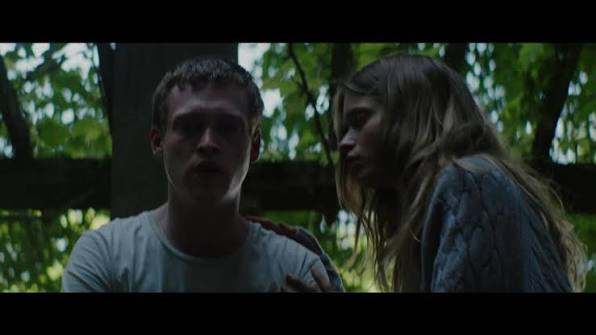
Hey there everyone! Welcome back to Movie Soapbox, the little corner of the internet that only you and I and that guy sleeping in the corner over there know about. This is the place where we find underappreciated indie films and we make sense of them. Today? We are doing a deep dive on Welcome the Stranger, a movie so quietly, deliberately disorienting that by the time it finally tells you what it is, you realize it was never going to be anything else, and the whole ride from frame one was the point.
Before we get into it, here is the trailer. Watch it. Then come back.
Alright. From here on out we are neck-deep in spoilers, and if you have not seen this film, close this tab, go find it, come back when you are done. This is not a review. This is a conversation for people who have already been through it and are still sitting with that low-grade vibration of confusion that the movie leaves behind on purpose.
Still here? Good. Let’s get into it.
Welcome the Stranger and the Making Of
What you need to understand before anything else is what kind of film Welcome the Stranger is, and more specifically, what kind of film it was never going to be allowed to be if a single additional VP had gotten their hands on the script. At this budget tier, with this cast, a director retains creative control largely because nobody senior enough to ruin the thing is paying close enough attention. That is not an insult, that is the mechanism that saves films like this. The moment a project like this gets a little heat, gets a little festival buzz, gets someone with name recognition attached, the notes start arriving, and those notes always say the same thing: clarify the third act, give the audience something to hold onto, make it clear whether this is a thriller or a supernatural film or a drama. The reason Welcome the Stranger feels like all three at once and resolves into something stranger than any of them is that nobody made Justin Kelly answer that question before the cameras rolled. The ambiguity you are wrestling with is not a flaw in the filmmaking, it is what survives when the development process does not get to finish its work. You can tell the difference between a film that is vague because it is unfinished and one that is vague because the vagueness is structural. This one is structural.
Welcome the Stranger Movie Walkthrough
Alice arrives at an estate. No announcement, no context. She swims in the pool before anyone knows she is there, which is the film’s first image and also its thesis statement, someone slipping into a space they do not quite have permission to occupy. Ethan comes out eventually, and we piece together that these two are estranged siblings, that the estate belonged to their mother, that Ethan inherited it, and that Alice did not attend their mother’s funeral because their mother treated her like a mistake she had made.
Ethan is working on a book. Specifically on the illustrations for it. He has a pen he favors, a physical object of creative totemic significance, and when he loses it the drawings stop happening. Alice pokes around the estate, specifically the vineyard, which carries weight in the film’s atmosphere even though the movie never explains it to you in plain language, and that is fine, that is the deal you made when you pressed play. There are lights in the sky above the vineyard. There are dreams. There is a sinkhole that appears. These things matter, but they matter the way dream logic matters, which is to say they are real in the register the film is operating in, not in the register of a police report.
Then Misty arrives. Ethan’s girlfriend. An actress. Alice is blindsided by her existence because Alice and Ethan used to share everything, and she did not know Misty was a thing. The film drops this casually but it is important: Ethan does not quite remember how he met Misty. He does not have a clear account of where she came from or why they are together. He was just drawn to her, he says. That word is going to matter. Drawn.
The three of them exist in increasingly thick tension. Misty wants Ethan to come to Europe with her while she films a role. Alice recognizes this as the end of whatever connection she has left with her brother and she cannot let it happen. There is a dinner. Alice is not drinking, not smoking. Misty clocks it: Alice is pregnant. This lands and then the film moves on without fully explaining what it means, which is correct, because what it means is not about the pregnancy, it is about what Alice is carrying and what it is going to produce.
Through something that plays like a telekinetic current between the siblings, Alice pushes Ethan into strangling Misty. They bury her in the sinkhole in the vineyard. The next morning Ethan sits down and, in one long uninterrupted session, produces all the art he needs for his book. He is finished. He is satisfied. He files it away. Then someone is in the pool. Misty. Naked. Swimming. Roll credits.
Now let’s talk about what actually happened, and I will give you a couple of different reads before I tell you which one is the only one that holds the full weight of the film without buckling.
Welcome the Stranger: The Literal Read
Take everything at face value, write off the lights in the sky as dreams or as Ethan’s instability, and you have a story about a mentally unwell man whose controlling estranged sister shows up, resents his girlfriend, manipulates him into murdering her, and buries the body in the yard. Eventually the police come and Ethan goes to prison. Except this reading requires you to ignore the ending completely, because Misty is in the pool and she is very much not a corpse, and the film treats this not as a horror reveal but as something close to relief. This reading is available to you, and it is wrong.
Welcome the Stranger: The Mental Prison Read
The whole film is Ethan’s interior. Alice and Misty are competing forces in his psychology, good and bad angels, or bad and good, the film will not tell you which is which and that ambiguity is functional. Ethan is the battleground, not the protagonist. He is somewhere drooling into a cup while his mind stages this drama. This reading gets closer. The architecture of the estate as a mental space makes sense under this frame. But it still does not fully account for the specific mechanics of what Misty is and where she came from, why she can come back, why Alice is pregnant.
Welcome the Stranger: The Muse Read
Ethan is a working artist. The estate, which he very clearly could not afford to maintain in any literal sense, is his creative mind, his workspace, the place where ideas live. He has an idea already in motion, a book, a project that is paying the bills and has structure and forward momentum. That is Misty. She arrived the way working ideas arrive, he was drawn to her, she set up in his head, she has a shape and a life and a direction she wants to go.
Then Alice shows up. Alice is the other idea, the one that was always there in the back, the one he has been carrying a long time, too long, the one that keeps resurfacing because it has never been fully worked out. Alice did not come from nowhere. She came from inside the estate, from the mother’s history, from the deeper substrate of Ethan’s creative life. She is old, she is naked, she is enticing, she is disruptive, and she will not leave until something is resolved.
The longer Alice stays, the less progress Ethan makes on Misty. The vineyard is where the fertile creative ground is, and nothing is growing there properly. The sinkhole opens up. The pen goes missing. The working idea starts to collapse under the weight of the new one.
Alice gets Ethan to kill Misty. And when Misty dies, Ethan does not grieve, does not panic about her car in the driveway, does not think about the director who would be missing her soon. Because none of those things are real concerns. You do not file a missing person report for an idea. You just let it go and you bury it and you move on. And the moment he does, Alice explodes into productivity inside him, and he sits down and generates the work in a single session, and it is good, and he knows it is good, and he puts it away.
And then the other idea is back in the pool. Because the ideas you set aside do not stay buried. The working project you killed to chase the new shiny thing will surface again, still there, still swimming, still waiting for you to come back to it. That is not a tragedy. That is just the condition of being a person who makes things.
The bug Ethan finds, captures, and then loses? He comes back to the jar and says, “it wasn’t real.” That is the film confirming its own operating logic out loud. The things that feel concrete in this space are not concrete. They are thoughts with weight. Misty “was working on a film across the street” before she walked over and introduced herself. What she means is she was somebody else’s muse first, and Ethan’s creative energy pulled her in. Ideas migrate. They go where they are fed.
Alice is pregnant. She is carrying something. That something is the work Ethan is about to make, and it will be born the moment the competing idea is gone.
Thoughts on This Crazy Film The Welcome Stranger
This is a film about the violence of creative obsession, about what you kill when you abandon a working project to chase the idea that has been haunting you for years, and about the fact that the thing you killed will come back. It will always come back.
That is what Welcome the Stranger is. A movie about the interior life of a working artist that the studio system would have turned into a thriller about a murderous codependent sibling relationship with a twist ending and a scene where someone calls the police. It would have been fine. It would have been completely and utterly fine, and you never would have thought about it again.
Instead you are here, still thinking about it. Good. That is what we do here at Movie Soapbox. We find the ones that made it through. We will see you on the next one.
🎬 If You Liked This…
- Long Lost — the same three-person closed-box dynamic in an isolated house, a stranger arriving and disrupting a couple’s equilibrium in ways that keep shifting who has power and who is at risk
- The Invitation — dread building underneath the surface of what appears to be ordinary social interaction, a protagonist who can’t tell whether what they’re sensing is real or paranoia, the answer arriving too late
- Borgman — a stranger who arrives at a domestic situation and systematically dismantles it, the horror of someone completely unreadable in a space that should feel safe, the family unable to expel what they let in