
Hey there everyone! Welcome back to Movie Soapbox, the little corner of the internet that only you and I and that guy in the back who hasn’t blinked in twenty minutes know about. This is the place where we find the films that slipped through the cracks, got buried by the algorithm, or just never got the push they deserved, and we make sense of them. Today? We are going deep on Ultrasound, a 2022 indie mind-fracture of a movie so layered, so deliberately disorienting, and so quietly confident in its own weirdness that the fact it exists at all in the form it does is kind of a small miracle.
Fair warning before we go any further: everything from this point on is a spoiler. Not a “oh you’ll see a twist coming” spoiler, a “the entire architecture of the film” spoiler. If you haven’t watched Ultrasound yet, close this tab, go watch it, come back. Mike will be here. The film is about a hundred minutes and it demands every one of them. Subtitles on, phone face-down, the works.
Still here? Good. Let’s get into it.
What This Film Had to Survive
Before we walk the plot, you need to understand what kind of movie this was trying to be and what the gravitational pull of the industry would have done to it in other hands. This is a film adapted from a comic book, Generous Bosom by Conor Stechschulte, and Stechschulte also wrote the screenplay, which is already unusual enough to be worth noting, because the single most reliable way to kill a weird, formally ambitious source property is to hand the adaptation to someone who has no memory of why they loved it. He didn’t let that happen. But you can read the bones of a film like this and know exactly what kind of notes it would have received in a studio development room: “Who is the protagonist we’re rooting for?” “Can we get into the facility faster?” “The carnival stuff is confusing, can he just be a doctor from the start?” The whole movie’s power comes from the slow, disorienting layering, from not knowing which reality you’re in or how many realities deep you already are, and that is precisely the kind of structural choice that gets sanded down by the time a movie reaches a wide release. At a budget somewhere in the several-hundred-thousand-dollar range, nobody had the leverage to demand those notes get addressed. That is not a coincidence. That is the math of independence working exactly as intended.
The Walkthrough: What You Actually Watched
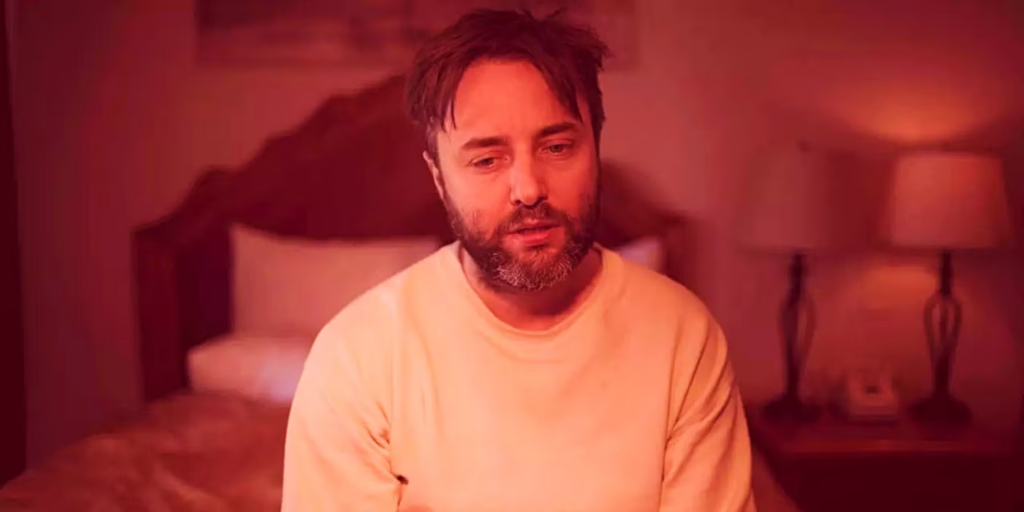
The film opens on what looks, deliberately, like the setup for a bad direct-to-VOD thriller. Glen (Vincent Kartheiser) has a flat tire in the rain, finds himself at the home of Art (Bob Stephenson) and Cyndi (Chelsea Lopez), and Art essentially talks Glen into sleeping with his wife. It feels cheap. It feels like a wrong turn into genre slop. That feeling is the whole game. The film is betting that you’ll either write it off in the first ten minutes or stay suspicious enough to keep watching, and if you stayed, you already know the bet paid.
Then we cut to Katie (Rainey Qualley), a woman swimming laps, who does not realize she is visibly pregnant. She thinks her clothes shrank. She is, we eventually learn, the kept mistress of Alex Harris (Chris Gartin), a sitting senator in the middle of a reelection campaign, and she is being managed, sedated might be the better word, into not processing her own physical reality. She is essentially imprisoned in her apartment, waiting for a man who comes to visit rarely and leaves quickly to get drinks whenever a real conversation might start.
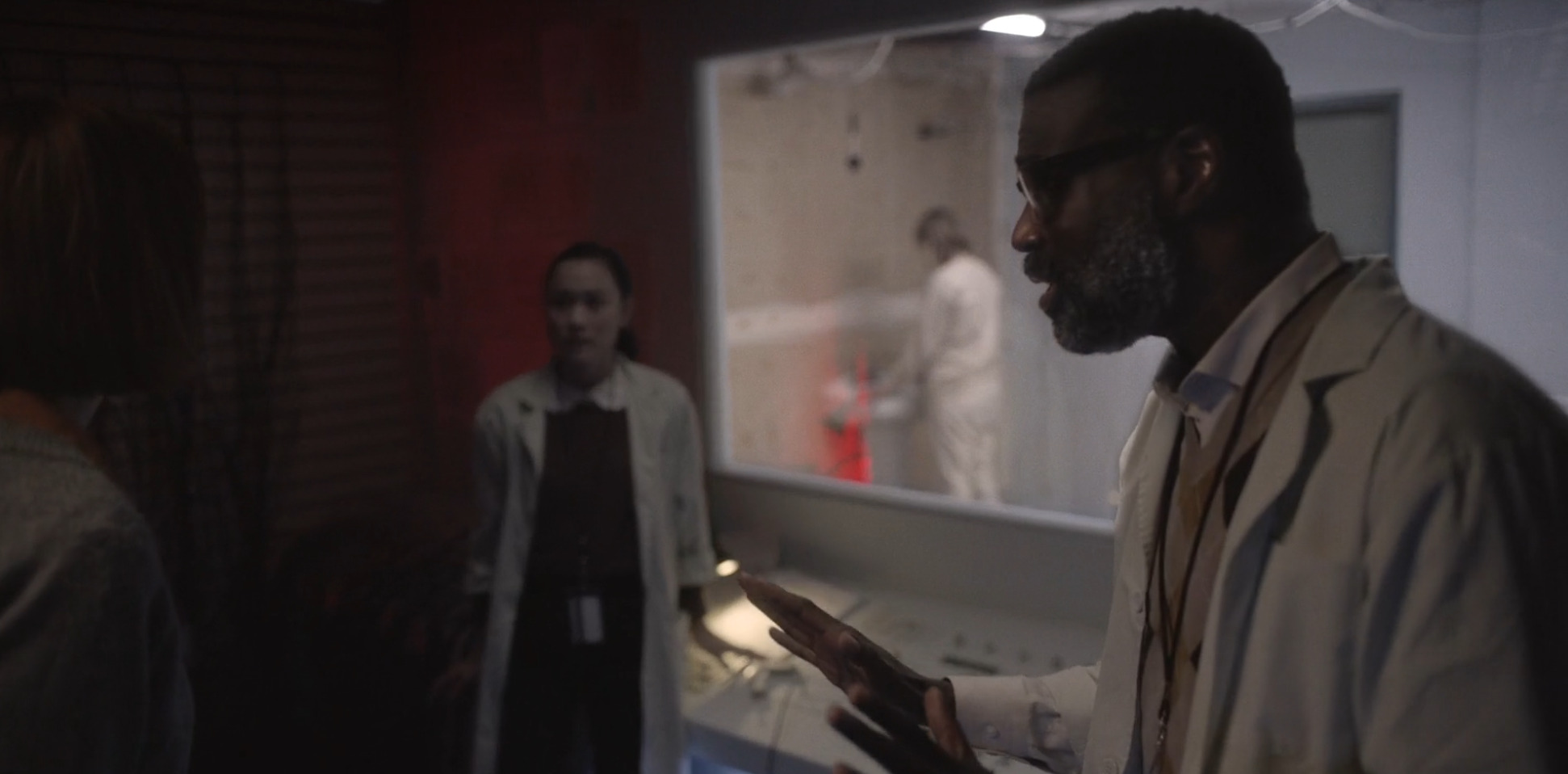
Then we get Shannon (Breeda Wool) and the lab. Dr. Conners (Tunde Adebimpe) runs a research facility where Glen is being held and studied, and where Shannon has been employed under the impression that the work involves PTSD treatment. It does not. What Conners is actually doing is attempting to reverse-engineer the frequency-based hypnotic suggestion research of his former collaborator, Art Thomas, who had a psychotic break and vanished. The only way Conners can reconstruct the research is by working backward from Art’s existing test subjects, which means he has kidnapped Glen and Cyndi and is running experiments on people who have no idea they are in a lab.
The moment that cracks Shannon open is small and precise: she has always known Glen to be paralyzed. Conners, demonstrating for military benefactors, asks Shannon to tell Glen to walk, and Glen walks. The paralysis was a suggestion. A layer Conners himself had added on top of Art’s original work. Shannon immediately asks how many times Glen has been wiped. She also notices that Conners never showed the military the reversal frequency, which is the key to undoing any of this. That omission will matter.
Shannon decides she has to get Glen and Cyndi out. She passes them her keycard, they escape in the night, and they end up at a motel that feels vaguely familiar. It should. The “escape” was another suggestion. They never left the facility. The motel is a lower observation room, less finished, wires showing through the walls. The reason Cyndi can break free is that Shannon had slipped her the reversal frequency and told her to use it whenever reality felt wrong.
The film ends on three images in quick succession: Glen pulling a lottery ticket from his sock with a smirk, thinking it is a winner. Katie calling her mother to say she is pregnant, the suggestion having finally broken. And Art, standing among the senator’s supporters on election night, earpiece in, watching everything he has built hold together, smiling.
The Mechanism: How the Layers Actually Stack
Work backward from the ending and the architecture becomes clear. Art Thomas is not the fringe element in this story. He is the origin point. Art and Conners were research partners until Art either broke down or woke up to what his work could do and decided to go freelance with it. What Art has developed is a method of sustained hypnotic suggestion using specific sound frequencies, targeted and maintained over weeks or months without the subject’s knowledge. He is not a stage hypnotist doing parlor tricks. He is running long-term covert behavioral modification on real people.
Art’s project, the one running through the whole film, is about power over a senator. Alex Harris had an affair with Katie, and Katie is pregnant. That pregnancy is a threat to Alex’s career, his marriage, his reelection. Art neutralizes the threat by making Katie believe she is not pregnant. At the same time, Art has lined up Cyndi and Glen, placed them both under the suggestion that they had an affair, and that Cyndi is now carrying the child from that affair. The plan: when Katie’s baby is born, it gets handed to Cyndi and Glen, who will believe it is theirs, born from a relationship they think they remember having. The baby disappears into a family that will love it and never ask questions, because they believe the story Art gave them. Alex is clean. Art has a senator in his debt.
But before any of that can complete, Conners tracks down Glen and Cyndi and pulls them into his facility. Now Art’s plan has a hole in it. Which is why the third thread, the couple being vetted for adoption, appears. Art is now improvising a backup disposal route for a baby whose original destination just got kidnapped.
Glen’s layers, specifically, stack like this: the first suggestion, from Art’s carnival act, is the lottery ticket in his sock. He was a plant in the show, not a real audience volunteer, but Art ran real suggestion on him anyway, using the performance as cover. The second suggestion is the affair with Cyndi, the whole rain-and-flat-tire scenario. The third suggestion is the paralysis, which Conners added on top of Art’s work to control Glen while studying him. When Conners demonstrates the reversal to the military, he is only unwinding that third layer. Glen is still living inside the first two.
The final image of Glen with the lottery ticket tells you everything: he has come up one layer but he is not out. Shannon’s reversal frequency got Cyndi closer to the surface. Glen is still somewhere in the middle. How many times, exactly, has he been wiped and reset? The film does not tell you. That is a generous choice.
Several Theories To Explain the Movie Ultrasound
Ultrasound Movie Theory Number One
The first: is Cyndi actually free at the end? The optimistic read is that Shannon’s reversal frequency worked, that Cyndi waking up in the unfinished observation room represents a genuine break from suggestion, and that she walks out of that facility with something close to her real self intact. The more suspicious read is that the reversal frequency, as Conners himself implies, works per layer, and that Cyndi has simply surfaced one level, the way Glen has, and is still living inside one or more of Art’s original suggestions without knowing it.
Ultrasound Movie Theory Number Two
The second: how much of what we see as the “real” world of the film is itself under suggestion? There is a reading where the entire narrative frame we are given, the scenes we assume are ground-level reality, the senator’s campaign, the lab, Shannon’s arc, is itself being filtered through the perception of a subject who has been under sustained suggestion long enough that no floor can be trusted. The film does not confirm this, but it does not close the door on it either.
Moviesoapbox’s Preferred Read of This Movie
Cyndi is not free and Glen is definitely not free, and the film knows this and wants you to sit with it. The lottery ticket at the end is not ambiguous, it is a statement. Stechschulte is telling you that liberation from this kind of control is not a door you walk through and then you are out. It is a process of layers, and you may not know how many there are, and the reversal tools you are given may only reach so far down. Shannon did a brave thing. She did not fix these people. She moved them one floor closer to the surface. That is all anyone can do from inside a system built to maintain itself.
What the film is really about, underneath the mechanics, is the question of who gets to author your reality and what they want from you in exchange. Art is not a monster. He is a pragmatist. The senator needed a problem managed. Art managed it. The currency was other people’s perception of their own lives. That trade happens in rooms that look nothing like a carnival and nothing like a basement lab. It happens in PR firms and campaign offices and networks of people who need favors and know how to collect them. Art just found a more literal version of the toolkit. The smirk at the end is not triumphant. It is patient. He has been doing this long enough to know that most people never get to the floor where the real question lives.
Conor Stechschulte made a movie about power and suggestion on what was probably not enough money to cater a Marvel second unit for a day. He did not simplify it to make it marketable. He did not add an action sequence to prove the concept had franchise legs. He trusted the architecture. That almost never survives contact with distribution in this industry. The fact that you can watch Ultrasound in the form Stechschulte intended it, strange and unresolved and confident in its own strangeness, is the whole argument for why the budget tier this film lived in exists and deserves to keep existing. Some things only get made because nobody had enough money to ruin them.
🎬 If You Liked This…
- Sound of My Voice — another cult leader, another group of believers, another film that refuses to tell you what’s real
- Time Lapse — a camera that photographs tomorrow, three people who can’t stop looking at it
- Timecrimes — Spanish time travel on a shoestring, tighter and nastier than anything Hollywood would greenlight