
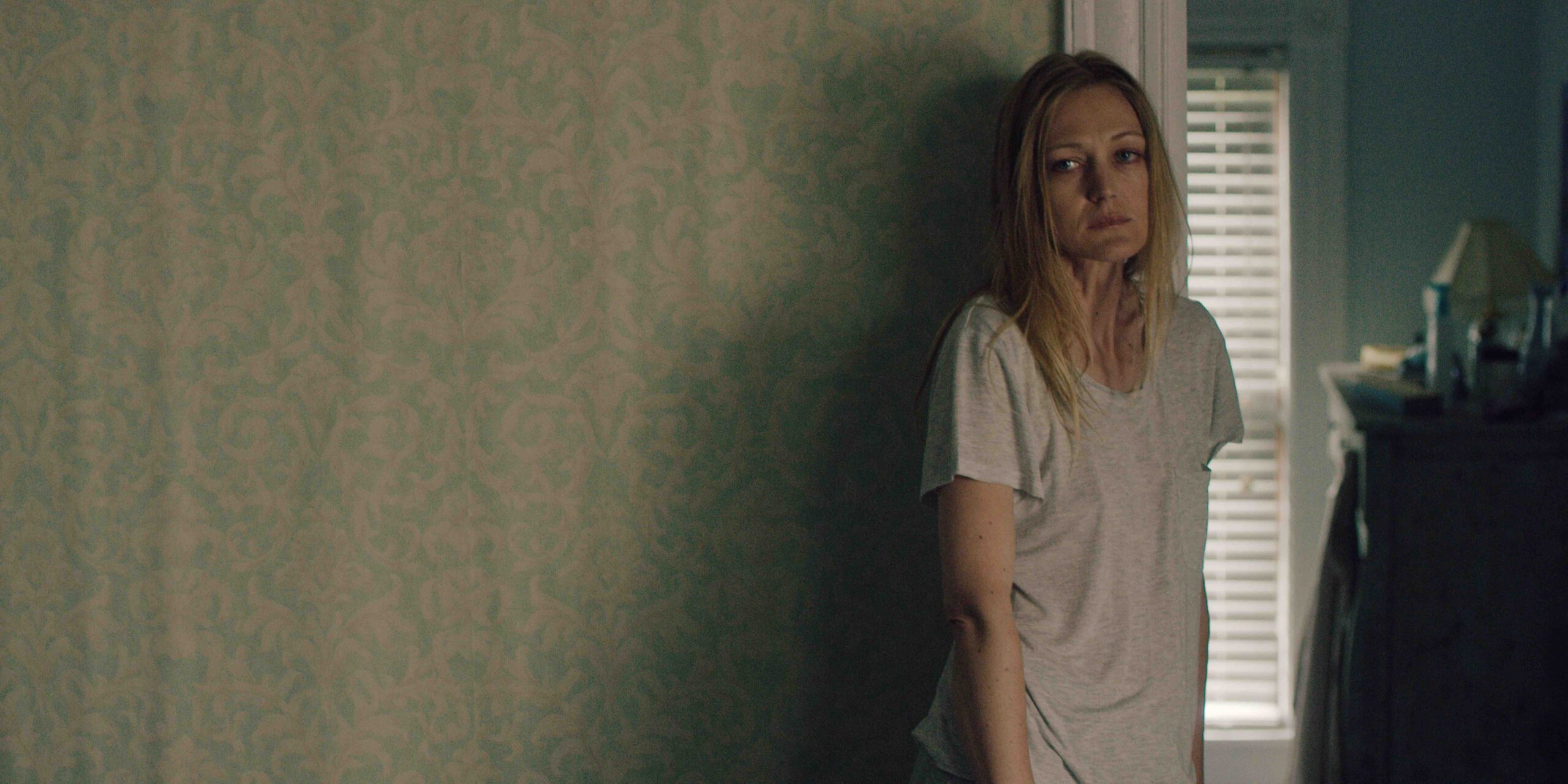
Hey there everyone! Welcome back to Movie Soapbox, the little corner of the internet that only you and I and that guy asleep in the back booth know about. This is the place where we dig into underseen, undersupported indie films and we make sense of them, or we at least sit with them long enough to feel the bruise they leave. Today we are doing a full deep dive on The Swerve, a movie so quietly, devastatingly precise about the way a person can be dismantled from the inside out that the fact it exists at all in its current form is, frankly, a small miracle of the film financing cosmos.
Fair warning before we go any further: everything below is about what happens in this film, including how it ends, including what Holly does to get there, including the pie. If you haven’t watched The Swerve yet, close this tab, go find it, come back when you’ve let it sit on you for a day. This one needs to land cold. You’ll thank me, or you’ll resent me, either way you’ll understand why I’m being territorial about the experience.
Now. Let’s talk about how a film like this actually makes it to your screen.
The Swerve Movie and the Making Of
A movie built around a middle-aged woman having a complete psychological dissolution, with no redemption arc, no cathartic resolution, no moment where the camera flatters anyone, and an ending that refuses to let the audience off the hook on their own complicity, that film does not survive most development pipelines. You want to know what this script looked like by the time a typical mid-tier distributor got done “helping” it? It looked like a thriller. It had a third act where someone figures something out. The mouse became a metaphor someone explained out loud. The pie had a different finale. That’s the version of The Swerve that gets made ninety-five times out of a hundred. The fact that writer-director Dean Kapsalis kept the film as airless and unforgiving as it is tells you something about either the financing structure or the tenacity of the people around him, probably both. Films this committed to their own discomfort don’t survive when there are twelve people in a room with opinions. This one got through. You can feel it, the absence of the note that wasn’t taken, all over the third act.
The Swerve Movie Walkthrough
Okay. The film. The Swerve opens with a flash-forward, which is the movie immediately telling you this collapses. There is no mystery about whether Holly (Azura Skye) reaches some kind of equilibrium, the opening frames strip that hope out before you’ve even settled in. What the film then does, for the entirety of its runtime, is make you understand the specific texture of the world that produces what you already know is coming. That is the whole project. And it is a brutal one.
Holly is a high school English teacher, a wife, a mother of two boys, a daughter, a sister. She is none of these things in any meaningful sense to anyone around her. Her husband Rob (Bryce Pinkham) is in a perpetual low-grade crisis about his grocery-store management career and whatever woman at that grocery store has his attention this week, and he orbits the house like a man who regards his own family as ambient noise. Her sons treat her as furniture that occasionally makes requests. Her sister Claudia (Ashley Bell) has made a career out of being the dramatic one, the one in and out of rehab, the one who requires management and patience, which has had the convenient side effect of rendering Holly invisible by comparison, a supporting character in the family narrative about Claudia’s chaos. Her mother looks at Holly like she’s a slight disappointment that became permanent. Every single person in this woman’s orbit has decided, without a meeting, without ever saying it out loud, that Holly does not require their attention. She is the operational infrastructure of several other people’s lives. She keeps things running. No one asks how she is. No one notices, because she keeps things running.
Into this comes a mouse. A single mouse in the kitchen, which Holly discovers and which becomes, in the architecture of her unraveling, something close to a symbol, though the film is too smart to lean on it that way. The mouse is small. The mouse is manageable. The mouse is something she can actually do something about in a life where she can do nothing about anything. She buys rat poison. She sets about solving the one problem that has a definable solution. And the rat poison sits in the cabinet, and her mind files it somewhere.
Meanwhile there is Paul, the student. A boy in her class who looks at Holly the way no one in her adult life does, with genuine attention, with something that functions like reverence. He sketches her. He thinks she’s brilliant. He sees her. And Holly, a woman so starved for being seen that she has started manufacturing the experience of it in her own head, responds to that the way a person who has been in the dark for years responds to light, badly, desperately, in a direction she cannot stop. The relationship becomes sexual. The film does not flinch from what that means, Holly is an adult, Paul is a minor, and this is a crime, and Kapsalis holds both truths at once: that Holly is a sympathetic figure and that she does something unforgivable. The film refuses to resolve that tension. That’s one of the things that makes it genuinely serious.
The fracture in Holly’s grip on reality becomes clear gradually, then all at once. There is a sequence where Holly, parked with Paul, throws open the minivan door and screams at her husband and another woman who she believes she can see across the lot. Nobody is there. She has hallucinated the confrontation she needs. The humiliation she wants to inflict on Rob, the desire for him to witness her, has become so intense that she has willed the scenario into existence in her own perception. Her husband isn’t watching. Her husband is never watching. So she generates a version of events where he has to watch.
There is also the swerve itself, the incident the film is named after. Holly believes she drove home alone from a party, was harassed by men in another car, swerved deliberately, caused them to crash into a tree, killed them both. The film eventually makes clear she was never in that car. She fell asleep at the party and dreamed it, or read about it and absorbed it, and the event became real to her in a way she cannot distinguish from actual memory. Her kids laughed at her for drooling on herself while she slept. She never left. But Holly has carried this thing as real, which means Holly is living, at least partially, in a version of events the rest of the world doesn’t have access to.
The pie is where the film arrives at its terrible logic. Holly makes a pie, the way she has made hundreds of pies, the way she has performed competence and care for people who don’t acknowledge it, and this time she puts the rat poison in it. The film makes this feel inevitable without making it feel earned in any satisfying way, which is the right call. It doesn’t earn it. It just happens, because Holly has a mechanism available and she is done. The pie kills her sons. It may kill Claudia. Holly does not die from it.
What Holly does instead is take a gun to the grocery store. She walks past Paul without stopping. She finds Rob in the back, and Rob, who has spent the entire film registering almost nothing about his wife, understands immediately that something is irreversible. He begs. He sees her. Finally. And Holly does not shoot Rob. She shoots herself, in front of him, which is the ending the whole film has been constructing, a woman who spent her entire life trying to be seen choosing, as her final act, to make herself impossible to ignore. “You’re finally looking at me.” Those are her last words. Rob will look at nothing else for the rest of his life. That is the point. That is what she wanted.
The Swerve Movie Theories
Now. The competing reads on what actually happened in this film, because they matter.
The Swerve Movie – A Literal Take
The first and most literal read is that everything we see is essentially real, that Holly murdered her sons, likely murdered or gravely injured her sister, hallucinated a few specific sequences (the parking lot confrontation, the swerve incident), and that the film is a tragedy about the end-state of invisible-woman syndrome pushed past the point of no return. This read takes the events at face value and understands the hallucinations as localized symptoms of a broader breakdown.
The Swerve Movie – The Unreliable Narrator
The second read is more aggressive about Holly’s unreliability as a narrator and suggests the film’s unreality is more pervasive than just a couple of scenes. In this version, more of what we witness is filtered through Holly’s fractured perception, including some of the cruelty of those around her, which may be real but which Holly’s mind is amplifying and distorting. Her husband may be bad, but perhaps not uniformly, comprehensively monstrous in the way she experiences him. Her sons may be indifferent teenage boys, which is not the same as being instruments of her torture. This read asks how much we can trust anything we’ve seen, and doesn’t give a comfortable answer.
The Swerve Movie – A Greek Tragedy
The third read is the thematic one that Kapsalis himself has gestured toward, the Greek tragedy frame, the Dante frame, this as a portrait of a society that is walking around in individual hells, people sitting next to each other at parties and in grocery stores and at dinner tables and having no idea what the person next to them is actually experiencing. Holly is not just Holly. Holly is a type, a warning, evidence of what happens when the social infrastructure of actually looking at the people around you collapses completely. The mouse is the stand-in for everything she could not solve, and the rat poison is what happens when the only tool you have is the one you used on the smaller, solvable problem.
Moviesoapbox’s Perspective on the Movie The Swerve
My read? The second one is too convenient, too much of an escape hatch. Yes, Holly’s perception is compromised, yes the swerve incident is manufactured, yes the parking lot confrontation is a hallucination. But the cruelty of the people around her is real. The film earns that. Rob’s affairs are real. The invisibility is real. Kapsalis is not making a film about a woman who imagined she was mistreated. He is making a film about a woman who was genuinely, systematically mistreated and who also broke in a way that made her capable of killing her own children. Both things are true simultaneously. Holly is a victim and Holly is a killer. The film insists you hold that without resolving it, and that insistence is where its actual seriousness lives.
What Holly wanted, the whole film, was simple. She wanted someone to look at her. She wanted the people in her life to register that she was there, that she was a person, that she had weight in the world. She tried the affair with Paul, the only person who gave her that freely, and it wasn’t enough because it came from the wrong direction, a boy, a student, someone outside the circuit of her actual life. She hallucinated Rob witnessing her with Paul because the fantasy of Rob finally seeing her mattered more than the reality. And at the end, dying on the floor of the grocery store, she got exactly what she spent the whole film not getting. He looked at her. He couldn’t look away. She made him look.
That’s not a victory. That’s a greek tragedy ending, which was always the only ending this film was ever going to have. The suits who pass on films like this are right that nobody wants to sit with this. The suits who pass on films like this are also the reason we don’t have nearly enough films like this. The Swerve survived. Go watch it. Sit with it. Then look at the people around you at dinner and ask yourself what you haven’t bothered to notice.
🎬 If You Liked This…
- The Kindergarten Teacher — a woman in a suffocating ordinary life making increasingly destructive choices in pursuit of something that feels like meaning, the obsession consuming everything around it before she can stop it
- Nocturnal Animals — the same beautiful surface of a comfortable life concealing something that has been rotting for years, a woman whose choices have hollowed her out and left her in a life that no longer fits
- Lady Macbeth — a woman trapped inside a domestic situation making ruthless choices to escape it, desire as something that destroys everything it touches, the same refusal to offer the protagonist redemption or the audience comfort