
Hey there everyone! Welcome back to Movie Soapbox, the little corner of the internet that only you and I and that guy asleep in the back booth know about. This is the place where we take the films that got away, the ones that slipped past the algorithm and the opening-weekend discourse, and we figure out what they were actually doing. Today we are going deep on The Prestige, a Christopher Nolan film so precisely engineered to deceive you that the deception is still working on most of the people who think they already cracked it.
Before we go any further, here is the trailer, in case you need a refresher or just want to remember what a film looks like when a director is actually trying.
Alright. If you have not seen The Prestige for the love of all that is good and HOLY – STOP! Leave. I think it’s over on Hulu and Disney+ for free. Heck, rent it on Prime for $3.99… and it’ll be the single best four bucks you spend this entire year. Regardless, close this tab, go watch it, and come back. What follows is a full spoiler autopsy of the entire film, every trick, every body in every tank, and one theory that will make you feel genuinely conned in the best possible way. You have been warned, and I will not be apologizing for anything.
What the Prestige Had to Surmount to Survive
Here is what you need to understand before we touch a single frame of this movie: a period piece about stage magicians with a non-linear structure, an unreliable dual-diary narration, and a third act that deliberately refuses to close its own loop is not something a studio greenlight committee builds consensus around, it is something a director smuggles through on the back of two movie-star leads and a prior film that made enough money to buy him one round of trust. You can see the fingerprints of that negotiation on the casting, Jackman and Bale and Caine and Johansson and Bowie in the same film, because that is what Nolan has to assemble when the script is this strange and this uncompromising. Without that cast, this film gets notes. Nolan had not made it to the blank check portion of his career yet. Without a cast it gets forced on it a clearer ending. It gets a scene where someone explains the Tesla machine in plain English so the audience can go home satisfied, and in the process the entire architecture of what Nolan built collapses. The film that exists is the version where enough leverage existed to protect the ambiguity. That is not luck. That is a filmmaker spending political capital as precisely as he spends screen time.
The Map of the Movie The Prestige
On the surface, fine, simple enough. Two young magicians, Angier and Borden, start out working the same circuit, a tragedy involving Angier’s wife cleaves them apart, and what follows is a years-long war of escalation that consumes both of them completely. Angier, played by Jackman, is a showman of the first order and a magician of middling talent. Borden, Bale, is the inverse: raw gift, no instinct for presentation, and a commitment to his craft so total it reads as sociopathy. The rivalry is the engine. Everything else, the Tesla machine, the drowning tank, the transporting man, is fuel.
Nolan structures the film as two diaries being read by the other magician… Angier reading Borden’s notebook, Borden reading Angier’s journal, each one written knowing the other would eventually find it. The timeline is fractured. The narration is weaponized. And somewhere in the final twenty minutes, depending on how closely you have been watching, either one, two, or three things click into place.
Most audiences get two of them. The third one is the point.
The Prestige Theory One: The Populist Read (What Most People Landed On)
The version of this film that the majority of viewers walk away holding goes roughly like this: Borden is secretly a set of identical twins, Alfred and Fallon, who have been living a shared life in rotating shifts for their entire adult careers, one twin playing Borden, the other playing his silent assistant Fallon, trading off the performance and the sacrifice for the sake of a single perfect trick. Tesla’s machine is real, it duplicates whatever is placed inside it, and Angier uses it to perform his version of the transporting man by creating a copy of himself every single night, with one copy teleporting to the balcony and the other dropping through a trapdoor into a water tank below the stage and drowning. The bodies in the tanks at the end are all those drowned Angiers, stacked up like evidence.
This reading is not lazy. You have to do real work to arrive here. The timeline has to be reconstructed manually, the diary structure has to be parsed, and the twin reveal requires you to go back and rewatch half the film with new eyes. Most people who get this far feel, correctly, that they have solved something. They have. They have solved the first two tricks.
The machine actually working, though, the science fiction premise sitting in the center of a film that has otherwise operated as a period drama about obsession and craft and the cost of total commitment, that part leaves a residue. R.J. Carter, a science fiction writer of all people, felt cheated by it. Not because he was unsophisticated but because the film had established a contract with him that the final act appeared to break. He was right to feel that. He was just wrong about which contract had been broken.
The Prestige Movie Theory Two: The Machine Is a Prop
This is the theory that changes everything, and it is buried in plain sight across the entire film if you go looking for it with the right question in mind: why, after months of successfully using the Tesla machine to duplicate himself every single night, does Angier still desperately want to know how Borden’s trick works?
He has the machine. He has been running the trick. He should have zero remaining curiosity about Borden’s method, because by the logic of the populist reading he has transcended it. And yet he is purchasing Borden’s notebook, bargaining with a condemned man in prison, obsessing over the mechanism of a trick he has already surpassed. That is not the behavior of a man who has the answer. That is the behavior of a man who is still performing one.
Walk through the actual chronology with this lens applied:
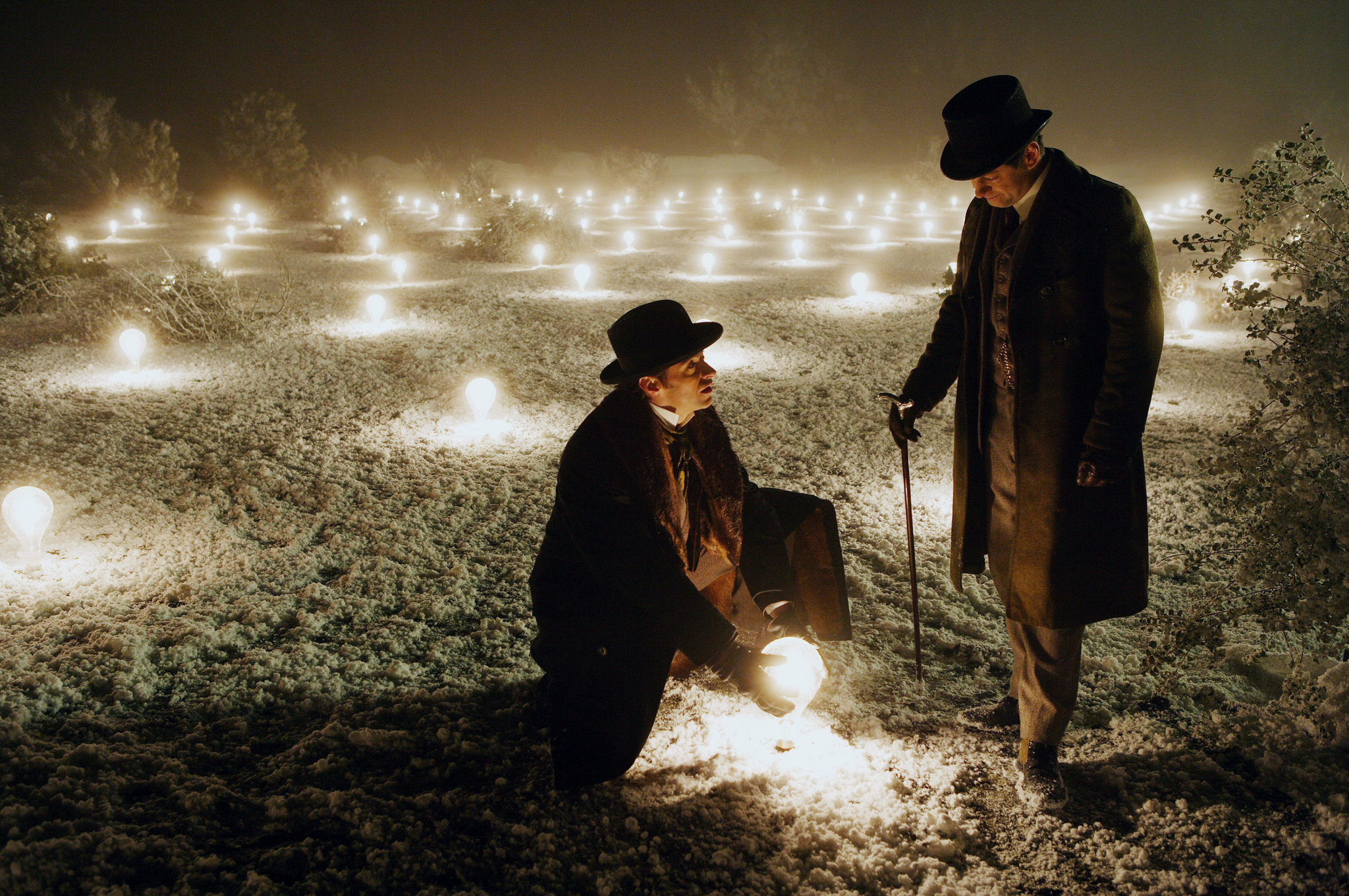
Borden and Fallon develop the transporting man. Angier, desperate to understand it, eventually captures Fallon as leverage and forces Borden to give up the keyword: Tesla. Angier travels to Colorado to commission a machine from Nikola Tesla. Tesla, who has been tipped off by Borden about Angier’s intentions, takes Angier’s money and runs a long, expensive, entirely theatrical con on him. The hats Angier finds scattered across the field, the cats, the apparent evidence that the machine is duplicating things, all of that is staged. Angier figures this out after the lab is destroyed and he is already on his way back to England, sitting with the knowledge that Tesla built him a box full of sparks and charged him enormously for the privilege.
And then Angier makes a decision. He decides that this is, in fact, exactly what he needed. Not the machine. The story of the machine. Because the trick he is going to perform is not for the London stage audience. It is for an audience of one: Fallon. The drowning tank, the bodies, the tanks full of dead Angiers at the end, these are props in a magic trick aimed at Borden’s surviving twin, engineered to make Fallon believe, with incontrovertible physical evidence, that Angier’s sacrifice was real.
The scene where we see Angier shoot his duplicate after the machine produces one? That is Angier telling Fallon what happened, during a scene framed as his testimony. We watch it as a visualized account. And the film has already told us, explicitly, that every piece of narration in this story was written to be found and to manipulate whoever found it. Angier’s own diary is a planted document. His word is the least reliable source in the film. We just forget that when the visual storytelling takes over, because film does that, it launders unreliable narration through imagery and we stop questioning it.
That is the third trick. Not the Tesla machine. The Tesla machine is the pledge. The entire film is the prestige.
The Mechanism: Why the Narration Is the Key
The film has two primary narrators: Angier reading Borden’s diary, and Borden reading Angier’s journal. Both documents are explicitly revealed to be written for the other person’s consumption. Borden’s diary is a trap built for Angier. Angier’s journal is written knowing Borden will eventually read it. The film tells you this, clearly, and then continues to present the contents of both diaries as factual visual information, and almost everyone accepts that presentation without applying the skepticism the film has just instructed them to apply.
The scene of Angier shooting his double is shown to us in the context of Angier’s journal being read. The bodies in the tanks are physical evidence, yes, but Angier has spent the entire film demonstrating that he will go to extraordinary lengths to manufacture incontrovertible evidence for his tricks. Twenty lookalikes. Twenty wax figures. The exact level of commitment required to make a trick designed for one specific spectator completely unassailable. He has learned Borden’s central lesson: you have to live the performance completely, there is no part-time dedication to this.
The film even telegraphs this. The whole thematic spine of the movie is that real magic requires total sacrifice, that the great performers give up something that cannot be recovered. Borden gave up any possibility of a real personal life, split permanently between two identities, never fully inhabiting either. What does Angier sacrifice? If the machine is real, he sacrifices a copy of himself, which is philosophically almost nothing. If the machine is fake, he sacrifices everything: his identity, his reputation, his body, his actual life, staged as a murder to destroy the man who ruined him. That is the proportionate sacrifice. That is the version that rhymes with what the film is saying.
The Competing Reads, Fairly Stated
The machine is real and the film is science fiction. Tesla was a documented eccentric genius operating at the edge of what electrical science could explain in that period. The film presents his work as genuinely anomalous. The physical bodies in the tanks are real bodies, not props. The story Angier tells Fallon about shooting his double is the literal truth shown to us visually. Nolan is making a film about obsession that happens to end in a science fiction register, and the dissonance of that is intentional, it is meant to feel like the wrong genre has been entered because that is how far gone both men are by the end.
The machine does not work and the whole thing is an elaborate con. The diary narration is unreliable by the film’s own explicit instruction. The physical evidence is fabricated with the same commitment Angier has applied to every performance. The science fiction ending is the trick: the film performs a genre switch on the audience the same way a magician switches a real card for a fake one. Most people accept the switch because they were not watching the hand. Nolan has said on multiple occasions that the film operates as a magic trick structurally, with the three-act structure mirroring the pledge, the turn, and the prestige. If the film is the trick, the prestige is the audience accepting a science fiction ending to a non-science fiction film, and the real revelation is for the viewers who noticed.
The ambiguity is deliberate and neither reading is meant to win. Nolan calibrated the evidence exactly evenly on both sides. The film cannot be definitively closed. This is the same architecture as Memento, where the director built a machine that produces irresolvable interpretive conflict as a feature, not a flaw, because the irresolution is the experience the film is designed to create.
Pause on this point one moment. Nolan hangs his movies in the balance. He intricately weights his movies pro or con for a certain point. Consider the movie Inception. Does the top stop spinning, or continue? Or is the question a third thing? (News flash, it’s a third thing…) That isn’t an accident that Nolan does this. Memento is the same way. Nolan carefully crafts his movie as a delicate game of jenga that will fall if you remove even one piece of the puzzle. It’s the same way with the movie The Prestige.
The thing that bothers me most about the movie The Prestige, isn’t the movie (it’s my favorite Nolan film, by a long margin), but the way the viewing audiences doesn’t even see the spinning top… does it spin, does it stop question. For 98% of the viewing audiences, if you bring up the top question (does the machine work, does it not) they will
Moviesoapbox’s Final Read on this Contentious Debate
The machine does not work. I will plant that flag and stand on it.
The evidence that points this direction is not just circumstantial. It is structural. The film instructs you twice, clearly and in plain dialogue, that the narration cannot be trusted, and then it uses that narration to show you the machine working. The entire thematic argument of the film is that real artistry requires disproportionate sacrifice, and a man shooting a copy of himself is not disproportionate, it is nothing, it is a man discarding a receipt. Angier sacrificing his actual life, his name, his physical existence, to destroy Borden from beyond the grave while dressed as a dead lord, that is the sacrifice that matches the scale of what Borden gave. The film’s internal logic demands it.
And then there is the smallest thing, the thing the populist reading never quite accounts for: Borden, on stage, before his death, watching Angier perform the transporting man, genuinely baffled. He knows about Tesla. He is the one who pointed Angier at Tesla in the first place. If the machine worked, he would know exactly what he was looking at. Instead he is backstage demanding to know what is under that stage, frantic, confused, a master magician who cannot figure out the trick. The only version of this film where that scene makes sense is the version where there is no machine. Where what is under the stage is a man who has committed completely to a performance Borden cannot decode because it does not follow any known method. Because the method is pure sacrifice and Angier invented it himself.
Nolan made a film about two men who destroyed themselves to be the best. The one who was willing to destroy himself most completely, without the crutch of a science fiction device, won. That is not a science fiction movie. That is a tragedy. And it is a hell of a lot darker than a cloning machine. But more than that, I believe in the POSSIBILITY that the machine doesn’t work. Does the top fall, or not? That is the question on the table here today that Nolan has created for us to consider.
Are you watching closely enough? Most people are not. That is the whole point. That is the prestige.
🎬 If You Liked This…
- Memento — the other Nolan puzzle-box, same structural trick of the film’s form mirroring its subject, same reveal that recontextualizes everything and leaves you wanting to immediately watch it again from the beginning
- Predestination — identity folding back on itself until the pursuer and the pursued turn out to be the same person, the same Mobius strip logic as The Prestige’s obsession with doubles and sacrifice
- Red Lights — a man obsessed with exposing a fraud across years, the same rivalry-as-self-destruction energy, and a twist ending that pulls the rug in a way that divides audiences the same way The Prestige’s does