
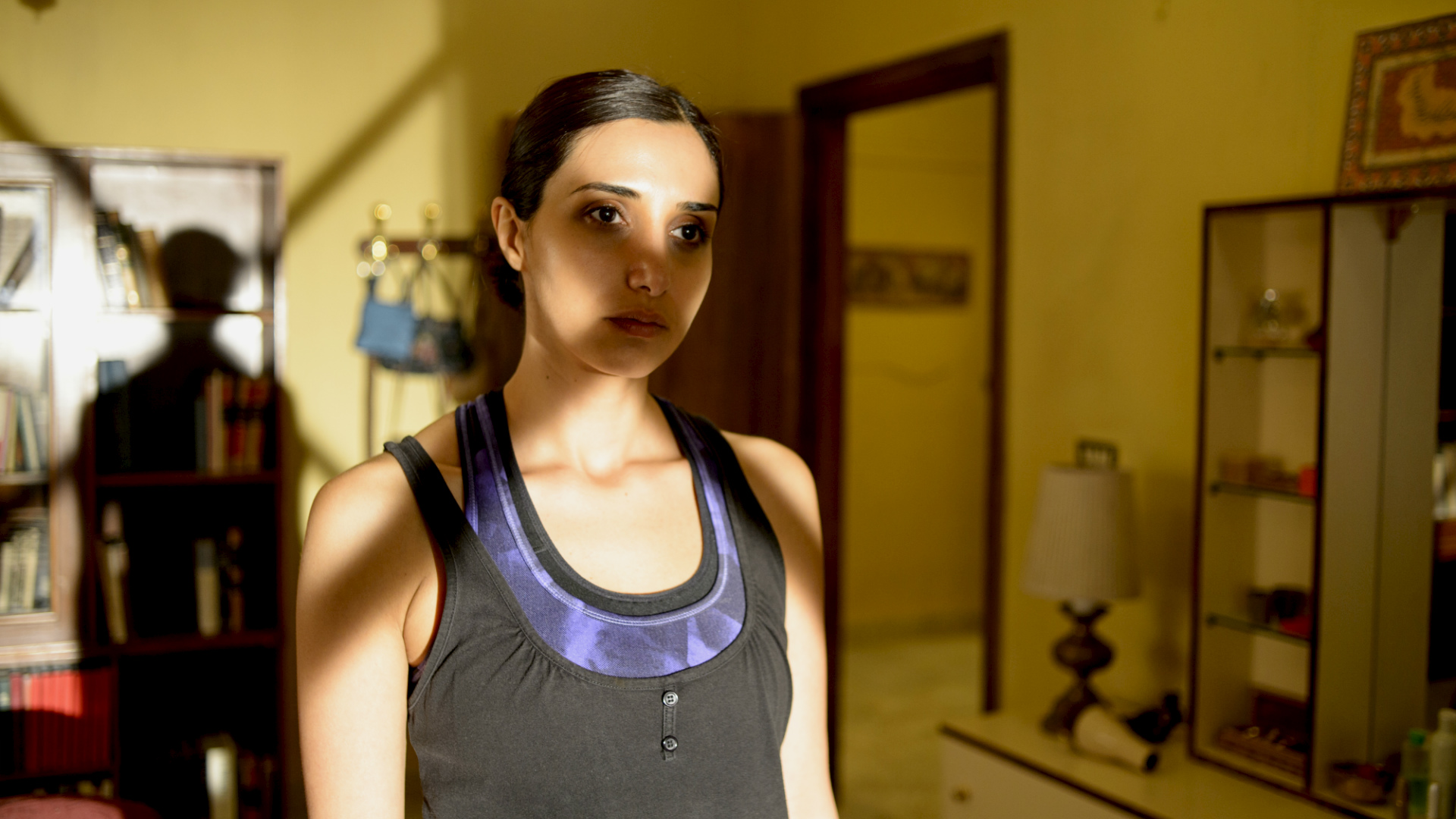
Hey there everyone! Welcome back to Movie Soapbox, the little corner of the internet that only you and I and that guy sleeping in the corner over there know about. This is the place where we find underappreciated indie films and we make sense of them. Today? We are doing a deep dive on Under the Shadow, a movie so quietly, suffocatingly brutal that even describing the premise to someone feels like issuing a warning.
Before we go any further, go watch this film. It is on Netflix, has been for a while, and there is no excuse. Come back when you’re done, because everything from this point forward assumes you have seen it, and I am not going to protect you from what happens.
Still here? Good. You have been warned.
So let’s talk about what this film actually is, before we talk about what it’s doing. Babak Anvari wrote and directed Under the Shadow on a budget that would not cover the catering bill on a mid-tier Marvel reshoots week, set it in Tehran during the Iran-Iraq war of the 1980s, and produced something that most English-language studio horror has been failing to make for decades, which is a film where the supernatural threat and the political threat are the same threat, and neither one lets you pretend otherwise. You can clock a film like this by its specificity. Every detail earns its place. Nobody spent three days in a writers’ room arguing about whether the monster needed more backstory.
The World that Under the Shadow Film Lives In
To understand what Under the Shadow is actually doing, you need at least a working knowledge of the ground it is standing on, and it is not standing on neutral ground.
The Iranian Revolution completed itself in 1979. The short version runs like this: Great Britain had been extracting oil from Iran for decades under arrangements that left most of the Iranian population in poverty. A Prime Minister named Mossadegh came to power in 1951, began nationalizing the oil infrastructure, and was promptly overthrown in a 1953 CIA-backed coup because the United States decided that a popular democratic leader was less important than keeping Soviet hands off the petroleum supply. The Shah resumed control. The West got its oil. The Iranian people got two more decades of autocracy dressed up in western aesthetics, and then, in 1979, the whole arrangement collapsed. The Shah fled. Ayatollah Khomeini returned from exile. By April of that year, Iran had voted itself into an Islamic Republic, and the cultural transformation that followed was total, fast, and for a lot of people, devastating.
That is the world Shideh was politically active inside, on what the new regime considered the wrong side. And that is why, as the film opens, her application to medical school has been denied.
Then, in 1980, Iraq invaded. The war lasted more than eight years. Iraq’s logic, such as it was, included a fear that Khomeini’s revolution would spread to Sunni Iraqis, and an opportunistic read on Iran’s post-revolution military disorganization. The two countries proceeded to pound each other at enormous human cost for nearly a decade. Tehran got bombed. Real buildings, real streets, real apartment complexes full of real people who had nowhere better to be.
That is the backdrop. Anvari is not using it as flavor. He is using it as the monster’s delivery system.
The Hook of Under the Shadow
You can tell when a film has survived a certain kind of pressure in development because of what it does NOT do. Under the Shadow never softens Shideh’s situation into something a committee would have approved. A less protected production gets notes somewhere around draft three that suggest the political content is alienating, that western audiences need an easier entry point, that maybe the revolutionary backstory could be condensed into a single line of expository dialogue and then dropped. Films at this budget tier, with this kind of first-time-feature director attached, almost always take those notes. Anvari didn’t. The oppression Shideh is living under is not backdrop, it is load-bearing structure, and the film treats it that way from the first scene to the last. That is what a director with final cut looks like. Not every director in this tier gets it. A lot of them find out after the fact.
Under the Shadow Movie Walkthrough
Shideh, played by Narges Rashidi in a performance that should have made her a household name in every country with a functioning film culture, lives in a Tehran high-rise with her daughter Dorsa. Her husband Iraj is present just long enough to establish that he has absorbed the revolution’s paternalism whole, and then he is called back to the front, leaving Shideh with the choice of taking Dorsa to his parents’ house, where she is not welcome, or staying put in the building as the bombing escalates. She stays.
The building has a population. A neighbor boy moves in after his parents are killed in a bombing, mute from the shock of it, and he gives Dorsa a charm made of cat hair to ward off Djinn. He is serious about this. Shideh throws the charm away without understanding what it is. This is not a character flaw the film judges her for, it is a consequence of being a rationalist in an environment that is about to make rationalism very expensive.
A missile hits the building and does not explode. It sits embedded in the structure like a held breath. An upstairs neighbor survives but begins talking to empty air, then dies of a heart attack. Dorsa develops a fever, starts reporting a woman appearing in their apartment, and loses her doll, Kimia, which she treats as catastrophe because the boy told her the Djinn take things. One of the departing neighbors tells Shideh directly: if a Djinn takes something of yours, it will not stop until you belong to it.
Eventually the building empties out around them. The nightmares compound. Shideh’s own things begin disappearing, including the medical textbook her late mother gave her, the one object she kept when she threw all the others away. Phone calls from Iraj devolve into something that sounds like the Djinn mimicking his voice and using it to say everything he probably should not have said to her but maybe believed. The film is not subtle about what it is rhyming.
When Shideh finally accepts that they have to leave, she knows they cannot go without Dorsa’s doll or the Djinn follows them. They find Kimia. Its head has been severed. Shideh reattaches it as best she can and they run.
On the way out, she hears Dorsa screaming from somewhere else in the building while Dorsa is standing right next to her. She chases the screaming, attacks what she finds, comes back and has to apologize to her daughter for leaving her. Then the Djinn envelops them both in its shroud, and Shideh fights her way through it, finds Dorsa somewhere inside it, and they break out. They get in the car. They drive toward Iraj’s parents’ house.
The last image: Kimia’s severed head, left behind on the pavement. Shideh’s book, still in the building, flapping in the wind.
What the Ending of Under the Shadow Is Actually Telling You
The mechanics are not ambiguous. The Djinn has established a claim through the objects it has taken or damaged, and both objects are unresolved: the doll is broken and the book never made it out. Shideh and Dorsa have escaped the building but they have not escaped the Djinn. The film ends on a chase, not a conclusion. Wherever they go, the wind goes too.
The book is the sharper detail. Shideh kept it because her mother gave it to her, because medicine was the life she was supposed to have before the revolution took it, because it is the physical object that represents everything the state decided she was not allowed to want. The Djinn taking it is not random. The film is telling you that the thing that haunts you will always know which object to take.
The Theories of Under the Shadow Movie
The readings that circulate around this film break into a few camps, and they are not mutually exclusive.
Under the Shadow Theory #1 – The first reading is the most literal: the Djinn is real within the film’s internal logic, the haunting is genuinely supernatural, and the story is a horror film that uses a culturally specific mythological figure to drive its dread. This reading is completely supportable. Anvari never gives you an out-clause, no fever-dream sequence, no moment where a rational explanation is offered and accepted. The Djinn behaves consistently according to the rules the film establishes for it.
Under the Shadow Theory #2 – The second reading is the political one: the Djinn is the revolution and everything it brought with it. The oppression Shideh faces, the restrictions on her movement, the state’s claim on her body and her ambitions and her past, the way the regime uses fear and takes things from people and cannot be reasoned with or outrun. The Djinn as government. The Djinn as ideology. The shroud the Djinn travels in looks exactly like a chador, and Anvari is not doing that by accident.
Under the Shadow Theory #3 – The third reading is the war itself: the way sustained, proximate violence colonizes the mind, produces exactly the kind of fear and anxiety the film quotes directly as the conditions the winds require, and cannot be separated from the people it touches even after they physically leave the blast radius. Post-traumatic haunting dressed in mythological clothes.
Most serious engagement with this film lands somewhere between readings two and three, treating them as the same argument from different angles.
Moviesoapbox’s Preferred Theory Pick
The political reading is the correct one, the second theory. And it is not in competition with the supernatural one, because the film is insisting they are the same thing. Anvari is not hiding this. The Djinn requires fear and anxiety to operate, and the film establishes a system, the war, the regime, the isolation of women from public life, the erasure of Shideh’s professional future, that produces fear and anxiety as its primary output. The Djinn is not a metaphor for those forces, it IS those forces, given a mythological body that the culture already had language for. The most quietly devastating moment in the film is not the haunting, it is the moment Shideh realizes she cannot call for help because leaving her apartment without a hijab is a crime, and she has to make a calculation about which danger is more survivable. The supernatural threat and the state are competing for the same woman in the same moment. Anvari just literalized what that feels like.
The ending does not offer escape. It offers survival, and survival is not the same thing. The Djinn follows you. So does everything it stands for.
What Under the Shadow Film Had to Be
Babak Anvari made this film in 2016. It was the UK’s submission for the Academy Award for Best Foreign Language Film. It cost almost nothing and it is one of the most formally controlled horror films of the decade. It works because Anvari understood that the most terrifying thing he could put on screen was not a monster but a woman who is simultaneously being crushed by her government, abandoned by her husband, isolated in a building that is literally being bombed, and expected to hold it together for her child, and then he gave that woman a supernatural enemy that operates on the same logic as all the other enemies she is already fighting. Somewhere there is a version of this film where a distributor got nervous about the political content and suggested softening it, where the war backdrop gets reduced to ambient sound design, where Shideh’s backstory with the revolution gets cut for pacing. That film does not exist. Be grateful.
🎬 If You Liked This…
- The Maus — the other film on the site using horror as a vehicle for real historical and wartime trauma, the supernatural and the political fused so completely that you cannot separate one from the other
- I Am the Pretty Thing That Lives in the House — the same atmospheric dread built through a domestic space that has turned against the person living inside it, horror that accumulates through stillness rather than sudden violence
- Hidden — a family in a confined space facing an external threat that wants them specifically, the same claustrophobic tension of safety becoming conditional, temporary, and entirely outside their control