
Hey there everyone! Welcome back to Movie Soapbox, the little corner of the internet that only you and I and that guy sleeping in the corner over there know about. This is the place where we find under-appreciated and overlooked films and we make sense of them, the ones that survived the machine or got chewed up by it or somehow, against all reasonable odds, came out the other side still breathing. Today? We are doing a deep dive on Sinners, Ryan Coogler’s Southern gothic fever dream of a film, a movie so layered and strange and achingly alive that you genuinely have to wonder how it got past a single greenlight meeting with its soul still intact.
Pull up a chair. We’re going in.
Here is the trailer, so you know what you’re walking into.
Full spoilers from this point forward, and I mean full spoilers, the kind where I tell you what the ending means and why the vampire almost works as a metaphor for the entire history of American cultural extraction. If you haven’t seen it yet, go see it, then come back. I’ll be here.
What This Film Had to Survive to Exist
Before we get into the film itself, you need to understand something about what a movie like Sinners looks like on paper to a room full of studio executives. You’ve got a period horror film set in 1930s Mississippi Delta, built around the blues, starring a Black cast, with a runtime that does not apologize for itself, shot on 70mm film, which costs more than most entire indie budgets just to process and project. The vampire is Irish. The central argument of the film is about cultural memory and who gets to consume Black art. There is no clean franchise extension built into the premise. Now read that back to yourself and imagine pitching it to twelve VPs who haven’t read a novel since a book report in 2003.
Films like this get notes. They get the third act softened. They get a tonal shift toward something more “accessible” after a rough test screening in Burbank where the audience couldn’t place the genre. What’s remarkable about Sinners is that it reads, in every frame, like a film that survived that gauntlet without being flattened by it. The reason is almost certainly Coogler’s leverage, built film by film since Fruitvale Station, cashed in at exactly the right moment for exactly the right project. You can feel the creative control in how the music is handled, how the horror is deployed, how the film refuses to over-explain its own symbolism. A film that went through five more rounds of notes would have given you a scene where someone explains what the chain-dragging means. This one trusts you. That trust is a production decision, not an accident of editing.
Michael B. Jordan, Twice
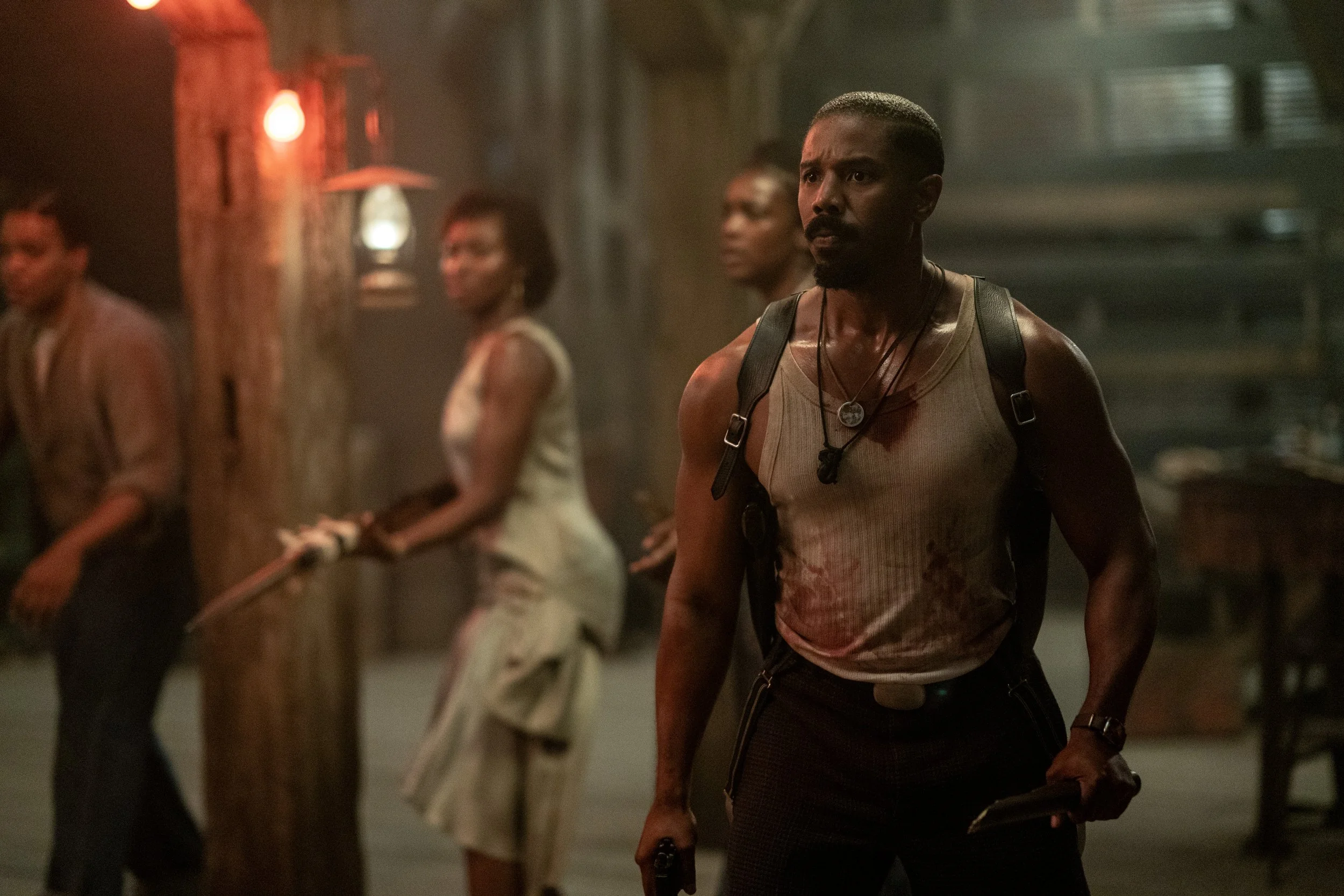
Smoke and Stack. Twin brothers, played by Michael B. Jordan, and if you need me to tell you which one is which after twenty minutes of screen time, then Jordan has already failed, which he doesn’t. What’s worth pausing on is not the technical achievement of the dual performance, though it is technically extraordinary, seamless in a way that makes the few films that have attempted this before look clumsy and obvious. What’s worth pausing on is the dramatic logic of casting one actor in both roles in a film that is explicitly about the violence of being split, of having part of yourself consumed by a place and a history while another part tries to build something new in the ruins.
Stack is the dreamer, all forward motion and chord progressions and the particular dangerous optimism of a man who believes that a juke joint full of music might be able to hold back everything the world is trying to do to him. Smoke is what happens to that optimism after the world gets a few good hits in. Broken-glass fury, loose and barely held. The scene where they argue in the neon glow outside the juke joint, Stack trying to save the dream and Smoke trying to save their actual lives, that scene lands because Jordan has built two complete human beings, not two masks for one actor to swap between. The camera just watches. Coogler knows when to get out of the way.
The Music Is Not Underscore. The Music Is the Argument.
Every film has a soundtrack. Maybe a third of films have a score that actually serves the story. Sinners has something rarer, a musical architecture that is making the same case the screenplay is making, just in a different language. The recurring piano motif you catch early, that slightly detuned, hymn-adjacent melody, it starts as something that feels like a lullaby, like comfort, like the kind of music a grandmother plays in a house that smells like Sunday dinner. And then it warps. Slowly, incrementally, without you noticing until you notice, it becomes something threatening. Something that remembers what the land it came from cost.
That’s not a music supervisor decision. That’s a director who understands that the blues are not just historically significant, they are structurally load-bearing to the argument this film is making about who owns American culture and what it does to the people it extracted that culture from. Remmick the vampire, walking around in his linen suit with his silky Irish menace, is not here for blood in any simple sense. Andrew Scott plays him as temptation, as the offer that sounds almost reasonable, almost generous, until you understand what accepting it actually means. The horror in this film is not jump scares. It’s the recognition of a pattern you’ve seen before.
The final number, and I’m not going to over-describe it because you should arrive at it clean, is the moment when the film cashes every thematic check it has written across two hours. Score, vocals, visual grammar, all of it converging. When a film earns its ending this honestly, it’s usually because someone fought to keep the screenplay alive long enough to shoot it the way it was written. That’s the real miracle here.
The Horror Is the History
Coogler is using the vampire the way Toni Morrison used ghosts, as a formal structure for the weight of memory, as a way of making visible something the realist mode of filmmaking can’t quite hold. The lynchings in this film’s recent past are not backstory. They are the soil everything is planted in. The juke joint the brothers build is an act of defiance against that soil, a declaration that joy is possible here, that something beautiful can be made in the exact place where beautiful things have been destroyed.
The supernatural haunts the film without overwhelming it. You feel centuries in the fog, in the way certain characters flinch at certain sounds, in the hollow ring of the church bells. The horror elements are doing symbolic work, which is the only kind of horror worth a damn in a film that has this much to say.
70mm, and What That Choice Costs
Someone signed off on shooting this on 70mm film. That is a commitment with real financial consequences, it’s a decision that signals something about how seriously the filmmakers took the visual grammar of this story, and it’s a decision that most studios would have negotiated away by the fourth budget revision. The colors in this film are not the colors of a digitally shot genre picture. They are deep and dense and physical, the night scenes carry actual weight, the juke joint shimmers with the specific quality of light that only exists on large-format film stock. The costumes work because the frame can hold that level of detail, Stack’s perpetually slipping suspenders, Smoke’s clothes hanging loose like a man trying to become invisible inside them.
Every frame is a choice that cost money and creative capital to protect. You can see the result of those choices in every scene.
The Competing Theories to Explain Sinners
The competing reads on this film are worth laying out honestly. The purist horror reading says Remmick is simply a monster in the classical mode, a predator with good manners, and the film is a genre exercise executed at an exceptionally high level. The cultural-extraction reading says Remmick is explicitly a figure for the white music industry’s relationship to Black blues musicians, the vampire who makes an offer, takes what he wants, and leaves a husk. The grief reading focuses on the brothers themselves, the twin as a structure for the self divided by trauma, and the juke joint as the last possible attempt at wholeness before the world closes back in.
They are all in the film. Coogler built the thing to hold all of them at once.
Where Moviesoapbox Lands on the Theories
The cultural-extraction reading is the spine. Everything else is hanging off it. Remmick’s argument, the one where you almost want him to win, is the argument that has always been made to Black artists about visibility, about access, about what you have to give up to be heard by the right people. The film’s answer to that argument is the music. Not the compromise, not the transaction, the actual thing, the blues played the way it was always played, in a room full of people who needed it, on land that cost everything. That’s what the juke joint is. That’s what the final number is defending.
Coogler made a film about what Black art survives to become. He made it on 70mm. He got Michael B. Jordan to play both halves of the argument. He kept the ending.
The suits could have had this one. They almost did, probably. They didn’t.
Hey, thanks for hanging out here at Movie Soapbox, the little corner of the internet where we take the films that matter seriously enough to actually dig into them. If Sinners got under your skin the way it got under mine, come back, there’s more where this came from. We’ll keep the light on.
🎬 If You Liked This…
- Afflicted — the same vampiric transformation as something that consumes a person from the inside, the body becoming the site of a war between who someone was and what they’re becoming
- The Cured — the same question of who gets to belong to a community once they’ve been transformed by something they never chose, and whether a society can ever fully accept what it once feared back into itself