
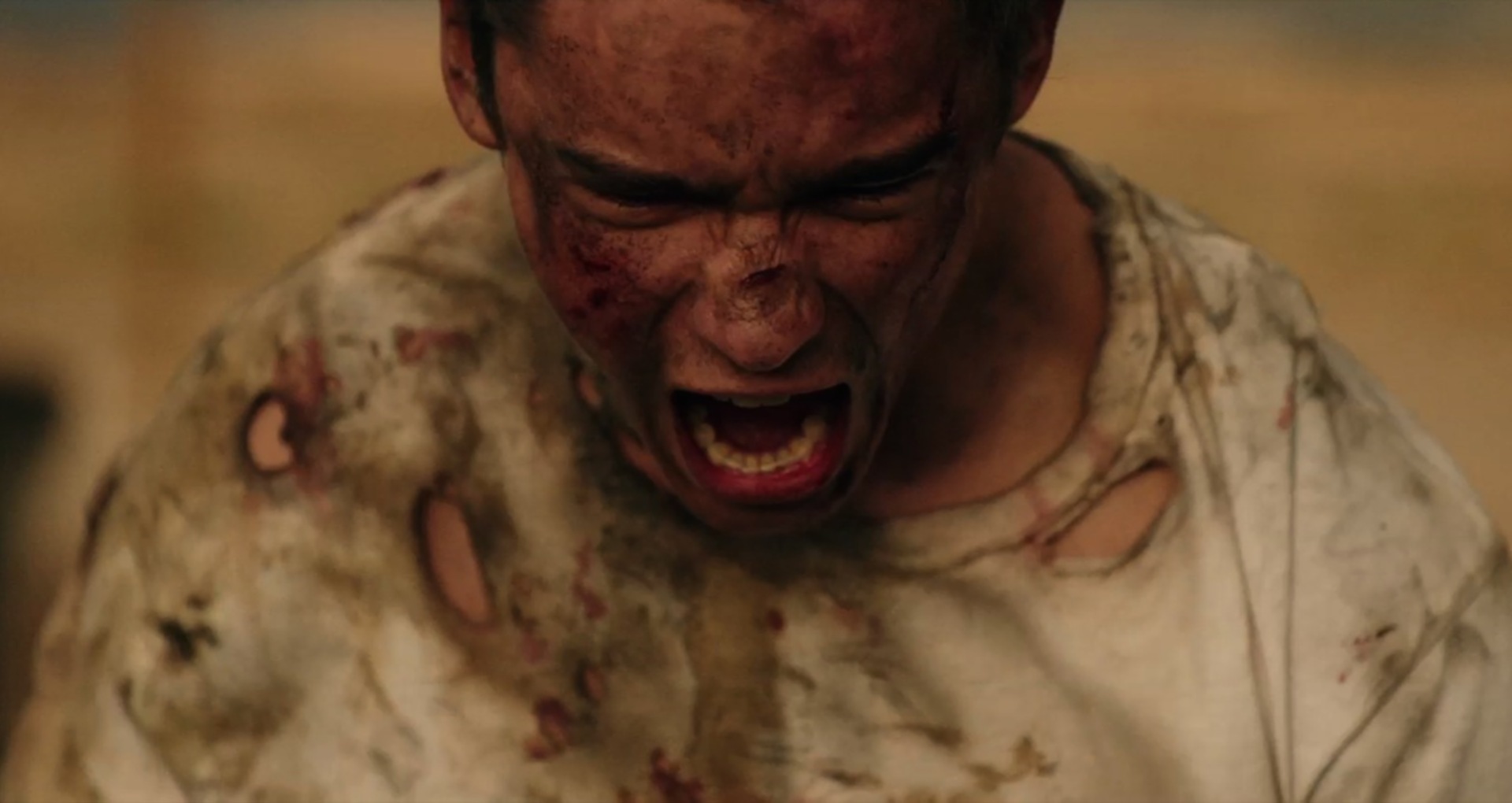
Hey there everyone! Welcome back to Movie Soapbox, the little corner of the internet that only you and I and that guy sleeping in the corner over there know about. This is the place where we find underappreciated indie films and we make sense of them. Today? We are doing a deep dive on The Signal, a movie so genuinely disorienting, so quietly ambitious, that the studio apparatus it bumped up against on its way to distribution never quite knew what to do with it, and honestly, neither did most of the people who saw it. Pull up the trailer first. Get your bearings.
Alright. From this point forward we are going deep into the film, beat by beat, theory by theory, with no apologies and no parachute. If you have not seen The Signal yet, close this tab, go watch it, and come back. Everything after this sentence will detonate the movie for you, and you do not want that. You want to sit with the disorientation the first time through. That disorientation is the whole point. Go. Watch it. Come back.
Still here? Good. That means you’ve seen it, or you’re the kind of person who reads the last page of a novel first, and honestly, I respect the chaos.
What The Signal Film Had to Do to Survive
Before we walk through what happens in The Signal, you need to understand what kind of film this is in industry terms, because that context changes how you read every frame. William Eubank made this thing on a budget that would not cover catering on a mid-tier Marvel production. The Laurence Fishburne casting is the tell. When you see a recognizable face in a film operating at this budget level, it almost always means one of two things: either someone believed in the project enough to take a serious pay cut, or the film needed exactly one name to get past the acquisition desk at a distributor who would otherwise have binned it. Probably both, in this case. What that means practically is that Eubank almost certainly retained more creative control than a director working at the next budget tier up would have, because there was no studio with enough skin in the game to station a VP in the editing room. The idiosyncratic structure, the refusal to explain itself on the audience’s schedule, the ending that lands like a door slamming, those are not accidents of style. They are what happens when a filmmaker does not have twelve sets of notes to survive. You can tell when a film has been committee-softened in post. The Signal does not have that smoothed-over quality. It is still angular where it wants to be angular.
The Setup: Nic, Jonah, Haley, and a Hacker Named Nomad
When the film opens, you are dropped into a road trip that is already quietly falling apart. Nic and Haley are a couple, MIT students, and Haley is moving to California for a year, which in relationship terms is a slow-motion breakup that neither of them has officially called. Jonah is along for the drive, Nic’s best friend, and the kind of third wheel who is perceptive enough to see exactly what is happening between the other two and smart enough to stay out of it. Nic is shutting Haley out. Not cruelly. Just with that particular cold competence that people use when they have already decided something is ending and have not yet gotten around to announcing it.
And then Nomad shows up.
Nomad is a hacker, anonymous, and escalating. He hacks Haley’s laptop and sends them footage of themselves in their hotel room. Then he sends photos of their car taken while they were driving, just to demonstrate range, just to demonstrate that there is no safe perimeter. Nic and Jonah are accomplished hackers themselves, and Nomad is either a rival or an obsessive, and either way they decide to trace him and confront him. Director William Eubank has talked about how much he loved Catfish and the way that film builds toward an anticlimactic farmhouse arrival, and how he wanted to take that exact structure and blow it past the point of return. So that is what he did. The three of them trace the signal to a location in Utah. They arrive at a shack in the middle of the night. Then the world ends.
Nic wakes up in a facility. Old. Clinical. The architecture and the technology are both wrong for the era in a way that feels deliberately mocking. Cassette recorders. Landline phones. Corridors that look like they were designed by someone whose only reference point for a government building was a photograph from 1957. And Damon, played by Fishburne, arrives in a hazmat suit to run tests on Nic and tell him exactly nothing useful. Damon is courteous, meticulous, and completely unwilling to answer any question that matters. Nic wants to know where Jonah and Haley are. Damon wants Nic to sort colored tiles.
The Signal Movie Questions You Had Watching This
A few things in this film trip up first-time viewers consistently, and they are worth clearing before we get into the theories.
The Signal of the title. There is no audible signal in the film the way the early trailers implied there might be. Eubank confirmed that the signal in the title is the lure, the trace that Nic and Jonah are following when they hunt Nomad. The signal is the trap. Nomad, who is also Damon, is baiting high-intelligence subjects with a puzzle they cannot resist following to its source. The title is referring to what Nic and Jonah think they are chasing, not a sound only certain people can hear.
The legs. Nic in the flashbacks runs. Nic in the present day is on crutches. He has a degenerative muscle disease that has been destroying the use of his legs, which is a major piece of character context the film parcels out slowly because Nic is not the kind of person who discusses it. When he wakes up in the facility he has been given prosthetic legs that are several generations past anything that exists in any publicly known medical technology. Those legs become the film’s most important prop in the final act.
The era problem. The film is set in the present day, and the cassette recorders and vintage architecture in the facility are deliberate misdirection. Eubank has pointed out that real government facilities often have sections that architecturally have not been updated since they were built, and he used that as cover. The dated aesthetic inside the facility is designed to make you uncertain whether you have skipped time periods. You have not. The world outside is contemporary. The facility just looks like 1958 because whoever built it has not redecorated, or because they want you disoriented, or both.
The red briefcase. It has a gun in it. That is the whole answer. Damon presents it with ceremony because the ceremony is the point, the red briefcase means the experiment is over and the test subject is being retired. The ritual around it is more important than the object itself.
The scrambled people outside the facility. When Nic and Jonah get out and start moving through what appears to be a contained rural environment, the people they encounter are mentally destroyed. Those are previous test subjects. The ones who did not produce whatever result Damon was looking for. They got left in the environment, which functions as a kind of vast outdoor holding pen, and they have been there long enough to come apart completely.
Three Theories. All of Them Defensible. One of Them Right.
Theory One: The Mental Trauma Reading
In this reading, everything you see after Nic arrives at the shack is an internal psychological landscape generated by a young man whose body is failing him and who does not know how to process that. Nic was a runner. A serious one. His identity and his sense of physical capability were built around that, and the degenerative disease has not just taken his legs, it has taken the version of himself he understood. The shutting-out of Haley, the cold competence, the refusal to be vulnerable, those are all symptoms of someone who is managing a grief they have not yet admitted to having. The facility, Damon, the experiments, the escape, the robotic legs that let him run again, the god-tier physical capability he discovers in the final act, all of it reads in this theory as an extended fantasy of restored agency. The hero legs. The gun battles. The final sprint through a barrier. That is a young man who can no longer walk, dreaming himself whole.
The problem with this theory is that it requires you to treat the film as almost entirely internal, which means dismissing most of what you are shown as reliable information. It is coherent as a reading but it works by subtraction.
Theory Two: The Shack View
Everything before the shack is real. Everything after it is not. Nomad hit them with something in the house, a psychotropic agent, a gas, some kind of experimental compound, and what follows is a drug-induced hallucination, or a dying dream, or a psychological test being run on people who are actually still inside the shack and going nowhere. The Jacob’s Ladder parallel is intentional and the film knows you will make it. The environment outside the facility, the odd contained geography, the scrambled former test subjects, none of it has to be physically real in this reading, it is all interior architecture. Nic is still in the shack. Everything since has been happening inside his head while his body sits in a room in Utah.
This theory is cleaner in some ways and messier in others. It explains the disorientation. It does not explain why the dream is structured so specifically around the things Nic does not know yet.
Theory Three: The Literal Reading
What you see is what happened. Nic and Jonah followed a signal to a shack in Utah, and the shack was a trap set by an alien intelligence that has been studying humans by abducting and testing the most cognitively capable specimens it can locate. The facility is real. The tests are real. The contained outdoor environment they escape into is a habitat on an alien vessel. The scrambled people are previous test subjects who were used up and left. Damon is an alien, or an alien construct, or a human proxy for an alien intelligence, and the red briefcase is for when a subject stops being useful. Nic’s robotic legs are alien technology. When he uses them to break through the outer barrier in the final sequence, the barrier is the hull of the ship, and what he sees on the other side confirms that they have been in orbit the entire time.
The film rewards this reading most generously. The internal logic holds. The details that seem like misdirections, the dated tech, the strange geography, the impossible medical upgrade, all of them resolve cleanly. And the ending, Nic breaking through into open space and seeing the ship from outside, is shot with a visual confidence that does not read like a metaphor. Eubank is showing you something real. He committed to it. The frame is not ambiguous, it is declarative.
Moviesoapbox’s Solution to Solve The Signal
The literal reading is the one the film is actually telling, and the other two theories exist because Eubank was canny enough to build a psychological character study inside his genre film, which means viewers whose attention landed on Nic’s grief got a coherent and emotionally resonant experience even if they missed the alien ship entirely. That is good craft. That is a filmmaker who understood that the emotional infrastructure had to be load-bearing even if the genre revelation is the actual roof. But Nic’s degenerative legs and his suppressed grief are not the subject of this film. They are the mechanism Eubank uses to make you care about a character who is going to be tested past his limits by something that does not understand or care about human fragility. Damon is not a metaphor for the clinical detachment of the medical establishment. Damon is an alien who finds humans interesting the way a researcher finds a specimen interesting, with a curiosity that has been completely evacuated of empathy. That is what the film is about. The ending is not a symbol. The ship is real. Nic is in space. He has been in space the whole time, and his new legs, the ones that let him run again, the ones that gave him back the thing the disease took, they are the most frightening gift in the movie because they came from something that does not love him and never will.
What Haley Knows
Eubank has said publicly that Haley is the element of the film he most wants to return to in a sequel. He has described Nic as an unreliable narrator and noted that from Nic’s perspective Haley is a symbol of what he is trying to protect, which means the film is not really watching her, it is watching what Nic projects onto her. Eubank buried details about Haley throughout the film that he did not get to excavate. Whatever those details are, they suggest that Haley’s role in what happened to the three of them is larger and stranger than Nic understands. She is not a damsel. The film just has a narrator who needs her to be one.
A lot of films get made every year that would love to have that kind of sequel hook buried in a supporting character. Most of them do not get sequels. Most of them get forgotten. The Signal deserved the franchise conversation that never happened, and the fact that it did not get it is not a reflection of what the film is. It is a reflection of how difficult it is to sell a science fiction film that trusts its audience enough to let the alien revelation happen in the last ninety seconds instead of the first act. That patience is rare. It almost always gets trained out of filmmakers by the time they get to a second project. Eubank built something that asked you to sit in uncertainty for an hour and twenty minutes before paying you off, and the market mostly decided that was too long to wait. The film survived anyway. On streaming, in forum threads, in conversations exactly like this one. That counts.
Some things make it through despite everything. The Signal is one of them.
🎬 If You Liked This…
- The Colony — a person waking up in a controlled environment with no clear explanation of what they are or why they’re there, the same slow institutional horror of a facility that won’t tell you the truth about itself
- Coherence — reality shifting under people who thought they understood their situation, the same discovery that the ground you were standing on was never what you thought it was
- Infinity Chamber — a man trapped in a facility he cannot escape, held by something that won’t explain why, same micro-budget ingenuity and same dread of being a subject in someone else’s experiment