
Hey there everyone! Welcome back to Movie Soapbox, the little corner of the internet that only you and I and that guy sleeping in the corner over there know about. This is the place where we find underappreciated indie films and we make sense of them. Today? We are doing a deep dive on I, Origins, a movie so quietly dangerous in its ambitions that the people who financed it probably didn’t fully understand what they’d greenlit until the rough cut landed on someone’s desk and the room went very, very still.
Before we go any further, you need to know that what follows is wall-to-wall spoilers, and not the gentle, euphemistic kind. We are going all the way to the bottom of this film, the ending, the post-credits scene that 99% of audiences missed, the Lincoln and Hitler eye-scan reveal, all of it. If you haven’t seen I, Origins yet, go watch it. Come back. We’ll be here. Because the only way this conversation means anything is if you’ve already been through it.
Still here? Good. Let’s get into it.
I, Origins Movie the Making Of.
Mike Cahill wrote and directed this film. He shot it for a number somewhere south of a million dollars, which in practical terms means he had zero leverage the moment Fox Searchlight got involved, and Fox Searchlight got involved because Cahill had already sold them the sequel, a film called I, the thing I, Origins was always the prequel backstory for. You want to understand why this film feels like a man running very fast before someone can catch him? That is the reason. When a director’s follow-up project is already purchased before the first project is finished, the first project becomes a proof of concept, and proof-of-concept films get notes. What’s remarkable, given that structural trap, is how much of Cahill’s original architecture survived. The post-credits scene alone, the Lincoln scan, the Hitler scan, the implication of a cosmic moral ledger, is exactly the kind of thing that gets killed in a third round of notes from a VP who is worried about alienating the audience. It’s still there. That should mean something to you.
I, Origins Movie Walkthrough
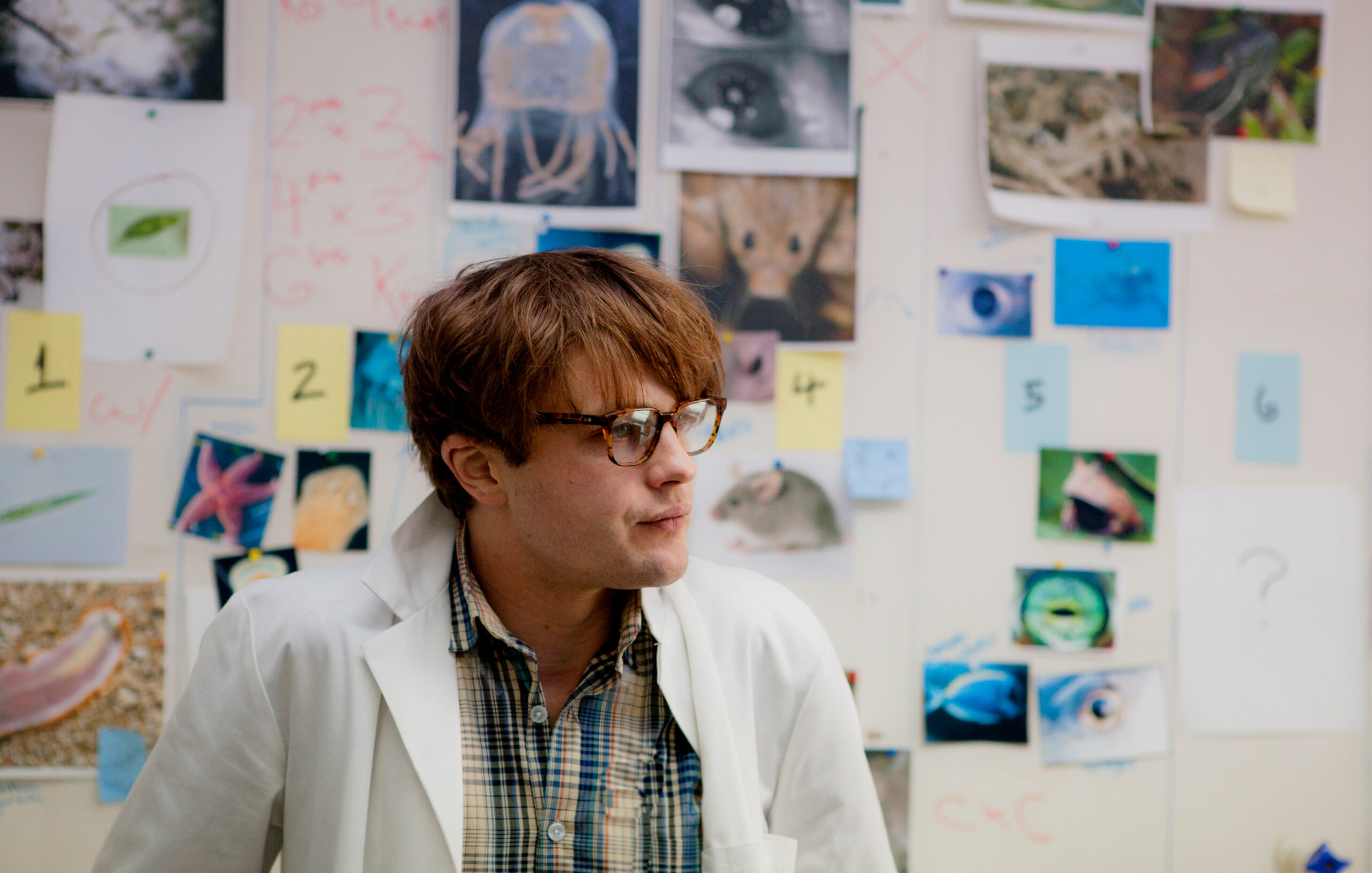
So. On to the film. Ian Gray is a molecular biologist with a fetish for irises and a bone to pick with Intelligent Design. His specific obsession is with the eye as the centerpiece of the “irreducible complexity” argument, which goes roughly like this: the eye requires so many interdependent components to function that it could not have assembled itself by accident, therefore something assembled it on purpose, therefore God. Ian’s entire research program with his lab partner Karen is built around demolishing that argument by creating a functional eye in a blind organism from scratch. He wants to prove the eye is not a miracle. This is important. Keep it. Because the film is about what happens when the evidence decides to prove the opposite.
Along the way, Ian meets Sofi. He finds her first as a pair of eyes on a billboard, tracks her down the way obsessives do, and falls hard. Sofi is his philosophical opposite, spiritual where he is empirical, intuitive where he is methodical, and she spends their entire relationship gently prying at the walls he’s built around the idea that the universe might contain something unmeasurable. They almost get married. Then an elevator malfunction kills her. The film lets that land like a stone and moves on, because grief in Mike Cahill’s world is not a scene, it’s a condition that reshapes everything that comes after it.
Ian and Karen eventually find each other in the wreckage of that loss, which is its own kind of logical collapse, the scientist who builds a hypothesis about irreducible complexity and then stress-tests it with his own life. They marry. They have a son. And when their son goes through an iris scan, standard biometric procedure in the world of the film, the scan returns a match. A statistical impossibility. The boy’s iris matches a dead man named Paul Edgar Dairy, who died roughly ten months before the boy was conceived.
This is where the film pivots from grief story to investigation, and it does it without breaking a sweat, because Cahill has been laying the groundwork the whole time. Ian’s iris fetish, the thousands of high-resolution photographs he’s collected across years, suddenly becomes a research database. Karen’s scientific rigor, which had previously been aimed at the eye-evolution argument, gets redirected toward a new hypothesis: that irises carry a signal across lifetimes, that the biometric identifier we use to confirm individual identity might actually be confirming something older and stranger than identity.
They scan Sofi’s archived iris images against the global database. They find a match. A girl in India. A girl born after Sofi died.
Ian flies to India. He finds the girl, Salomina. He runs the same associative memory test they ran on his son, showing her images that were meaningful to Sofi, tracking her eye-movement heat maps for signs of recognition. The test is inconclusive. The data doesn’t confirm the hypothesis. And then, on the way out of the building, Salomina sees the elevator and comes completely apart.
Ian chooses to believe she is Sofi.
That is the ending. A scientist, a man who built his life around the principle that belief without evidence is intellectual failure, looks at a terrified child and a broken elevator and chooses faith. The film doesn’t editorialize. It just shows you his face. You can read it however you need to.
The Post-Credits Scene of the Movie I, Origins Explained
Now. The post-credits scene. Because this is the part where Cahill tips his hand about what I, Origins was always actually building toward.
Two scientists are reviewing a project. They’ve collected high-resolution iris scans from archival photographs, dead people, historical figures, and they’re running those scans against the living population in the database. The implication is staggering: if the iris-reincarnation theory holds, you could scan the eyes of Abraham Lincoln in a photograph and find the living person he became. And the film shows you exactly that. Lincoln: match found. Hitler: no match found. There is a list of other names cycling on the screen, the morally judged, the sorted, the ones who made the cut and the ones who didn’t, and the logic the film is quietly proposing is a cosmic karma system with a biometric audit trail.
A few things worth untangling here, because the film moves fast and the implications stack up.
First, the Hitler no-match result does not definitively mean Hitler was not reincarnated. It means Hitler’s iris, if he were reincarnated, did not appear in the scanned population of roughly 300 million people. That’s a fraction of the living population of Earth. The absence of a match is not proof of absence. The film knows this. The scientists running the scan know this. The result is suggestive, not conclusive, which is the film’s way of staying honest about its own metaphysics.
Second, the Lincoln match does mean something within the film’s logic. It means the person Lincoln became was scanned. That specific person, living right now, somewhere in that database of 300 million, is carrying Lincoln’s iris. The film doesn’t tell you who it is. Of course it doesn’t. That’s the sequel. That’s the film called I that Fox Searchlight purchased and that, as of the time Cahill last discussed it publicly, still hadn’t been fully cracked at the script level. The post-credits scene is a trailer for a movie that may never get made, and that’s its own kind of tragedy.
Third, the moral logic the film is proposing with the match or no-match binary is genuinely uncomfortable, and the film intends it to be. Other names cycle on that screen, public figures whose reincarnation status the film quietly adjudicates, and the act of putting Margaret Thatcher in the no-match column, or wherever she lands, or the ambiguity of not knowing where she lands, is the film acknowledging that this system, if real, would be the most consequential moral judgment apparatus in human history. Operated by two scientists in what looks like a moderately-budgeted lab.
There are a few competing reads on what the film is ultimately arguing, and they’re worth laying out cleanly.
I, Origins Movie Theories
I, Origins Movie Theory Number 1 – The first read is the materialist read: the iris matches are a real phenomenon in the film’s world, but they don’t necessarily prove the soul. They might prove something weirder, that genetic or quantum information propagates across generations in ways that produce similar biometric outputs. Under this read, Ian’s choice to believe in Sofi at the elevator is a category error, a man confusing a statistical anomaly for a spiritual sign. The film is a tragedy about the limits of the scientific mind when it encounters grief.
I, Origins Movie Theory Number 2 – The second read is the spiritual read: the irises are exactly what Ian and Karen’s hypothesis says they are. The soul persists. The eye is the proof. Ian’s choice at the elevator is the correct choice, the one the whole film has been building toward, and his arc from militant empiricist to reluctant believer is the film’s thesis delivered directly. Under this read, I, Origins is a love story about a man who needed to lose everything he believed in before he could find the thing worth believing.
I, Origins Movie Theory Number 3 – The third read, and the one I find most interesting, is that the film is arguing neither position wins. Ian chose faith over the inconclusive test data, and the film refuses to confirm whether he was right. The girl might be Sofi. The girl might just be a child who was stuck in a building elevator once. The post-credits scene expands the technology but does not resolve the epistemological problem. You can scan every iris on Earth and still not know what the matches mean. The data will always stop short of the answer. That’s Cahill’s actual argument, the gap between evidence and meaning is where every human being lives, whether they call themselves a scientist or a mystic, and no instrument yet built can close it.
Moviesoapbox’s Personal Take on I, Origins –
That last read is the one I believe. Not because it’s the most comfortable, it’s actually the least comfortable, it’s the one that gives you the least solid ground to stand on. But it’s the only read that accounts for why the test on Salomina comes back inconclusive. Cahill could have made her pick Sofi’s favorite flower or flinch at Sofi’s ex-boyfriend’s photograph. He didn’t. He gave Ian nothing but a scared child in front of an elevator and made him choose anyway. A director who wanted to confirm the spiritual thesis would have given Ian more. A director who wanted to confirm the skeptic thesis would have given him nothing. Cahill gave him exactly enough to make the choice impossible to evaluate, and then cut to credits.
Cahill reportedly conceived the film as backstory he had to write in order to unlock the real story, the film called I, which Fox Searchlight now owns and which may never see production. Which means the film you just watched was a foundation for a house that may never get built. And somehow, that makes I, Origins feel more complete, not less. Some films earn their ambiguity. This one earned it the hard way, with a shoestring budget, a sequel already sold before the first script was finished, and a post-credits scene that most of its audience walked out before seeing.
🎬 If You Liked This…
- Another Earth — the other Mike Cahill film, same collision between scientific certainty and something that breaks it open, same emotional devastation underneath a sci-fi premise that shouldn’t work as well as it does
- The Discovery — scientific proof of something metaphysical that nobody was prepared for, the same question of what happens to everything you thought you knew when the evidence goes somewhere your framework can’t follow
- Arrival — science and language as tools for approaching something that transcends both, the same emotional gut-punch underneath an intellectual framework, and the same refusal to let the ending be comfortable