
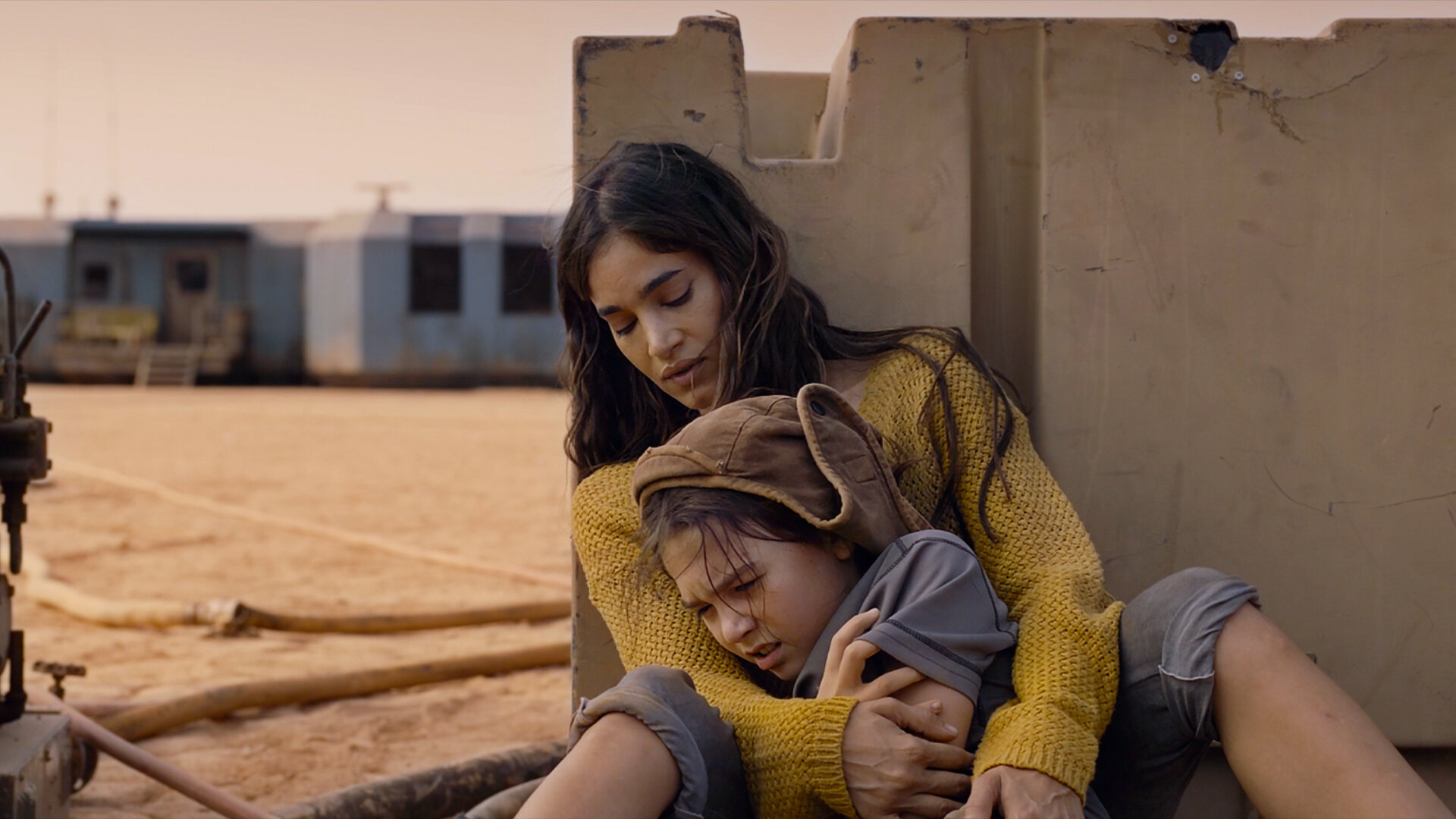
Hey there everyone! Welcome back to Movie Soapbox, the little corner of the internet that only you and I and that guy sleeping in the corner over there know about. This is the place where we find underappreciated indie films and we make sense of them. Today? We are doing a deep dive on Settlers, a movie so quietly, stubbornly, beautifully strange that it got buried under a streaming algorithm the week it dropped and has been rotting there ever since while the people who actually made it deserve so much better.
Fair warning before we go any further: everything from this point on is a full spoiler walkthrough. We are not dancing around the ending, we are not hinting at it, we are going directly through the front door and telling you exactly what happens and exactly what it means. If you haven’t seen the film yet, go watch it, come back, and we’ll be here. Still? Good. Let’s get into it.
The Making of Settlers
Before we walk through the film beat by beat, there is something you need to understand about the kind of movie Settlers was always going to be, and the kind of movie it very easily could have become in the wrong hands, at the wrong budget level, with the wrong amount of interference. A sci-fi film with this cast tier, Sofia Boutella, Jonny Lee Miller, Ismael Cruz Cordova, Brooklynn Prince, shot on a Namibian landscape doubling for Mars on what is clearly a lean budget, this is the kind of project that a certain class of streaming executive looks at in the rough cut stage and starts typing notes about “tonal clarity” and “audience orientation.” Those notes are code. They mean: we don’t understand who this is for. They mean: the third act doesn’t resolve the way we expected. What you are watching when you watch Settlers is a film that almost certainly survived a version of that conversation, because the third act does something those executives hate more than almost anything else, it refuses to rescue anyone. That it came through with its spine intact is either a function of smart contracts or a director, Wyatt Rockefeller, who knew how to nod and smile and then go back and shoot what he was always going to shoot. Films at this level of restraint rarely make it out undamaged. This one did.
The Full Settlers Movie Walkthrough
The film opens on a family that has already been forged by hardship before we ever meet them. Reza, played by Jonny Lee Miller, Ilsa, played by Sofia Boutella, and their daughter Remmy, played by Brooklynn Prince, are scratching out a subsistence life on a Martian mountainside under a dome that provides breathable air in an otherwise hostile atmosphere. They tend pigs. They grow tomatoes. They repair what breaks. The film gives you their life in the specific, unhurried way that most studio films about survival refuse to do because test audiences apparently find competence boring. You see how the work gets done before you see anything go wrong.
What goes wrong is the word LEAVE, written on the side of their dwelling. A small group of strangers has arrived, and the situation escalates into violence fast, the kind of violence that doesn’t feel choreographed because Rockefeller is not interested in choreography. Ilsa and Reza fight back hard enough to hold their ground initially, dropping several of the strangers. But Reza goes out to investigate the aftermath, goes over a ridge, and doesn’t come back. Because he’s dead. Shot by the man we will come to know as Jerry, played by Ismael Cruz Cordova, the sole survivor of that group, who has taken a bullet in the ankle from Reza and returned the favor with considerably more permanence.
What Jerry tells Ilsa when he arrives at the dome is the pivot the entire film turns on. He was born here. This dome was his parents’ home. He was conscripted, sent to fight a war on Earth, and while he was gone, Ilsa and Reza arrived on Mars fleeing the catastrophe of Earth, were eventually permitted to shelter here by Jerry’s family, and then at some point Ilsa killed Jerry’s father in a struggle that the film deliberately leaves partially off-screen and morally unresolved. Jerry’s wife and friend, the people who traveled with him back to Mars, were killed in the initial firefight by Ilsa and Reza. Jerry has lost everyone. He has come home to nothing. He wants the dome back, and he wants to use it to continue existing on a planet that is slowly, inexorably dying anyway.
The deal he offers Ilsa is strange and telling in equal measure. Thirty days. On day thirty, he puts his gun on the table, and she can do whatever she wants with it. What this tells you about Jerry immediately is that he has a performer’s instinct for power. He is not offering mercy. He is staging a demonstration of control so complete that he can afford to hand over the weapon. He knows what thirty days of proximity and shared labor will do to a grieving woman with a young daughter and no other options on a dead planet. He has run this math already. And by day twenty-seven, he appears to be right. Something between Ilsa and Jerry has softened into what might generously be called coexistence, and what the film allows to read as something more, though it never fully commits to naming it.
Day thirty. The gun goes on the table exactly as promised. Ilsa picks it up and pulls the trigger. It isn’t loaded. She goes for the knife. There is a struggle inside the shelter that Remmy can only hear from outside, the sounds of two adults fighting with everything they have in a small enclosed space. And then Jerry walks out, stabbed in the arm, and Remmy, who is ten years old and has already lost her father and now understands from the silence what just happened, knows her mother is dead.
The film then jumps ten years forward, and this is where it shifts registers entirely and becomes something colder and more patient and more interested in what survival does to a person over time than in any further plot mechanics. Remmy, now played as a young woman, has been living in the dome with Jerry for a decade. Not speaking. Not connecting in any meaningful way. Tending to the animals, doing the work of staying alive, coexisting with the man who killed both of her parents in the narrow technical sense that he pulled the trigger on one and created the conditions that made the other’s death inevitable. This is the film’s real subject. Not the western genre inversion, not the sci-fi world-building beautiful as that world-building is, but what you become when surviving and being safe are two entirely different things and you can only have one of them.
The thaw, when it comes, is as uncomfortable as the silence was. Jerry gives Remmy a drawing he has made of her mother. She cries. He takes the crying as invitation. He tries to kiss her. He finds her stolen gas mask and the scene that follows is the film’s most overtly horrifying sequence, Jerry forcing the mask over her face and explaining in vivid terms how she will die in the open Martian air without his protection, hitting her hard enough to render her unconscious, and then tying her to the bed. The Adam and Eve language he uses is the kind of rationalization that doesn’t deserve careful analysis. It is the language of a man who has decided and is now looking for a framework that makes the decision sound inevitable rather than chosen.
What stops him is the station’s AI, a robot that has been moving quietly through the background of the film doing maintenance work and carrying the faint suggestion of something like loyalty to Remmy. It fires a rock-fragmenting tool into Jerry’s neck. Remmy, untied now, standing with her father’s rifle, points it at him. Jerry says “we need each other.” Remmy says she doesn’t see it that way. And she shoots him in the forehead and that is the end of Jerry.
The Underbelly of Settlers Explained
Now. What the film is actually doing under all of this, at the level of backstory that the movie never fully diagrams for you but rewards you for assembling yourself: Jerry traveled from Earth back to Mars after the war ended. He did not travel directly to this dome. The sky on Mars is described as turning bluer, which means atmospheric conditions are shifting, and the smaller or less well-maintained domes are losing viability. Jerry’s journey home almost certainly included a stop at a different habitat, one that was failing, which is why he arrived with a wife and a companion who are now dead and why he was so specifically, grimly determined to hold onto this particular dome. He had already lost one shelter. The propagation logic he pushes on Remmy is, as the original analysis correctly notes, not a genuine survival calculus. The planet is dying. He knows the planet is dying. The Adam and Eve framing is the story he told himself because the actual story, I am alone and I want this, is too plain to say out loud.
The tunnel and the barrier that young Remmy runs into when she tries to flee, the clear shining wall, the door, the passage that she passes out before completing, those are the edges of the dome’s pressurized zone. The dome is large enough that its perimeter isn’t immediately visible from the settlement, which is part of why Remmy didn’t understand what she was looking at as a child. What she understands now, at twenty, after watching Jerry travel to this dome from somewhere else on the planet, is that the dome is not the whole of Mars. There are other habitats. There are other people, or the ruins of other people, or the possibility of other people, which is enough.
So when Remmy packs the gas mask and the oxygen and walks out through the tunnel and into the open Martian surface and the door closes behind her, she is not walking into a suicide. She is walking into a bet. A deliberately unresolved bet that the film refuses to cash in for you because cashing it in would betray the entire logic of what the film has been building. The point is the choice, not the outcome. She has chosen an unknown horizon over a known captivity. The film respects that choice enough to not cheapen it with a survivor-finds-other-dome epilogue.
A Spin on the Movie Settlers Meaning
There is a reading of the film’s ending as tragedy, Remmy alone on a dying planet with finite oxygen making a gesture of defiance that kills her slowly, and there is a reading of it as the only genuinely hopeful thing in the film, a young woman who has survived two murders and a decade of coercive imprisonment walking toward the possibility that there is something else out there because she watched someone travel to find her. Both readings are available. The film holds them simultaneously without blinking.
Moviesoapbox’s Read on the Movie Settlers
My read? Jerry is the key. He didn’t appear out of nowhere. He came from somewhere else on Mars, across open terrain that should have killed him, with a wife and a companion, which means he was part of a small community that had been functional enough to maintain at least two other people. That community is gone now, its dome probably failing, but the infrastructure that made it possible, other habitats, other pressurized zones built during the period when Mars had cities and civilization before all of that collapsed, does not go away because Jerry’s group did. Remmy is walking into ruins, yes, and she may find nothing. But she knows the surface can be crossed. She has seen it crossed. She has a gas mask and the knowledge that at least one other dome existed within traveling distance. That is more than nothing. That is, in the logic of this film, everything.
What Settlers got right that almost no studio-adjacent film in this genre gets right is the refusal to let the survivalist framework do Jerry’s moral work for him. The film never argues, not even for a second, that the continuation of the human species on Mars is a justification for anything Jerry does in that bedroom. The question of whether Remmy and Jerry “need each other” to survive is live and unresolved, and the film lets her answer it anyway, with a bullet, and then lets her walk out into the open and face the consequences of that answer alone. A film that went through five more rounds of studio notes would have given you a reason to feel better about that ending. This one hands you the gas mask and opens the door and says good luck. That’s rarer than it should be. It’s the whole reason the film is worth two hours of your life.
We’ll be back with another deep dive soon. Keep finding the weird ones. They’re still out there, even though the algorithm does its level best to make sure you never do.
🎬 If You Liked This…
- The Survivalist — the same brutal resource scarcity, a person alone protecting what little they have from strangers who arrive with needs of their own, the same question of whether survival justifies what it costs you
- Approaching the Unknown — a man alone on a journey to Mars, the psychological weight of isolation pressing in from every direction, same sparse existential register as Settlers without the intruder
- Die Wand — a woman completely alone in an isolated landscape with no explanation and no exit, survival as the entire frame of existence, the same meditative dread of being the last person in a place that was never meant for one