
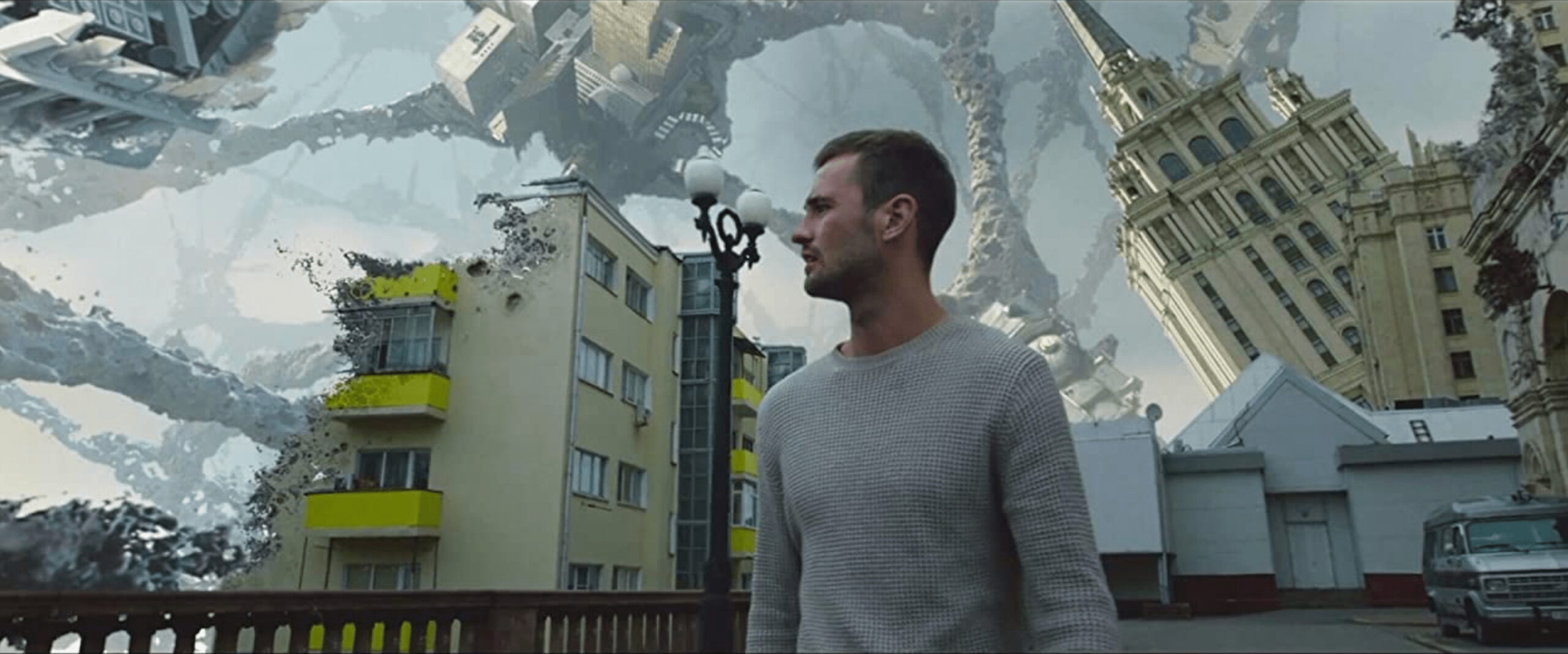
Hey there everyone! Welcome back to Movie Soapbox, the little corner of the internet that only you and I and that guy asleep at the back table know about. This is where we dig out the films that fell through the cracks, the ones that never got a proper release in your country, the ones that somehow exist at all, and we make sense of them together. Today we are doing a full deep dive on Coma, the 2019 Russian sci-fi film that is so visually deranged and so narratively flimsy that watching it feels like someone handed a Michelin-starred pastry chef a screenplay written on a cocktail napkin and told him to just, you know, make it work. He mostly did. We are going to talk about why that is both impressive and a little damning.
Alright, stop here if you haven’t seen it. Everything past this sentence is going to ruin the film’s handful of actual surprises, and the one thing Coma has going for it beyond the visuals is that the structural reveal lands with a little more weight if you don’t see it coming. Go watch it. Come back. We’ll be here.
The Making of the Russian Movie Coma
So. A visual effects artist named Nikita Argunov makes his feature directorial debut with this thing, and you feel that in every single frame. Not as a criticism, exactly, more as a statement of fact about what you are actually watching. The world of the film, a shared psychic space where coma patients build a reality out of their jumbled collective memories, is the entire reason this movie exists. The screenplay is, to be generous, a delivery mechanism for the world-building. And the world is genuinely spectacular in a way that mid-budget Western sci-fi hasn’t been in years, not because of how much it cost, but because someone with a very specific and deeply practiced skill set decided the rules of physics were a personal insult.
Now, before we get into the walkthrough, there is something worth understanding about what this film is and where it comes from, because it changes how you read the whole thing. A first-time director with a VFX background getting greenlit for a high-concept sci-fi feature is not the story of someone who charmed a room full of executives. Russian film financing, particularly at the mid-tier level, operates on patron relationships and production house deals that leave fingerprints all over the creative choices, and what you can tell about Coma is that whoever held the purse strings wanted spectacle first and let the story figure itself out. That is not a guess. That is what a film looks like when the mandate was visual. You can read it in the script’s skeleton: the rule systems get established just long enough to justify the next set piece, then quietly abandoned when they become inconvenient. The third act does not feel like a story resolving. It feels like a production running out of runway. Whatever version of this script had a fourth rewrite and a story editor who actually pushed back on the time-ratio logic, that version did not get made. This version did, and honestly, for what it is, it’s worth your time.
Coma Movie Deep Dive Walkthrough
Viktor, our Architect (played by Rinal Mukhametov), wakes up in an apartment that is decaying around him. The girlfriend in his photographs is dissolving. Oil-black monsters are coming. A crew of survivors pulls him out and explains the situation in that slightly exhausted way people explain things when they have explained them too many times already: you are in a coma, we are all in a coma, everyone who goes into a coma wakes up here, and those oil things will kill you in the real world if they get you here. The shared space is built from the collision of everyone’s memories, a barge from one person’s childhood sitting next to a highway overpass from someone else’s, the whole thing a beautiful, impossible jigsaw city that would make an architecture student weep. The oil monsters, the reapers, can only travel along the memory-bridges, the connective tissue between remembered places, which is why the group keeps trying to find or build a location that nobody remembers, something new, something clean, an island with no bridges in.
Viktor can’t figure out what his ability is. The group shoots tin cans at him, runs him through combat drills, stresses him out in a dozen ways, and he basically just absorbs punishment and looks confused. Then on a submarine retrieval run, reapers come, and Viktor instinctively builds a ramp out of nothing, a structural solution to a structural problem. He was an architect in the real world. His power is building. The film lands this like it is a revelation, and credit where it is due, the setup is patient enough that it earns the beat even if you saw it coming from the first frame.
Yan, the group’s leader (Konstantin Lavronenko, doing serious work in a role that could easily have been pure villain cardboard), has a vision: stop trying to find a safe pocket of remembered space, build one from imagination instead. No memories means no bridges means no reapers. A genuinely new world. A city on a hill. He is evangelical about it, and the film wants you to feel the seduction of that before it shows you the rot underneath.
Then Viktor wakes up. And this is where the movie earns its one genuinely good screenplay beat.
Viktor in the real world is a talented architect nobody will hire. He and his girlfriend are struggling, the relationship fraying under financial pressure. A religious organization reaches out, wants to see his work. He goes. The organization is Yan’s cult, and Yan is not just a coma survivor, he is the man who built the coma space deliberately, who needed funding for his research and found that building a religion was the most efficient fundraising mechanism available to him, and who populated his experiment with society’s cast-offs: the infirm, the desperate, the people nobody would go looking for. Viktor refuses to participate. He and his girlfriend run. They have a car accident. They wake up in Coma with no memories of any of this. And suddenly the whole first act reshuffles in your head. Fly is the girlfriend. Yan is the architect of the trap. Viktor built nothing in the real world that anyone wanted, and now he is the most valuable person in a world built from rubble. The film stumbles toward this reveal at a full sprint and it lands hard enough to make you forgive a lot of what came before it.
Yan, back in the real world, offers Viktor a deal: go back in, take a compound that amplifies his ability, build the promised city in the clouds, and Yan will release him and Fly. Viktor agrees. Yan crosses his fingers, literally, behind his back, and instructs his assistant to cut their life support at a predetermined moment. This is where the film’s logic starts eating itself.
The Mechanics of How Coma Works
Because Coma established, via direct dialogue from Yan himself, that time in the coma space runs approximately a hundred to one relative to the real world. This is not a subtle implication. It is an expository statement delivered with the confidence of a man who built the machine. The film uses this rule elegantly early on: Fly arrived in Coma before Viktor, which is why she is established and capable when he shows up confused and powerless, and when you learn they are the same couple from the same accident, the time gap explains her competence without the movie having to spell it out. That is good screenwriting. But then Viktor wakes up, spends something in the neighborhood of thirty minutes in the real world talking to Yan, and returns to Coma to find the group in exactly the same position, mid-field, mid-run, reapers just arriving, as if he stepped out for thirty seconds. By the film’s own math, fifty hours should have passed. Two full days. There should be evidence of a siege. There should be exhaustion, improvised fortifications, dead reapers in a ring around their position, something. There is nothing. The rule gets swallowed by the set piece’s need to continue without interruption, and once you notice it, you cannot un-notice it, because the rest of the film’s time management is equally casual about its own stated logic. Christopher Nolan built Inception around a time-ratio premise too, and he treated that premise like a contract he had signed in blood. Argunov treats it like a suggestion he made at a party and forgot about by morning.
The death sequence at the end compounds this. Yan’s assistant begins shutting down life support, and people in Coma start dissolving. But the gap between shutting down one person’s support and moving to the next would be, at minimum, seconds in the real world, which translates to minutes in Coma space. Characters die in rapid succession with no coherent elapsed time between them. The rule that was the film’s most interesting structural premise becomes, by the climax, purely decorative.
Viktor figures out the exit. Yan warned everyone early on not to approach the dream-images that grow in their sleeping quarters, portals to their own subconscious that he claimed would swallow you permanently. Viktor realizes those images are the door out, not a trap. He finds his, walks through, wakes up in a hospital. He pulls Fly’s breathing tube out and she wakes up too. No, that is not how respiratory failure in a coma patient works. No, the film does not care. The visuals in the surrounding minutes are extraordinary.
The epilogue gives us Viktor doing normal architecture now, the square efficient kind, the kind people actually buy. He has a job. Fly is still with him. Yan and his team faced no legal consequences because no survivors would testify. Viktor has received another invitation from Yan’s organization. He seems to be considering it. The film frames this as ambiguity, as the seduction of the extraordinary over the mundane, and fair enough, that reading works. But there is another reading underneath it, the one where Viktor watched a man abduct, exploit, and murder the most vulnerable people he could find specifically because nobody would miss them, and Viktor’s response was to go home, get a normal job, and not call the police. The film wants this to read as human complexity. It reads more like the screenplay forgot it had established Yan as a murderer.
Coma Movie Explanation and Theories
So. What is Coma actually about, underneath the spectacle? A few ways to read it.
Coma Theory Number One – The most straightforward interpretation is a riff on the Inception question: what do you owe the ordinary world when an extraordinary one is available? Yan built Coma as a utopia, and the people he put in it, people who had nothing in the real world, chose to stay. The film never quite condemns that choice. Viktor’s return to normal architecture is framed as a kind of defeat as much as a victory. The mundane world won, but it doesn’t feel triumphant. That ambivalence is the film’s most honest emotional note.
Coma Theory Number Two – The second reading is about the God complex in institutional medicine, a scientist who decided the suffering of people nobody valued was an acceptable cost for a breakthrough, who built a religion around himself to fund the experiment, and who faces no consequences because the system designed to hold him accountable simply doesn’t, because his victims were the kind of people the system was already ignoring. This reading requires you to take the screenplay more seriously than it perhaps deserves, but it is coherent, and it would explain why Yan is written with such ideological conviction rather than as a simple villain.
Coma Theory Number Three – The third reading, and the one that gives the film the most credit for intentionality, runs through the specific history of Soviet attitudes toward disability. Soviet ideology classified worth through the ability to work, and those who could not work, the disabled, the mentally ill, the injured veterans, were systematically made invisible, shuffled out of cities, stripped of the holy fool status that Russian Orthodox tradition had historically extended to them. Yan’s victims are exactly this population: the cast-offs, the ones society had already decided were not worth accounting for. His Coma world gives them extraordinary ability, super powers rooted in their real-world identities, and lets them build something magnificent. The film’s horror is not that they are trapped. The film’s horror is that they are happier trapped than they ever were free. That is a very specific kind of critique, and if Argunov intended it, it is the most interesting thing in the movie.
The moral retreat reading and the Soviet critique reading are not mutually exclusive. The most honest version of both is the same: a society that fails its most vulnerable creates the conditions in which a Yan becomes possible, because a man who promises the discarded a world where they matter will always find willing participants, and always find funders, and always find enough institutional indifference to operate without consequence.
Moviesoapbox’s Preferred Reading for the movie Coma
Movie Mike lands here: the Soviet disability critique is the film’s real spine, buried under the spectacle but visible if you look at who Yan selected and why, and what the coma space actually gave them that the real world refused to. The ending’s moral ambiguity isn’t a flaw. It’s the film saying, quietly, that Viktor’s testimony wouldn’t have mattered anyway. The people Yan used were never going to be the kind of victims that systems protect. That is dark, and the film doesn’t fully commit to it, but it is there.
What you are watching is a first-time director with a genuinely rare visual talent working with a screenplay that needed two more drafts and a logic editor, in a production context that prioritized spectacle and probably handed him the script in a form close to what you see on screen. The version of this film with a tighter story would be a minor classic. The version we have is a spectacular mess that earns its runtime on the strength of what it looks like and one structural reveal that actually works. In a studio system it would have gotten five more rounds of notes and come out flatter and safer and worse. The flaws are the price of the film existing the way it does. Most films that look like this don’t exist at all. That counts for something.
🎬 If You Liked This…
- Inception — the film Coma is clearly in conversation with, constructed dreamscapes with their own internal logic, reality layered on top of reality until you lose track of which one matters
- Sound of My Voice — another film where the reality being presented may be entirely constructed, and the question of whether to believe it is the whole movie
- Interstellar — impossible spaces built from memory and emotion, a man trying to find his way back through a reality that keeps changing the rules on him