
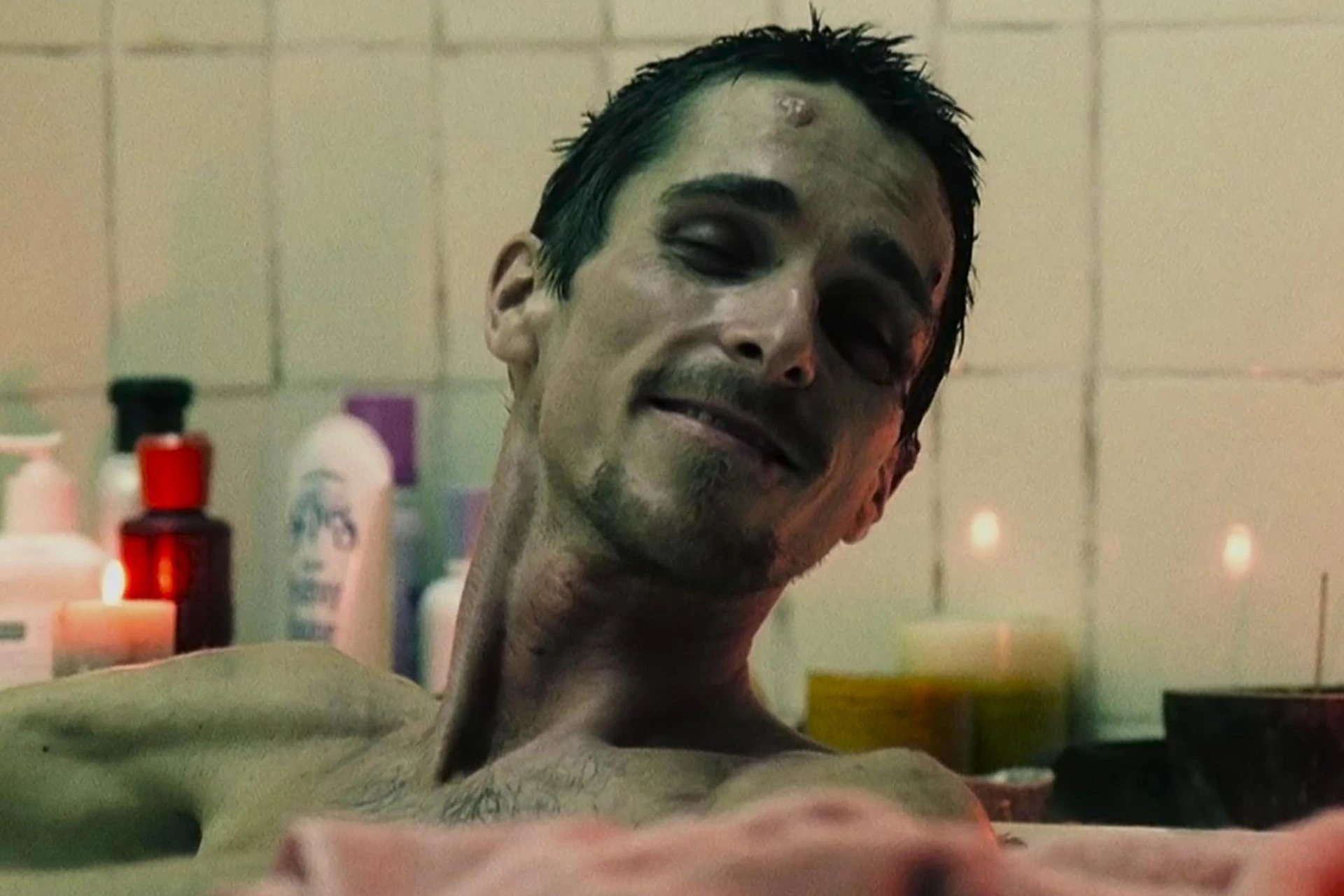
Hey there everyone! Welcome back to Movie Soapbox, the little corner of the internet that only you and I and that guy sleeping in the corner over there know about. This is the place where we find underappreciated films and make sense of them, the ones that got mangled or almost did, the ones that survived the machine by sheer stubbornness or dumb luck. Today? We are doing a full deep dive on The Machinist, a 2004 psychological thriller so stripped down and so relentlessly interior that the people who funded it had to have been confused about what they were paying for, and that confusion, weirdly, is probably the reason it came out as well as it did.
Before we go any further, understand that everything from this point on assumes you have seen the film. We are going in all the way, no oxygen tank, no rope back to the surface. If you haven’t watched The Machinist yet, close this tab, find it, sit with it alone in a dark room the way it deserves, and come back. You’ll know when you’re ready, because you’ll be staring at the ceiling at two in the morning wondering what year it actually is.
Still here? Good. Let’s get into it.
The Machinist Movie and the Making of
What you need to understand before the first frame even settles is what kind of film The Machinist should have been by the logic of every development office that touches projects at this budget tier. A script about a man who hasn’t slept in a year, who has no reliable memory, no reliable perception, and who spends the whole movie potentially hallucinating his co-workers, that script lands on a VP’s desk and gets a note that says something like, “we need to understand what is real and what isn’t.” Maybe a second note that says, “can the co-worker be more of a threat, more active, give us something to cut to.” And then a third note, from someone who read the coverage but not the script, suggesting that the ending needs to feel more like a reveal and less like a man quietly walking into a police station. Brad Anderson, working overseas, working cheap, working with a lead actor who was losing weight at a rate that would have terrified any insurance underwriter worth his premium, somehow avoided all of that. The film you get is the film someone actually wrote. That almost never happens at this price point with this kind of material, and the fact that it did is the first thing worth paying attention to.
The Machinist Movie Detailed Walkthrough
So. Trevor Reznik. Let’s talk about what actually happened to this man.
The short version: Trevor was driving recklessly, distracted trying to light a cigarette, and he ran a red light and killed a small boy. He watched the boy’s mother collapse over her son’s body, used the chaos of her grief as cover, and left. He never came forward. His car got reported as totaled. Nobody traced it back to him. And from that moment, Trevor’s mind began doing what minds do when they cannot process something and refuse to let it surface cleanly: it buried the memory and built a whole architecture of distraction on top of it.
The Machinist & How The Architecture is the Film.
The insomnia is not a symptom of guilt in some vague, literary sense. The insomnia IS the guilt, operating as a physiological lockout, because sleep is where the unprocessed material comes back, and Trevor’s subconscious has decided that material cannot be allowed to surface yet. So he doesn’t sleep. He wastes away. He becomes the visual representation of what a year of self-punishment looks like when you won’t let yourself know what you’re being punished for. Christian Bale lost somewhere in the range of sixty pounds for this role, and you need to hold that number in your head not as a trivia fact but as the physical argument the film is making. Trevor is not thin because the filmmakers wanted a striking image. Trevor is thin because the film is literalizing psychological destruction in the only way cinema actually can, by putting it in the body.
Now let’s sort out who is real and who is not, because the film is deliberate about this and you need the map before the territory makes sense.
What is Real in the Machinist: Stevie, the woman who works as a prostitute and who clearly has genuine feeling for Trevor. Miller, his co-worker, the one who loses his arm. Mrs. Shrike, his landlady. His supervisors. His other co-workers. All of these people exist and interact with him in the actual world of the film.
What is Not Real in the Machinist: Marie, the waitress at the airport diner. Nicholas, Marie’s son. Ivan, the co-worker who keeps appearing and disappearing.
Each of these invented figures is Trevor’s guilt wearing a costume. Let’s go through them in order.
Marie and Nicholas are the names Trevor has conjured for the two people he watched from behind the wheel on the day of the accident. Nicholas is the boy he killed. Marie is the boy’s mother. He never knew their names, so he assigned them names that felt right to whatever part of his mind was running this particular simulation. In his imagination, Marie is a warm, patient waitress at the airport diner, a place Trevor keeps returning to because the airport represents escape, the possibility of running, the specific fantasy of disappearing. He tips her generously, he has long conversations with her, he is tender toward her son. In reality, the actual waitress at that counter watched a hollow, silent man sit and stare at a cup of coffee he never drank. The generous tips are $0 notes. The conversations never happened. What Trevor is doing at that diner, on some level he cannot access consciously, is practicing a version of connection with the people he destroyed, in the only safe space where that connection cannot cost him anything.
The zoo trip follows the same logic. Trevor has memories of going to the zoo as a child with his own mother. He transplants those memories onto Marie and Nicholas. When he takes what he believes is a photo of Marie at the zoo, the photo that later shows up in his old album is of his own mother in that same pose, because the photo always was. The greeting card he sees on Marie’s refrigerator has handwriting that matches his own because he wrote a card like that once, for his own mother, and the detail has migrated from his real memory into his constructed one. The scene where he transitions from Marie’s kitchen to his own, mid-fantasy, is the film showing you the seam, very briefly, before Trevor’s mind papers over it again.
Ivan is the engine of the whole thing. Ivan is Trevor’s guilt, externalized, given a body and a face and a job description so that Trevor can interact with it, chase it, confront it, and eventually try to destroy it. Ivan appears for the first time at the moment Trevor is lighting a cigarette in his car, the exact action that caused the accident, and that is the trigger. Ivan drives a red Pontiac, Trevor’s old car, the car from the accident, the car Trevor reported as totaled. Ivan has missing fingers replaced with toes, a detail that probably functions as a symbol of substitution and displacement, of the way Trevor has replaced one reality with another, though the film is generous enough to let that specific image be somewhat open. When Trevor goes through Ivan’s wallet and finds a photo of Ivan with a co-worker named Reynolds, the photo is actually Trevor himself, and Reynolds is the name Trevor has assigned to the man in the photo because he cannot recognize his own face anymore. He has been away from himself for a year. Guilt will do that.
The hangman game on the refrigerator is Trevor’s subconscious giving him letters. He fills in the letters over the course of the film without understanding why. The word, assembled one piece at a time, is KILLER. He thinks it’s Tucker doing it to him, then he thinks it’s Miller, then Stevie, then Ivan. The answer is that he’s doing it to himself, slowly, in the small hours when the part of him that wants to confess gets a few unguarded minutes.
The time 1:30 appears repeatedly, on clocks, at the airport, at the moment of the accident. Time stopped for Trevor at 1:30 on the day he drove away. He has been living in a loop since then, not moving forward, not sleeping, not eating enough to sustain a life, because on some cellular level he has decided he doesn’t deserve to move forward. The insomnia is the sentence he’s imposing on himself without the trial.
Route 666, the theme park ride, is the film doing its most explicit symbolic work. The ride is a compressed version of Trevor’s guilt-landscape, the word GUILTY written on the wall, a car accident, a body, and at the end a fork in the road where you can go toward salvation and can’t make yourself take it. Nicholas has an epileptic seizure on the ride, and this connects to the Dostoevsky novel Trevor is reading throughout the film, The Idiot, whose protagonist is a figure of radical empathy and moral clarity who also suffers from epilepsy. Trevor is reading the opposite of himself, a man who cannot run from moral consequence, as a kind of unconscious self-indictment.
When Trevor finally attacks Ivan and kills him, wraps the body in a rug, and drives to the cliff, he is enacting, in the logic of his own delusion, a murder of his guilt. He is trying to dispose of the thing that has been following him. When he arrives at the cliff and unrolls the rug and there is nothing inside, and the man with the flashlight who caught him is Ivan, standing whole and unhurt, this is the moment the film tells you that you cannot kill what you’re carrying by throwing it off a cliff. You can only confess it.
The Ending of the Machinist Explained
The ending works because it earns its quietness. Trevor opens the refrigerator, the power having been cut because he forgot to pay the bill, the fish beginning to thaw, blood pooling at the bottom of the drawer, and for the first time he sees himself in the photograph. Not Ivan. Himself. The memory comes back all at once. The cigarette, the red light, the boy, the mother’s face, the decision to drive away. He sits with it. He packs a bag. He gets in the car. He sees the fork in the road, airport or downtown, escape or surrender, the same fork that appeared in Route 666. He goes downtown. Ivan stands outside the police station and waves goodbye, because Trevor doesn’t need him anymore, the guilt has been acknowledged, it doesn’t need a body. Trevor walks inside and confesses. He is taken into custody. And in his cell, finally, for the first time in a year, he sleeps.
Theories to Understand The Machinist By
The theories that circulate around this film mostly cluster around how conscious Trevor is of his guilt at various points, and whether any of the imagined sequences represent genuine memory or pure fabrication. The stricter read says Trevor knows absolutely nothing of the accident until the refrigerator moment, that the entire architecture of Ivan and Marie is an airtight unconscious construction with no deliberate element. The softer read suggests that Trevor’s repeated returns to the airport, his specific tenderness toward Marie and Nicholas, his reading of The Idiot, all point to a man who is circling the truth with increasing intention, not quite conscious knowledge but something closer to guilty instinct. The Route 666 ride, on the softer read, is Trevor engineering his own exposure, putting himself through the experience of the accident in a context where he can survive it, because he needs to survive it before he can confess it.
Moviesoapbox’s Read on the Movie The Machinist
My read is the second one, and I’ll tell you why. The detail of the handwriting on the greeting card is too precise to be random subconscious noise. The fact that the hangman puzzle advances in his own kitchen, on his own refrigerator, letter by letter over days, and that he’s the only one who actually lives there, points to a man who is leaving himself messages he won’t let himself read. The airport visits, framed as escape fantasy but never resulting in escape, suggest someone who keeps returning to the threshold of running and can’t quite make himself do it again. Trevor’s subconscious is not just surfacing his guilt passively. It is actively building the case against him, gathering exhibits, until it has enough to force a verdict. The confession at the end doesn’t feel like a breakdown. It feels like an arrival. He’s been walking toward that police station for a year.
What The Machinist had to survive to reach you was the gravitational pull of the industry toward explanation, toward a plot that tells you what is real on a schedule, toward a villain who does something instead of a guilt that just accumulates. Brad Anderson and writer Scott Kosar kept the film small enough and strange enough and far enough from the machinery that it came out the other side intact. Most films carrying this premise don’t. The ones that don’t come out the other side are the ones you never saw, because they tested badly with an audience that wanted the reveal in act two and the committee gave it to them. This one held the line. Trevor got to take the long way downtown. That matters.
We’ll see you at the next one. Stay curious, watch something that costs you something, and we’ll be here when you get back.