
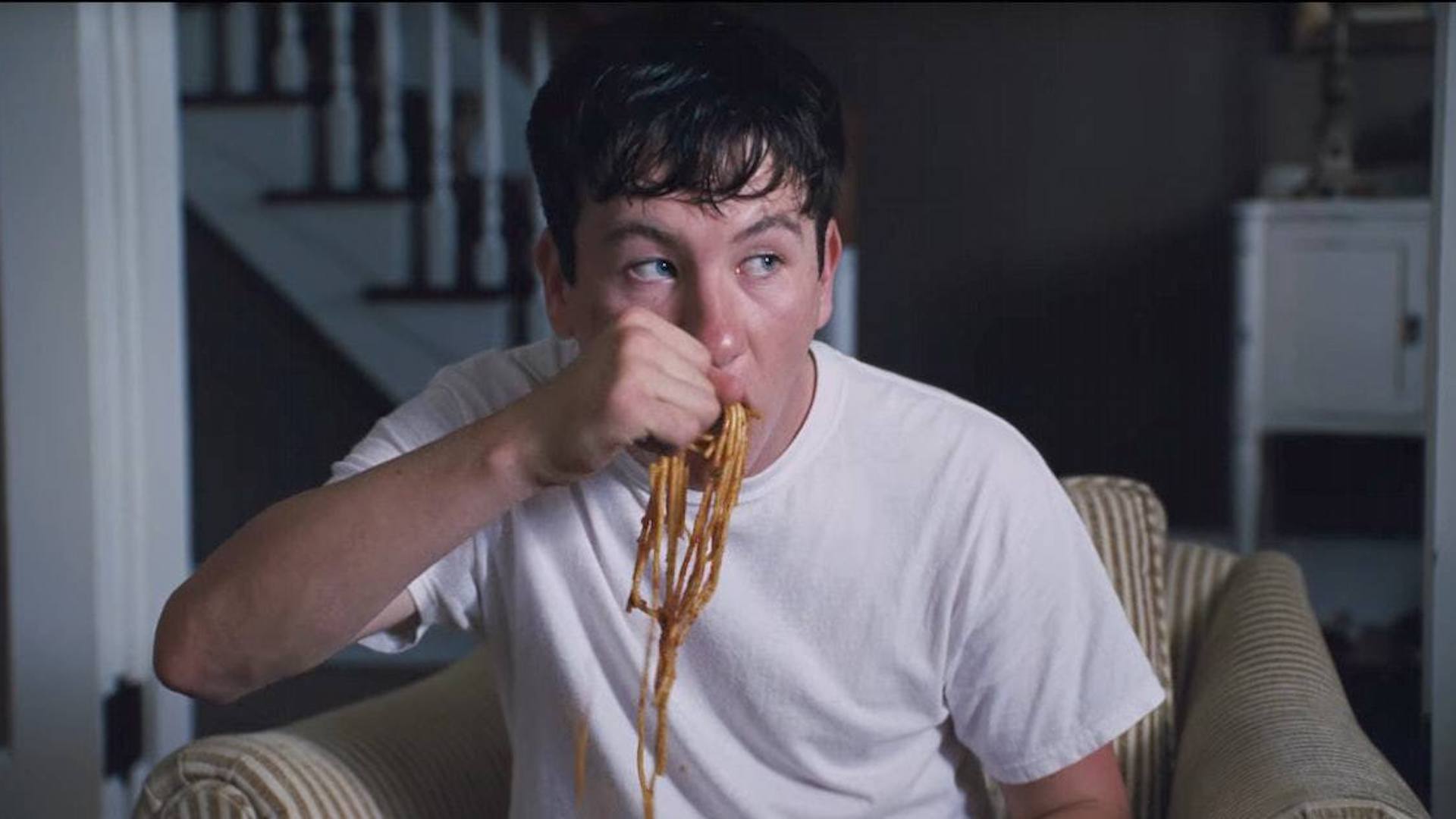
Hey there everyone! Welcome back to Movie Soapbox, the little corner of the internet that only you and I and that guy in the back who hasn’t blinked in twenty minutes know about. This is the place where we dig up the films that got released into three theaters on a Tuesday in October and somehow contain more actual cinema than anything playing on the other twelve screens. Today? We are doing a full deep dive on The Killing of a Sacred Deer, a movie so precisely, methodically, almost clinically merciless that half the people who saw it in 2017 are still sitting with their arms crossed trying to decide if they were assaulted or enlightened, and the answer is yes, they were both, and Yorgos Lanthimos doesn’t care which word you use.
Before we get into the machinery of this thing, here’s the trailer, so you know what flavor of wrong we are dealing with today.
Alright. From this point forward, everything in this post is a spoiler, front to back, wall to wall. If you haven’t seen the film and you’re still reading anyway, that’s on you and I respect it, but don’t say I didn’t tell you. We are walking through every beat of this movie, including the ending, including the shot that closes it, and we are not slowing down for anyone. You’ve been briefed. Let’s go.
What Actually Happens in The Killing of a Sacred Deer
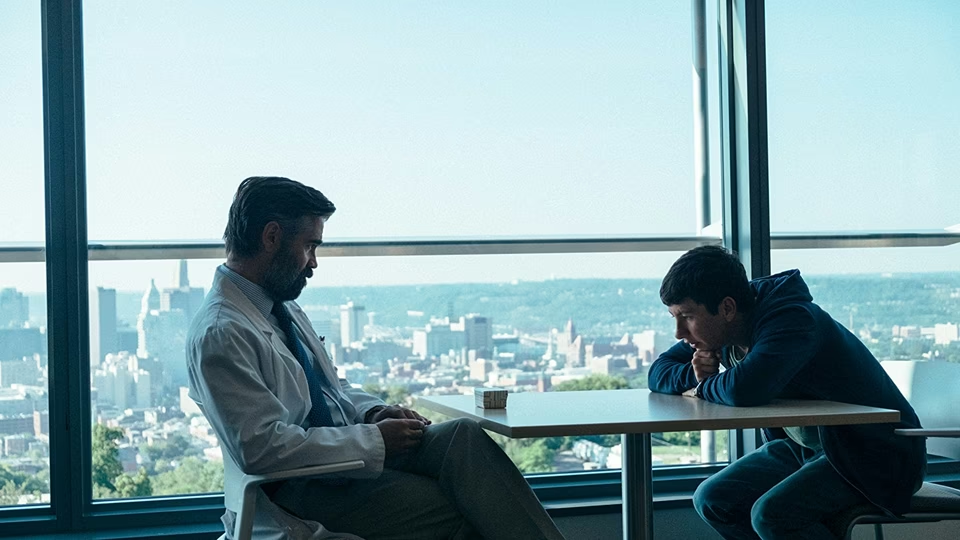
The spine of this story is simple enough that you could put it on a notecard. A cardiac surgeon named Dr. Stephen Murphy killed a man on his operating table. The man had a son, Martin, a teenager who dresses like a forty-year-old accountant and has the energy of something that crawled out of a lake to deliver a message. Martin shows up in Murphy’s life and makes him an offer that isn’t really an offer: kill one member of your own family, or watch all of them die in sequence, paralysis first, then refusal to eat, then bleeding from the eyes, then the end. Murphy doesn’t believe him. Then his son Bob can’t walk. Then his daughter Kim can’t walk. The offer becomes undeniable.
Murphy kidnaps Martin, beats him, shoots him in the leg, does all of this in the basement of his own McMansion, and none of it stops the clock. His wife Anna eventually lets Martin go. The kids keep deteriorating. Murphy runs out of runway. He blindfolds himself, spins his children in a chair in the living room, and when the spinning stops he shoots whoever is in front of him. It’s Bob. Bob dies. Kim recovers. The family goes to a diner. Martin walks in. Nobody says a word. Cut to black.
That’s the what. The what is almost beside the point.
What This Film Survived to Get This Cold
The Myth Inside the Movie
You want to understand why this movie feels the way it feels, start here. Lanthimos works in a register that every development exec in a glass office building is trained to soften on contact. The flat affect, the zero-catharsis ending, the refusal to give the audience a single scene where somebody cries in a way that feels earned and releasing rather than wrong and airless, all of that is exactly what gets “fixed” in the note process. A film like this, at the budget tier it was made, with a cast including Colin Farrell and Nicole Kidman, would typically arrive at a distributor with a list of suggested changes that begins with “we just need a little more warmth in act two” and ends with Murphy delivering a monologue about what he’s learned. The fact that this film has no such monologue, that Murphy never admits guilt, never breaks, never performs remorse for our benefit, tells you something about how much Lanthimos had accumulated enough goodwill from The Lobster to keep the suits from touching the thermostat. That doesn’t always happen. Most of the time it does not happen.
The title is doing real work and it’s worth tracking where it comes from because the whole architecture of the film is built on top of it. There’s a Greek myth about Agamemnon, who accidentally kills a deer in a grove sacred to Artemis, goddess of the hunt. Artemis responds by killing the winds so his fleet can’t sail for Troy, and the seer Calchas tells Agamemnon what it’ll take to get the winds back: sacrifice your eldest daughter, Iphigenia. Agamemnon refuses, then caves, then the winds come back, then the rest of the Oresteia happens and none of it is good for anyone.
Now look at the structure of this film. Murphy kills Martin’s father, a careless act of negligence during a surgery he may have gone into impaired. Martin is Artemis, or he’s playing Artemis, or he IS the mechanism of Artemis, and the distinction barely matters. He doesn’t want revenge exactly, he wants balance. He says it plainly: “It’s the only thing I can think of that’s close to justice.” One death for one death. The fact that it has to be a child, that the sacrifice has to cost something that can’t be recovered, that’s not cruelty on Martin’s part, that’s the terms of the myth. Lanthimos is not editorializing on those terms. He’s just showing you the machine running.
And what makes Murphy Agamemnon rather than just a bad man is this: he never admits it. Not once. He blames the anesthesiologist. He blames circumstances. He blames everyone in the orbit of that operating table except the man who walked in possibly drunk and cut open another human being. The myth requires not just blood but unrepentant blood. Agamemnon’s crime isn’t just the deer, it’s that he doesn’t understand what the deer was. Murphy’s crime isn’t just the surgery, it’s that he will never, not once in this film or presumably after it ends, understand what he did.
The Mechanics People Get Confused By
A lot of people walk out of this film asking whether Martin’s power is real or psychological, whether the paralysis and the bleeding are supernatural or psychosomatic, whether there’s a rational explanation sitting under the surface. The film earns both readings and won’t hand you a resolution. What you need to track is that the illness progresses on a schedule that has nothing to do with proximity to Martin, nothing to do with what the children know or believe, and nothing to do with any physical contact. Bob starts declining before there’s any reason for him to be afraid of Martin. That’s not consistent with a psychological explanation. Lanthimos is not interested in giving you the escape hatch of “it was all suggestion.” The rules of this world are the rules of the myth, not the rules of a thriller with a twist.
The other mechanical thing worth being clear about: the final selection in the living room is genuinely random. Murphy blindfolds himself. He spins the kids. He fires. Bob dies because Bob was in the chair when it stopped, and for no other reason. There’s no symbolism in which child dies. There’s no subconscious choice being surfaced. The randomness is the whole point. The myth doesn’t care about your preference. The debt has to be paid and the specific coin is whatever you pull out of your pocket.
The Competing Reads on What This Film Is Actually About
There are roughly three ways people have organized their interpretation of this film and all three have real traction.
The Mythological Reading to Explain The Killing of a Sacred Deer:
The first is the straightforward mythological reading: this is the Iphigenia story transplanted into suburban Ohio, a precise and deliberate retelling of what happens when a powerful man causes a death through arrogance and then refuses to account for it. Martin is divine mechanism made flesh. The family is collateral. The film is about justice in the oldest possible sense of the word, not legal justice, not emotional justice, but cosmic balance, the kind that doesn’t ask whether it’s fair.
The American Allegory Reading to Explain The Killing of a Sacred Deer:
The second reading is the American allegory. The Murphy house is enormous and immaculate and full of objects that signal success without suggesting anyone inside it has ever had a real thought. Murphy’s refusal to admit guilt mirrors a particular American relationship to culpability, a prosperity so thoroughly internalized that accountability looks like an attack. Martin, in this reading, is whatever is owed: to colonized land, to workers, to anybody who got run over by the machine and left a family behind. The diner at the end, the ketchup standing in for blood, the hamburgers and the fries, Murphy staring at Martin over the remnants of a meal, unbroken and still fundamentally fine, is the film saying the bill is still on the table.
The Psychological Manipulation Reading to Explain The Killing of a Sacred Deer:
The third read is the one that lets you sleep: it’s a movie about a disturbed kid who used psychological manipulation, sustained pressure, and possibly some pharmacological interference to break a family that was already fragile, and Murphy’s failure to admit the drinking is what made him vulnerable to the whole thing from the start. This reading requires you to ignore the timing of the illnesses but some people find the trade worth it.
Moviesoapbox’s Preferred Reading of The Killing of a Sacred Deer
The American allegory reading is the most culturally satisfying and the most widely discussed, and I think it’s basically correct as far as it goes, but I don’t think it’s what Lanthimos was most interested in. The allegory works because the myth works, and the myth works because Lanthimos understood something that most filmmakers who traffic in this kind of material refuse to commit to: the debt is real. Martin is not a metaphor for guilt or a projection of Murphy’s conscience or a symbol of anything. In the logic of this film, the debt is a structural feature of the universe. Blood was taken. Blood is owed. The only question is which blood and when.
What makes Murphy Agamemnon and not just a villain is that he survives. He is still there at the diner. He is still sitting with his back straight and his face composed, watching Martin over the rim of whatever he’s drinking, and Martin looks back, and the transaction is complete, and both of them know it, and nothing has changed in Murphy’s eyes. He paid with Bob’s life and considers himself current. That is the film’s real indictment, not the sacrifice, but the composure after it. The myth doesn’t promise transformation. It promises balance. Lanthimos is just honest enough to show you that those are not the same thing.
What It Took to Get This Ending
A version of this film ends with Murphy weeping over Bob’s body while a string arrangement tells you how to feel. A version of this film ends with Kim looking at her father in a way that signals long-term psychological damage and future reckoning. A version of this film ends with Martin being arrested, or explained, or pitied. Every single one of those versions is the version that gets made when there are too many voices in the room with the director.
This version ends with ketchup and eye contact and a family that will never say out loud what they did, in a country that built the diner they’re sitting in on the same principle. Lanthimos got that ending because he earned it, and because the people who might have taken it away from him looked at the Cannes jury prize on the shelf and decided this one wasn’t their fight.
Most films like this don’t have that shelf. Most of them get the string arrangement. Remember that the next time somebody tells you the industry rewards the best work.