
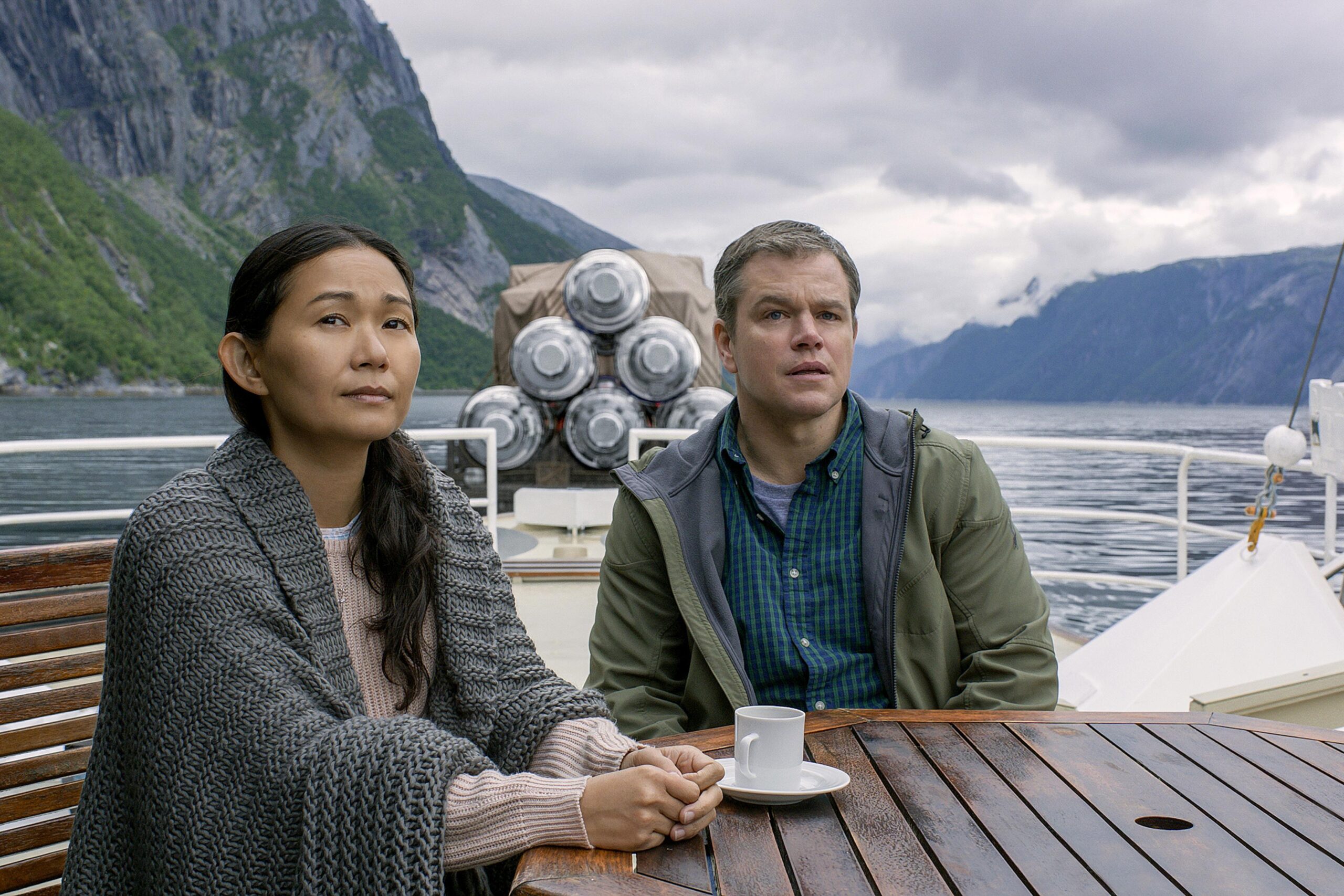
Hey there everyone! Welcome back to Movie Soapbox, the little corner of the internet that only you and I and that guy sleeping in the corner over there know about. This is the place where we find underseen, underexplained films and make sense of them, or at least make an honest attempt before the movie in question actively resists all sense-making. Today? We are doing a full deep-dive on Downsizing, a movie so bafflingly, expensively, committedly pointless that even trying to describe what it is about to someone who hasn’t seen it sounds like a bit you’re doing. You will not believe this was a real theatrical release. You will not believe the budget. You will not believe the cast. Let’s get into it.
Fair warning before we go any further: everything from here is spoilers, wall to wall. But I want you to understand something about that warning. Spoiling Downsizing for you is a public service, the kind of thing a good friend does when they take your car keys. If you haven’t seen this movie yet, what follows may save you two hours and twelve minutes of your one irreplaceable life. And if you have seen it, you need someone to sit across from you and confirm that yes, it is as incoherent as you remember, and no, you didn’t miss a smarter version of this film playing somewhere nearby. You didn’t. This is all there is.
What This Film Was, Versus What It Had to Be
Alexander Payne spent the better part of a decade developing this thing, which is the first piece of information you need to hold onto as we walk through it, because a decade of development on a film like this should produce something with a spine, a point of view, a sentence you can finish when someone asks what the movie is about. A decade in development with a studio behind it means the script went through rounds of notes from people whose job is to make films more commercially legible, which means that whatever sharp satirical thing Payne originally had in mind, if anything, got smoothed and committee-rounded until the edges disappeared entirely. You can see this in the finished film. You can see the places where a harder idea used to live. The downsizing-depresses-the-economy scene, the poverty-exists-in-miniature scene, these are remnants of arguments that once had teeth and got filed down somewhere around draft eleven. The film that exists is not a film that got made too fast with too little oversight. This is a film that got developed to death, every interesting corner rounded off, until what remained was a very expensive, very pretty vessel for a message that never got chosen.
The Plot, Scene by Scene, Against My Better Judgment
Paul Safranek, played by Matt Damon in full everyman-adrift mode, and his wife Audrey, played by Kristen Wiig in a role so thin she essentially evaporates from the film by act two, decide to undergo an irreversible procedure that shrinks them to approximately five inches tall. The pitch is economic: a miniaturized person’s modest savings translate to enormous purchasing power in a scaled-down world, so the working-class couple that can’t afford the life they want can simply change the scale of everything they want. Fine. That is a workable premise. A little cold, a little satirical, you can see where it could go.
Paul goes under. Paul wakes up miniaturized. Audrey did not go through with it and is not answering her phone from the full-sized world. Paul is now irreversibly small, legally still married to a full-sized woman, and living in a Barbie Dreamhouse he no longer has any psychological reason to occupy. This is the first fork in the road where the film needed to make a decision about what it was and didn’t. A dark comedy leans into the horror of this. A satire uses it to say something about the social contract, about what we owe the people we make irrevocable decisions alongside. Downsizing treats it as a mild inconvenience that gets Paul to his next set of circumstances.
Paul sells the miniature McMansion, moves into an apartment, takes a job at a call center doing ergonomics consulting, and wanders through the film’s second act bumping into people. He meets his neighbor Dusan Mirkovic, a small-world socialite and smuggler who functions as the film’s most alive character because Christoph Waltz is constitutionally incapable of being boring on screen. Through Dusan he meets Ngoc Lan Tran, a Vietnamese dissident who was miniaturized involuntarily, survived the trip from Vietnam hidden in a television box that killed twenty-four of the twenty-five people she traveled with, and now lives in the miniature world’s version of a slum running a cleaning business while caring for her community’s sick and elderly.
Ngoc mistakes Paul for a doctor. Paul is not a doctor; he is a physical therapist of ambiguous competence. She recruits him anyway to help a sick friend. The friend, through a chain of events involving an accidental Percocet overdose that the film plays for dark comedy without quite committing to the darkness, dies. Paul destroys Ngoc’s prosthetic leg in a related mishap. He is now socially indebted to her and begins helping with her cleaning rounds, which expand into providing meals, then into playing makeshift physician to a community of extremely poor miniaturized people who have nobody else.
This section is, quietly, the most interesting thirty minutes in the film. Not because it’s well-constructed, it isn’t, but because it accidentally stumbles into something true about how people end up doing good in the world: sideways, through obligation, without intending to, because someone with more energy and less self-pity than them simply handed them a mop and walked away. Ngoc is the best character in this film and she’s in a different, better film than the one surrounding her.
Then the film abandons this entirely.
Dusan arranges a trip to Europe. Paul and Ngoc join him. They travel to a Norwegian fjord community where the original inventor of the downsizing process, Dr. Jorgen Asbjornsen, has built a self-sustaining miniature village and is preparing to lead the community underground into a sealed bunker, because he believes massive methane releases from permafrost will render the surface uninhabitable within a generation. Paul meets Asbjornsen. Paul decides, with startling immediacy, that God is clearly calling him into the bunker. He tries to get Ngoc to come. She refuses, because Ngoc is the only character in this film with a consistent interior life. Paul gets in line for the bunker. Paul discovers it is a nine-month walk through a tunnel. Paul turns around. Paul goes back to Ngoc. The end.
The Actual Mechanics: What You Need Untangled
A few things the film is vague about that are worth clarifying if you are trying to reconstruct the plot from memory or from someone else’s confused summary.
The downsizing procedure is irreversible in the film’s internal logic. There is no going back. This is established early and then functionally ignored, because the film never uses irreversibility as a source of genuine dramatic pressure the way it should.
Ngoc lost her leg during her escape from Vietnam, not during the downsizing process itself. The film implies this but doesn’t state it cleanly.
The environmental apocalypse Asbjornsen describes is presented as real within the film’s world, not paranoid or mistaken. The methane is coming. The surface will be unlivable. The bunker is the correct response. Paul is not choosing between a crazy cult and reality; he is choosing between survival and going back to a woman he loves. The film wants this to feel like a meaningful choice. Given that Paul has demonstrated no consistent values for two hours leading up to this moment, it lands instead as arbitrary.
The transition where Paul sells the McMansion and moves into the apartment happens off-screen between scenes with no explanation. You did not miss a scene. The film simply did not shoot one.
The Theories: What People Think This Film Was Trying to Do
Theory One: It’s an eco-conscious satire about reducing our footprint. The most straightforward read. Payne takes the small-house movement to its logical absurdist limit and asks what would happen if we solved our environmental impact by literally shrinking ourselves. The problem is the film actively argues against this reading through its own dialogue. A bar scene establishes that miniaturization destabilizes labor markets and depresses economies. A slum establishes that poverty is scale-independent. If the eco-satire reading were correct, the film is making the argument that its own premise doesn’t work, which would be a coherent satirical move if the film then did something with that argument. It doesn’t.
Theory Two: It’s a counter-cultural manifesto about civilizational change. Payne as Thomas Paine, writing a call to restructure society before the environmental collapse he sees coming. The problems here are too numerous to catalogue without sadness. Paul Safranek is the least useful vessel imaginable for a manifesto. He has no politics, no convictions, and no particular desire to acquire either. A manifesto needs a protagonist who wants to change something. Paul wants to feel less lonely.
Theory Three: It’s a social satire in the Suburbicon tradition, a cutting observation about class, race, and American materialism. This theory gives the film credit for ambitions that would require the film to actually follow through on the implications of what it shows. The miniature slum is the most pointed image in the movie, tiny Vietnamese and Hmong and Latinx immigrants crammed into a barrio at the edge of a gleaming miniature suburb, and the film looks at this image, nods, and then moves Paul to Norway. A social satire does not leave its sharpest observation in the second act and board a flight to a fjord.
Theory Four: It’s a character study about learning to live for others. Paul starts as a man entirely buffeted by other people’s expectations, his wife’s, society’s, the miniature world’s, and through Ngoc’s inadvertent mentorship learns to act from genuine care rather than obligation. This is the reading that gets closest to something true about the film’s emotional texture. The problem is that Paul leaves Ngoc’s community of need the moment a shinier obligation presents itself, and returns to her only because the shinier obligation turned out to require nine months of walking. The film accidentally makes the argument that Paul’s growth was entirely contingent on logistics.
Theory Five: It’s about learning to stop outsourcing your decisions. Paul spends the entire film doing what everyone else tells him. Downsizing because society suggested it and his wife agreed. Helping Ngoc because social debt compelled him. Heading for the bunker because a Nobel Prize winner told him the world was ending. And in the end he chooses, for once, for himself. The miniaturization is a metaphor for the feeling of being small in a world that keeps telling you what to do and where to go. This is probably the most generous reading available, and it is almost undone by the fact that the decision Paul finally makes for himself is to turn around after nine months of walking seemed like too much work. Freedom tastes like logistics optimization.
What Moviesoapbox Actually Thinks This Film Is
Payne gave the game away himself, in a quote that deserves to live in whatever museum eventually opens to house cinema’s most honest confessions of creative abdication: “We’re not political filmmakers per se. We weren’t setting out to make a movie about overpopulation and climate change. But I thought it would only be decent of me to do something with some kind of political consciousness to it.”
Decent. He thought it would be decent. He had a premise with genuine satirical potential, a budget north of seventy million dollars, Matt Damon, Kristen Wiig, Christoph Waltz, and Hong Chau giving a performance that deserved a better film around it, and his ambition was decency. A bit of political consciousness. Something in the direction of a point.
This is not a film that got mangled by the machine, and that’s what makes it unusual and worth understanding. This is a film that failed from the inside out. The studio did not kill whatever Payne intended, because Payne never fully committed to intending anything sharp enough to survive contact with a committee. The result is something rarer and more instructive than a studio hack job: a filmmaker with full creative authority, serious resources, a decade of development time, and a cast that could carry real material, making a film that spent every dollar demonstrating that creative control means nothing without a specific, uncomfortable thing you need to say.
Ngoc Lan Tran survives this film. She arrives from a country that miniaturized her against her will, loses twenty-four people in a shipping container, builds a life in a slum nobody wants to acknowledge exists, and refuses to follow anyone underground when the world ends because she has people to care for on the surface. She is a character with a philosophy. The film around her is a man who kept changing his mind.
The factory would have given us a cleaner third act and a more coherent theme, probably about climate change, probably with a hopeful button. What we got instead was a filmmaker who had the freedom to say anything and chose to say something decent. Seventy million dollars of decent. Hong Chau almost made it worth it. Almost.
Downsizing What Survives
Hong Chau’s performance. Christoph Waltz doing what Christoph Waltz does when he’s not wasted. One or two images of the miniature slum that gesture toward the film this could have been. The premise itself, which remains genuinely interesting and will be used better by someone eventually, in a film made by a director who decided, before they started shooting, what they actually thought about it.
Everything else? A cautionary exhibit. Not about what Hollywood does to filmmakers. About what filmmakers do to themselves when they have everything they need except a reason to be angry.
Thanks for spending time with us here at Movie Soapbox. You know where to find us. Same corner of the internet. We’ll be here.