
Hey there everyone! Welcome back to Movie Soapbox, the little corner of the internet that only you and I and that guy sleeping in the corner over there know about. This is the place where we find underappreciated indie films and we make sense of them. Today we are doing a deep dive on Lake Artifact, a movie so quietly, stubbornly weird that it almost defies the act of being explained, and yet here you are, having watched it, staring at your screen at whatever hour this is, needing someone to tell you what the hell just happened to you.
I’ve got you. Let’s go.
Watch that first if you somehow landed here without seeing the film yet. And then go watch the movie. Then come back. I mean it. What follows is going to spoil every single frame of Lake Artifact, including the ending, and if you haven’t seen it you are going to rob yourself of the only genuine experience this film can give you, which is the creeping, disorienting feeling that the ground is slowly being pulled out from under your feet and nobody in the cabin noticed. You’ve been warned. We’re going in.
Before we walk through what actually happens in this film beat by beat, you need a piece of context that most writeups on Lake Artifact skip entirely, because most writeups on Lake Artifact are just confused people trying to crowdsource an answer in real time. Director Bruce Wemple made this thing at a budget level where the contract you sign is basically a handshake with creative freedom, because there is no studio infrastructure willing to spend the money to ruin it for you. That sounds like a backhanded compliment. It is not. A film like this, with a third act that refuses to resolve cleanly, that trusts the audience to sit inside genuine ambiguity rather than handing them a decoded answer, that film gets the notes treatment the second a distributor with real money gets involved. You would have gotten a voiceover. You would have gotten a character who stops and explains the rules to another character in a way that felt like reading the manual. The third act would have been reshot around a single survivor with a clean face and a relieved exhale. The fact that Lake Artifact ends the way it ends is a direct consequence of nobody having enough leverage to make it end differently. That is not an accident of budget. That is the budget protecting the film from the people who would have fixed it.
Now. Let’s talk about what actually happens.
The Walkthrough
The film opens with Vernon in the woods, running, being chased by himself. One Vernon kills the other. That is your thesis statement for everything that follows, delivered in the first ninety seconds, before you’ve had time to settle in. It is a good opener because it does not explain itself and it does not apologize for not explaining itself.
Then we get the interview fragments, members of something called the Hand of God church, formerly the Hand of One, which was a cult, they’d like you to know the difference even though the difference is mostly paperwork. And a historian type who has spent his life mapping these organizations. The structural purpose here is smart and low-budget practical: Wemple needs to get exposition into your head about Vernon and Scroon Lake and what happened there in October 1953, a survival competition, twenty men, a bloodbath, a woman who apparently offered Vernon eternal life in exchange for a sacrifice, and the interview format lets him do it without writing a scene where two characters stand around telling each other things they already know. It is the kind of solution a director finds when he cannot afford to be clumsy.
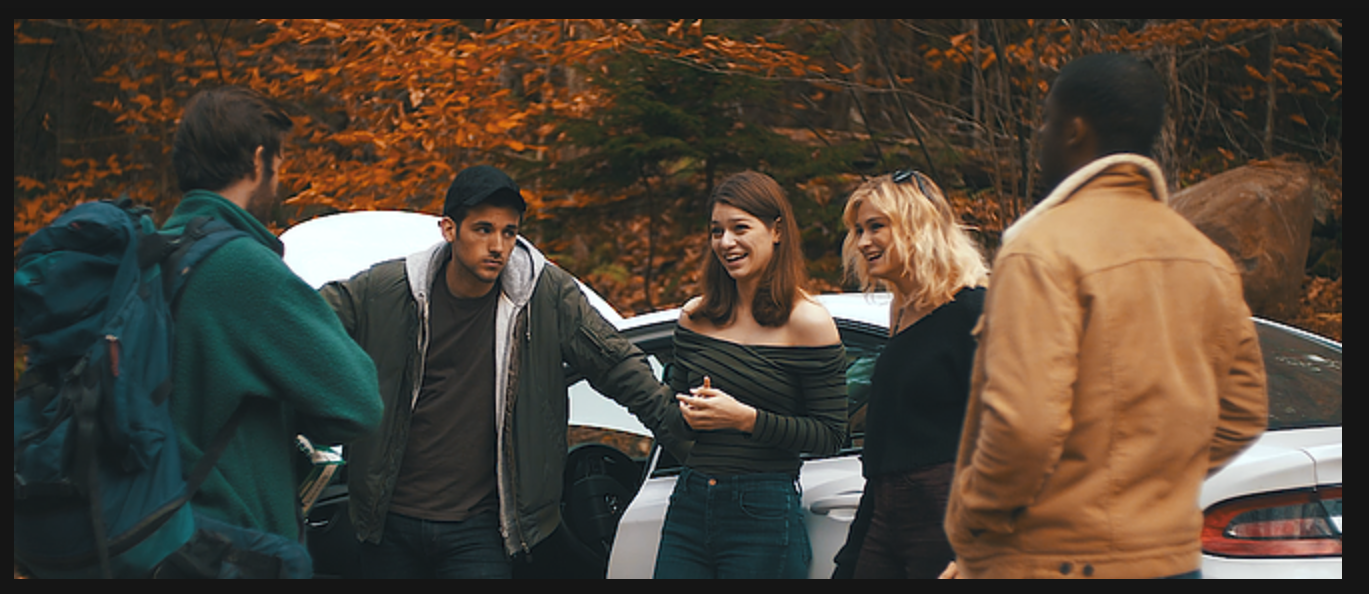
So, Day 1. Four friends arrive at the lake for the weekend. Tommy, Grace, Megan, and Kip. They pick up a hitchhiker on the way, Thomas. Almost immediately the place starts doing what the place does: photographs appear that could not have been taken yet, and in some of them you can make out figures in the background that do not belong there. The film is polite enough to let you notice this without underlining it seventeen times.
Kip goes looking for food and does not come back. Tommy and Thomas go after him. An old man appears in the woods screaming Megan’s name, over and over, and Thomas knocks him out. The old man is obviously Kip, aged up by whatever the lake does to time inside its loop, but the film lets that sit as an uncomfortable maybe for a while before confirming it.
Day 2. The old man, conscious now, is still screaming for Megan. Megan tells everyone he was dead when she found him that morning, which means he said something in the gap we did not see. Tommy and Thomas keep walking in circles in the woods, unable to leave, unable to return. The loop is already operating on them physically. That night Kip returns to the cabin as himself, young again or a version of himself that reads as young, and Megan goes at him with a knife, so they lock her in her room. Then Thomas gets up for water in the night, falls, and dies. The film treats this as ordinary and that flatness is the right choice.
Day 3. Thomas’s body is in the garage. They nail Megan’s window shut. New photographs have appeared: Tommy dead, Megan dead. The photographs are not predictions exactly and they are not memories exactly, they are evidence of other versions of these events running in parallel, which is where the film starts requiring your full attention. The group is beginning to understand, at a gut level before an intellectual one, that only one of them is getting out.
Megan ends up alone in the cabin with a gun. Tommy and Grace take the car. Kip kills Megan, and then tells Grace, with what reads as genuine relief, that he’s glad Megan never found out about the two of them, meaning Kip and Grace had an affair before this weekend. Megan died before she found out. That is played for dark irony and lands correctly. Then Kip moves to kill Grace, Tommy caves his head in with a bat.
Then we get the Vernon thread resolving: Thomas stumbles into Vernon and another man, and Vernon is explicit with him. He is not going into those woods. He is a hundred years old because a woman at the lake told him she could make him live forever, and that is the cost of it. He has been watching this machine run for a century.
Then the film resets. Or rather, it does not reset, it collides. We are suddenly watching what appears to be Day 1 again, except these are not the same four friends, these are Tommy2, Grace2, Megan2, Kip2, a second loop of the same people arriving at the same place. And Tommy1, the Tommy we have been following, comes flying out of the woods and hits the hood of their car. Grace1 is behind him. And Grace1 shoots all four of the new arrivals dead, efficiently, like someone who has been in the loop long enough to understand that a new group of themselves arriving is not a rescue, it is a complication.
Then MeganX shows up and stabs Grace1, which is where my notes, if I had been keeping any, would say something unprintable, because we watched Megan die, and now here she is, and the film does not explain which Megan this is or how she survived or from which timeline she has arrived. It does not owe you that explanation. That is the correct artistic choice and also the choice that will frustrate you at 1am.
The final image: two men at the edge of the woods, talking like they might know each other. One says, “Have we met before?” And we know from that line that one of them is new to the loop. He walked in, found the carnage, found the survivor, and has not yet understood what he walked into. Fade to black.
Untangling the Mechanics of Lake Artifact
The rules, as best they can be reconstructed from what the film shows you rather than tells you, work like this:
First: the lake property operates on a one-survivor logic. Regardless of how many people enter, the loop does not release more than one. If a group enters and they refuse to kill each other down to one, the loop does not shrug and let everyone go. It cycles. Day 1 resets.
Second: the cycle runs three days. After three days, if you are the last one standing, you can leave. If you are not, you start again. The three-day figure is not accidental, Wemple is leaning on resurrection imagery, and it maps onto the Vernon origin story cleanly enough that you can take it as structural rather than decorative.
Third, and this is the one that blows the clean version of rules one and two apart: the property also sits at a junction between alternate realities, meaning the loops are not just cycling in time, they are branching. Every decision, every course correction, generates a new timeline, and those timelines physically abut each other at the lake. Which means when you leave the cabin and come back, you may not be coming back to the same cabin. You are coming back to a cabin. A version of it. Where the photographs are slightly different and one of your friends is in a slightly different situation and the whole thing is slightly off in a way you cannot immediately locate.
The best existing framework for this, and the film is clearly aware of it, is Coherence. In that film, leaving the house and returning means crossing an invisible barrier between versions of the same location. The people inside the house you return to look identical to your people and mostly act like your people, but they made different choices at some juncture and the house they are in is technically a different house. Coherence gave its characters color-coded glow sticks and ping pong paddles as totems to track which version of events they were in. Lake Artifact gives you photographs. The photographs appearing before the events they depict are not prophecy, they are bleed-through from a timeline where those events already happened, arriving into your timeline slightly ahead of schedule because the walls between them are thin here.
The Vernon loop makes more sense inside this framework. He has been entering solo for decades, by his own account, and each time he enters he sees his younger self arriving as he leaves. That is two timelines touching at the seam, the one where old Vernon is exiting and the one where young Vernon is entering, and they are not the same timeline, they just look like it from inside the loop. Vernon learned to go in alone because one person entering means one person surviving, and that survivor is always him, and after seventy years of it he looks like a man who has stopped finding it interesting.
The Competing Reads
There are roughly three camps on what the end of this film means, and they each have something going for them.
The first read is the cleanest: by the time we reach the final scene, we have at minimum two collapsed loops, Loop 1 where our original four plus Thomas went through the full three-day cycle, and Loop 2 where fresh versions of the same four arrived by car. Grace1 killed Loop 2’s arrivals. Megan from some loop, possibly a third, killed Grace1. Tommy1 survived. Thomas2 walked in from outside the forest, having left Vernon by the road, and found Tommy1 at the edge of the woods, and neither of them fully knows what the other is yet. The “have we met before” line is Thomas2 not recognizing Tommy1 because he is new. This version is tidy and requires the fewest loops to account for.
The second read is messier and probably more accurate: the loops have been running much longer than the film shows you, and the collision at the end is not a two-loop collision but a three-or-more-loop pileup, with survivors from different cycles having been bouncing between realities long enough that some of them, Megan especially, are effectively ghosts of the system, people who by the strict rules should be dead in every timeline they originated from but who have persisted through enough branching that they exist in a kind of in-between state. Under this read, the film is not showing you an ending, it is showing you one moment in an ongoing process that has no ending, which is the same thing Vernon has been living for a century.
The third read, which is the most pessimistic and possibly the most honest, is that the film is not fully in control of its own mythology in the final twenty minutes. The collision of loops in the climax introduces more variables than the rules established earlier can cleanly account for, and some of what feels like deliberate ambiguity is actually the seams of a production that ran out of runway to resolve everything it set in motion. Under this read, you are not meant to fully understand MeganX because Wemple himself made a choice about what the ending felt like rather than what it meant, and the feeling is correct even if the logic has gaps.
Moviesoapbox’s Perspective on Lake Artifact
The second read. The loops have been running longer than we see, and the film is showing you a cross-section of a system that has been grinding for decades, possibly since 1953 and Vernon’s original competition. The survivors that accumulate in the cracks between timelines, the Megans who should be dead, the Vernons who watched themselves enter a hundred times, are the real horror of the premise, because the lake does not just kill you, it recycles you, and after enough cycles you stop being a person with a coherent timeline and become something the loop uses. The final image is not a resolution. It is a new pair of people walking into the same machine. Thomas2’s “have we met before” is the most chilling line in the film precisely because it is so ordinary. He does not know yet. He will.
That reading makes the Vernon framing at the beginning and end of the film do real work, because Vernon is not a warning the characters can act on, he is a demonstration of the endpoint, a man so thoroughly owned by the loop that eternal life and eternal imprisonment have become identical. The woman at the lake gave him exactly what she promised. That is the oldest trick in that particular genre of story, and Wemple earns it by not underlining it.
Bruce Wemple made this on whatever this budget was, with a cast of people you have probably not seen before, and he got something genuinely strange and genuinely disquieting onto the screen that plays by its own internal logic more consistently than half the studio-produced mind-job films that come out of development with seventeen producer credits and a resolution focus-grouped into coherence. Films like this do not usually survive with their endings intact. This one did. That is worth something.
Find the ones that survived.