
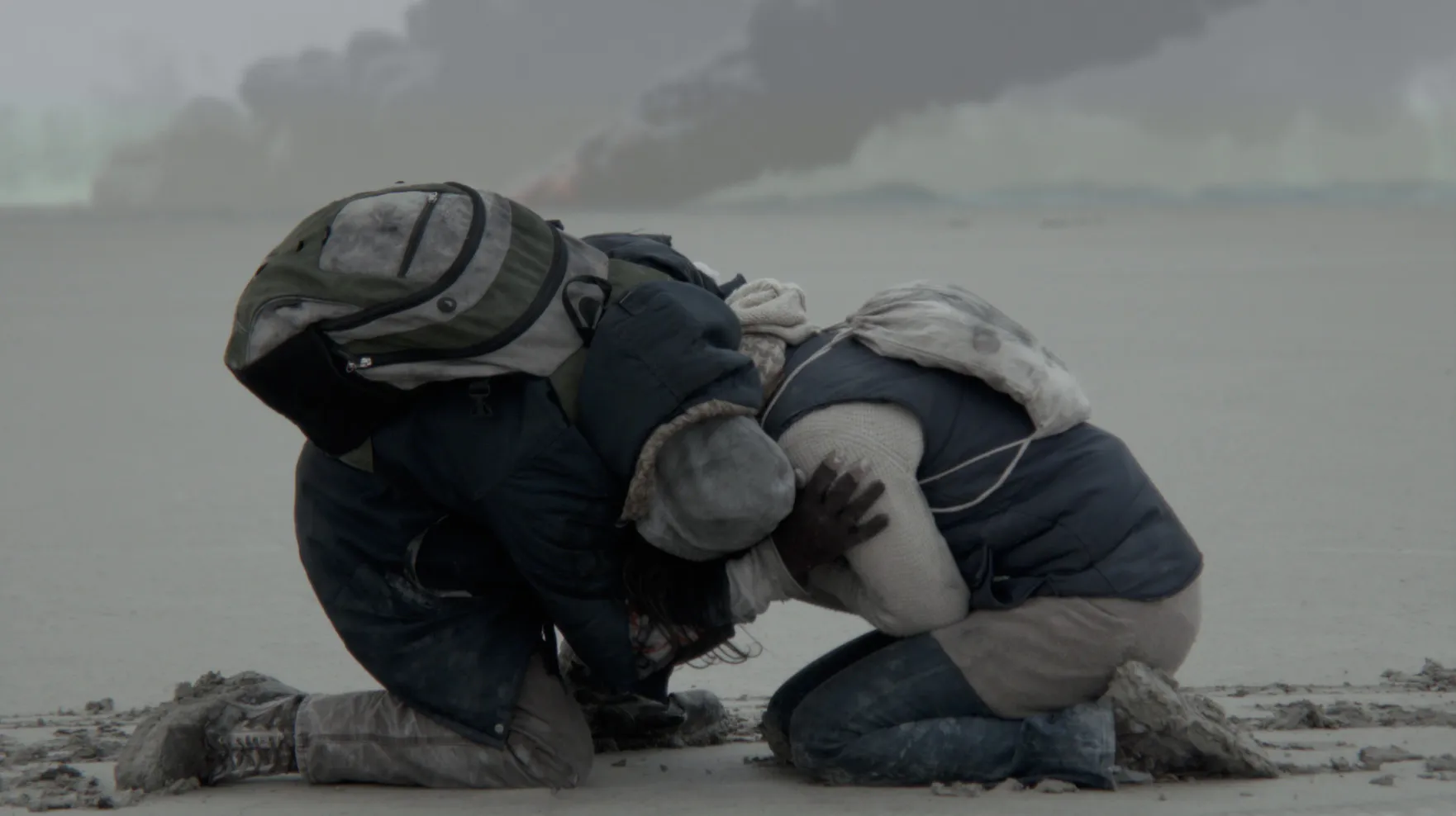
Hey there everyone! Welcome back to Movie Soapbox, the little corner of the internet that only you and I and that guy sleeping in the corner over there know about. This is the place where we find underappreciated indie films and we make sense of them. Today? We are doing a deep dive on Diverge, a movie so quietly, stubbornly deterministic that even the character who invented time travel in the film got his own thesis completely wrong.
Before we go any further, watch the trailer. You should know what you’re walking into.
Alright. If you haven’t seen the film yet, stop here, go watch it, and come back. What follows accounts for every major story beat including the final five seconds, and those final five seconds are the entire reason we’re here. You’ve been warned in the only way that matters: plainly, once, by someone who actually means it.
So. You’re watching a small-budget sci-fi film with a cast you almost recognize, shot in what looks like a combination of a coastal quarantine zone and the kind of desert that costs nothing to film in, and for the first forty minutes you are fighting it. The pacing resists you. The world-building is delivered in the flattest possible affect by people wearing the emotional expression of men explaining a car problem. And somewhere around the midpoint you start to wonder whether this film is austere or just underfunded, whether the restraint is a choice or a limitation, and the honest answer is that at this budget level those two things are the same thing. A film like this gets made because one person pushed it through, and it gets distributed because it was cheap enough that a distributor could take a flier. The version of this story with a bigger budget and a name above the title would have had that third act rewritten by a committee until the loop was explained, underlined, and explained again in a piece of expository dialogue that insults you. The version we got lets you figure it out from a shell. That is a creative decision that the money would have reversed. Remember that when you’re sitting in the first act wondering if it’s worth finishing.
Diverge Movie Timeline Walkthrough
Before we can talk about why the ending works, you need the architecture of what actually happens. The film is running two versions of Chris and two versions of Anna, and if you lose track of which is which the ending is just a man smiling at a rock on a beach, which is not a satisfying conclusion to anything.
Chris1 is in the ravaged future. Anna1 is dead. He can’t save her. Leader1 appears, makes him an offer, and sends him back. Chris1 lands in the past, where Chris2 and Anna2 are still alive, still intact, still early enough in the timeline that the antidote hasn’t been stolen yet. Leader2 warns Chris1 to stay away from Anna2. Chris1 ignores this, gives Anna2 the antidote, saves her. Then Jim Eldon and Whitmore show up, because the corporate struggle over the antidote is happening on a separate track that doesn’t care about any of this, and in the shootout that follows Chris1 kills both of them. Chris2 walks in on the aftermath. The two of them stand off, Chris1 holding the weight of everything he knows, Chris2 holding a gun pointed at a stranger with his face. Anna2 ends the standoff by stabbing Chris1 with scissors. Chris1 tells Chris2 it’s alright to shoot, Chris2 doesn’t, and Chris1 walks away to the beach.
On the beach, he finds a shell. He smiles. The outbreak happens anyway. Chris1 dies on the beach of the infection, the same one he came back to stop. Later, Chris2 and Anna2 wander through the same landscape. They find Chris1’s body. They take his gun. Anna2 picks up the shell. And that smile? That is the whole film.
Diverge Movie – Why Leader Is Wrong About Everything
Leader’s entire operating theory is divergence. Go back in time, introduce a change, and the timeline forks, a new branch splits off, new outcomes become possible. This is the optimistic read of time travel, the one where effort means something and the past can be rewritten. Leader sends Chris1 back because he believes the rock dropped in the river will redirect the river permanently.
The film disagrees with Leader completely, and it proves it quietly, without announcing itself.
Chris1 does everything differently. He gives Anna2 the antidote. He kills the men who would have taken it. He removes the variables that caused the catastrophe. And the catastrophe happens anyway. The baby still dies. Anna2 still gets sick. Chris1 dies of the same infection he came back to prevent, on the same beach, and his younger self finds the body. This is the river hitting the rock and swinging back on course. The timeline absorbed the intrusion and closed around it. Leader’s divergence theory is wrong. The loop is deterministic, the way 12 Monkeys is deterministic, and Chris1 figures this out at the exact moment he finds the shell.
Because here is what the shell means. Chris1 finding the shell on the beach is not a random moment of peace before he dies. It is the recognition that Chris2 will find this same shell on this same beach next to his own dead body. It is the handoff. It is proof that the loop has already run before and will run again, that Chris3 and Chris4 and ChrisN are all out there somewhere, each one sent back by a Leader who believes in divergence, each one dying on the same beach, each one leaving the same shell for the next iteration to find. The smile is not comfort. The smile is a man understanding, too late, that he was always the rock in the river and the river was always going to win.
Various Theories to Explain the Movie Diverge
Diverge Movie Theory #1 –
There are two serious ways people walk out of this film. The first is Leader’s read, which is also the read of anyone who found the ending ambiguous rather than conclusive. In this version, Chris1’s actions do create a divergent timeline. Anna2 got the antidote, which she wouldn’t have had without his intervention, and so Chris2 and Anna2’s future is genuinely improved even if Chris1 dies. The shell is a coincidence or a symbol, not a loop mechanism. The film is a tragedy about sacrifice, not a film about determinism.
Diverge Movie Theory #2 –
The second is the closed-loop read, which is the one the film is actually building toward. Chris1 does not change the outcome. The antidote he delivers is neutralized by the same outbreak that kills him. Anna2 still gets sick. The shell exists in Chris2’s hands at the end because it was always going to exist in Chris2’s hands at the end, because this has all happened before. Leader is wrong. The divergence theory is the film’s red herring, the false hope the plot hands you so the last five seconds can take it away.
Moviesoapbox Reading We’ll Defend
The closed loop. Completely and without reservation. The film earns it structurally. If this were a divergence story, the ending needed to show you the divergence, needed to give you some signal that Chris2 and Anna2’s future is genuinely altered. Instead it gives you Anna2 looking sick in the desert and a dead body on the beach. The only new information in the final sequence is the shell changing hands, and the only reason that matters is if the shell is proof of repetition rather than coincidence. Director James Morrison is not being coy here. He is being precise. The smile is Chris1 understanding the mechanism, and the mechanism is a loop that Leader’s entire enterprise has been feeding without knowing it. Every time Leader sends someone back, he guarantees the loop runs again. The divergence machine is a perpetual motion device for determinism.
This movie almost didn’t make it to that ending. At this budget level, with this kind of ambiguous close, the distributor had every reason to demand a cleaner resolution, a line of dialogue where someone explains what the shell means, a grace note that tells the audience how to feel. The fact that the film ends on a smile and a cut to black, trusting you to do the work, is the thing that makes it worth the forty minutes you spent wondering if it was worth finishing.
Most films like this one don’t get to keep their ending. This one did. And that makes it amazing.