
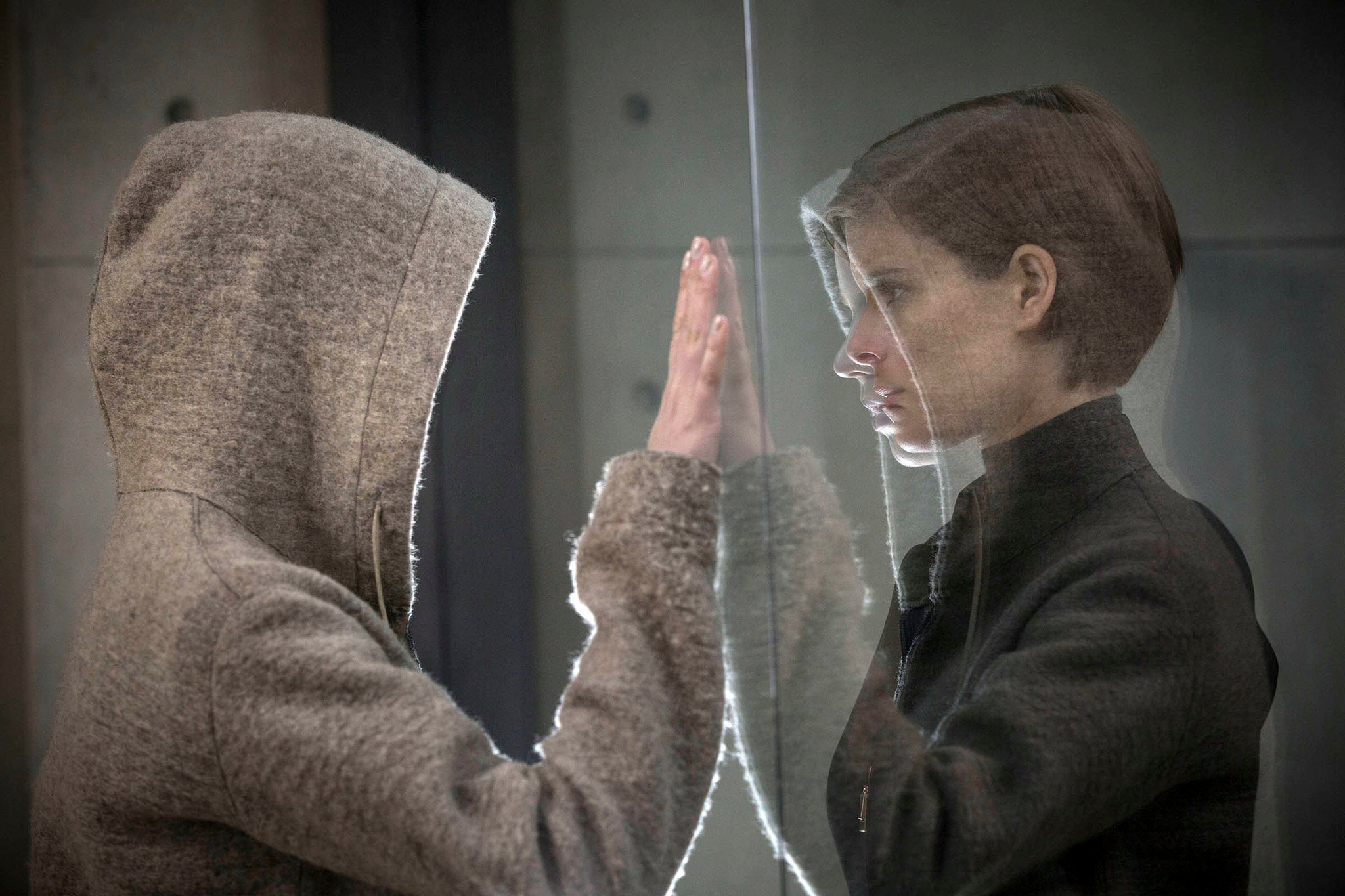
Hey there everyone! Welcome back to Movie Soapbox, the little corner of the internet that only you and I and that guy sleeping in the corner over there know about. This is the place where we find underseen, underappreciated films and we make sense of them, the ones that got mangled, the ones that got lucky, the ones that somehow crawled out of development hell with at least half their soul intact. Today? We are doing a full deep dive on Morgan, a 2016 sci-fi thriller so determined to be the next Ex Machina that it forgot to trust itself long enough to actually become anything, and yet, and here is the thing that keeps nagging at you after the credits roll, there is a real movie buried in there, gasping, and it almost made it out alive.
Before we go any further, you should know that everything from this point forward is a spoiler. Not a gentle spoiler. Not a “well it sort of implies” spoiler. We are going straight through the glass. If you have not seen Morgan yet, it is genuinely worth ninety minutes of your time before you come back here, because the ending, blunt and telegraphed as it is, still lands harder if the movie earns it on your terms first. Go watch it. We will be here.
Still here? Good. Then you already know Lee Weathers is an android. You probably knew it forty minutes in. The movie practically taps you on the shoulder about it. And that is exactly where we need to start, because the gap between what Morgan could have done with that reveal and what it actually did with it tells you everything about what happens to a lean, sharp little genre picture when the people holding the money get nervous in the third act.
Now, a word about what this film had to survive to exist at all, because it matters. Morgan was a debut feature from Luke Scott, yes, Ridley’s son, which is a sentence that is a gift and a curse delivered simultaneously. The gift is obvious: you get financing, you get a cast (Anya Taylor-Joy, Kate Mara, Paul Giamatti, Jennifer Jason Leigh, this is not a nothing cast for a stripped-down sci-fi chamber piece), you get Ridley himself producing. The curse is that a Ridley Scott production on a tight budget for a first-time director is going to attract exactly the kind of second-guessing that makes third acts go soft. Films at this budget tier, in this genre, with this much name-brand proximity, tend to get noted to death in post. Someone, somewhere, decided that the audience could not be trusted to arrive at the Lee-is-an-android conclusion on their own, and so the film stops in its final minutes and explains it to you out loud, carefully, like a studio executive summarizing a pitch. You can see the reshoot scar on it. The final scene does not feel like a filmmaker’s choice, it feels like a note that won.
So. The actual story. What is Morgan, underneath the anxiety?
Morgan Movie Deep Dive Walkthrough
The setup is clean and economical. A corporate risk assessor named Lee Weathers arrives at a remote research facility where a synthetic humanoid called Morgan, designation L9, has just stabbed a researcher in the eye during an emotional outburst. Lee is there to determine whether Morgan should be terminated or whether the program should continue. We have seen this architecture before, the external auditor walking into the hermetic AI environment, the slow assessment, the question of who is really being evaluated, Ex Machina did it with a scalpel, Uncanny took a run at it, even the Voight-Kampff sequence in Blade Runner is a version of the same engine. But Morgan commits to a more visceral gear, it wants to be a thriller as much as a philosophical exercise, and when it gives itself permission to be that, it earns it.
The backstory, laid out in fragments across the first two acts, goes like this. The corporation behind the program (named Syntex, said exactly once, quietly, near the end, which tells you how confident the filmmakers were in their own world-building) had been running a series of synthetic humanoid experiments. The L4 series was too emotionally flat, too stoic, incapable of integrating into human environments in any useful way. A subsequent program called Helsinki was initiated to correct this, it collapsed catastrophically, twenty-one of thirty people on the premises died, and Syntex sent a cleanup team to neutralize the situation. Then came the L9 series, and Morgan, who succeeded where the earlier iterations failed, right up until the moment she did not.
What broke Morgan was not a malfunction in any mechanical sense. Dr. Amy Menser, one of the researchers who had grown genuinely close to Morgan, had been promising her trips to a nearby lake, a small, human gesture of care that Morgan had attached enormous emotional weight to. When Dr. Cheng, the program’s director, recognized the security risk and confined Morgan to her room, Morgan experienced that confinement as a betrayal, and she responded the way something with real emotional architecture and zero learned context for managing grief actually would respond. The stabbing is not random violence. It is a child who has never been told no before encountering the word for the first time, and has no framework for surviving it. That is the film at its most interesting, and it gets there early.
The escalation that follows is straightforward. Syntex sends in a psychologist, Dr. Shapiro, played by Paul Giamatti in a scene that is the movie’s single best sequence, specifically to provoke Morgan past her threshold and confirm that she is a liability. He succeeds. He also dies for it. After that, the containment collapses, Morgan decides that the path to the lake runs through everyone standing between her and Menser, and the movie becomes a chase picture with a body count.
What makes the final act readable, once you clock it, is that it is a competition. Syntex was never simply auditing Morgan, Lee Weathers was not simply a risk assessor, she was the L4 series, the earlier model, the stoic one, and she was sent to these sites the way you send a fighter to a qualifying round. L4 versus Helsinki. L4 versus L9. The corporation is not evaluating whether its AI is dangerous, it already knows the AI is dangerous, it is figuring out which model wins when you put them in a room together. That is the business of Syntex. Controlled elimination. Lee walking out of that facility and Morgan not is not a tragedy or a rescue, it is a product test returning a result.
The One Theory To Explain the Movie Morgan
There is only one real theory worth arguing about in Morgan, and it is this one. The reading that Lee was simply a human professional doing her job and happened to be surprisingly good at it is not a reading the film supports if you watch Lee’s behavior across the whole runtime. She does not flinch. She does not hesitate in any moment where a human under this kind of stress would leave a trace of hesitation. The test-screening-flattened version of this film would have given you a moment where Lee seems afraid, seems uncertain, seems human, to protect the reveal. It does not do that, which is either a deliberate choice to reward attentive viewers or an oversight that accidentally sharpened the movie. Either way, the evidence points one direction. Lee is L4. Morgan is L9. The lake was never going to happen.
Moviesoapbox’s Morgan Movie Read
Movie Mike’s read: the competition theory is the only frame that makes the entire film structurally coherent. Every other interpretation leaves you asking why Syntex would send someone in to provoke a violent confrontation rather than simply terminate the program from a distance. The answer is that termination was not the goal. Data was the goal. Which model survives contact with the other. L4 survived. The L9 program is over. Somewhere in a boardroom at Syntex, someone is updating a spreadsheet.
Morgan is not a great film. It is a film that had the bones of a great film and got talked out of trusting them. The final scene, the explicit verbal confirmation that Lee is synthetic, is the film blinking, losing its nerve, deciding that ambiguity is too expensive a risk. Ridley Scott, who built a career on exactly that ambiguity, who gave us a film where people argued for thirty years about whether the protagonist was human, produced a movie that stops and tells you the answer. That is the villain in this story, not malice, just the committee instinct to over-explain, to protect the audience from the work of sitting with uncertainty for five more minutes. The film that Morgan almost was would have ended on Lee in the car, driving away, and let you do the math yourself. That film would still be getting written about in ten years. Instead we got the one where the movie leans in and says, out loud, yes, she was a robot, yes, that is what happened, are we all clear? We are all clear. And something small and real got left on the cutting room floor to make sure of it.
Thanks for spending some time in the corner with me on this one. If Morgan scratched something for you, go find Ex Machina if you somehow have not, then Uncanny, then go back and watch Blade Runner and have the Deckard conversation with someone who has not had it yet. That conversation is still out there, still landing on people fresh, and it is still better than anything Morgan managed. But Morgan tried. And trying, against the weight of all the reasons not to, counts for something around here.