
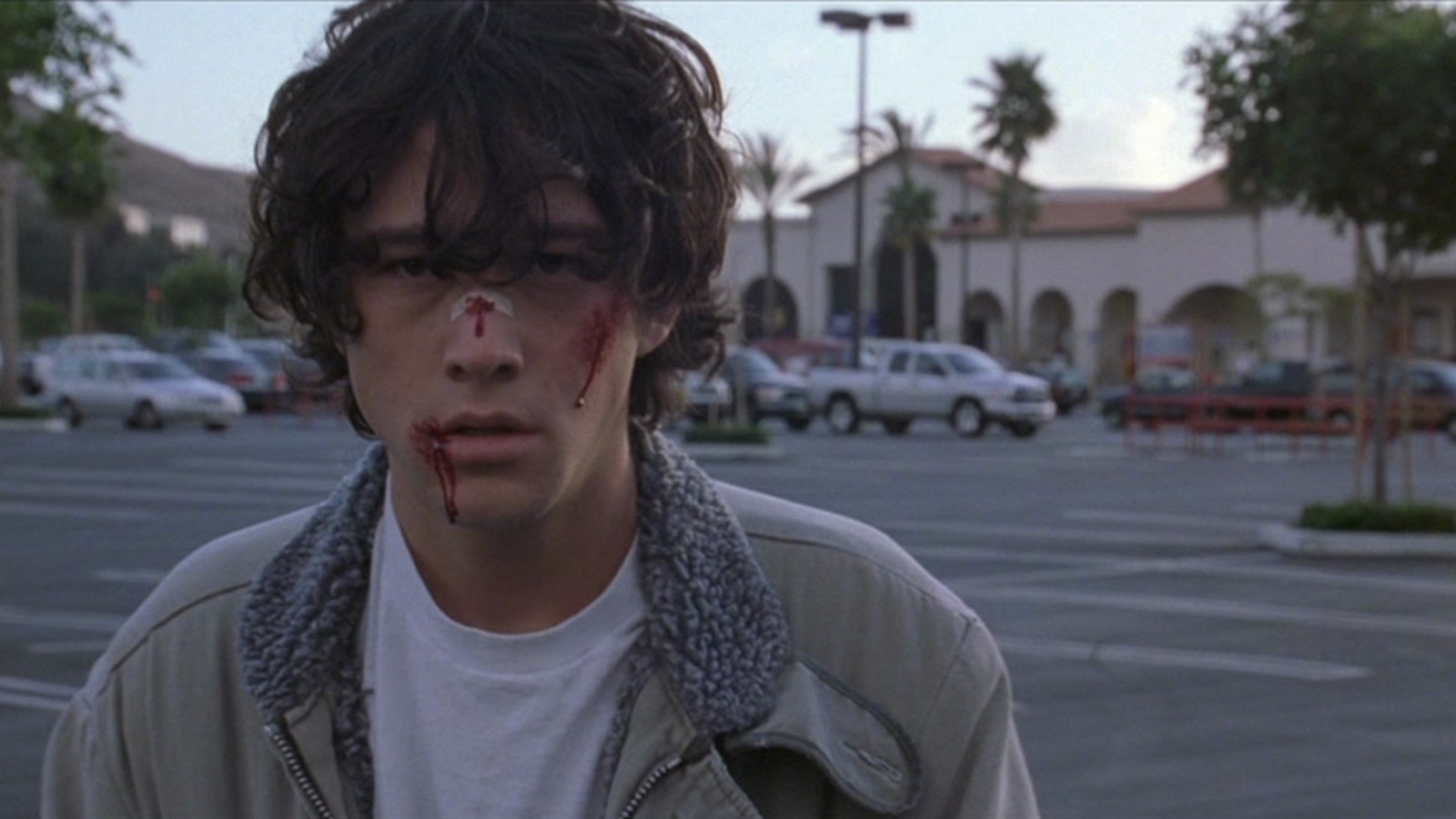
Hey there everyone! Welcome back to Movie Soapbox, the little corner of the internet that only you and I and that guy sleeping in the corner over there know about. This is the place where we find underappreciated indie films and we make sense of them. Today? We are doing a deep dive on Brick, a movie so deliberately, aggressively opaque that it managed to alienate the exact audience that would have loved it most, which is a trick only a genuinely original filmmaker pulls off on a first feature.
Fair warning: everything from this point forward is a spoiler. The whole enchilada. The dead girl in the drain, the ninth brick, what Laura whispered, whose kid it was. If you haven’t seen the movie, go watch it, come back, and we’ll be here. You’ve been warned, and Movie Mike does not do spoiler-free.
Now. Brick came out in 2005. Rian Johnson wrote it in college, shot it for around half a million dollars, and somehow talked a young Joseph Gordon-Levitt into anchoring the whole thing. At that budget level, at that cast tier, the conventional wisdom inside a development office is that the director has already traded creative control for financing before the cameras roll. You can feel the places where that negotiation usually happens: the third act, the tonal consistency, the sound mix. What’s remarkable about Brick is that none of those places show the usual scars. The third act is exactly as weird as the first. The tone never flinches toward something more comfortable. The sound mix is, if anything, more alienating than it needed to be, which means nobody with final cut anxiety got into this edit. Johnson kept the wheel. You can tell, because the movie that exists is exactly the movie that would have been killed in notes round three at any studio that greenlit it for twice the budget.
So let’s get into what actually happens, because the movie earns the confusion it causes and you deserve to have it untangled properly.
Who Killed Emily, and Why
The film opens on Brendan (Gordon-Levitt) crouched over Emily’s body in a drainage tunnel, and then spends the next ninety minutes making you work for the reason she’s there. The answer, once you peel it back, is cleaner than the film makes it feel in the moment.
Tugger killed Emily. That’s the what. The why takes longer. Someone stole one of the nine bricks from The Pin’s supply, cut it with something that sent one of his men to the hospital, and the finger landed on Emily. Tug went to her to settle the account. Emily, cornered, told him she was pregnant, that the baby was his, hoping it would buy her safety. Tug killed her anyway.
That’s the bottom layer of the onion. Every other question in this movie is about who engineered the situation that put Emily in front of Tug in the first place.
Laura’s Play, Explained From the Outside In
The answer to that question is Laura (Nora Zehetner), and the movie only confirms it in the final field conversation between her and Brendan, delivered in Johnson’s own screenplay voice.
Laura stole the ninth brick. She kept half, added filler to reconstitute the weight, and either intentionally or accidentally poisoned the batch in the process. When The Pin started closing in on the actual thief, Laura pointed at Emily. Dode, trying to protect Emily, hid her. The Pin found her anyway and sent word he wanted to meet. He sent Tug instead. You know the rest.
The final piece of Laura’s endgame is the meeting at The Pin’s house. Brendan had already arranged for the police to arrive, trying to force a clean conclusion. Laura’s move was to steal the ninth brick before that meeting, so that when The Pin demanded Tug prove himself by taking a hit from it and the brick turned up gone, the room would go to war. She wanted The Pin dead. She wanted Tug dead. She wanted Brendan dead, because Brendan was the only one still asking the right questions. The house went exactly the way she planned. Tug killed The Pin. The police killed Tug on his way out. Brendan survived because he’d already stepped back from the blast radius, which is the one variable Laura hadn’t accounted for.
Brendan’s closing move, the one that pins her, is telling her he already knew the ninth brick was in her locker. The screenplay has him tipping the VP rather than the police directly, which is a small difference that actually matters for the logic, because the VP is the bureaucratic mechanism of the school’s version of law enforcement, and the whole film is operating inside that parallel-universe institutional structure. Either way, Laura walks away knowing she’s already done.
And then she whispers “motherfucker” into his ear and leaves. The closed captions confirm it. Johnson left it in the wind because it’s funnier and uglier that way.
Why Tug Killed Dode, and What That Move Tells You
The Pin calls the meeting to hear Dode out. Dode was at the tunnel. Dode saw Brendan arrive and then move Emily’s body further in. He was about to tell The Pin that Brendan killed Emily. Tug kills Dode before he can finish the sentence.
Why? Because Tug killed Emily. Letting Brendan take the fall would have solved Tug’s problem cleanly. But Tug killing Dode to protect Brendan from a false accusation is the tell, the one moment where Tug’s actual guilt becomes visible through his action. He can’t let the wrong man burn for a thing he did. That’s the noir math working correctly underneath all the slang and the high school hallways.
The Mechanics, Untangled
A few things that the movie lets you trip over without explaining:
Emily disappeared about three months before the film begins. That timeline matters, because it’s the same window in which she stopped spending time with Brendan and started running with Dode and Tug. Laura’s final monologue on the field makes the father explicit: “You know whose kid that makes it, or have you known all along?” Brendan knew. It was his. Emily had told Laura she didn’t love the father, which is a brutal detail the script buries in a single speech, and Laura had arranged for her to tell Tug the baby was his because she calculated it would buy Emily some protection. It didn’t.
The other thing worth nailing down is the sequence of Brendan’s plan heading into the final meeting. He had already put Emily’s body in the trunk of Tug’s car, pointing the police toward Tug before the house meeting even started. His offer to take the hit from the ninth brick himself was a stall, a false gesture of trust designed to hold the room together long enough for the police to arrive. When the brick went missing he understood immediately that someone else had been working the board the whole time. He just had to survive long enough to figure out who.
Brick Movie Theories
Brick Movie Theory #1 – The Straight Read
This is a sincere, formally rigorous neo-noir that happens to be set in a high school, and the high school setting is a deadpan ironic frame that the film maintains with absolute commitment. The slang is real 1940s hardboiled dialogue, not parody. The student/teacher power structure maps onto the cop/informant structure of the genre. Johnson is asking what happens when you apply the most cynical adult genre to the most supposedly innocent social environment, and the answer is that it fits without alteration, which is the actual joke and the actual horror.
Brick Movie Theory #2 – The Brain Doesn’t Exist
The Brain (Matt O’Leary) is Brendan’s externalized cognition, an alternate personality that lets him process information and run scenarios he can’t consciously acknowledge. Every task Brain is given is a task Brendan could have completed off-screen. Brain is never shown interacting with anyone else in a way that another character independently confirms. If you watch the film with that frame, Brendan becomes a much more unsettling protagonist, a kid running a fragmented dissociative intelligence through a genuine grief spiral. The movie doesn’t confirm this and doesn’t deny it. Johnson leaves the hatch open.
Brick Movie Theory #3 – The Absurdist View
There’s a third, smaller read that treats the whole thing as a comedy about genre itself, the high school noir as inherent absurdism. This one doesn’t hold up to the film’s actual tone. Johnson plays it completely straight. Comedic reads require winking. This film does not wink.
Moviesoapbox’s Personal Take
The Brain theory lands for me, and here’s why I commit to it: the film is operating inside Brendan’s subjective experience from the first frame. Everything we see is filtered through a kid who is grieving, isolated, and running on almost no sleep or food through several days of escalating violence. The scenes with Brain function structurally as internal monologue rendered as dialogue, which is a technique with deep roots in the genre. Johnson knew exactly what hardboiled fiction does with the detective’s internal voice, and he found a cinematic equivalent that doesn’t require voiceover, which would have been the easy, lesser choice. Brain as genuine separate person is possible. Brain as the part of Brendan that stays cold and analytical while the rest of him is falling apart is the reading that makes the film a genuine character study underneath the genre machinery.
Laura as the villain works whether Brain is real or not. But if Brain is a construct, then Brendan spending the whole film in conversation with his own dissociated intelligence while trying to find out who got his girlfriend killed and his child buried becomes one of the bleaker portraits of grief in American indie cinema. A movie that got made for half a million dollars, kept entirely out of the hands of people who would have softened that, and still exists exactly as intended. That almost never happens. When it does, you pay attention.
If You Liked Brick…
Revolver (2005) – Crime underworld rules filtered through a puzzle-box structure where the con has more layers than the plot can hold. Ritchie at his most ambitious and divisive.
The Tangle (2019) – Noir dialogue, conspiracy architecture, and a world built on surveillance — all on a micro budget. If Brick proved high school could be noir, The Tangle proves nanobots can be too.
Red Lights (2012) – An investigation that uses misdirection the same way a stage magician does. The ending pulls the rug with the same confidence Brick does in its final act.