
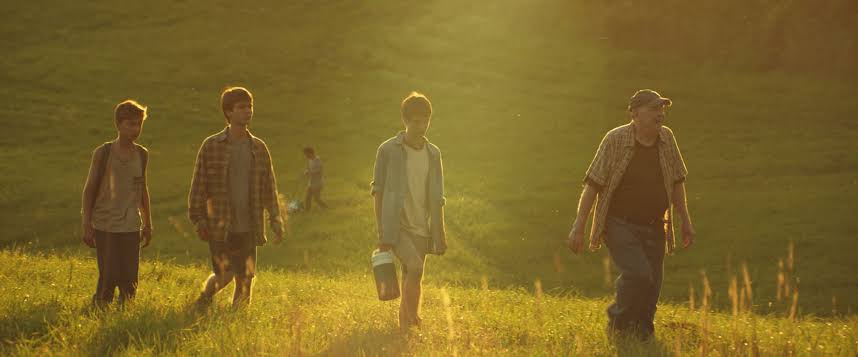
The Strange Ones Explained 3 Theories on What Really Happened. Welcome back to Movie Soapbox, the little corner of the internet that only you and I and that guy sleeping in the corner over there know about. This is the place where we find underappreciated indie films and we make sense of them. Today? We are doing a deep dive on The Strange Ones, a movie so deliberately fractured and quietly horrifying that most people finish it, sit in the dark for a minute, and then go look for someone to explain it to them. Which is exactly how it was supposed to work. And also exactly why it almost never got made.
Before we go any further, you need to know that every single thing from here on out is a spoiler. The whole analysis requires you to know the ending, the structure, the twist in the architecture of the thing. If you haven’t seen it and you want to go in clean, close the tab. Come back after. I’ll be here. For everyone else, let’s go.
So here is what you need to know about a film like The Strange Ones before you even look at the story. Directors Christopher Radcliff and Lauren Wolkstein made this as a short first, built an audience for the concept, then expanded it to feature length, which is one of the few paths left where a filmmaker can actually protect something this uncomfortable from the committee. You can tell, watching this film, that nobody got to soften it in the third act. There’s no scene where a caring adult enters and reframes what we’ve seen in a way that makes the audience feel absolved. The film ends on a mantra that is supposed to be comforting and reads like a threat. That’s a specific choice, a hard choice to defend in a pitch room, and the fact that it survived to the final cut tells you something about how little oxygen the suits had in this particular room. A film with this subject matter and a slightly more prominent cast attached would have had four more rounds of notes and a reshot ending that explained everything twice. What Radcliff and Wolkstein delivered is a film that trusts you enough to leave you alone with what it just told you. That is rarer than it should be.
Strange Ones Movie Walkthrough
Now, let’s actually walk through what happened, in chronological order rather than the order the film gives it to you, because that alone will dissolve about ninety percent of the confusion people carry out of the theater.
Sam lives with his father Robert. Robert works nights and beats Sam when he’s home. Standard absent-then-violent dynamic, the kind of home situation that becomes the gravitational center of a kid’s entire interior life. While Robert’s at work, Sam stays with the next-door neighbor, Nick. This is the holy trinity of the film: Sam, Robert, Nick. Everything else radiates out from those three points.
Nick tells Sam, essentially, that he doesn’t have to take it. That if he were in Sam’s position he’d defend himself. This is the seed. This is where the film’s real horror begins, not with Robert’s fists, but with Nick’s counsel, because Nick is not a good man giving good advice. Nick is a predator who has identified an isolated, frightened child and positioned himself as the only safe harbor in the boy’s world, which is the oldest move in that particular playbook.
Sam kills his father. Not in some ambiguous off-screen way, the film gives you enough to be certain. Robert comes home, apologizes, turns away, and Sam does what Nick told him to do. Nick then helps Sam burn the house down, and the two of them run. They are headed back to Nick’s childhood territory, a cabin in the woods, this idyllic future Nick has been painting for Sam in his head all along. Every step of this plan was Nick’s. Every piece of the fantasy was Nick’s. Sam is twelve years old and he just killed a man because a neighbor built a mythology of escape around him and handed him a reason.
On the road, things deteriorate. Nick hits a deer. They end up at a roadside hotel managed by a woman named Kelly, who takes a liking to Nick, and for a moment they have a genuinely safe harbor. Sam blows it. He tells Kelly that Nick might rape her, outs him as gay, torches the arrangement entirely. And here is where a lot of viewers get lost, because it seems self-destructive, inexplicable. But think about what Sam is actually doing. He is the only thing in Nick’s world that Nick wants. A woman showing interest in Nick is a threat to Sam’s place in that arrangement, and Sam, who has been trained by abuse to read threats and neutralize them, neutralizes it. Nick hits him for it. Because Nick is not the rescue Sam thought he was, Nick is just a different room in the same building.
They make it to the woods. Someone spots them, Nick gets shot, tells Sam to run. Sam finds a summer camp, gets taken in. The authorities put it together. Nick dies in a shootout in a cave. Sam winds up in conversation with a Child Protective Services worker who feeds him the official narrative: Nick killed Robert, abducted Sam, the end. And Sam, who knows exactly what happened, lets that version stand. He lets it stand because he is twelve years old and he just watched two men die and the truth is something he cannot say out loud and survive.
Sam goes to stay with his friend Sarah. Sarah has a crush on him. In their conversation, in the fragments and deflections and the flashbacks that punctuate this section, you get the truth assembled in pieces. Nick was sexually abusing Sam. Sam texted Sarah before the killing, said he wanted his father dead. When Sam finally rejects Sarah’s advance and runs out into the night, the flashbacks crystallize, and you see clearly what happened and why and who Nick really was. The film ends with Sam receiving the same advice from the camp director that Nick gave him, that your memories are under your command, that you can decide which parts of your history are real. Fade to black. No one is okay.
The Movie Theories To Make it Make Sense
Three theories have grown up around this film, and they are worth laying out properly before we decide which one the movie is actually making.
Theory One: The Literal Reading.
Everything above, taken at face value. Robert abuses Sam physically. Nick abuses Sam sexually. Nick psychologically manipulates Sam into killing Robert so that Nick can have exclusive access to Sam, framed as freedom, framed as escape, framed as the only love the kid has ever known. The triangle is all abuse, different vectors. This theory requires the least interpretive work and accounts for every scene in the film. The film’s editing is nonlinear to reflect Sam’s fractured mental state, not to suggest unreality. This is what happened.
Theory Two: Nick is Sam
The first comment on the original write-up of this film, three words: “Nick is Sam.” And look, you have to engage with this seriously, because the fractured-psyche genre has earned the right to be taken seriously. The argument runs like this: Sam is so comprehensively traumatized, by Robert, by repeated sexual abuse from rotating neighbors, that his mind splinters. He creates Nick as an externalization of himself, an older version, a protector, an escape plan. When Nick dies in the cave, Sam steps into the road and chooses his own death. The film’s nonlinear structure is not just damaged memory, it’s the flickering of a dissociating mind that has invented a companion for itself.
The problem is the sexual abuse between Nick and Sam, which the film makes too concrete, too specific, too present to read as self-inflicted in any coherent way. A fractured psyche that invents a protective older self does not then have that self sexually abuse the younger self it was invented to protect. You can’t get the logic to run cleanly, the pieces bind up against each other. The theory is creative and it comes from a real place of engagement with the film, it’s just not what the film built.
Theory Three: Determinism and the Lie of Willed Memory.
The mantra that runs through the film, first from Nick, then from the camp director, is that you can control your memories, you can decide they don’t exist, you can choose which parts of your history are real. If you take this seriously as a structural claim rather than irony, you get a film where Sam is genuinely rewriting his own experience in real time, where nothing we see is stable, where the film’s fractured chronology is Sam’s active revision of events rather than passive trauma response. The problem here is that the film is clearly using this mantra as a dark punchline, the advice Nick gives Sam is the same advice a predator always gives his victim, which is: forget it, move on, decide it didn’t happen. The camp director repeating it at the end is not comforting. That’s a horror beat dressed as a resolution. The film is not endorsing the mantra, it is pointing at the mantra and asking you to recognize it for what it is.
So here is what I believe, stated plainly, without hedging. Theory One is the film. Sam was manipulated into killing his father by a man who was sexually abusing him and wanted to ensure Sam could never leave. Nick built a fantasy of escape and freedom and self-determination around a child who had no frame of reference to evaluate the offer clearly, and then cashed that fantasy in for his own purposes. The philosophical question the film raises about free will and determinism is not an open question, the film answers it. Sam had no free will in this story. Every door that might have led somewhere else had been closed before he was old enough to find it. What the movie calls determinism, the real world calls grooming.
This is a film that survived being made because it stayed small enough and smart enough to keep the wrong people out of the room. The version of this story with studio notes is a version where someone adds a scene that explains it more, softens it more, makes the ending less like a punch to the sternum. That version doesn’t exist. What exists is this one, which trusts you enough to leave you with something that doesn’t resolve. That’s the whole job, and it got done.
Thanks for pulling up a chair here at Movie Soapbox. We’ll see you on the next one.