
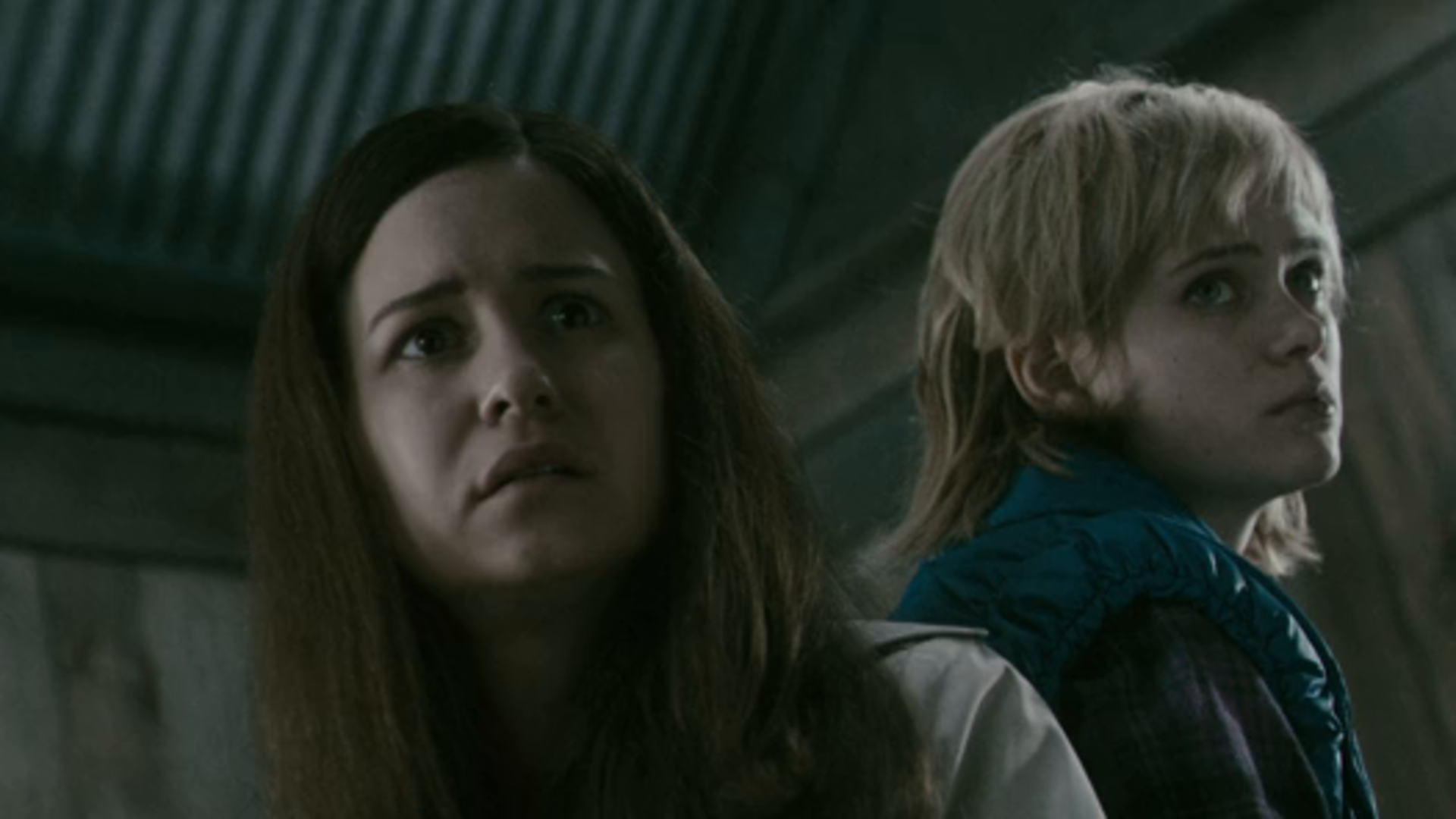
Hey there everyone! Welcome back to Movie Soapbox, the little corner of the internet that only you and I and that guy sleeping in the corner over there know about. This is the place where we find underappreciated indie films and we make sense of them. Today? We are doing a deep dive on Enter Nowhere, a movie so quietly, stubbornly strange that it somehow squeezed a genuine thesis about generational trauma and broken family lines into a closed-box mystery that most people have never heard of and most studios would have gutted before the third act even had a chance.
Listen, if you haven’t seen this film yet, go find it. I’ll be here when you get back. Because once you’re past this line, I’m going to tell you everything, every twist, every reveal, every moment where the movie earns what it’s trying to do. You’ve been warned. This is not a drill. Go watch it, come back, and then we’ll talk like adults.
Enter Nowhere Discussion of How It was Made
Before we get into what actually happens in this film, let me tell you something about the kind of movie Enter Nowhere is, and more to the point, the kind of movie it could have become in other hands. This is a sub-million-dollar closed-box with three unknown leads and one guy whose entire industry identity is being Clint Eastwood’s son, and what that combination typically means in a development context is that nobody with real leverage was fighting for the script’s weirder instincts. A producer with a distribution deal to protect would have been pushing for a cleaner horror framing, a more legible villain, some kind of creature or threat that the poster department could actually work with. The fact that this film got to be what it is, a generational-trauma time-puzzle that doesn’t even try to explain its own mechanics, tells you the director and writers either had iron in their spines or nobody important was paying enough attention to stop them. Either way, something real got through. That doesn’t always happen. Most of the time it doesn’t happen.
Enter Nowhere Movie Walkthrough
So. Enter Nowhere. Here’s how it moves. The film opens on Jody, played by Sara Paxton, mid-robbery with her boyfriend Kevin at a convenience store. She’s in charge, she’s got the gun, and when she orders the owner to open the safe, he tells her she can’t handle what’s inside it. She shoots him anyway. Pin that moment. The movie pins it for you whether you want it to or not.
We jump back slightly and meet Samantha, played by Katherine Waterston, who ran out of gas, wandered off to find some, and ended up at a shack in the middle of nowhere instead. She takes some food. She meets Tom, played by Scott Eastwood, who tells her she’ll die of exposure if she’s not careful. Then Jody shows up and they’re a trio. And when Tom tries to find a way out and returns from the exact direction he left, the geometry of the place starts telling them something is wrong. They compare notes. Samantha says it’s 1962. Jody says it’s obviously 1985. Tom tells them both it’s 2011, and the film just lets that sit there like a stone dropped in still water.
The standard closed-box reflex here, the Jacob’s Ladder move, the purgatory read, is to assume these people are trapped together because of shared moral failure and the exit is repentance. The movie lets you think that for a while. It earns that assumption. Then it detonates it, because the three of them aren’t strangers who happened into the same hell. They are the same family, three points on a single bloodline, pulled together across five decades into one place that has no name and no explanation.
Then a fourth person arrives and makes everything worse. Hans, a German soldier, comes crashing out of the woods firing his rifle. Samantha has some German, which doesn’t help much because Hans isn’t interested in conversation. He ties everyone up. There’s a long stretch of fear and threat, and the girls reason, reasonably, that this man is dangerous in every way a Nazi soldier in the middle of nowhere can be dangerous. But then Hans sees the lockets. Samantha’s locket. Jody’s locket. And he comes completely undone.
Because the woman in Samantha’s locket is his wife. Which means Hans is Samantha’s father. Which means the chain connecting all four of these people is not metaphorical, it is biological, and it runs in one direction through time.
Let me lay out the full lineage for you, because this is where the film asks the most of you and it’s worth getting it clean.
Hans Neumann is a German soldier, late to the party as far as the Nazi movement goes, but in it nonetheless. He dies in a bombing raid on Wielun during the war. Without him, Samantha’s mother eventually remarries an American. Both of them die in a car accident around 1959 or 1960. Samantha grows up, marries Adam Cohen, gets pregnant in 1962. Adam ships to Vietnam and dies there. Samantha goes into labor alone, complications set in, the paramedics are late, and Samantha dies in childbirth. Jody is born November 11th, 1962. Samantha’s surviving in-laws, Adam’s family, who never liked Samantha to begin with, take Jody in and abuse her throughout her childhood. Jody grows up angry and without anchor, takes up with Kevin Banks, and the two of them start robbing banks and stores. Kevin gets Jody pregnant. She doesn’t know yet. During a heist she shoots the convenience store owner. Then she kills Kevin to keep his share of the money. She’s caught, convicted, sent to South Dakota’s Women’s Prison, where Tom is born December 12th, 1985. Eight months later, Jody is executed. Tom goes to a Catholic orphanage. A priest abuses him. Tom eventually comes back and kills the priest. Then kills himself.
That is timeline one. Every person in that chain is failed by the absence of the person before them. Hans dies, so Samantha is raised without a father and without his resources. Samantha dies, so Jody is raised without a mother, passed to people who had no love for her. Jody is executed, so Tom is raised without anyone. Each tragedy is the mechanism of the next one. The war doesn’t just kill Hans. It kills everyone who would have existed in his orbit.
When the three of them piece this together, the dreams they’ve been having stop being dreams. They’re futures. Tom is the one who names the logic out loud: if Hans survives the bombing, Samantha’s mother doesn’t remarry, Samantha has family around her when Adam goes to Vietnam, someone drives her to the hospital, she doesn’t die, Jody grows up with a mother, Tom grows up with a real one. One man in a bomb shelter in 1939 or whenever it is undoes fifty years of cascading damage.
Samantha looks down and notices that Jody’s scar has disappeared. The timeline is already shifting.
What follows is the film’s most chaotic stretch, Tom trying to get Hans to the shelter before the bombs drop, Hans accidentally shooting Jody, Tom running around the building to intercept and Hans firing at him, and missing, because Tom is already dissolving. His mother just died a few feet away from him. If Jody doesn’t survive to exist, Tom cannot exist. He doesn’t die in this moment. He just stops. And that is a very specific thing to put on screen on a budget this small, and the movie does it without flinching.
Hans and Samantha make it to the shelter. The doors close. The bombs fall. And then the film rewinds everything and shows you the new version.
Timeline two: Hans comes home from the war. He and his wife raise Samantha together. Samantha marries Adam, gets pregnant, and when Adam ships to Vietnam, her mother is there. She makes it to the hospital. Jody is born with a mother waiting for her. Hans eventually dies, decades later, as a philanthropist. Samantha and Jody go to the beach to scatter his ashes. That’s the ending. That’s the whole movie.
Tom is nowhere in this version because there’s no version of this version where Tom exists. Kevin never meets Jody, or if he does, it’s a different story with no child in it and no execution at the end. Tom was never a person in this timeline. He was always a consequence of the damage, and when the damage is undone, so is he.
Theories to Explain the Movie Enter Nowhere
Now, the theories. There are three competing reads on what this film is actually doing, and I’ll give them to you straight before I tell you which one I believe.
Enter Nowhere Movie Theory #1 –
The first read is the supernatural purgatory model. These three are pulled together by some unnamed force to correct a wrong before they can all be released into their proper futures. The film doesn’t explain the mechanism because the mechanism is beside the point, it’s a moral corrective, not a physics problem. The closed box is a crucible, not a place.
Enter Nowhere Movie Theory #2 –
The second read is the determinism read. The timeline always needed to be corrected. The convergence of these three people was always going to happen because causality required it. They weren’t chosen or pulled, they were the only possible configuration of people who could have ended up in that location given how the damage ran through their line. The shack isn’t magic, it’s the inevitable meeting point of a broken chain.
Enter Nowhere Movie Theory #3 –
The third read, and the one the film itself seems most interested in, is the sociological read. The movie is using its time-loop mechanics to make a structural argument about what absent family actually does across generations. The supernatural frame is just the most efficient way to illustrate a chain of cause and effect that would otherwise take a five-season television show to dramatize. Hans isn’t a metaphor. He’s a variable, and the film is showing you what happens when you change it.
Moviesoapbox’s Preferred Theory –
I’ll tell you where I land. The third read is the right one, and I’ll go further than the film does in stating it plainly. What Enter Nowhere is actually arguing is that the wounds we think of as personal, as individual failures of character, the angry girl who picks up a gun, the broken boy who can’t find a way to live, are almost never individual. They are inherited. They are the specific shape of an absence that started somewhere upstream, in a war, in a hospital, in a family that didn’t want the child they were handed. Jody doesn’t shoot that convenience store owner because she is bad. She shoots him because every single person who should have been in her corner wasn’t there, and the film traces that absence back to a bomb that dropped in Poland before she was born. That is a genuinely hard idea to put into a low-budget closed-box thriller, and this film puts it there and holds it.
The film is imperfect. The acting is uneven in ways that are hard to argue around, and Scott Eastwood’s casting reads like a favor rather than a decision, which is a sentence that contains its own explanation. But the script knows what it’s doing, and the core structural move, using time-loop mechanics to externalize the invisible architecture of generational damage, is the kind of thing that gets crushed in development nine times out of ten. Some VP puts a note in that says the audience needs to understand the rules of the box, and suddenly you’re two rewrites deep into mythology-building that buries the actual idea. This film didn’t get buried. Something, luck or stubbornness or nobody being powerful enough to demand the changes, kept the real movie intact.
That’s what you’re watching when you watch Enter Nowhere. A film that knew what it was trying to say and said it, quietly, in a shack in the middle of nowhere, with nobody famous enough to protect it. Most films like this don’t make it out. This one did. That matters.