
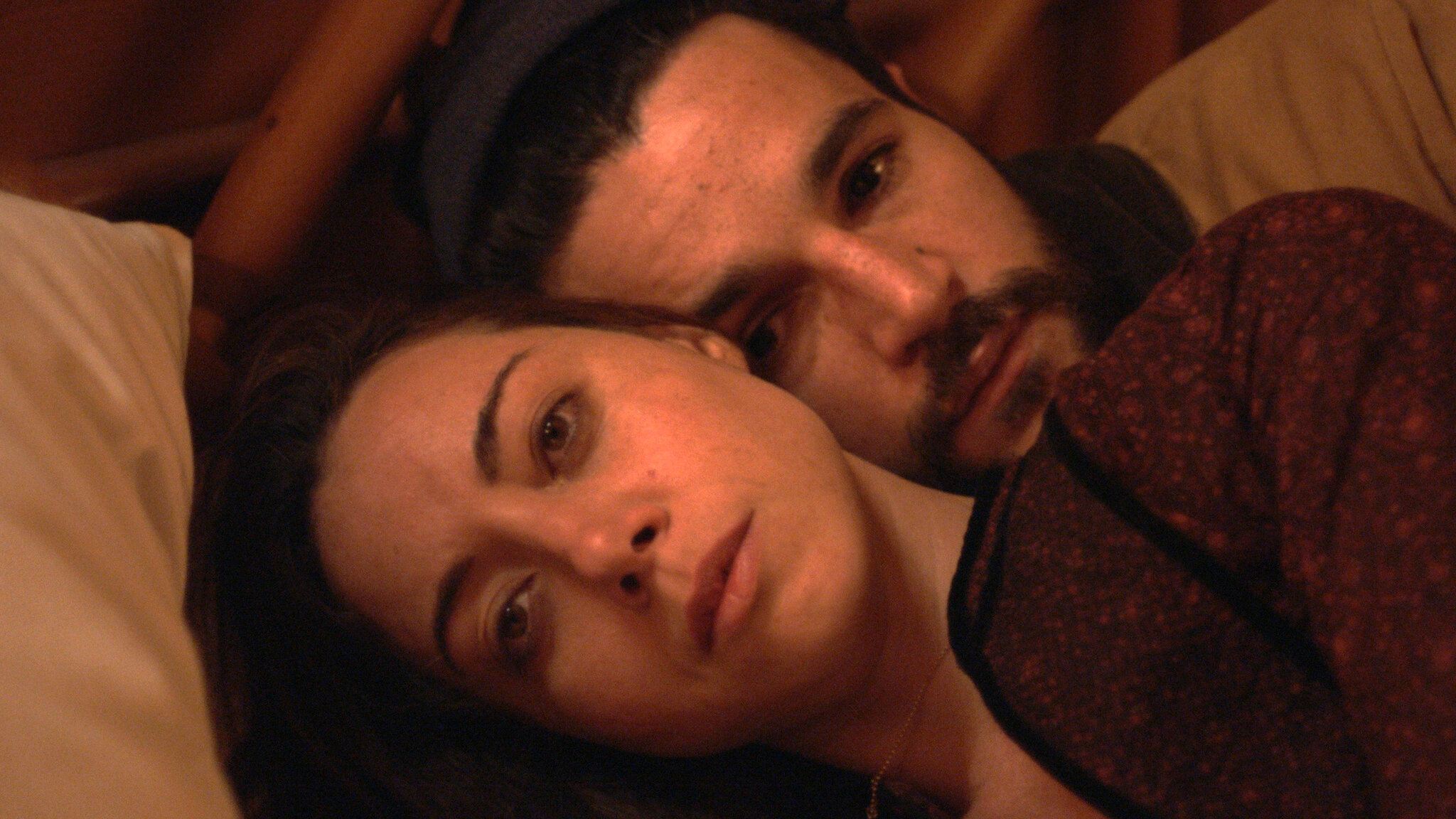
Hey there everyone! Welcome back to Movie Soapbox, the little corner of the internet that only you and I and that guy sleeping in the corner over there know about. This is the place where we find underappreciated indie films and we make sense of them. Today? We are doing a deep dive on Black Bear, a movie so aggressively, gleefully unwilling to explain itself that it will absolutely wreck 99% of the people who stumble into it thinking they signed up for a tasteful cabin-in-the-woods infidelity drama. They didn’t. Nobody does.
Before we go any further, a word from your host: everything past this paragraph is a spoiler, every single piece of it, and I am not going to be gentle about it. If you haven’t watched Black Bear yet, close this tab, find the film, watch it alone in a quiet room, and then come back. You’ll know why I said that when it’s over. The surprise is the whole point. Don’t rob yourself of it.
Still here? Good. You’ve seen it. So you know.
Black Bear – The Making Of This Crazy Movie
Let’s talk about what Lawrence Michael Levine actually pulled off here, and what it took to pull it off. Films like this one, genuinely structural, genuinely weird, films that fold back on themselves and refuse to hand you a key, don’t usually survive contact with money. A project this conceptually fractured, built around a lead performance that has to work on two completely different registers simultaneously, is the kind of thing that gets “fixed” in development. Some VP of creative somewhere reads the Part Two pivot and fires off a note: “Uh, Can we get rid of this mid-movie shift?” And then another note. And then a phone call. And then you get a movie that opens with a title card explaining that what you are about to see is “a filmmaker’s fractured imagination,” and the whole magic trick dies right there on the carpet. What Levine had going for him was scale, a tiny budget, a real location from a real friend, and Aubrey Plaza not just starring but producing, which meant there was somebody in the room who actually understood what the film was trying to do and had enough leverage to protect it. You can feel the absence of committee fingerprints in every scene. That’s not an accident of inspiration. That’s a consequence of keeping the suits out.
Black Bear Movie Part One: The Retreat
The film opens with Blair (Sarah Gadon, who you should already know from Enemy, where she was doing very similar work in a very different key) and Gabe (Christopher Abbott, who has quietly built one of the best under-the-radar careers of his generation across Martha Marcy May Marlene, It Comes at Night, A Most Violent Year) running what they are calling an artist’s retreat out of a cabin in the woods. Into this retreat arrives Allison, played by Aubrey Plaza, who has come ostensibly to write, ostensibly to recover, and is immediately handed neither, because Blair and Gabe are a catastrophe.
These two have fled New York, fled their meh-serviceable lives, and landed here to wait out the arrival of a baby that Gabe, it will turn out, considers an accident he is trapped by. The retreat is a fiction they have told themselves. They have no idea what they are doing or why. Allison, a working indie filmmaker with actual credits, very quickly stops pretending to write and gets absorbed into the gravitational field of these two people destroying each other at close range.
The dinner scene is where it cracks open. Gabe goes on an extended riff about gender roles, about the stabilizing function of traditional family structure, about how the upheaval of those structures has cost society something real, and Allison, instead of shutting it down, leans in. “I mean, I do get it, bitches be crazy.” Blair detonates. The argument that follows is genuinely interesting, not because any of it is resolved, but because Levine is smart enough to let both positions breathe before he uses the tension they generate as fuel for everything that follows.
Blair accuses Gabe of being attracted to Allison. Gabe talks her down, convinces her of his love, and they fall asleep. Then Gabe gets up, heads to the lake, finds Allison swimming, and confirms every single thing Blair accused him of. He loves her. He doesn’t love Blair. The baby was a mistake. He says all of it out loud. And then Blair comes down to the boathouse and finds them together, and the whole structure collapses in about ninety seconds: Blair is shoved, hits the ground hard, is bleeding, possibly losing the baby. Gabe screams for Allison to get the car. They speed out of the driveway and there, in the headlights, is a black bear. Allison swerves. The car hits a tree.
Cut to black.
Black Bear Part Two: The Bear by the Boathouse
We are back on the dock. Allison is sitting in the fog. Same image as the film’s very opening. She stands, walks up, and a crew member hands her a cigarette and a walkie crackles. “Did we cut?”
And just like that, the floor falls out.
Allison is an actress. Gabe is the director. The film we just watched was a film being made. And now we are on the set of that film, watching the machinery that produced it, and what we find is that the machinery is brutal. Gabe and Blair (now apparently Gabe’s real-world collaborator) have been running a long con on Allison, staging the appearance of an affair between them in order to destabilize her emotionally, to crack her open, to get the performance they need. Method cruelty as directorial strategy. It is, as the source points out, a documented move: Kubrick did it to Shelley Duvall on The Shining, told her the crew resented working with her, that Nicholson hated her, watched her deteriorate, filmed it. Levine knows this history and he’s putting it in the frame directly.
The manipulation works, then it works too well. Allison drinks herself to the floor. She bloodies Blair’s face in a scene that goes way past what the film required. She is barely functional. Gabe pulls the last take out of her through what amounts to a hostage negotiation. He admits, after the shoot wraps, that there was no affair, that it was all craft, all strategy, all in service of the movie. Allison tells him she will love him no matter what. Then she falls asleep.
Gabe slips away and goes down to the water. Where Blair is. And they are together at the boathouse, for real this time, and Allison wakes up and goes looking, and finds them through a window, and is about to go in, and then the bear that has been wandering the property throughout the whole film comes out of the dark. And Allison turns away from the window and walks toward the bear instead of through the door.
Then we are back on the dock. Fog. Allison thinking. She walks back to the cabin, sits at the table, and looks up at the camera. End.
Untangling the Mechanics of Black Bear the Movie –
The thing that trips people is the question of what is real and what is within what. Here is the cleanest way to hold it: the film gives you two discrete narrative layers presented sequentially, not simultaneously. Part One is a complete story. Part Two is a different complete story that shares actors, a location, and some character names with Part One, but is not a continuation of it. The Gabe of Part One is not the same Gabe as Part Two. The Allison of Part One is not the same Allison as Part Two, except that she is being played by the same person and is, by design, bleeding into her.
The opening and closing images, Allison on the dock in the fog, function as a frame around both halves. The film is bracketed by her, at rest, thinking, looking into the nothing. What sits between those two moments is everything she is either writing, imagining, dreaming, or processing. The bear is the recurring variable: it appears in the driveway in Part One to cause the crash, it appears on the property in Part Two to give Allison a choice about whether to fight for her life or walk toward the thing that might end it.
Levine has been explicit, or as explicit as he gets, that he did not want a single correct reading. He said this. So any theory that ends with “and this is definitively what happened” is probably wrong on its own terms. What he built was a structure that holds multiple readings simultaneously, and your job as a viewer is to pick the one that fits the thing you brought in with you.
Black Bear – The Theories
Theory One: The Writer Iterating. The simplest read. Allison is a writer with a block, or near-a-block, and what we are watching is her working. Part One is draft one of a story, Part Two is draft two, same skeleton, different complications, and the closing image of her at the table looking up is the moment she finishes. The frame closes. She has something now. This reading makes the movie feel like a craft documentary, which is maybe not the most resonant version of it, but it is the most internally consistent.
Black Bear Theory Two: The Auteur’s Psyche. If you apply auteur theory to Allison as the fictional director-within-the-film, then both halves are expressions of her inner obsessions: love triangles, manipulation, punishment for transgression, violent resolution. Death by car crash in Part One, death by bear in Part Two. She is drawn to stories where women pay for the chaos men generate. She is, in other words, processing something she has not yet named.
Black Bear Theory Three: Diary, Not Film. What if Allison is not writing a script at all? What if she is writing a diary, and the two halves are confessional entries, sketches of her real experiences with real people, fictionalized just enough to let her look at them? The cabin, the couple, the arguments, the aftermath: all of it slightly transformed but not invented. This reading gives Part Two’s manipulation plot a different weight. She has been manipulated like that before. She is writing it out.
Black Bear Theory Four: Actor’s Reckoning. The abuses in Part Two, the lying, the manufactured crisis, the director treating his lead’s emotional devastation as a production resource, are too specific to be accidental. This theory reads the film as Allison exorcising her professional past. She has had directors do this to her. She has had productions implode on her. She is staging it, replaying it, watching it from outside, because that is how you survive it. The bear at the end, in this reading, is the accumulated weight of all of it, and her walk toward it is either surrender or a strange kind of defiance.
Black Bear Theory Five: Just People, Just Shards. The most humanist read. Allison is a person with a brain, sitting at a lake, and this is just what brains do. They generate conflict, they people empty spaces, they run scenarios. The fact that she is a filmmaker is almost irrelevant. An architect would do the same thing with buildings. A poet with stanzas. These are not finished stories. They are the raw material of a life being lived in real time, and the film is gracious enough to let us watch them form and dissolve without insisting they mean more than they are.
Moviesoapbox’s Take on the Movie Black Bear
I’m going with Theory number Four. The actor’s reckoning. And here is why I land there: the mechanics of Part Two are too precise to be metaphor and too brutal to be craft demonstration. Levine is not just showing you how sausage gets made on an indie set. He is indicting the entire apparatus, the way directors acquire the right to use people as raw material and call it art, the way the performance extracted through cruelty is considered more valuable than the performance extracted through trust, the way a cast member’s psychological collapse can be framed as a breakthrough rather than a failure of the director’s duty of care. Allison walks toward the bear because the other option is to go through that door and confront the fact that even here, even with the person she loves, she is a resource to be managed. The bear, at least, is honest about what it is. That is what this film cost to say. And the fact that it got to say it, cleanly, without a title card explaining it, without a producer note softening it, is what makes it worth two hours of your life and probably a third viewing.
Factory Hollywood does not make Black Bear. Factory Hollywood makes the movie Gabe is directing in Part Two: extractive, strategic, certain of its own genius, indifferent to what it consumed to get there. Levine made the other thing. So did Plaza. So, by the end of it, did Allison. That is the whole damn point.
🎬 If You Liked This…
- Clouds of Sils Maria — the same blurring of performance and reality in an isolated location, two women where the roles they’re playing start consuming who they actually are, the same question of where the character ends and the person begins
- Braid — the same unstable reality where the rules keep shifting mid-film, the power dynamic between women as the real subject, and a filmmaker willing to let the ground disappear from under the audience without warning
- The One I Love — a couple in an isolated location discovering the version of reality they’ve been operating in isn’t the one they thought, the same structural trick of pulling the floor out at the midpoint and starting something new