
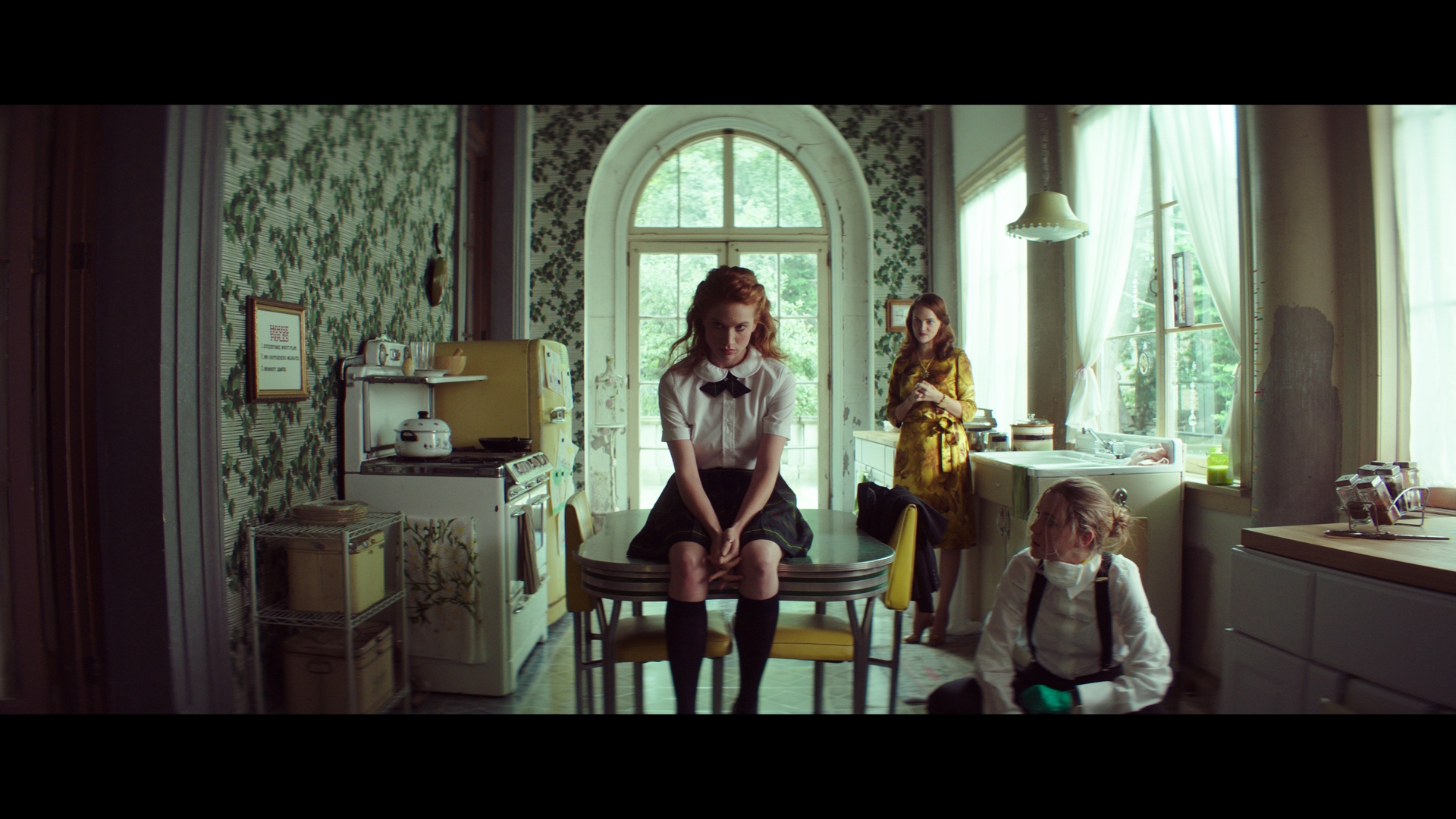
Hey there everyone! Welcome back to Movie Soapbox, the little corner of the internet that only you and I and that guy sleeping in the corner over there know about. This is the place where we find underappreciated indie films and we make sense of them. Today? We are doing a deep dive on Braid, a movie so psychedelically, structurally, philosophically unhinged that it somehow convinced a room full of people to fund it, which is either a miracle or proof that nobody reads past page thirty anymore.
Before we get into it, here is the trailer so you know what you are in for.
Alright. If you have not seen Braid yet, stop here, go watch it, come back. What follows is a full spoiler-forward breakdown of everything that happens in this film, every theory worth taking seriously, and why the whole thing means a lot more once you know whose life it is actually about. You have been warned, and I am not going to warn you again.
Braid and How This Movie Got Made
So here is what you need to understand before we even get to what happens on screen. Braid is a debut feature from Mitzi Peirone, an Italian filmmaker who came to the United States to model, then to act, then lost her visa and watched the floor disappear under her feet. She made this film on a shoestring, with a cast that includes Imogen Waterhouse and Sarah Hay, two performers with enough legitimate credits to make a distributor nervous in the best possible way. A film like this, at this budget tier, with this level of formal ambition, usually gets one of two fates: it gets picked up and quietly sandpapered into something more palatable, or it gets ignored entirely and dies on a festival circuit nobody outside the industry can name. The fact that Braid exists in essentially the form Peirone intended, unflattened, uncommitteed, still genuinely strange in its third act, tells you something. You can feel in the film’s structure the shape of what studio notes would have destroyed. The rules of the game, the refusal to resolve the question of what is real, the ending that hands you nothing comfortable to hold onto. A development executive at a mid-tier streamer would have put three notes on page one of that coverage and all three would have been some variation of the word “clarity.” Peirone did not give them clarity. Good.
Braid 2018 Movie Deep Dive Walkthrough
Petula (Imogen Waterhouse) and Tilda (Sarah Hay) are running from the police after a drug bust clears out their apartment. On the run, short on options, they land on a plan: go visit their old friend Daphne at her family’s enormous estate, locate the vault supposedly hidden somewhere inside it, and steal whatever is in it. Simple enough as a setup. Except Petula and Tilda both know, going in, that Daphne has rules. Specifically, three of them. Everyone must play. No outsiders allowed. Nobody leaves. These are the rules of a game the three of them have apparently been playing since childhood, a game in which Daphne is the mother, Petula is the doctor, and Tilda is the daughter. They agree to the rules because they think they can work around them. They are wrong about that.
The game starts running and you start trying to get your footing. The doctor checks in on the daughter, tests her reflexes, and finding none, corrects the situation with a meat cleaver. Elaborate meals are served that are clearly not meant to be eaten. Petula and Tilda start taking PCP. The film tips into pink and purple and the visual logic of the whole thing inverts. And here is where a lesser filmmaker flinches, cuts back to something explicable, gives you an anchor. Peirone does not flinch.
Understanding what is real in Braid is not a puzzle the film intends you to solve. The injuries the girls inflict on each other should leave marks, and sometimes they do, and sometimes they do not. We are shown a backstory: as children, Daphne was pushed from a treehouse, injured badly enough that she was told she would never have children. A police officer showed up to ask questions. Was any of that real? The film does not tell you. Was the injury part of the game even then? Possibly. The same police officer, or a police officer, turns up in the present timeline, tells Petula and Tilda something that stops you cold: they are missing. Possibly abducted. You watched them walk in through the front door on their own two feet, and now the film is telling you they are abducted. Daphne kills the officer. His body goes into the ground. When Petula digs up the grave later, the grave is empty.
And then the real gut-punch lands, delivered flatly by Tilda. This has happened before. Petula runs, she gets cut, she forgets, she comes back, and then she has this exact conversation again. The scars on her arm are not from a single incident. There are a hundred of them. She has been running and returning, running and returning, and every time she comes back she starts fresh. The outside world, Tilda tells her, is chaos. Out there, nothing holds. In here, inside the game, inside the estate, inside whatever this is, at least the rules are known.
That is the mechanics. Now the theories, because the film is generous enough to support several of them and honest enough not to collapse them into one.
Braid Movie Theories to Explain This Madness
The first read is the most surface-level and the film itself gives you the tools to dismiss it: that this is all still childhood play, that these women never grew up in any meaningful sense, that Daphne’s estate is just the treehouse taken to its logical conclusion. The problem is the final shot, an old woman listening as Tilda and Petula arrive yet again. Time has passed. A lot of it. Whatever is happening in that house has been happening across an entire lifetime. That is not a children’s game anymore.
The second read pulls in philosophy, and the film invites this explicitly with the quote it drops near the end. “Dream forever, for time in dreams is frozen.” The argument is that these three women exist inside a dream state, that the estate is a shared psychic space rather than a physical location, and that the question of what is real is the wrong question entirely because nothing is. Descartes gets there before Peirone does, Plato gets there before Descartes, and the film is comfortable sitting in that tradition without needing to resolve it. The dream theory is intellectually airtight and emotionally a little cold. It explains the mechanism. It does not explain the feeling.
Peirone herself, in interviews, describes the film as a philosophical essay about the cruelty of imagination, about how the same faculty that lets you build a dream life can lock you inside a hallucinatory one, about how the outside world terrifies precisely because the inside world, however brutal, is at least familiar. The game is not fun. The game has a meat cleaver in it. But the game has rules, and rules are a kind of safety.
Here is the theory I believe, and I am planting a flag on it. All three women are Peirone. Daphne, Tilda, Petula, they are not three characters in a story about three women. They are three aspects of a single consciousness, a filmmaker working out, in the most formal and unsparing way available to her, what it costs to come to a country that does not want you, to lose the ground under your feet, and to keep building anyway. The game is the creative life. The vault is the thing you came here to find. The rules are the terms on which survival is possible. The running and returning and forgetting is what it looks like to keep starting over. The scars are the record of every time you tried to leave and couldn’t.
Peirone made a film about her own mind, called it a horror movie, put a meat cleaver in it, and got it distributed. That is the whole story. Everything else is just the game.
Find out how Peirone got here from Italy sometime, read about the visa, read about the years before this film existed. Then watch it again. The factory would have given you answers. She gave you the truth instead.