
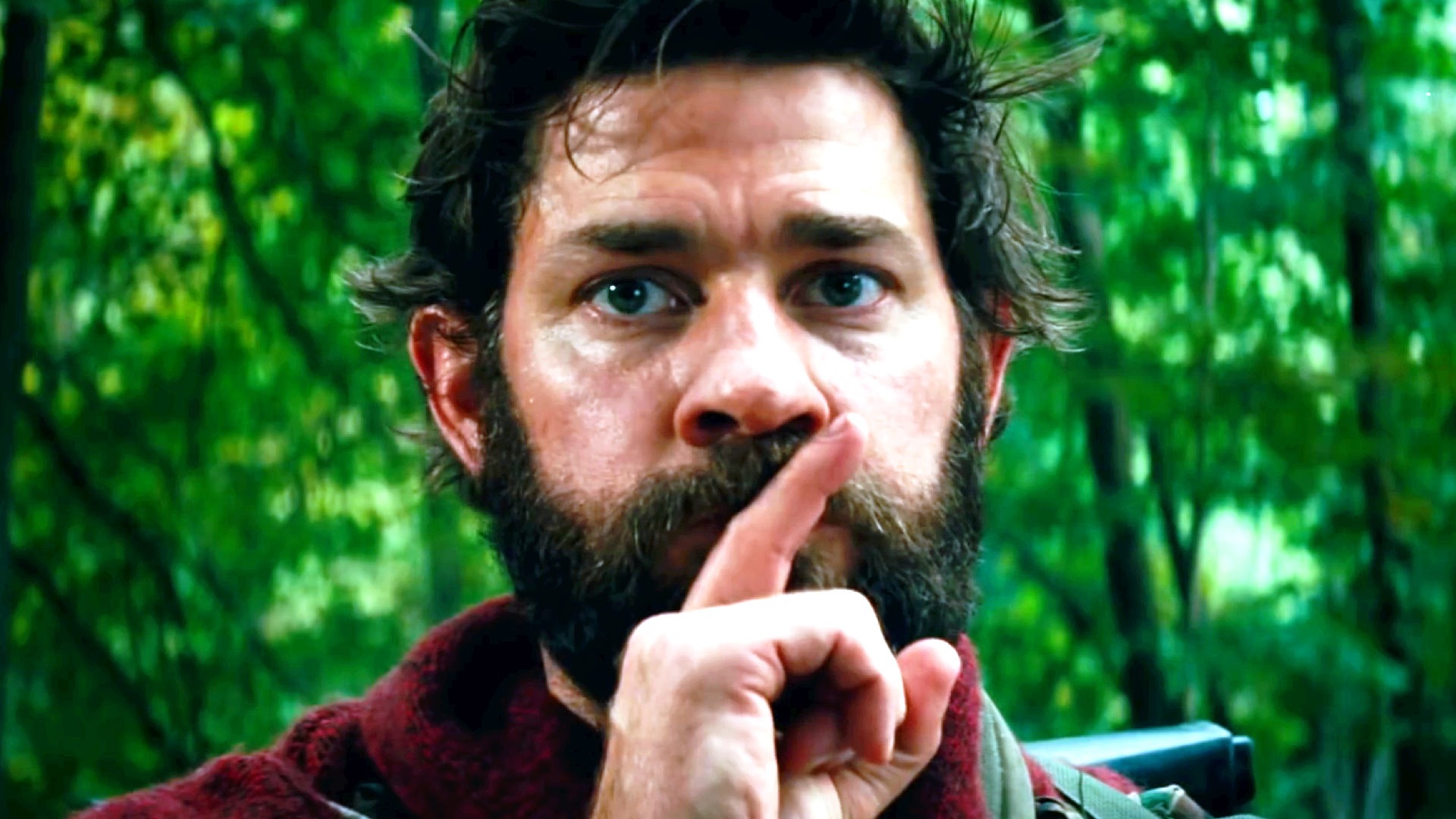
Hey there everyone! Welcome back to Movie Soapbox, the little corner of the internet that only you and I and that guy sleeping in the corner over there know about. This is the place where we find underappreciated films and we make sense of them, pull them apart seam by seam until we know exactly how the thing was built. Today? We are doing a full deep dive on A Quiet Place, a movie so quiet, so precise, so ruthlessly engineered around a single idea that it makes about ninety percent of what Hollywood spent the same year producing look like it was assembled by a committee of people who have never once been afraid of anything.
Fair warning before we go any further. Everything from this point on is a spoiler. The ending, the monster weakness, the final shot, the baby in the box, all of it. If you have not seen A Quiet Place yet and you want to walk in clean, close this tab, go buy a ticket, come back when you’re done. For everyone else, buckle in, because we are going scene by scene and rule by rule through the whole machine.
The Making of A Quiet Place Movie
Before we get into the walkthrough, let’s talk about what this film actually is, because the origin story matters more than most people realize. Scott Beck and Bryan Woods wrote this script (that was more of a picture book – truth be told) with the intention of making it in the woods of Iowa for around fifty thousand dollars, which is basically a down payment on a car, which is basically nothing. Their agent shopped it anyway, Michael Bay’s production company bit, Paramount got involved, John Krasinski read it and immediately handed it to Emily Blunt, and suddenly a film that was designed to exist outside the system entirely was inside the biggest studio pipeline in the country. That journey from backyard home-movie to A-list Paramount release is not just a fun piece of trivia, it’s the fingerprint you can feel on every frame of the finished film. You can tell when a director is working with a script that was written before the suits got to it, because the ideas are too clean, too committed, too unafraid of their own logic. Studio development, when it gets its hands on a high-concept premise early enough, has a way of softening the rules, punching holes in the internal consistency so the marketing department has fewer things to explain. The rules of A Quiet Place are airtight. Nobody watered them down. That tells you something about how fast this thing moved through the pipeline and how little room there was for twelve VPs to leave their fingerprints on it.
And that purity of idea didn’t come without a fight. John Krasinski tells a story about the very first monster attack. You know, the one that establishes the unbreakableness of the rules. The one where their little boy is ruthless murdered by alien malevolence right in front of their eyes in the first five minutes of the film. The execs just thought it was too intense for film audiences, way too harsh. Krasinksi had to stand on his principles, not give an inch… and the reason was obvious, and demandingly clear… without that scene audience isn’t educated as to the harshness of this world. Without that scene the whole movie collapses. It’s that kind of courage is necessary to make powerful movies like this one.
A Quiet Place Movie Walkthrough
The film opens on Day 89. We don’t get an explanation of what Day 89 means, the movie trusts you to do the math, and that trust is already doing something the average studio tentpole won’t do, which is treat you like an adult. Day 89 since the monsters came. And on Day 89, the youngest Abbott child, Beau, picks up a battery-powered space shuttle toy, and the family does not get to him in time, and a monster kills him in seconds. The film shows you the central rule and the central tragedy in the same breath, before you’ve had time to get comfortable, before the title card has fully faded. You know the stakes. You know what a mistake costs. The movie never has to explain this to you again.
Cut to Day 472. Lee Abbott is taking his son Marcus fishing. His daughter Regan, who is deaf and communicates in ASL, is furious about being left behind. And at the waterfall, the film gives you the first real conversation of the movie, spoken out loud, because the ambient noise of the water is loud enough to cover their voices. Bigger noise covers smaller noise. One rule, one elegant payoff. The whole film is built this way, every rule introduced early, every rule paid off later, nothing wasted.
On the way back from the waterfall, Lee and Marcus come across a man whose wife has just died, trauma from the monsters, and this man, already broken past the point of caring, screams. He knows exactly what he’s doing. He is choosing his exit. And he gets one. It is one of the bleakest twenty seconds in a mainstream studio film in recent memory, and it works because the film has already made you feel how much that sound costs.
Meanwhile, Evelyn Abbott, pregnant, alone in the house, steps on a nail and goes into labor at the same time. Any single one of those things would be unsurvivable in this world. Both of them at once should be the end. But Evelyn is smart, and she knows the noise rule cold, so she sets an egg timer to lure the monster chasing her away from where she’s hiding, and then she gets herself upstairs to the bathtub. Marcus saves her at the last second by setting off fireworks, pulling every nearby monster toward the explosion. The film is doing something here that a lot of creature-features don’t bother with, it’s making the monster a pure logic problem, and making survival the reward for thinking clearly under pressure that would shatter most people entirely.
Lee and Evelyn get their second real conversation of the film. She tells him she blames herself for Beau’s death, that her hands were free, that she should have been the one holding him. It’s a quiet scene and it’s doing the work that in a lesser film would have been done in an early backstory dump. Here it lands like a wound reopening. Then the basement floods, the baby nearly drowns in a Moses-in-the-reeds setup that the film is absolutely aware of and absolutely intentional about, and the two remaining kids fall into a corn silo, which, let’s be honest, corn is not quicksand, the physics of that sequence don’t hold up if you’ve spent any time around grain storage, but the tension is real enough that you’ll probably let it go in the moment.
Lee finds the kids. They hide in a truck. The monsters close in. And Lee Abbott, understanding exactly what he is about to do and why, screams. He pulls every monster in the area directly onto himself. He is buying his children the seconds they need to get to the house. He dies. The film doesn’t linger on it. It doesn’t need to.
Regan and Evelyn end up in the basement with a monster. And this is where the film’s long game pays off. Regan’s hearing aid, the one her father spent the entire movie trying to repair or replace, the one she’s been wearing even though it doesn’t work the way it should, produces a frequency when it gets close to the monster’s exposed inner ear that sends the creature into chaos. Its armor opens. Its unprotected ear is exposed. Evelyn shoots it in the face. The ending shot is Regan pressing her hearing aid to a microphone and Evelyn cocking the shotgun, ready to walk out into the yard and do it again to every other monster in range. The weapon was the daughter’s disability. The father never stopped trying to fix it. Take that apart for as long as you want.
The Rules of A Quiet Place Discussed
Now let’s go through the rules explicitly, because this is a film where the rules are the architecture and they deserve to be laid out cleanly.
The monsters are fully armored. Nothing conventional gets through. The monsters key entirely on sound, any sound, and they will move on the loudest source available, which is the key tactical fact that keeps the Abbott family alive through the whole film. Their hearing is calibrated to the dominant noise in any environment, which is both their strength and, ultimately, their undoing. The alien origin is implied through newspaper clippings visible in the farmhouse basement, global invasion, creatures that arrived fully formed and immediately lethal, with no clear weakness until Regan accidentally finds one. The frequency from her hearing aid, on feedback loop with whatever the monsters use to hear, forces the armor across their face to open and exposes the inner ear. Once that ear is exposed, it’s unprotected. One shotgun shell ends it.
There is a theory floating around that the red warning lights the family uses throughout the film also emit a high-frequency sound that distracts or repels the monsters, and that this connects to an early shot of a toppled traffic light that a monster appears to have attacked. Possible. The film is precise enough that a detail like that would be intentional if it’s there. But I wouldn’t hang the whole interpretation on it. The red lights read clearly as a danger signal within the family’s system, and the internal logic doesn’t require the extra layer to hold together.
Theories to Explain the Movie A Quiet Place
The competing reads on the ending come down to one question, which is whether Evelyn and Regan have a workable plan or whether the final shot is essentially a last stand dressed up as a plan. One read says yes, they have functional speakers rigged to broadcast the frequency outward, they know how many monsters are in the area, and they have enough shells, this is survivable. The other read says the film is ending on an image of defiance rather than a realistic path forward, that the point is the act of fighting back, not the guarantee of winning.
I’ll tell you what I believe. The film is too rigorous, too committed to internal logic, to end on false hope. The Abbotts have survived 472 days by being methodical. Regan didn’t press that hearing aid to the microphone as a gesture, she pressed it because she understood what it would do. Evelyn didn’t cock that shotgun for the camera, she cocked it because she was about to walk out and use it. The ending is a plan. It works. The people who built this world carefully enough to earn every scare in it are not going to let it end on a feeling when they can end it on a strategy. That’s my read, and I’m not moving off it.
Kudos to the Magic of Pure Film Making
Beck and Woods wrote a script so clean and so committed to its own rules that even after a studio got hold of it, even after it went from a fifty-thousand-dollar Iowa backyard film to a Paramount release with one of the most recognizable actors in the country directing his own wife, the idea survived intact. That almost never happens. Most films like this, films built around a single uncompromising premise, get softened somewhere between the first draft and the wide release. Some VP decides the rules need an exception. Some test screening audience in Burbank gets confused and the editor cuts around it. Not this one. The rules of A Quiet Place are the same in the finished film as they were in the script that was supposed to cost fifty thousand dollars to make. That’s the thing worth respecting here, not just the craft of the execution, but the fact that the idea was good enough, and the people around it were smart enough, to leave it alone.
🎬 If You Liked This…
- Hidden — a family hiding from something outside that will kill them if they’re discovered, the same suffocating tension of survival built around concealment, and a twist that recontextualizes everything
- The Colony — post-apocalyptic survival where the threat is environmental and relentless, the same family-under-pressure emotional register and the same question of what you’re willing to sacrifice to keep the people you love alive
- Midnight Special — a family on the run protecting something precious from forces that want to destroy it, the same parental sacrifice and child-as-the-stakes emotional engine, same genre craft in service of real feeling