
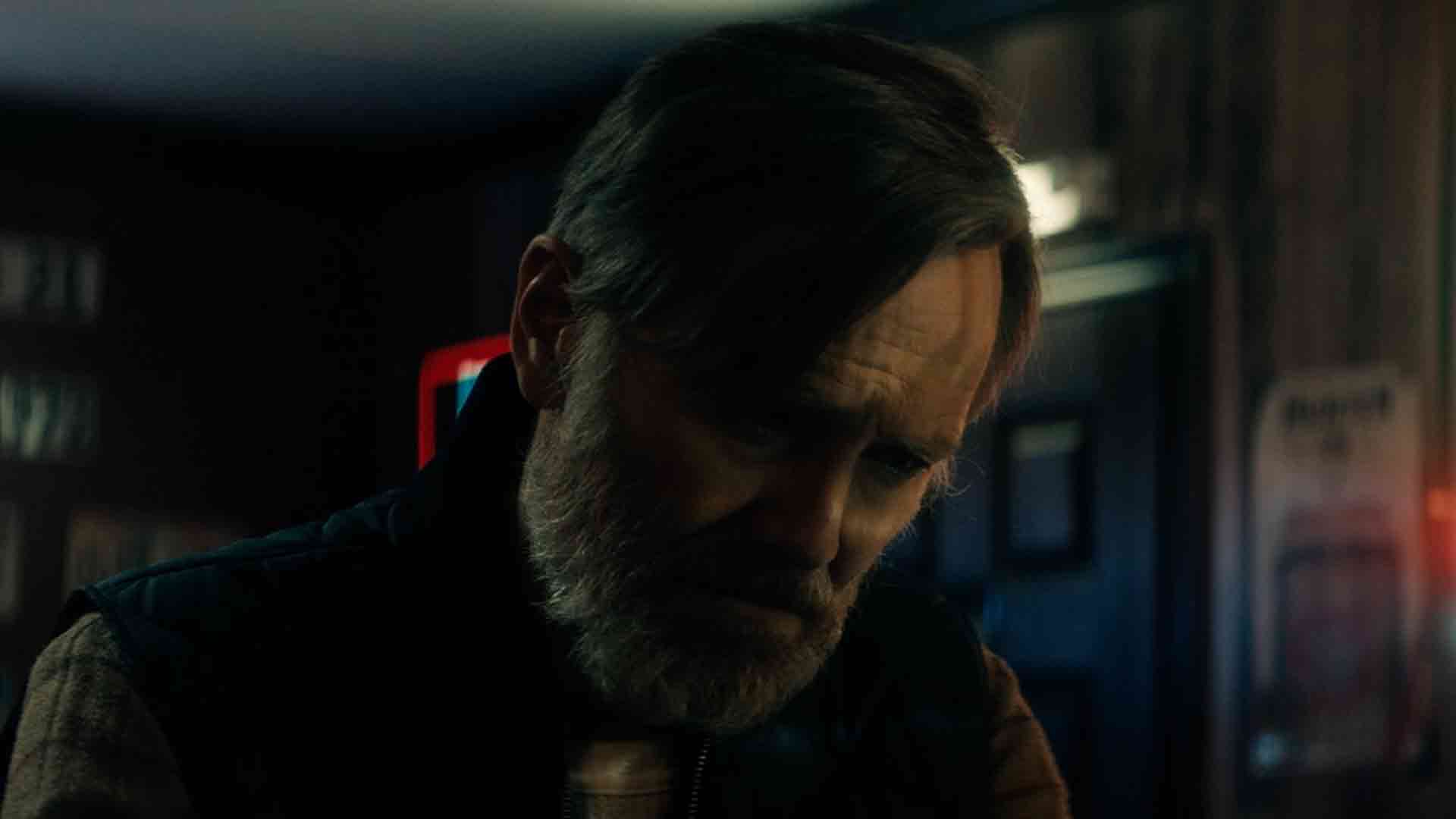
Hey there everyone! Welcome back to Movie Soapbox, the little corner of the internet that only you and I and that guy sleeping in the corner over there know about. This is the place where we find underappreciated indie films and we make sense of them. Today? We are doing a deep dive on The Oak Room, a movie so quietly, methodically ruthless that the studio system would have turned it into a straightforward revenge thriller with a needle drop and a twist that explains itself twice, just to be safe, because somebody in a test screening circled the word “confusing” on their card and that word travels fast up the chain.
This one survived all of that. We should talk about how.
Before we go any further, I need you to understand something: everything that follows is going to ruin this film for you if you haven’t seen it yet, and I am not going to apologize for that, because the only correct move is to watch it first and come back here after you’re sitting in your chair with that specific kind of quiet that a good closed-box thriller leaves you with. You’ve been warned. We’re going in.
The Oak Room started as a stage play, and you can feel it in the best possible way, the way a film knows exactly how much space it’s allowed, the way every word is load-bearing, the way the camera doesn’t have anywhere to hide and neither do the characters. Adaptations like this one almost never make it through a studio development process intact, because the note that kills a film like this is always the same note: “Can we open it up a little?” You open it up. You lose it. Somebody greenlights a $4 million version with a recognizable face attached, the distributor gets cold feet in post, they bring in a second editor, and what you’re left with is a movie that forgot why it was tense. The fact that The Oak Room landed with its bones intact, with its silences intact, with a budget clearly so lean that every creative decision had to be a real decision instead of a money decision, tells you something about the people who made it and the investors who, wisely, left them alone.
The Shot You Missed at the Beginning of Oak Room
The film opens on a glowing, near-empty beer bottle sitting on a bar, and you did what anyone does: you watched the beautiful amber light and let it wash over you and felt like you were watching something atmospheric and spare and good. And you were. But behind that bottle, half-visible, half-obscured by that glow you were so busy admiring, two figures are fighting, moving against each other in the dark. You missed it. Most people miss it. The film does not care that you missed it, because it is going to make you need it later, and by the time you need it the film is already over, and you have to hold that image in your memory and reconstruct it yourself. That’s the move. A lesser cut of this film has that shot held two seconds longer, or repeated in a cutaway, or underscored to tip you off. This version trusts you to catch up. The film earns that trust by the end; you have to earn it too.
What Actually Happens in Oak Room, Beat by Beat
Steve, played by RJ Mitte, walks into a bar in a storm. He and the bartender Paul have history, and all of it is bad, and the specific shape of the bad history is this: Steve didn’t come to his father’s funeral, and his father was Paul’s closest friend. Paul, not particularly interested in forgiving this, calls someone named Stelli, who is the kind of person you call when you want consequences to arrive in the near future. Stelli is maybe an hour out.
With that clock running, Steve does a strange thing. He starts telling Paul a story. A story about a bar called The Oak Room, a night a few days prior, a well-dressed man named Richard who came in out of a storm and sat down across from a bartender named Michael. The story has layers, and the layers keep stacking: Michael tells Richard a story, and inside that story is another story, and Paul eventually stops Steve to accuse him of “juicing” the story, embellishing it, which Steve admits to, but the embellishment is tactical, it’s not vanity, and you’ll understand why by the time the real version of events surfaces.
The real version of events at The Oak Room is this: Michael is not a bartender. Michael bludgeoned the actual bartender, cut off his head, stuffed the head in a duffel bag, and was mid-concealment when Richard walked through the door. Richard, you can deduce from this, does not survive the encounter either. The question the film then drops in your lap is: how does Steve know any of this, given that the only people present were a killer and two dead men?
The answer is Thomas Coward. That is the man’s actual name, and the film is not being subtle about it. The town drunk was in the corner the whole time, watching, the way drunks in bars become part of the furniture until they aren’t, and he saw everything and said nothing, which is precisely what his name tells you he would do.
The Wrong Bar, the Wrong Man, the Watch
Michael killed the wrong person. He was sent to a bar to kill Paul, and he drove through a blizzard and got turned around and ended up at The Oak Room instead, and he killed a bartender who had nothing to do with any of this, for no reason except that Michael is the kind of man who, once he’s arrived at a bar to kill a bartender, kills a bartender. The last words before he did it were “Jimmy Johnson sends his regards,” which lands on Paul like a physical blow, because Paul knows exactly what that sentence means and exactly who it was supposed to be aimed at.
Now the film starts assembling its final mechanism. The headlights in the parking lot. You’ve been watching the film long enough by now that you’re doing the math on who those headlights belong to. The watch is the confirmation: a specific watch on Michael’s wrist in the Oak Room story, the same watch on the wrist of the figure in the headlights. Same man. He found the right bar. And Paul has nowhere to go.
The film cuts. It ends. And then, if you’ve been holding that opening shot in your memory the way the film needed you to, you reconstruct what happens next yourself: two figures behind a glowing bottle, fighting, and one of them is not wearing a white sweater, because Steve was wearing a white sweater, which means the two figures are Michael and Paul, and Michael is very good at what he does, and Paul is a bartender, and you can finish the sentence from there.
What the Film Won’t Tell You (And Shouldn’t)
Steve’s fate is the one question the film deliberately leaves open, and it’s the right call, because Steve’s fate is less interesting than Steve’s interiority, which the film gives you exactly one unguarded look at: the bathroom scene, the mirror, the scream that comes out of him in a room where he thinks nobody is watching. That moment isn’t an accident. That is a man who has done something he can’t take back and is now watching it arrive at the place it was always going to arrive, and the scream is the only honest thing he does in the entire film.
The competing reads on Steve’s involvement break into roughly two camps, and they’re both defensible, which is a sign of a script that knew exactly what it was doing.
The Theories to Explain The Oak Room
Theory one: Steve is a coincidence. He found out about the Oak Room murder through the local dead-end-town grapevine, the same way Thomas Coward’s story probably made rounds in whatever dive bars Thomas Coward frequents. He came to Paul’s bar to collect his father’s things, settle old debts, maybe scrape together some kind of peace with a man who hated him. The story was a way of sitting with Paul for an hour without having to talk about the actual wound between them. And Michael’s headlights in the lot are just the universe’s grim sense of timing. That version of the film is about how wrong turns compound each other, how one mistake in a blizzard six days ago is still metastasizing into other people’s lives right now, none of whom asked for it.
Theory two: Steve called the hit. He knew Paul had a target on him. He knew who Jimmy Johnson was and what that name meant and what it had bought. He came to the bar not to make peace but to watch, or to warn, or to somehow be present at the thing he’d set in motion, because some people need to see the consequences of what they’ve arranged, they can’t just let it happen offscreen. The story he tells Paul isn’t just a story: it’s a confession delivered sideways, a way of saying “I know what’s coming and I know why,” without ever having to say it plainly. The hour he had to run? He stayed. That stays with you.
Moviesoapbox’s Take on The Oakroom
Steve called the hit. I’m putting that flag in the ground and I’m not moving it. A man with an hour’s head start who has just been told a professional killer is en route to this specific location, and who stays, who finishes the story, who watches Paul’s face drain of color as the headlights appear in the lot, that man is not a bystander who got unlucky with timing. The bathroom scene is not guilt about the past; it’s the specific kind of fracture that happens when you’ve decided to do something irreversible and the irreversible thing is now thirty seconds away from being irreversible. He stays because leaving would mean the whole machinery he set in motion happens without him witnessing it, and he needs to witness it, even if he also can’t stand it. That scream in the bathroom is the last private moment of a man who is about to find out whether he can live with what he’s done. The film, mercifully, does not answer that question. It just closes the door on him.
The Wrong Turn That Runs Through Everything
The storm never stops in this film. It was there before the story started and it’s there when the story ends and it will be there tomorrow, and every character in this film made their crucial wrong turn somewhere back in the dark before we arrived, before the camera was rolling, in some moment we didn’t see and the film isn’t going to reconstruct for us. Michael took a wrong road in a blizzard and killed an innocent man. Paul made friends with the wrong people at some point in a past life and now Jimmy Johnson is sending regards. Steve left when his father needed him to stay, or stayed somewhere he should have left, or made some choice years ago that calcified into the cold, controlled man we watch buying time at a bar while consequences arrive in the parking lot.
A film that came through five more rounds of studio notes would have explained that wrong turn. Would have given us a flashback, a conversation, a scene where Paul tells Steve exactly what he did and Steve tells Paul exactly what it cost him. The film that survived is the one that trusts you to know what wrong turns look like, because you’ve taken a few yourself, and leaves the specifics blank so you can fill them in with the ones you’d rather not think about.
That’s the kind of film that almost never gets made. When it does, it usually gets quietly buried by a distributor who doesn’t know how to market “trust the audience” to a multiplex. The Oak Room is out there. You found it. That’s the whole thing. Go back and watch that opening shot again.