
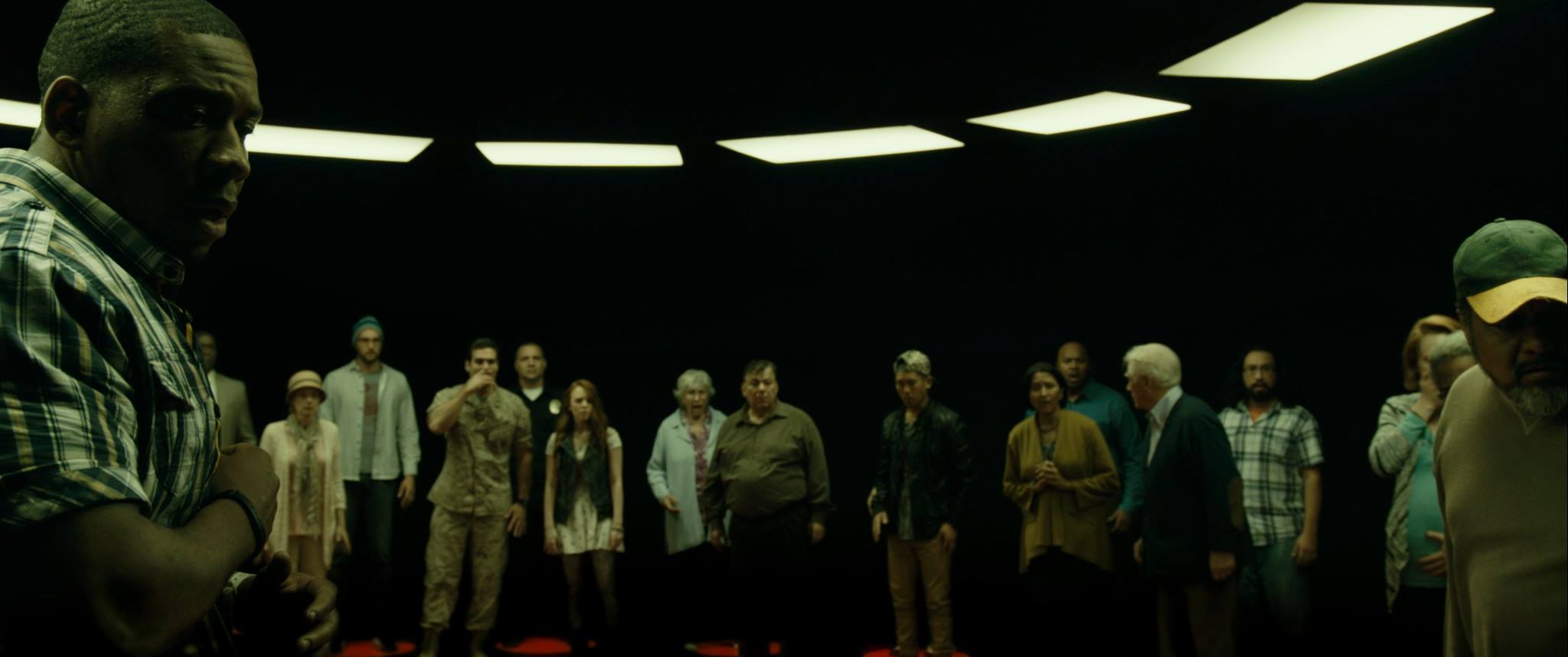
Hey there everyone! Welcome back to Movie Soapbox, the little corner of the internet that only you and I and that guy sleeping in the corner over there know about. This is the place where we find underappreciated indie films and we make sense of them. Today? We are doing a deep dive on Circle, a 2015 science fiction film so relentlessly bleak in its view of human nature that the people who funded it probably went home and reconsidered some life choices.
Fair warning: everything that happens in this movie is about to be on the table. Every vote, every death, every ugly calculation. If you haven’t seen Circle yet, close this tab, find the film, watch it, and come back. It runs about 87 minutes and costs nothing in terms of spectacle. What it costs you is something else entirely. Still here? Good. Let’s get into it.
The Making of The Circle
What you need to understand before we go scene by scene is the tier of filmmaking this movie lives in, and what that tier actually means for what ends up on screen. Circle was written and directed by Aaron Hann and Mario Miscione on a budget that, in Hollywood terms, rounds to zero. One set. Fifty actors on day rates, probably. No IP. No franchise hook. No second act where the aliens show up and fight each other in slow motion. When a film gets made at this level, it either survives because the concept is so airtight that no suit can figure out how to ruin it, or it gets quietly buried after a festival run and a VOD window nobody notices. The single-location conceit is what saved this one from the note-spiral, because there was nothing to rewrite your way out of. You cannot test-screen your way to a more comfortable third act when the entire film is fifty people standing in a circle arguing about who deserves to live. The brutal ending stayed brutal because there was no other version of the movie that was still this movie. That’s a rare kind of protection.
What Actually Happens in the 2015 Movie Circle
Fifty strangers wake up standing on individual pads arranged in a circle in a dark room. They cannot step off their pads. They cannot touch each other. Every two minutes or so, someone dies by electrical shock, randomly selected, unless the group votes. The person with the most votes dies instead. You cannot vote for yourself. Ties are complicated, and the complications matter.
That is the whole machine. Fifty people, those rules, and ninety minutes.
The film moves through three distinct phases, and if you watch them collapse into each other in order you are watching a compressed, brutal model of how humans actually organize themselves under pressure, which is to say, badly and with tremendous confidence.
Phase one is rule discovery. People die figuring out what the rules are. The oldest people go first because nobody frames it as cruelty, they frame it as logic. They’ve lived the longest. It barely takes a conversation. If you wanted a thesis statement for what this film thinks of us, you could stop right there.
Phase two is stereotyping. Once the rules are established, the group needs a faster system for deciding who goes next, and what they land on is profiling. The Latino man who mentions he has a record. The woman someone decides is a porn performer. The gay woman whose lifestyle the conservative with the suspenders finds objectionable. The film plays this so straight that it’s genuinely uncomfortable, which is the point. The filmmakers are not editorializing. They are just watching what happens when frightened people need a justification quickly. Every sociology lecture about how prejudice functions under scarcity conditions, this film just runs the experiment.
Phase three is game theory. As the group shrinks, two factions emerge around a single question: protect the pregnant woman and the young girl, or sacrifice them so someone else has a shot. Power blocs form. Deals are made and broken. A man named Eric has been quietly orchestrating survival for the woman and the girl, and you are meant to read him as a moral actor until the last five minutes, when you realize you’ve been watching a long con the whole time.
The Circle Movie Ending, Taken Apart
Eric gets the young girl to step off her pad, presumably believing he’ll do the same simultaneously. He doesn’t. She dies. The pregnant woman is voted out. Eric is the last person standing.
Then the countdown resumes. He screams something at whoever is running this experiment, something along the lines of acknowledging that everyone in that room was a terrible person, himself included, and he is clearly expecting to die. Instead, a tie. The pregnant woman’s body hasn’t fully cleared the pad, and the fetus, still registering as a life, is in a tie with Eric. Because the fetus cannot vote, Eric wins the tie. The fetus is killed.
Then, for the first time in the entire film, we leave the room. Eric is in an aqueduct in Los Angeles, standing among a crowd of other people, all of them looking up at alien ships crossing the sky. Credits.
Two things matter enormously here, and getting them wrong changes the whole interpretation.
First: the pregnant woman in the aqueduct crowd is not the same pregnant woman from the game. This is not a small detail. It means the deaths were real. Every person voted out actually died. Eric didn’t save anyone except himself, and only himself, and the mechanism he used to do it was the purest expression of game-theory egoism the film has to offer.
Second: the aqueduct crowd are presumably other winners, other people who survived their own versions of this experiment happening simultaneously, at global scale. Which means you are looking at the residue of a planetary culling. If fifty people played per group and one survived, and the scale was truly global, you are looking at roughly one fiftieth of the Earth’s population left standing. Seven billion people dead, and the survivors are the ones who gamed the vote the hardest. That is not an accident of plotting. That is the film’s thesis, stated plainly, in the last ninety seconds.
The Philosophy, Actually Explained
The film is in conversation with four major frameworks and it doesn’t pick sides, it just runs each one through the machine and shows you what comes out.
Nihilism is the reading where none of it matters. The aliens run the experiment, the humans slaughter each other along the lines they were already drawing in ordinary life, the winner gets dumped in a drainage ditch to stare at spaceships. No meaning extracted. No lesson delivered. Eric’s outburst at the end, his acknowledgment that everyone in the room was awful, is the nihilist moment. He’s not wrong. He’s also standing alone.
Determinism, in either its hard or soft form, reads the experiment as having already had an outcome. Eric won because Eric was always going to win. The game selected for a specific type of person, the type who could sustain a benevolent performance long enough for everyone else to lower their guard, then cash it in. Whether that’s God’s foreknowledge or just the predictable output of competitive selection pressure, the result is identical.
Consequentialism and Benevolence are the frameworks that get the most airtime in the middle section of the film, through characters who argue for protecting the pregnant woman on moral grounds, that her life plus the life of the child constitutes a greater good. This argument loses, comprehensively, to the man running a longer game.
Game Theory and Egoism are what actually win. The Prisoner’s Dilemma is at the center of Eric’s final move, he sells the girl on a mutual defection from the game, she defects, he doesn’t. He runs the dilemma twice in two seconds and takes both hands. The film’s ending suggests this is not a character flaw in Eric specifically but a structural outcome, run enough iterations and the game will consistently produce an Eric.
The Circle Movie Competing Reads
There are a few ways people have come at this film’s ending and larger meaning, and they’re worth laying out cleanly.
The pure nihilist read: The experiment has no discoverable purpose. The aliens aren’t selecting for anything. They’re not studying humanity. They’re not building a warrior class. They’re just watching, the way you might flip over a rock to see what runs. Eric wins and is deposited on Earth with nothing but the knowledge of what he did. That’s it. No reward. No revelation. The joke is on everyone.
The selection experiment read: The aliens are running a deliberate cull, selecting for the most ruthlessly self-interested survivors, building a population of 140 million people with the specific psychological profile required to win this game. What you do with 140 million egotists is left as an exercise for the viewer.
The mirror read: The experiment isn’t about the aliens at all. It’s a Rorschach test for the humans in the room, and by extension for the audience watching. The film holds up a structure and lets you observe what fills it. The prejudice wasn’t introduced by the experiment. The experiment just removed the social consequences of expressing it.
Moviesoapbox’s Read for the 2015 Movie Circle
The selection experiment is the correct frame, and here is why: the detail about the pregnant woman matters too much to be decorative. The filmmakers went out of their way to plant a different pregnant woman in the final crowd specifically so you would notice the switch, specifically so you would understand that the deaths were real and that the winner profile was being preserved. You do not put that detail in if the film is just a nihilist shrug. That detail has a function. It tells you the machine produced an intended output.
What the aliens wanted was Eric. They ran fifty people at a time, worldwide, to find the ones who could perform benevolence as a long-game strategy and abandon it at the precise moment it stopped being useful. The fetus detail is the final confirmation: Eric’s willingness to make that vote, that specific vote, is what gets him through the last gate. The experiment didn’t just want survivors. It wanted survivors who could clear every moral hurdle, including that one.
What they built with 140 million is the question the movie leaves you to sit with. It is not a comfortable place to sit.
What Hann and Miscione made, on no money, with one room and a cast of fifty people willing to stand on black circles for however many shooting days this took, is a film that has no business being as durable as it is. Somewhere in the machinery of the industry there are a thousand films with twenty times the budget that have generated one tenth the conversation. This one got through because there was nothing to compromise. You can’t cut the philosophy out of a philosophy film. You can’t test-screen your way to a happier fetus scene. The constraints were the armor, and the film survived them intact. That doesn’t happen as often as it should.
🎬 If You Liked This…
- Exam — strangers in a room with one brutal challenge and no way out, the same elimination logic and the same discovery that the real monster is what people are willing to do to each other when survival is on the line
- The Incident — a closed environment with no exit and no explanation, people dying inside a loop they cannot break, the same suffocating geometry of a space that will not let you leave
- Coherence — a contained group making increasingly terrible decisions about each other as the rules of their world collapse, the same brutal arithmetic of who gets to survive and what that choice costs