
Hey there everyone! Welcome back to Movie Soapbox, the little corner of the internet that only you and I and that guy sleeping in the corner over there know about. This is the place where we find underappreciated indie films and we make sense of them. Today? We are doing a deep dive on a whole genre, the last-man-standing film, a subgenre so small and so relentlessly uncomfortable that most major studios won’t touch it with a ten-foot pole unless someone staples a franchise logo to the front of it. Specifically, we’re using The Long Walk as the tuning fork. You know the Stephen King novel, the one that sat in a drawer for years before anyone was brave or foolish enough to adapt it. If that film got its hooks into you, this list is the map to everything else worth watching in this space.
Before we go any further, here is the trailer so you know exactly what frequency we’re operating on today.
Fair warning: everything from this point forward assumes you’ve seen these films or you don’t care about spoilers. If you’re still in the dark on any of these, bookmark this page, go watch them, come back. I’ll still be here, annoyed about the same things.
Now. Here’s what most people writing lists like this one won’t tell you, because most people writing lists like this one haven’t spent any time thinking about why this subgenre is so small in the first place. The last-man-standing film, the real kind, the kind built around psychological disintegration and moral compromise rather than choreographed action sequences, is almost impossible to get made at scale. A story where the whole point is that survival costs you your humanity is a story with no clean hero arc, no marketable redemption beat, and no sequel hook. You cannot test-screen that into something comfortable without destroying the thing that made it worth watching. The films on this list that came out intact, Circle, The Exam, The Platform, they came out intact because they were small enough that nobody with real money got nervous about them. The ones that got studio money got studio fingerprints, and you can feel exactly where those fingerprints are every time you watch them.
Battle Royale
If you want to understand the whole genre, you start here, a Japanese production from 2000 that the American market spent years pretending didn’t exist because the premise, a government drops a class of teenagers on an island and tells them to kill each other, was too uncomfortable to distribute without triggering a congressional hearing. The film is violent in the way that honest films about violence are violent, which is to say the violence feels like it costs something. Every kid on that island had a name and a history before the game started, and the film makes you feel the weight of that before it starts removing them. What makes Battle Royale the ancestor of everything else on this list is the thing it shares with King’s novel: the system is not the threat, the system is the environment, and the real horror is watching what people choose to do inside it.
Circle
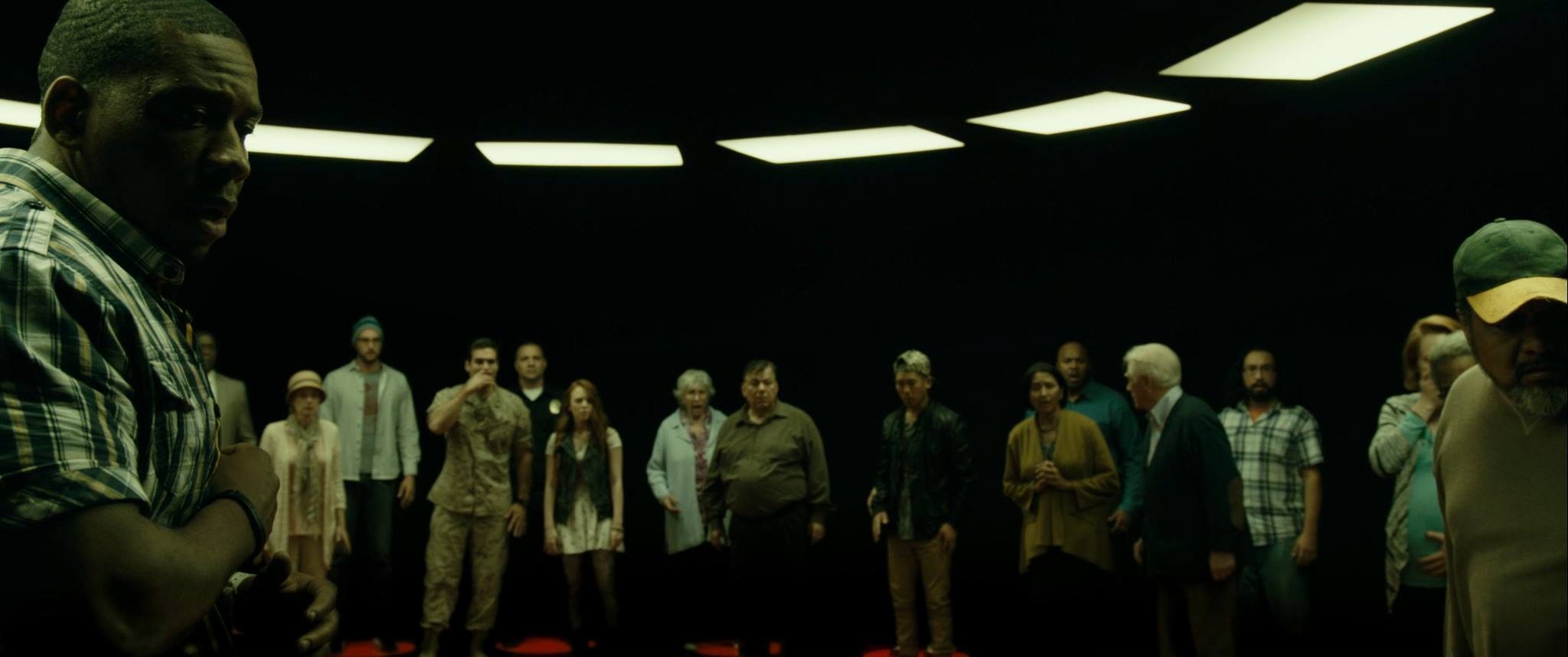
Fifty people wake up standing in a circle. Every two minutes, one of them dies by group vote. That is the entire film, and it is enough. Circle is what happens when you strip the last-man-standing premise down to pure dialogue and moral arithmetic, no action sequences, no location changes, no score swelling to tell you how to feel. The talk IS the engine. People form coalitions, make arguments, throw each other under the bus with the particular fluency of people who spend their professional lives in conference rooms. It’s the most office-political film on this list and it was almost certainly made for very little money by people who understood that the budget constraint was actually a creative gift. No money means no studio, no studio means no notes, no notes means the ending stays intact. The ending of Circle is intact. You’ll know what I mean.
The Exam
Eight candidates. One room. One exam paper. One rule they don’t understand yet. The Exam belongs in the same conversation as Circle and Cube, confined-space films where the architecture is the antagonist and the characters have to think their way out of something that wasn’t designed to be survived. The dread in this film is bureaucratic, which is a specific and underrated flavor of dread. The system observing these people from behind mirrored glass doesn’t hate them. It doesn’t feel anything about them at all. That indifference, the sense that the people running the game could not care less whether you make it, is exactly what King was writing about in The Long Walk, and it’s exactly what most action-packaged versions of this premise sand off because indifferent authority figures don’t make for satisfying third-act confrontations.
The Platform
A vertical prison. Food descends on a platform from the top floor down. The people on floor one eat like kings. The people on floor 200 eat whatever’s left, which is nothing. The Platform is the most overtly allegorical film on this list and the least interested in hiding it, the social commentary is not subtext, it is text, capital letters, underlined. What saves it from feeling schematic is the performance at its center and the film’s genuine willingness to go where the logic leads, including a final image that the distributor almost certainly had opinions about and thankfully did not win. This is a Spanish production that found its audience on streaming after a festival run, which is the 2020 version of the path a film like this has to take when it can’t get a wide theatrical release because nobody can figure out how to sell a movie where eating is a war crime.
The Belko Experiment
Here is where the list starts to show the seam between the films that came out intact and the films that got enough money to attract enough opinions. The Belko Experiment had James Gunn writing it, had a real cast, had a real distributor, and you can feel every dollar of that investment in the production value and every dollar of it in the places where the film flinches. The corporate satire angle is genuinely sharp, the setup is genuinely uncomfortable, and then somewhere in the third act the film decides it would rather be a well-executed action movie than finish the thought it started. That reshoot-or-recut energy is all over the back half. It’s still worth watching. Just watch it knowing that the version you’re seeing is not the version that was written.
The Killing Room
Four volunteers think they’ve signed up for a paid psychology study. The film knows you’ll spend the first act assuming it’s going somewhere familiar, and it uses that assumption against you. What The Killing Room understands, and what most of the bigger-budget films on this list don’t, is that the most effective horror in this genre is mathematical. When the rules become clear enough that the audience can calculate the remaining survivors, something shifts in the room. You stop watching the characters and start watching the clock. The film earns that shift, which is harder than it sounds.
Would You Rather
A wealthy sadist invites desperate people to a dinner party and offers them money in exchange for playing an escalating game of choices. The film leans into the class dynamics in a way that the premise demands and most similar films avoid. The horror here is not that rich people are capable of cruelty, anyone who’s worked below the line on a studio production already knows that, the horror is the way the desperate people in the room start rationalizing their own participation one choice at a time. That incremental self-betrayal is the whole subject of The Long Walk, and Would You Rather handles it in a tighter, meaner package than its modest profile would suggest.
The Tournament
Every seven years, thirty of the world’s top assassins are dropped into a city and given twenty-four hours to be the last one standing, while a group of wealthy gamblers watch on hidden cameras. The Tournament is the most purely action-oriented film on this list and the least interested in the psychological dimension of the premise. That is a real tradeoff and I’m not going to pretend otherwise. But it earns its place here because the spectacle-of-violence-as-entertainment framing is genuinely committed, and the film doesn’t dress it up as anything other than what it is. Sometimes that kind of honest vulgarity is more useful than a film that gestures at depth and then runs away from it.
The Running Man
King wrote this one too, under the Bachman name, same period as The Long Walk, same preoccupation with state-sanctioned death as mass entertainment. The 1987 Schwarzenegger version is not the book. The book is lean and bleak and ends badly. The film is a piece of extremely 1987 American action cinema with a bodybuilder in a tracksuit, which has its own value but is not the same thing. What’s worth noting is that the gap between what the novel is and what the film became is a near-perfect case study in what a certain tier of studio money does to material in this subgenre. The mechanism is always the same: the uncomfortable ending gets replaced with a victory, the systemic critique gets replaced with a charismatic individual overcoming the system, and the audience gets to feel good about the same structure that was supposed to disturb them. Schwarzenegger kills the game show host. The game show continues tomorrow. The film doesn’t mention that part.
The Hunger Games
The Hunger Games is what happens when this subgenre gets a $100 million budget, a franchise architecture, and a mandate to be seen by teenagers whose parents will also buy tickets. That is not an insult, that is a description of the engineering constraints. Collins’ source material had real teeth and the first film preserves more of them than it had any business preserving given the commercial pressure involved. Jennifer Lawrence’s performance in the first film carries the weight of what the premise actually is, which is a story about a child being forced to murder other children for the entertainment of a population that has been conditioned to enjoy it. The franchise softens that premise progressively across four films, adding mythology and romance and rebellion arcs until the original horror is almost ambient. Still, the first film lands. If you haven’t seen it since it came out, watch it again and pay attention to what it’s willing to show you before it decides to be a franchise.
The through-line in every film on this list worth watching is a simple one: the system doesn’t care whether you survive. The game was not designed with your survival in mind. It was designed for the people watching. That’s the King obsession, that’s the Long Walk, and that’s what every small, intact, studio-fingerprint-free film on this list understood well enough to leave alone. The ones that flinched at it you already know, because they ended with the hero winning and the system still running, and the credits rolled, and you sat there feeling vaguely cheated without being able to say exactly why. Now you can say why.
If you’re picking two to start with, make it Circle and The Exam. Small, mean, and nobody got to ruin them. See you again next time.