
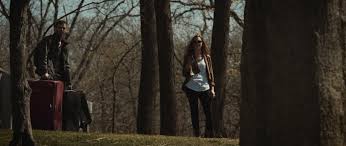
Hey there everyone! Welcome back to Movie Soapbox, the little corner of the internet that only you and I and that guy sleeping in the corner over there know about. This is the place where we find underappreciated indie films and we make sense of them. Today? We are doing a deep dive on Home With a View of the Monster, a movie so quietly, stubbornly strange that even the people who finished it are sitting there staring at the ceiling wondering what they just watched, and whether the ceiling is watching back.
Before we go any further, I need you to understand something: everything from this point forward is a spoiler. Not a soft, courtesy-warning spoiler. A full-surgical-dissection, nothing-left-intact spoiler. If you have not watched this film yet, close this tab, go watch it, and come back. I will wait. I am always waiting. This place does not exist without the film in your eyes first, so go do the work and come back when you’re ready.
Still here? Good. You watched it. You’re confused. That is not a failure on your part, and I want to be clear about that right away, because this film earns its confusion the hard way, which is the only way that actually matters.
The Pre-work of Home With A View of the Monster
The single most important thing you can hold in your head before we start: this story is told non-linearly, and not in the fun, Tarantino-shuffle way where the pieces are clearly labeled. The film drops you in the middle, drags you backward to the real beginning, skips past it, doubles back, and see-saws like that all the way to the end. Most of the chaos dissolves the moment you reorder events chronologically. So that is exactly what we are going to do. I am going to walk you through what actually happened, in the order it actually happened, and by the end you will understand why the movie feels like a fever dream even though the plot itself is, structurally, almost classical.
Now, before we get into the beat-by-beat, let me tell you something about what kind of film this is, because it matters for how you read every creative choice here. A movie at this budget tier, shot in a single primary location, with a cast this small, is not the result of a director who had options and chose restraint. This is a director working with the only canvas available, which means every formal decision, the non-linear structure, the slow dread, the way the haunting bleeds into character psychology rather than jump-scaring you every eight minutes, is load-bearing. You can tell when a film at this level has been left alone to be what it is, because the weirdness is consistent. The weirdness has a logic. Compare that to what happens when a distributor panics in post on a micro-budget horror: you get choppy re-edits, you get a voiceover explanation bolted on at the front, you get the ambiguity sanded off so the trailer has a clean hook. Home With a View of the Monster has none of that scar tissue. Whoever finished this film got to finish it their way, and that is rarer than it should be.
Movie Home With a View of the Monster Walkthrough in Chronological Order
Alright. Chronological order. Here we go. Two people are at the center of this: Chance, played by Jasper Hammer, and Kate, played by Danielle Evon Ploeger. They know each other, loosely. They have arranged a trip together. What Kate does not know is that Chance has been in contact with her grandmother, and her grandmother wants her dead, and has specifically asked Chance to make it look like a drug overdose. Chance has agreed to this. He is traveling with a syringe and a vial of drugs and a plan. He is the prince in this fairy tale the same way a loaded gun is the prince in a fairy tale.
Kate, meanwhile, has changed their accommodations at the last minute. Instead of a hotel, she wants a VRBO rental. Chance goes along with it. Neither of them knows yet that this change will be the thing that kills them both, just not in the order or manner either of them expected.
The house they have stumbled into belongs to Rita, played by Ellen Humphreys, and Dennis, played by Sébastien Charmant. Rita and Dennis bought this house for far less than it was worth, and if you have ever wondered why a beautiful house with a view sells for peanuts, the answer in this film is the same answer it always is: something is wrong with it. The house is haunted. Not metaphorically. Functionally haunted, in a way that has been destroying their marriage, their mental health, and whatever sense of shared future they were trying to build. They even brought in Christian exorcists at some point, and the exorcists fled. Priests who perform exorcisms for a living saw what was in this house and decided they had somewhere else to be. Rita and Dennis have been living with whatever those men ran from.
To get some distance from it, they have gone camping. They have put the house up for short-term rental, maybe hoping the energy shifts, maybe just hoping to get a weekend without the weight of the place on them. Chance and Kate are the renters who show up.
Inside the house, both of them start noticing things. Knives left out on the counter. Cabinets opening. Water running on its own. Each one attributes it to the other’s weirdness. That is the house doing what the house does, which is locate the wound in whoever walks through the door and press on it.
That first night, the house finds Chance’s wound. His daughter. She drowned in a pool while he was drinking and fell asleep nearby, and the house resurrects her, or a version of her, to come visit him. He sees her. He passes out from shock and sleeps until morning.
While Chance is unconscious, Kate does what she came here to do. She had already decided, before this trip, that this weekend was going to be her last one. She brought drugs for exactly this purpose. She overdoses on the couch. The plan, as best we can reconstruct it, was a last night with Chance, some kind of blaze of human connection, and then a quiet exit. The house accelerated the timeline. Chance was out. She did it alone, on the couch, and she died there.
When Chance wakes up in the morning, Kate is there. She is talking to him, moving through the house, pouring wine. She seems fine. She is not fine. She is not Kate. The house has done to Kate what it does: it has kept her, or remade her, or resurrected something that wears her face and carries her memories and has found, in the video on Chance’s phone, the footage of her grandmother arranging her murder.
Call her House-Kate. Ghost Kate. The film does not label her for you, because the film is not interested in making this easy. What matters is that this version of Kate has watched the video of her grandmother and decided that she and Chance are going to go out together. Romeo and Juliet logic, applied by something that is no longer fully human to a situation it is experiencing from the wrong side of death. She drugs the wine. Chance drinks it, realizes what has happened, and forces himself to vomit it back up. He survives, barely, and he now understands at least part of what is happening: Kate is dead, and the thing he has been talking to is not her.
He finds Kate’s actual body. He puts it in the trunk of his car. Now he needs his phone, the one with the grandmother video, the evidence, the only thing tethering this whole nightmare to the world outside this house. House-Kate has hidden it, or is keeping him from it, and Chance is increasingly desperate.
Rita and Dennis come back from camping early. They made a decision out there under whatever sky they were sleeping under: forget the house, forget the dread, they are going to move forward, have kids, build a life. They come home resolved. What they find is a stranger with an axe in their driveway who is trying to explain that the woman inside their house is dangerous, that Rita should not go in there, that there is going to be a bloodbath. Dennis punches Chance in the face and sends him away. This is a reasonable response to a man with an axe making apocalyptic claims about your VRBO tenant. It is also the wrong call.
Chance comes back that night. He steals Dennis’s gun. He forces Rita to hand over her phone. Then, in the detail that has broken the most brains trying to follow this ending: he uses Rita’s phone to call his own phone, which is downstairs, and the ring tells him exactly where it is. He retrieves it. He puts Rita’s phone back on the puzzle table. He goes upstairs and duct tapes Rita and Dennis together. Then he leaves, gets in his car in the driveway, and calls Kate’s grandmother to report that the job is done.
Kate’s grandmother does not answer. Kate’s grandmother is dead. House-Kate got to her first.
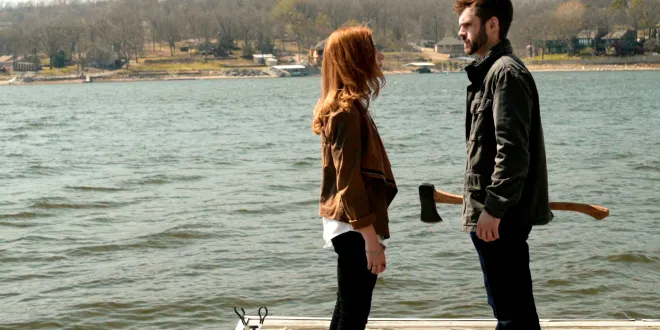
While Chance is sitting in that car processing this, his daughter finds him again. The thing wearing his daughter’s face, the same haunting that dropped him the first night, comes back, and this time it does not just scare him. It kills him. He dies on the front lawn.
Inside, Rita and Dennis, still duct-taped together, make their way downstairs. Rita hooks her foot around her phone on the puzzle table and pulls it to her. They call the police. Then they crawl out to the front lawn to wait, and while they wait, Rita tells Dennis about the children’s book she has been thinking about. Dennis tells her he thinks they should adopt. The haunted house they bought for peanuts has, in the wreckage of this one terrible weekend, resolved the central question hanging over their marriage. Whether that resolution means anything given what lives in their walls is a question the film leaves entirely to you.
Explain the Movie Home With a View of the Monster to Me!
What this movie is, structurally, is a Twilight Zone episode that respects you enough not to explain itself. Two people with dark private histories walk into a house that amplifies the worst things they carry, and neither of them gets out. The owners survive, but survival here is its own ambiguous prize. The house is still the house. The view is still the view. And whatever is in there is still in there, waiting for the next renters.
Now let me give you the competing reads, because this film has generated a few.
Theory one: the haunting is literal and external. The house has a genuine supernatural presence, it manifested Chance’s dead daughter, it manifested ghost Kate, it killed the grandmother remotely, it killed Chance on the lawn. Everything the film shows you is real within the film’s reality. This is the most straightforward read and, honestly, the one the film supports most consistently if you follow the non-linear structure back into chronological order.
Theory two: the haunting is psychological and the house is a catalyst, not an agent. Under this read, Chance’s guilt about his daughter was always going to break him, Kate’s suicidal ideation was always going to end her, and the house just provided the pressure that made existing fractures catastrophic. The grandmother’s death is a coincidence, or an off-screen event that happened to land during the phone call. The house is not supernatural, it is just a specific kind of isolation that removes every buffer between a person and whatever they are running from.
Theory three: everything after Kate’s death is Chance’s psychological break. He found her body, he could not process it, and everything he experienced from that moment forward was his mind constructing a narrative that externalized his guilt. Ghost Kate is his conscience. His daughter attacking him is his guilt completing its work. Rita and Dennis are real. Everything else is interior.
Moviesoapbox’s Take to Explain the Movie Home With a View of the Monster
My read? Theory one, with one modification. The house is real, the haunting is real, but the film is smart enough to build its supernatural logic out of the same material as psychological horror, which is why theories two and three feel plausible even though they require you to explain away several things that are clearly presented as external events. What makes this film interesting is that the haunting does not invent new wounds. It only finds the ones that were already there. Chance’s guilt was real before the house touched it. Kate’s death wish was real before the house accelerated it. A good haunting story does not manufacture the horror from nothing. It locates what is already rotting and gives it teeth.
That is the whole movie. A director working in a single location with a small cast made something formally ambitious enough to confuse people who were paying attention, and strange enough to stick with you after. No test screening flattened that non-linear structure into something easier to follow. Nobody bolted a title card on the front explaining the timeline. The film trusts you, and in a landscape where trust is increasingly a liability, that is the thing worth noting.
If this one grabbed you, look at They Remain and The Wind. Both of them operate in the same territory: isolated locations, psychological pressure, supernatural ambiguity that never fully resolves. You’ll know the neighborhood.
We’ll see you at the next one.