
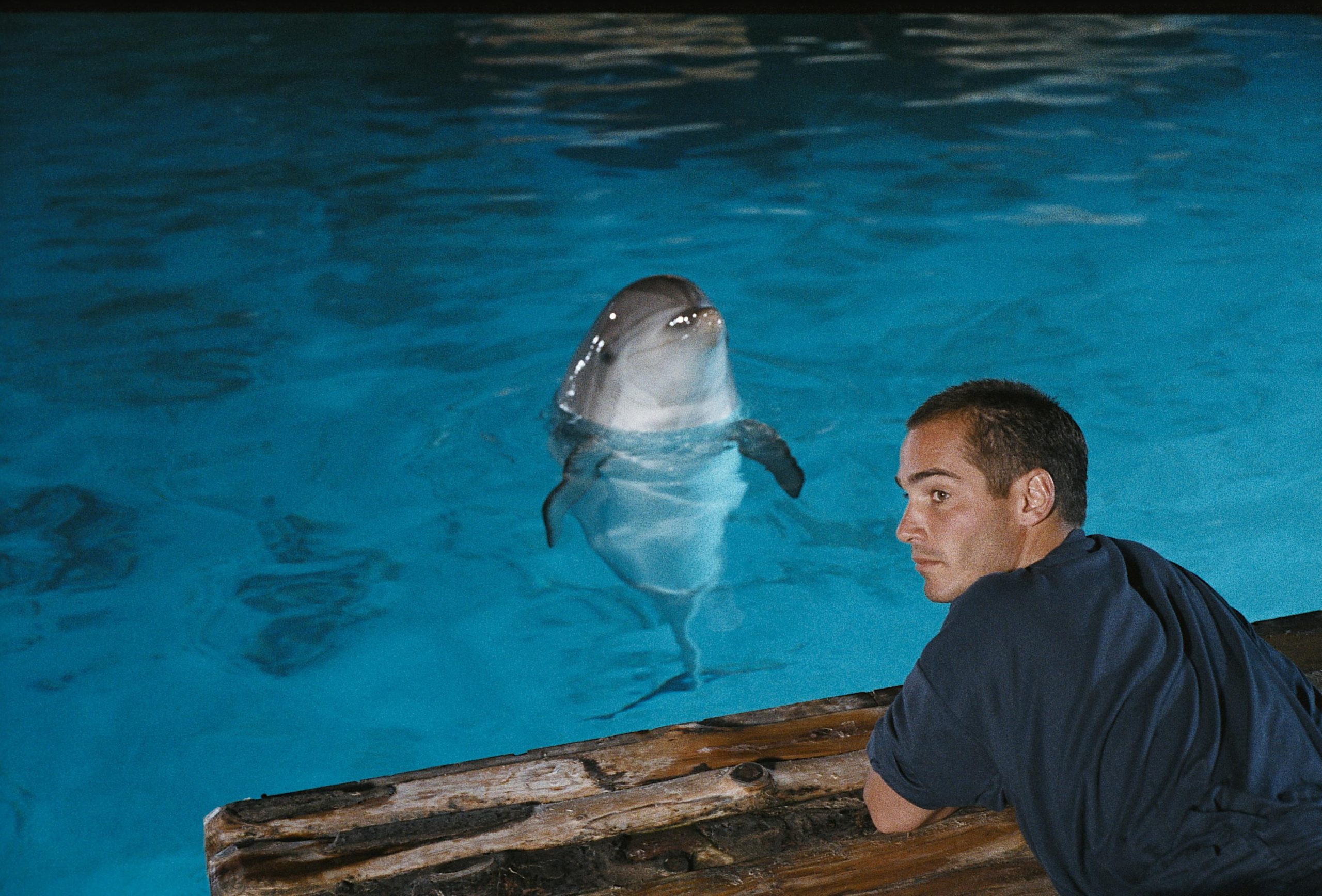
Hey there everyone! Welcome back to Movie Soapbox, the little corner of the internet that only you and I and that one guy who keeps refreshing the page at 2am know about. This is the place where we find the films that got buried, mangled, or quietly shelved, and we make sense of them. Today? We are doing a deep dive on The Big Blue, a movie so quietly devastating, so genuinely weird in the best possible way, that even the director himself made the wrong call about which version the world should see, and Luc Besson has been wrong about it for thirty-five years.
Fair warning: everything after this paragraph is going to ruin the ending of The Big Blue for you if you haven’t seen it, and I am not going to apologize for that, because if you haven’t seen it yet you’ve had since 1988 and at some point that’s on you.
The Big Blue Movie Making Of
So here is what you need to understand about this film before we go a single frame further. The Big Blue was a Luc Besson project from the period before Besson became a brand, before he became the guy who manufactured glossy action product out of a Paris warehouse and stamped his name on it like a quality seal. This was the version of Besson who was making something personal, something that had the actual fingerprints of Jacques Mayol, the real free diver, all over the screenplay. Mayol helped write this. His voice is in the bones of it. And that matters because what this film is actually about, underneath all the gorgeous Aegean footage and the Jean Reno charisma and the Rosanna Arquette love story, is a man who found the only place in the world where the noise stopped, and couldn’t fully choose to leave it. You can feel that in every long, slow underwater sequence. The film does not rush. It does not explain. It just descends, the way Mayol descended, and waits to see if you have the patience to follow it down.
Now pay attention, because this is the part that tells you something about how films survive the machinery that’s supposed to support them. The Big Blue landed in France and Europe like a cathedral, 132 or 168 minutes depending on which cut, a hymn to depth and beauty and the particular madness of men who treat the ocean floor as a homecoming. In America it got roughly twelve seconds of theatrical attention before being quietly retired to VHS and then pulled from print entirely. The conventional explanation, the one Besson himself has offered, lays the blame on the Bill Conti score and the shorter running time and the American ending. And Besson took his ball and went home: he shut down the American theatrical release, let it go out of print, and effectively declared the European extended director’s cut the only version that should exist. The American theatrical version is now a ghost. You cannot buy it. You can barely find it. What Besson did with that decision is the kind of thing that happens when a director with full artistic conviction mistakes “my film failed commercially in a territory” for “that territory’s version of my film is the problem.” Those are two different diagnoses and they lead to two completely different treatments. The American cut did not fail because of Bill Conti. It failed because it was a slow, meditative, European art film about a man’s gravitational pull toward death, and it opened in America in the summer of 1988, and Americans wanted Batman.
The Big Blue Movie Walk Through
The film follows Jacques Mayol (Jean-Marc Barr) and Enzo Maiorca (Jean Reno) as they chase each other toward the bottom of the ocean in no-limits apnea competition. No oxygen. No fins at depth. Just a weighted sled on the way down and a balloon on the way back up, and the absolute outer edge of what a human body can suppress in terms of its own survival instinct. The current world record in no-limits apnea is 214 meters. That is 702 feet. My ears start complaining at around twenty. The film is not really about the competition though. The competition is the frame around what the film is actually about, which is the way Mayol experiences the ocean as the only place where he belongs, more than on land, more than with the woman who loves him (Johana Baker, played by Arquette), more than in any life the surface world can offer him. Maiorca is his rival, then his friend, and Jean Reno turns what could have been a one-note foil into something warm and furious and alive. He is the earth to Mayol’s water. The film needs him to make Mayol’s pull toward the deep feel like a choice rather than just an inevitability.
And the settings. The Greek islands, the Sicilian coast, the Peruvian sequences early in the film. Besson shot in locations that do not require any directorial embellishment to be otherworldly. You could run thirty minutes of raw footage from this production and call it a nature documentary and it would still be more beautiful than most films that were made with beauty as their primary objective. The underwater sequences, specifically, have a quality of silence and light that no amount of budget can manufacture if the cinematography isn’t right. Carlo Varini, who shot the European version, and the team that worked the American sequences, caught something real down there.
Now. The versions. Because this is where the film gets complicated, and where the hot take that is the whole reason we’re here today gets deployed.
There are three cuts of The Big Blue. The European theatrical version at 132 minutes. The American theatrical version at 118 minutes, with Bill Conti’s score and a different ending. The European extended director’s cut at 168 minutes, with Éric Serra’s score, which is the version Besson considers correct and which is the only one you can legally purchase today. The director’s cut adds roughly forty minutes to an already deliberate film, swaps the score, and restores the European ending. Besson loves it. The French love it. Most people who have seen only one version love whichever version they saw first, because that is how film memory works.
Moviesoapbox’s Take On The Various Versions of The Big Blue
But here is the thing that nobody wants to say out loud: the Bill Conti score is correct for this film, and the American theatrical version is the version that works, and Luc Besson has spent thirty-five years being wrong about his own movie in a way that has made it functionally inaccessible to new audiences. The Éric Serra score, which Serra also did for Besson’s later work, is cold and electronic and creates a certain kind of distance, a detachment that reads as sophisticated in some contexts and reads as the film being afraid of its own emotions in this one. Conti’s score leans into the grandeur. It believes in the beauty it’s scoring. It lets the film feel like what it is, which is a myth, a gorgeous impossible story about a man who was more fish than human, set against the most beautiful water on earth. You cannot score that with synthesizers and detachment and call it a better fit. You cannot.
The Ending of the Film The Big Blue
Now, the ending. And here is where Mayol himself becomes the most important context you can bring to this film, because Mayol, the actual man this story is partly about, the man who helped Besson write the screenplay, committed suicide in 2001. He was seventy-four years old and he went into the ocean and did not come back up. And when you read his interviews from across his career, the language he used about the ocean, about breath-hold diving as a continuation of the womb, about melting into the sea, about becoming a diving mammal, it reads less like poetry and more like a man who spent his whole life announcing exactly what he was going to do, in a language that people around him kept interpreting as metaphor. It was not metaphor.
So. The ending. Both versions converge on the same image: Mayol, at depth, after his girlfriend Johana has begged him from the surface of the boat to come back, to choose her, to choose the surface world. He rides the sled down anyway. And at the bottom, a dolphin meets him. In the European version, Mayol swims out toward the dolphin and we cut to credits. In the American version, we see a shot of light rippling upward through the water, and then Mayol and the dolphin break the surface together, and Conti’s score swells into something that sounds like triumph or transcendence depending on what you’ve decided the film means.
The fan consensus is that the European ending is more ambiguous, more artistic, more honest about the darkness at the film’s core. The American ending gets labeled the “happy ending” because of the surface shot and the swelling music. But watch them back to back and ask yourself what you are actually seeing. In the European version, Mayol swims toward the dolphin and vanishes from the frame. In the American version, he surfaces, but he surfaces into light, into something that does not quite look like the world he left, and Conti’s music is not exactly celebrating. It is exulting, which is a different thing. Exultation is what you feel when something is finally over. When you have finally arrived. You can read that ending as survival. You can read it as the moment of death rendered as release. Mayol himself, the man whose words are threaded through the screenplay’s DNA, would probably not have found those two readings mutually exclusive.
The competing interpretations of this film’s ending tend to split along a fairly clear fault line. Viewers who came to the film through the European theatrical release tend to argue that the ambiguous cut to black is the honest ending, that having Mayol surface into the world again would betray everything the film has built about his relationship to the deep. Viewers who came to the film through the American version, or who have seen both and prefer the Conti-scored cut, tend to argue that the surface shot does not confirm survival so much as it confirms arrival, that Mayol reaching the dolphins, the creatures he identified with more than any human being, is the film’s true destination regardless of whether his body is still breathing when he gets there. A third read, which I find genuinely defensible, is that Besson built an ending so deliberately open that it functions as a Rorschach for the viewer’s own relationship to the film’s central tension, which is the tension between loving someone enough to stay and loving something enough to go.
Moviesoapbox’s Take On Which Ending is Which??
Movie Mike’s read: the American theatrical version is right, the Bill Conti score is right, the ending is right, and it depicts Mayol dying in the only way that would have felt like peace to him. The surface shot is not survival. It is arrival. He made it to where the dolphins are and the light comes from above and the weight of the land is gone. That is what the film has been building toward across 118 minutes, and Conti’s score knows it. Besson added forty minutes, swapped the score for something colder, and in doing so created a version of the film that holds the audience at arm’s length from the exact emotional experience the film exists to deliver. He made the correct film and then spent three decades insisting the inferior version was the real one, and pulled the better version from circulation to prove his point. That is a damn shame.
What makes The Big Blue worth finding in whatever form you can find it is that it is one of the rare films about obsession that does not pathologize the obsessive. Mayol is not presented as broken or self-destructive in the way that requires the audience to diagnose him and feel safely distant from his choices. The film asks you to understand why the bottom of the ocean is more real to him than anything on the surface. And if you have ever had one thing in your life that felt more true than everything else around it, the film gets its hooks in you and does not let go. It survived Besson’s later choices about how to present it. It survived American audiences not knowing what to do with it in 1988. The version that should exist is barely findable, preserved on aging laserdiscs and grainy rips that circulate among the people who know. That is the kind of thing that happens to films when the person who made them decides their own commercial failure is a version problem. It almost never is. This film deserved better than that.