
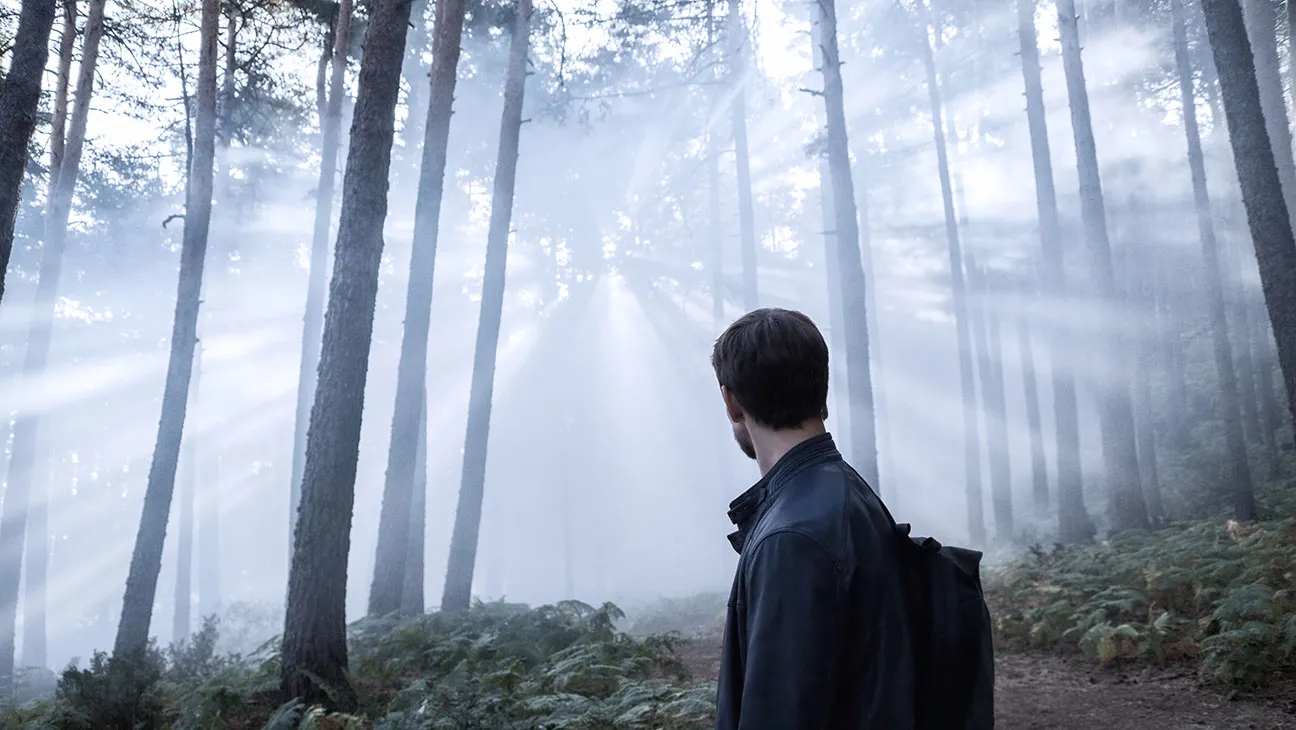
Hey there everyone! Welcome back to Movie Soapbox, the little corner of the internet that only you and I and that one guy in the back who keeps rewinding the same three minutes of a film he can’t quite crack know about. This is the place where we find under-appreciated indie films and we make sense of them. Today we are doing a deep dive on The Maus, a movie so rooted in genuine historical trauma and so uninterested in holding your hand through it that the algorithm never knew what to do with it, and quietly left it to die on a shelf where almost nobody found it.
Here is the trailer, for whatever that is worth, and I will warn you right now, Mike has thoughts about it.
Yeah. That trailer is a disaster. Quick cuts, a thumping dance track, the slow-motion money shots served up front like a buffet of spoilers. Someone in a marketing suite watched forty minutes of this film, identified the six loudest frames, and built a package designed to attract the wrong audience and repel the right one. The people who would have loved The Maus saw that trailer and kept scrolling. The people who clicked based on it left angry reviews about being confused. That is the whole story of how a film like this lives and dies, right there, in two minutes and fourteen seconds of someone else’s decisions.
Alright. Full spoilers from this point on. Every twist, every false start, every theory about that ending. If you haven’t watched The Maus yet, go find it, come back, and we will be here. This post is not going anywhere and neither am I.
The Making of The Maus Movie
Before we get into the mechanics of what this film is actually doing, I want to name something that the trailer and the marketing and frankly most of the reviews completely sidestepped. The Maus is a film built on a specific, particular, documented historical atrocity, and a very specific psychological condition that atrocity produced in its survivors. That is not a backdrop. That is the entire engine of the movie. A film like this, grounded this specifically in the Bosnian War and its aftermath, in a Muslim woman’s PTSD layered over genuine genocide survivor guilt, gets made at this budget level because nobody with a bigger checkbook thought there was an audience for it. And the director ran with that. When a film gets made small because the money stayed away, sometimes you get a committee-proof version of the story the director actually wanted to tell. The fingerprints on The Maus are singular. Nobody gave enough notes to sand it down into something safer. You can feel that in every scene where the film refuses to clarify whether what you are watching is real, and just stares at the back of someone’s head and waits.
The Maus Movie Walkthrough
The film opens on darkness, a prayer in Arabic, and then a long, patient hold on a woman’s face. The prayer is addressed to Ya Hafizu, one of the ninety-nine names of God in Islam, meaning The Preserver, The Guardian. Within the first thirty seconds, before a single line of dialogue, before we know anyone’s name, the film has told you everything you need to know about Selma: she is Muslim, she is asking something to protect her, and whatever she is afraid of is not small. You can spend the rest of the movie unpacking that one opening prayer, because it pays off in every single theory about what this film is actually doing.
Selma is Bosnian. If that detail lands with full weight for you, the film hits harder. If it doesn’t, here is the context you need: from 1992 to 1995, Bosnian Serb forces, backed by the Serbian military, carried out a systematic campaign of ethnic cleansing against Bosniak Muslims. Roughly 100,000 people were killed. Tens of thousands of women were raped as a deliberate instrument of war. It was the worst act of genocide on European soil since the Holocaust. Sarajevo was under siege for 1,425 days. Whole villages were executed and buried in mass graves that flooded out of the earth years later. The reason Selma and Alex are in that forest is because flooding uncovered one of those graves, and it was her family’s. She is not on holiday. She is identifying her dead.
Into that forest, the film drops two Serb men. Four actors total in this entire film, and the weight of an entire war compressed into every scene they share. That is the setup. Now let’s walk through what the movie does with it.
Rafael Reparaz, the cinematographer, makes a specific and deliberate choice throughout The Maus that is easy to miss and impossible to un-see once you’ve caught it: he keeps the camera tight on the back of a character’s head when the important action is happening out of focus behind them. You are watching the person watching the thing, not the thing itself. This is not a budget limitation or a stylistic tic. This is the formal strategy of the entire film. You are inside a subjective experience. You are not getting an objective record. Every time Reparaz does this, you should be asking yourself whether what is blurring in the background is actually happening or whether it is the inside of Selma’s head rendered as image.
The PTSD shards come fast. Selma envisions stepping on a landmine, being seized, being raped. Then the film cuts back and none of that happened, at least not now, not on this trip. The dog steps on the mine. The men kill the dog. But the violation in Selma’s vision is something she carried into this forest from before, a memory that lives in her nervous system and fires when the conditions get close enough to the original wound. The film does not label this. It does not give you a helpful visual grammar to separate the real from the remembered. You have to do that work yourself, and the film is betting you will, because the people who made it were not worried about losing the audience who won’t.
When the two Serb men, Milos and Vuk, make themselves known, the film becomes a pressure cooker with four people in it and no exit. Alex calls what he thinks is emergency services, dials 911 like a Western tourist who never checked, and gets nothing, because in Bosnia the emergency line is 122. He doesn’t know that. He is, as the film keeps showing us, a confident young European man who does not know what he doesn’t know. The two Serbs reveal they understand English perfectly, tell him they are Serbs, not Bosnians, and offer the loaded implication that a Serb might not be the most reliable help for his Bosnian girl. Dinner is served.
Selma has another break. Alex steadies her, tells her he is her guardian angel. Then he is shot in the chest. Then Selma is dragged through an outpost filled with corpses and Serbian soldiers. Then the film snaps back and Alex is fine and Selma has to explain to him, urgently, that they cannot trust these men, that Serbs killed her entire family. The film is not being coy. It is showing you what it is like to live inside a mind that cannot always locate the boundary between memory and present. That is not a horror gimmick. That is a clinical description of complex trauma.
What happens next is the moral center of the film, and it is where most horror-adjacent films would flinch. Selma goes into the outpost with a knife. She and Milos struggle. She sees the alien female form, the entity the film has been building since the opening prayer, the thing the forest seems to contain. And then Selma slits Milos’ throat. The film has trained you by this point to assume this is another false start, another psychotic juke. It is not. Selma actually kills him. And then the alien entity, the Hafizu figure, removes his head entirely. Two different acts of violence, one fully real, one possibly not, layered on top of each other, and the film does not separate them for you.
Selma then stabs Vuk in the gut. She tells Alex it is over. They start to bury the bodies. Alex realizes she cut Milos’ head off and looks at this woman he has been with for a year like he has never seen her before. He finds the amulet, her hamajlija, the talisman her father gave her, in Vuk’s pocket. Vuk is still breathing under the dirt. Alex cannot finish him. Selma can, and does, repeatedly, with a rock, while the camera holds on the back of Alex’s neck and we watch an out-of-focus woman destroy a man’s skull. Alex runs. Hits a landmine.
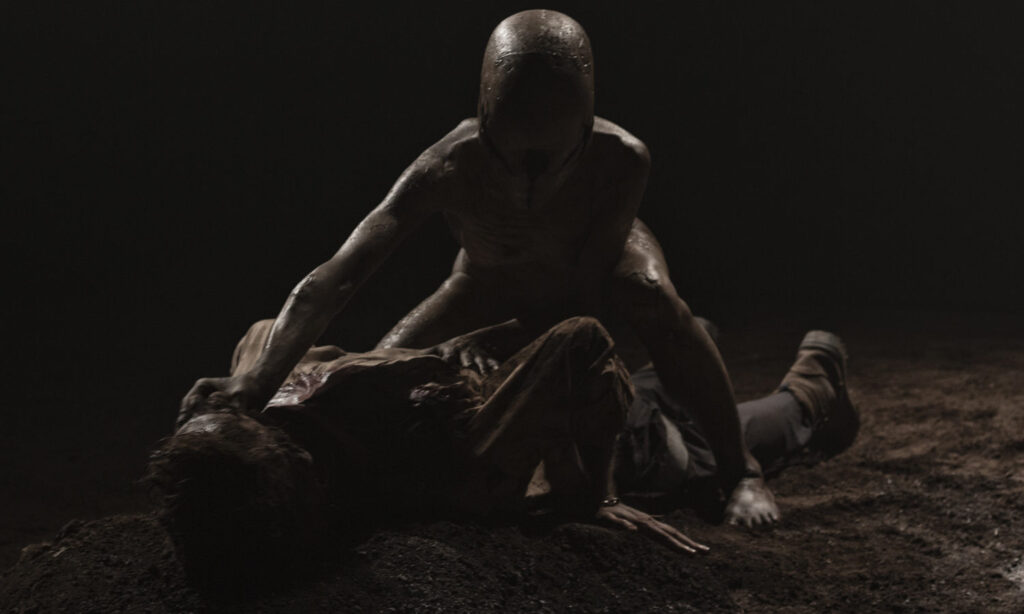
Now. The ending. Because the ending is where the film puts all its chips on the table and asks you to decide what kind of movie you just watched.
We know, after the mine, that Alex is alive, because we see him. He is in a park, on a normal day, with a new woman, trying to reassemble a life. Children are playing. It is quiet. And then a sound like an explosion rolls through the park and people scatter, and a blurred female figure slides into frame in front of Alex, holding an AK-47. Cut to black.
The Maus Movie Theories to Explain that Ending
Four theories exist for what that ending means, and they are not equally weighted.
Maus Ending Theory one: Alex did not survive the landmine. The park, the new woman, the quiet afternoon, all of it is the last firing of a dying brain constructing a life it never got to live. Selma is the last thing he sees because Selma is what the mine brought back to him in his final seconds. This is the cleanest reading and requires the least scaffolding.
Maus Ending Theory Two:Alex died from the original gunshot, early in the film, and everything after that is Selma’s dissociation building an entire second half of a story in which he survives long enough to see what she becomes. The film certainly earns this reading given how many times it has already told you that the thing you just watched did not happen.
Maus Ending Theory Three: both of them survived. Alex got himself out of that forest, got himself to a therapist, got himself a new life. And the trauma did to him what it did to Selma. His nervous system learned to produce its own Hafizu, its own guardian figure pulled from the wreckage of what happened in those woods. The blurred woman with the AK-47 is Selma the way Selma’s alien entity was Selma, a projection of the thing that preserved him and destroyed him at the same time. He is not in danger in that park. He is having a break. The explosion is not real. The crowd running is not real. It is his version of her mine-step vision in the first act, and the film is telling you that trauma is not something that happened to Selma specifically. It is something that happened to anyone who got close enough to the wound.
Maus Ending Theory Four: This is the literal read, and Moviesoapbox is going to tell you why it works even if it is the least elegant: they both survived. They separated. Alex moved on. Selma did not take moving on as a conclusion she agreed to. She found him in that park. The blurred woman is real. The AK-47 is loaded. The crowd is running because something actually happened or is about to. This reading makes Selma fully, irreversibly broken, past any ambiguity the film has offered her, and it defines every flashback and psychotic episode as the path that led here. Selma survived the war. She crossed the moral line twice in that forest, once with intent and once in cold blood. Alex drew the line and she ignored it. This is the consequence.
Moviesoapbox’s Preferred Ending Explanation:
Mike’s pick is theory three, and he is not hedging on it. The formal strategy of this entire film is to show you the same architecture of trauma replicated in two different people. Selma’s Hafizu figure is herself, the dark and surviving version of herself that did whatever it took to get through. She projected it outward, gave it a form, let it do the work she couldn’t consciously claim. If Alex survived and carries what happened in those woods inside him now, he would build the same kind of projection from the same raw material. The thing that saved him and the thing that nearly broke him are the same woman. Of course she is the last thing he sees when his brain fires. Of course she is blurred, because she is not there. The film has shown you this grammar four times already. Theory three is the film finishing the sentence it started in the opening prayer.
What almost happened to The Maus is that it almost got sold as a creature feature set in Bosnia and marketed to an audience that wanted jump scares and a clean monster reveal. The trailer they actually made is the version of this film that almost was. The film that exists is what survived that instinct, a quiet, brutal, formally rigorous study of what it costs to live inside a history that the rest of the world processed as a news event and moved on from. Four actors. One forest. The weight of a genocide and everything it left behind in the people who walked out of it.
Films like this one don’t get sequels. They don’t get franchise extensions or IP deals or a prestige limited series adaptation. They get made once, small, by people who cared more about getting it right than getting it wide. And then they drift. And then someone finds them years later in a corner of the internet and writes about them, and maybe you find it, and maybe it gets one more watch, one more person who needed to see it. That is the whole economy of a film like The Maus.
We will see you at the next one.