
Hey there everyone. Welcome back to Movie Soapbox, the little corner of the internet that only you and I and that guy sleeping in the corner over there know about. This is the place where we find underappreciated indie films and we make sense of them. Today? We are doing a deep dive on Remainder, a movie so structurally strange, so relentlessly committed to its own loop, that watching it feels less like sitting in a cinema and more like being caught inside someone else’s compulsion and slowly, against your will, starting to understand it.
Before we go any further, here’s the trailer. Watch it, or don’t, honestly it won’t prepare you for this film the way you think it will.
Alright. Full spoilers from this point forward, for the entire film, every beat, every loop, every body on the floor. If you haven’t seen it and you want to go in clean, stop here, go find the film, come back. If you’ve seen it and your head is still spinning, which is the correct response, stay put. I have some things to tell you about what this film had to survive to exist in this form, and then we’re going to walk through the whole thing together.
Remainder Movie Deep Dive
Because there is something you should know before we get into the scene-by-scene of it. Remainder is adapted from a novel that, when it was first published, couldn’t find a mainstream publisher willing to touch it, ended up with a tiny French imprint, and then got detonated into literary fame by a single 9,000-word essay from Zadie Smith that basically declared it the future of fiction and everything else a retreat into comfortable lies. That is the energy this story carries. And when a film gets made from source material with that kind of literary baggage, a specific thing happens in development, a very specific gravitational pull toward explanation, toward accessibility, toward giving the audience a handle to grab. You can feel, in films like this one, the ghost of the note that was never delivered, or if it was delivered, was never acted on. The note that says: but why is he doing this, can’t we just tell them why. The fact that director Omer Fast either never received that note, or received it and smiled politely and then went back to his edit and did exactly what he was going to do anyway, is the entire reason this film is worth your time. At this budget level, with this cast, a director either has enough cover to protect the strangeness or he doesn’t. Fast had just enough. You can tell because the strangeness is still there, intact, undiluted, quietly horrifying.
Remainder Movie Walkthrough
The film opens mid-motion. Tom is crossing a street with a suitcase. He glances back at a Black woman watching him from the curb. He turns. Something falls from the sky and destroys him. And right there, in the first ninety seconds, the movie has handed you everything you need to understand it, wrapped it in total ambiguity, and walked away whistling. You will come back to this opening. The film will make sure of it.
Tom survives, barely. He wakes up with no memory of anything before the impact. His entire pre-accident identity is gone, legally settled away for close to ten million pounds in a deal he barely understands from a company whose debris did the crushing. And what fills the void where his past used to be is not nothing. It is fragments. A boy. A coin. A woman. A stairwell. An apartment building he cannot place. These are not quite memories because he has no memories, but they arrive with the full emotional weight of memory, and chasing that feeling, that hit of almost-knowing, becomes the organizing logic of everything he does from here forward.
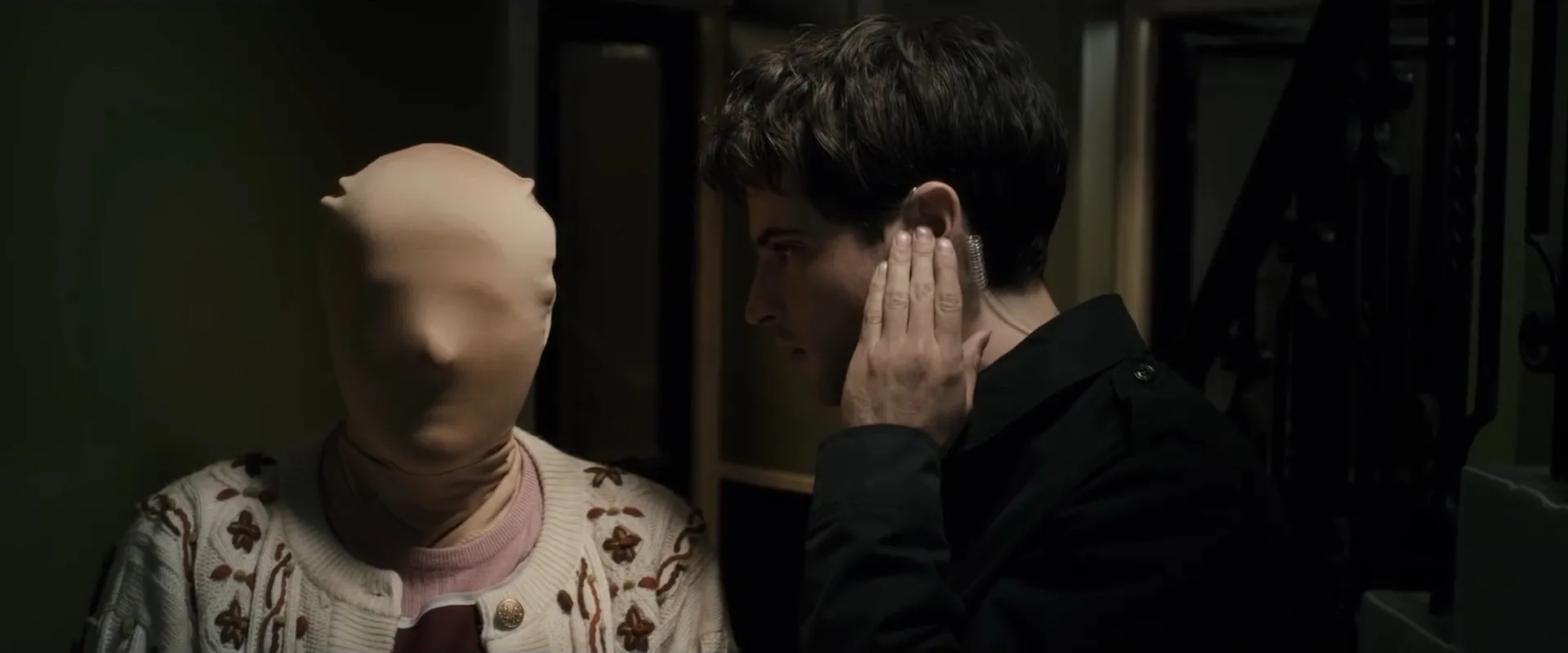
He starts small. Sketches. Models. Mock-ups of the building that keeps recurring. When those fail to deliver the feeling with sufficient intensity, he hires a service, finds the actual building in London that matches the one in his head, buys it, and begins populating it with actors doing exactly what the fragments suggest the real occupants once did. An old woman cooking liver in the apartment above. A pianist cycling endlessly through Chopin. A couple on the first floor whose faces Tom can’t recover, so they wear bags over their heads. He directs them from above, from a scaffolding rig he builds so he can oversee the whole tableau, and he runs them through their actions again and again and again until the quality of the loop produces the feeling he is after. Which it never quite does. Which means the next iteration has to be more precise, more controlled, more total.
The people circling Tom during all of this are worth a paragraph. Greg, who presents as an old friend, though whether that relationship was real or constructed is genuinely unclear. Catherine, Greg’s ex, who seems to want something from Tom, romantic or financial or both, and whose appearance later in the film is either a coincidence or the mechanism of a trap, depending on which theory you walk out carrying. And two men who present as plain-clothes police but whose actual authority or purpose is never confirmed, who appear periodically to remind you that someone outside Tom’s control is watching. None of these people get explanations. The film treats them the way Tom treats the actors in his reenactments, as functional presences, as parts of the machine, and if you want their interiority you are on your own.
The reenactments escalate. From the apartment building to a full warehouse reconstruction of the building, the street, the sky, the ambient texture of a London neighborhood. Tom hires hundreds of people. He controls their movements down to the precise angle of a hand on a door handle. He pauses them mid-action, mid-breath, and stands over them studying the freeze like a man trying to read a word he almost recognizes. The actors are not people to him. They are instruments. The book is reportedly far more explicit about how ugly this control becomes, but the film shows you enough. Tom’s relationship to other human beings is purely instrumental and has been, you suspect, since before the accident.
Then the bank fragment surfaces. Tom becomes certain, with the full hallucinatory conviction of his recovered impressions, that a bank robbery was part of whatever it is he is trying to reconstruct. He brings in an ex-con consultant. He casts four bank robbers. He runs the heist in his warehouse, over and over, hundreds of repetitions, driving the time down toward five minutes. And then he decides that a warehouse reenactment no longer produces sufficient fidelity. He decides to run the heist on a real bank. The cast will believe it is another rehearsal. They will not know the guns are loaded until they are pointed at something real.
His logistics man, Naz, walks Tom through the mathematics of containment. There are twelve scenarios, 104 permutations, and every version requires that no one outside the operation knows what the operation actually was, which means everyone inside the operation eventually has to be removed. Tom absorbs this the way he absorbs everything, as a logistical parameter rather than a moral event.
The heist happens. Catherine is in the bank when it goes down, there to access a safety deposit box, and the suitcase she’s carrying is, in Tom’s certainty, his suitcase, the one from the opening of the film. The robbery goes mostly clean until one of the robbers trips on the carpet in the lobby and is shot by another member of the crew in the confusion. The rest of the team, now standing in a crime scene instead of a rehearsal, looks around trying to understand what just happened. Tom walks through them and shoots each one, systematic, unhurried, the way you’d reset actors between takes. He walks out of the bank onto the street carrying the suitcase. He stops. He looks up. He knows what comes next. Something is going to fall from the sky.
The film closes with Tom’s monologue, delivered over the image of him standing on the pavement waiting:
“About the past I can say very little. Something fell down from the sky. Technology, bits, parts, squashing me onto the pavement. And then nothing. A blank. Eventually the sun will set, and the universe will run down like a toy whose spring is unwound, then there will be no more music, no more loops, and there will be nothing to recreate. No buildings to renovate, no people to rehearse, how to freeze, how to move. For now though, the clouds will part and something will fall down, turning, returning, heading back, getting nearer. Here I am. Waiting, reborn, again.”
The loop closes. Or doesn’t close. It recurs. That’s the point.
What Is Remainder Actually Doing Mechanically
The structural question you need answered before the theories make sense is this: is the loop in this film a narrative device or a literal event in the story’s world. Because the film doesn’t fully commit to either, and that ambiguity is load-bearing.
What’s clear: the film opens with Tom crossing a street with a suitcase and ends with Tom on a street holding a suitcase, about to be hit again. The woman on the curb at the opening appears, or a woman like her, during the bank sequence. The suitcase Tom takes from Catherine in the bank is almost certainly the suitcase he was carrying when he was first struck. Everything Tom has spent his entire fortune building toward, every reenactment, every loop, every controlled repetition, has produced exactly the initial conditions of the event that wiped his memory. He has reenacted himself back to the beginning.
Whether this is because he has always been in a loop and we are watching one iteration, or because his compulsive reconstruction accidentally reproduced the original event through sheer accumulation of fidelity, is where the film leaves you. Both readings are available. The film does not wink at either one.
The characters of dubious identity, Greg, Catherine, the pseudo-cops, exist in both readings. In the loop theory, they are recurring figures who appear in every iteration, playing their parts. In the reconstruction theory, they are people from Tom’s real pre-accident life whose actual history with him we never recover, and whose presence in the final heist may be coincidence or may be the mechanism by which the loop was always going to close.
The Remainder Movie Theories
The Nostalgia Reading: Tom is a man who lost his past and is trying to get it back. The reenactments are driven by a homesickness for his own life, a literal attempt to rebuild the world as it was and step back inside it. Emotionally coherent, and it maps cleanly onto the film’s early sections. The problem is that Tom never reenacts anything from before the accident. He can’t. He has no memories of before the accident. What he is reenacting are fragments that turn out to be from his future, the bank heist, the street, the moment of impact. The nostalgia frame collapses the second you track what he’s actually trying to reproduce. He is not homesick for the past. He is magnetized by something else entirely.
The God Complex Reading: Tom is a man with ten million pounds and no prior self to constrain him, and what he builds with that freedom is a miniature universe over which he has total control. The reenactments are about power, specifically the power to freeze time, to reverse causation, to force the physical world into compliance with his will. There is a scene in the book, less present in the film, where Tom becomes obsessed with making windshield washer fluid appear to dematerialize, to make matter vanish on his command. That is not a man chasing a memory. That is a man trying to repeal physics. The problem with this reading is that it doesn’t explain the compulsion to repeat. If the point is control, why does no single iteration ever satisfy? Power that requires infinite rehearsal is not power, it’s a different kind of helplessness.
The Freudian Death-Drive Reading: Freud’s most unsettling idea, buried in Beyond the Pleasure Principle, is that organisms don’t only seek survival and pleasure, they seek return to a prior inorganic state. There is a pull toward dissolution, toward the condition before animation, that runs underneath and sometimes against the survival instinct. Tom, by this reading, is not chasing the past or chasing control. He is chasing the moment before he existed, the stillness before the accident, the inanimate state the impact briefly delivered him to. The reenactments are attempts to reproduce that stillness, that blankness, that absence of self, with enough precision to finally inhabit it permanently. The loop, by this reading, is not punishment. It is desire that can never be consummated because the consummation would require nonexistence.
The Sisyphean Judgment Reading: Tom, before the accident, was the fifth man in the bank robbery. He shot his crew, walked out with the money, and was struck down on the pavement by what the film calls space debris but what this reading would call consequence. He is now condemned to reconstruct the crime, over and over, accumulating the exact conditions of the original act, without ever achieving the recognition that would let him stop. He is not trying to remember. He is being made to repeat. The loop is not a feature of his psychology, it is a sentence. The problem with this reading is that it requires a judge, a mechanism of punishment, a moral architecture the film never confirms. It also requires Tom to have been, in some prior iteration, a man capable of loyalty and betrayal, and the film presents him as someone for whom other people have never registered as real. Hard to betray what you never acknowledged.
What Moviesoapbox Actually Thinks
The Freudian reading gets closest, but it needs one adjustment to land properly. Tom is not chasing the pre-animate state in the abstract. He is chasing the specific moment of the impact, the fraction of a second when something fell from the sky and emptied him out and the world went blank and clean. That moment was, for him, the only authentic experience he has ever had, the one thing that happened to him that he could not rehearse, could not control, could not direct from a scaffold above. And everything since, every million-pound reconstruction, every actor held motionless over a sink, every loop of Chopin, every bank heist run until the timing is under five minutes, is an attempt to reproduce the conditions of that one real moment with enough fidelity to feel it again. He is not trying to remember who he was before. He is trying to get back to the thirty seconds after the debris hit, when he was no one, when the loop hadn’t started yet, when there was nothing to recreate.
He can’t get there. The fidelity is never high enough. So he runs it again.
The tragedy is that the only iteration with sufficient fidelity is the original, which he can only reproduce by standing on the pavement with the right suitcase at the right moment and waiting for something to fall. Which is exactly where the film leaves him. Waiting. Again.
This is a film about a man who mistook total control for the thing he actually needed, which was to be completely, irreversibly out of control one more time. The industry makes films about men like this all the time and turns them into thrillers, into puzzle boxes, into franchises with merch. Omer Fast made this instead. That it exists at all, intact, in this form, unflattened, unexplained, ending on a man looking up at the sky waiting to be destroyed, is not nothing. Most films like this don’t make it. Most of them get the note about the handle, take the note, and give you the handle. This one didn’t. Remember that while you’re standing there with your head spinning, trying to figure out what hit you.