
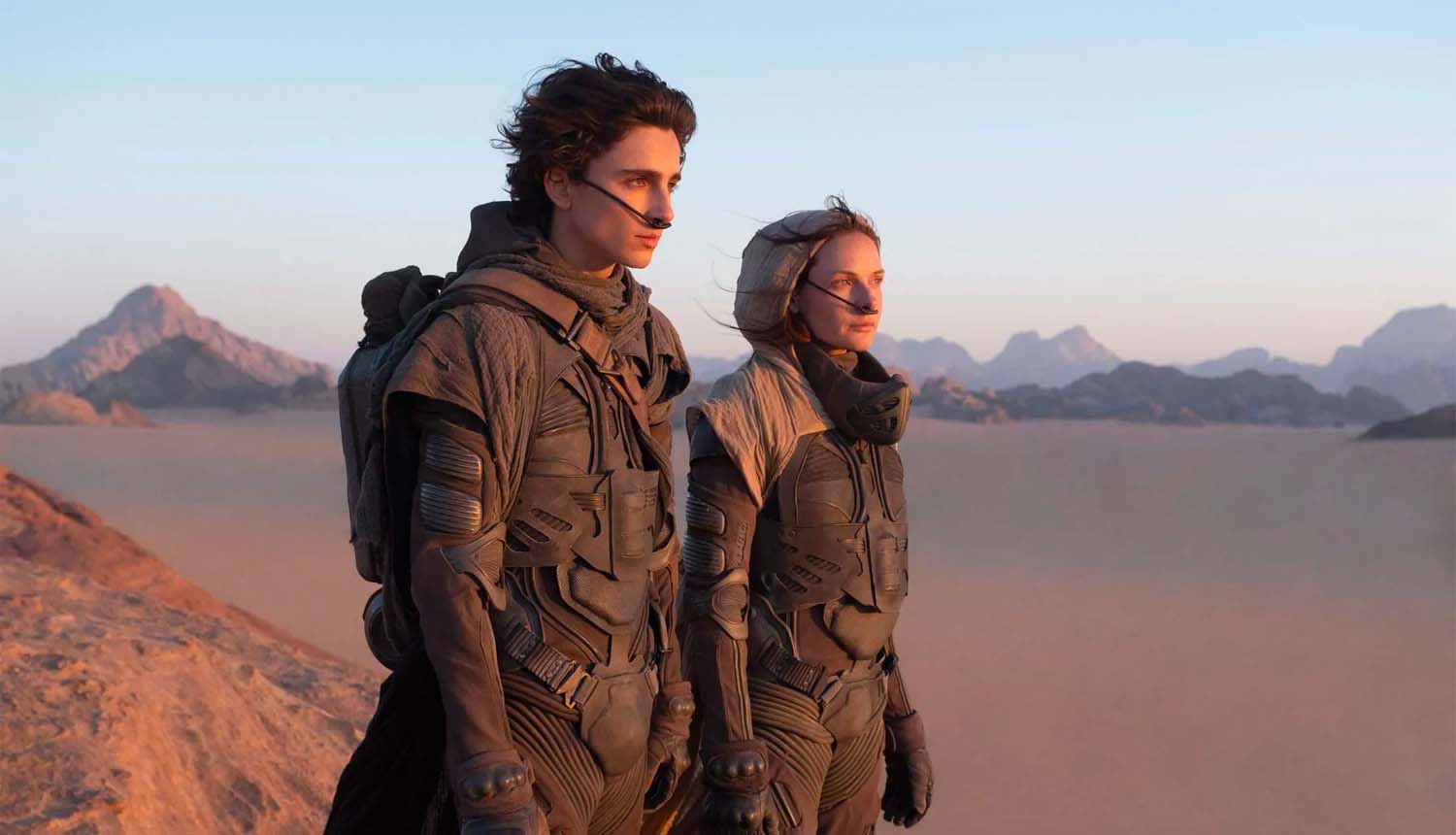
Hey there everyone! Welcome back to Movie Soapbox, the little corner of the internet that only you and I and that guy sleeping in the corner over there know about. This is the place where we find under-appreciated and misunderstood films and we make sense of them. Today? We are doing a deep dive on Dune Part 1, a movie so cosmically ambitious, so structurally patient, so openly contemptuous of the modern blockbuster’s need to explain itself every eight minutes, that the studio financing it reportedly had genuine cold sweats watching the first cut.
Before we go any further, understand that everything from this point forward assumes you have seen the film. The full film. All two and a half hours of it. Paul Atreides, the desert, the worm, all of it. If you haven’t, close this tab, go watch it in the best home theater setup you can access, come back. Because we are going deep, and I am not slowing down to protect you from the story. Now. What Denis Villeneuve actually did here, and why it matters that he did it at all.
Somewhere around the time this film was in late development, a studio executive at Warner Bros. was looking at a screenplay for a two-and-a-half-hour sci-fi epic with no real villain defeat, no romantic resolution, no triumphant third act, and a ending that is functionally the midpoint of a six-decade-old novel, and that executive had to sign off on releasing this thing day-and-date on HBO Max against a global pandemic backdrop. You want to know what a director’s cut looks like before the committee gets hold of it? This film is almost certainly closer to Villeneuve’s vision than any studio picture of this budget tier has any business being, and the reason for that is specific: he had the leverage of Blade Runner 2049 behind him, a film that was a commercial disappointment and a visual masterpiece, which in Hollywood means you get exactly one more swing before the suits decide you’re a liability. He knew it. He swung anyway. And somehow, against the math of franchise filmmaking, the math didn’t win. That is not nothing. That is, in fact, almost everything.
So let’s talk about what you actually watched.
Dune 1 Deepdive Walkthrough
The Houses, the Spice, and Why Any of This Is Happening
The entire engine of this story runs on two tracks, and if you kept losing the thread, it’s because you were probably watching one track while the film was laying the other. Track one is political. Track two is spiritual. The film barely separates them, because the book never does, and here is the core thing to hold onto: the spice is the reason both tracks exist at all.
Arrakis is the only place in the known universe where melange, the spice, grows. The spice extends life. It sharpens perception to the point of precognition for those with the capacity to use it. It makes interstellar navigation possible, because the Guild Navigators who pilot ships between star systems are so saturated with spice that they can fold space in their minds. Without spice, the entire civilization of this universe stops functioning. So whoever controls Arrakis controls everything, and everyone knows it, and everyone is lying about what they intend to do about it.
The Emperor has just transferred stewardship of Arrakis from House Harkonnen to House Atreides. Leto Atreides, the Duke, knows this is probably a trap. He goes anyway, because refusing the Emperor’s command is a death sentence with extra steps. What he doesn’t fully know, what the film lets you feel rather than states outright, is that the Emperor has already made a private arrangement with the Harkonnens to take Arrakis back by force, using the Emperor’s own elite soldiers, the Sardaukar, disguised in Harkonnen colors. The Emperor’s motive, and this is a thing the movie gestures at rather than explains, is that House Atreides has become too popular, too capable, a potential rival to the throne itself. So the Emperor uses the Harkonnens to do what he cannot be seen doing himself.
Inside House Atreides, there is a traitor. Wellington Yueh, the family’s doctor, a Suk physician who has been conditioned against harm the way a Pavlovian subject is conditioned against a bell, has been broken by the Harkonnens, who have taken his wife. He lowers the shields. The Harkonnens and their Sardaukar-backed troops pour in. Leto is captured. Yueh, in a gesture of partial redemption that the film handles quietly and well, replaces one of Leto’s teeth with a poison gas capsule and gives Jessica and Paul a path out into the desert. Leto dies trying to use the tooth to kill the Baron. He kills several people in the room. He does not kill the Baron. The Baron survives, the Atreides are shattered, and Paul and Jessica are presumed dead in the deep desert.
They are not dead. This is where the second track, the spiritual one, takes over completely.
The Bene Gesserit, the Breeding Program, and Paul’s Problem
Lady Jessica is not simply Leto’s concubine. She is a member of the Bene Gesserit, an ancient order of women who have spent thousands of years selectively breeding human bloodlines toward a single goal: the creation of a superconsciousness, a being with the full cognitive and precognitive power of the Bene Gesserit but amplified beyond anything a woman in the order could achieve. They call this figure the Kwisatz Haderach. The Fremen, whose mythology the Bene Gesserit have been quietly seeding for generations as a political tool, call him the Lisan al Gaib.
The Bene Gesserit told Jessica to bear a daughter. She bore a son instead, out of love for Leto, because she wanted to give him an heir. That son is Paul. And Paul is, possibly, the thing the order has been building toward for centuries, arrived a generation early, outside the order’s control, which is the part that makes the Reverend Mother Mohiam look at him the way she does throughout the film. Not with wonder. With something closer to dread.
Paul’s visions are not dreams. They are the spice activating a capacity he was born with, a capacity his mother’s bloodline and the Bene Gesserit’s centuries of careful breeding made possible. The visions are fragmented, contradictory, sometimes wrong, and the film is very careful to show you that Paul cannot yet read them cleanly. He sees possible futures, not the future. One of those futures is a holy war fought in his name across the galaxy. He sees it clearly. He is not thrilled about it.
The Reverend Mother’s test at the film’s opening, the gom jabbar, the box that produces unbearable pain while a needle waits at Paul’s throat, is a test of whether Paul can override animal survival instinct with conscious will. Animals pull away from pain. Humans, the Bene Gesserit version of humans, do not. Paul passes. Mohiam is not relieved by this. She is, if anything, more unsettled.
The Fremen, the Desert, and What Actually Ends the Film
After the attack, after the escape, Paul and Jessica are found in the desert by Fremen, the native people of Arrakis, whom every outside power has chronically underestimated. The Harkonnens thought of them as a nuisance population, a few thousand desperate survivors scratching out existence in the deep desert. They are not a few thousand. They are a civilization, disciplined, ecologically sophisticated, militarily formidable, living in vast underground communities called sietches. Leto Atreides understood this, or was beginning to, and it was part of his plan for securing Arrakis. He didn’t live to execute it.
Paul and Jessica are brought into Sietch Tabr. A Fremen warrior named Jamis challenges Paul’s right to be there, and to be alive. In Fremen culture, this challenge is settled by combat, to the death. Paul kills him. He is not happy about it. He takes Jamis’s water, as custom demands, and he earns provisional status inside the community. Jessica, a Bene Gesserit, is recognized by the Fremen’s own Reverend Mother, Stilgar, as something significant, though the film keeps that thread loose for part two. The film ends with Paul watching a Fremen boy ride a sandworm, the great beasts the Fremen have learned to summon and mount as a rite of passage, and Paul watching with the expression of a man who has just understood the shape of something enormous and is not sure he wants to be right about it.
Dune 1 Movie Explanation Theories
Two broad reads on what this film is actually about have circulated since release, and both have real textual support.
Dune 1 Movie Theory #1 – A Hero’s Journey
The first read is the hero’s journey, taken at face value. Paul Atreides is the chosen one, his bloodline prepared, his abilities real, his destiny to lead the Fremen to liberation and claim his rightful place as the universe’s ruler. The visions are true. The prophecy is being fulfilled. This is the read the film’s surface-level narrative supports, the read that makes it a satisfying genre film.
Dune 1 Movie Theory #2 – Paul as Warning
The second read is the one Frank Herbert himself insisted was the correct one, and it is considerably darker. Paul is not a hero. Paul is a warning. The Bene Gesserit manufactured a messiah myth across generations as a political manipulation tool, and now that tool has produced an actual person who fits the template, and that person is going to ignite a jihad that kills billions. Paul’s visions of the holy war are not glorious. He is terrified of them. Herbert wrote the book as a deliberate deconstruction of charismatic leadership and the human appetite for saviors. The hero’s journey framing is the trap, the thing the reader is supposed to walk into and then have pulled out from under them in the sequel.
Moviesoapbox’s Personal Take
Oh, come on. If you know where the book Dune Messiah goes with Paul’s character, you know that without question, it has to be the second one. Paul as warning. Villeneuve earns this reading in every frame he gives Timothee Chalamet to work with, every time Paul looks at his own visions with something that is not excitement and not wonder but something closer to a man watching a car accident that hasn’t happened yet and understanding he is the car. The film is too aesthetically reverent, too genuinely beautiful, for you to feel the horror of it in part one. That is intentional. You are being set up. Herbert set readers up the same way for a hundred pages before the carpet pull. Villeneuve is doing the same thing across two films, and the fact that he got to do it at this scale, with this cast, with this much creative latitude intact, is the small miracle underneath the large beautiful one you watched on screen.
The factory would have given you a triumph. A villain defeated, a hero crowned, a score that swells at exactly the right moment to tell you how to feel. Villeneuve gave you a young man watching a child ride a worm and understanding, with every gift he was born with, that this is the beginning of something he may not be able to stop. That film got made. It got made at IMAX scale with Hans Zimmer doing genuinely alien sound design and a cast that treats the material like it means something. That almost didn’t happen. Remember that next time the algorithm tells you the audience only wants what it already knows.
We’ll see you back here soon. There’s always another film that deserves this conversation.