
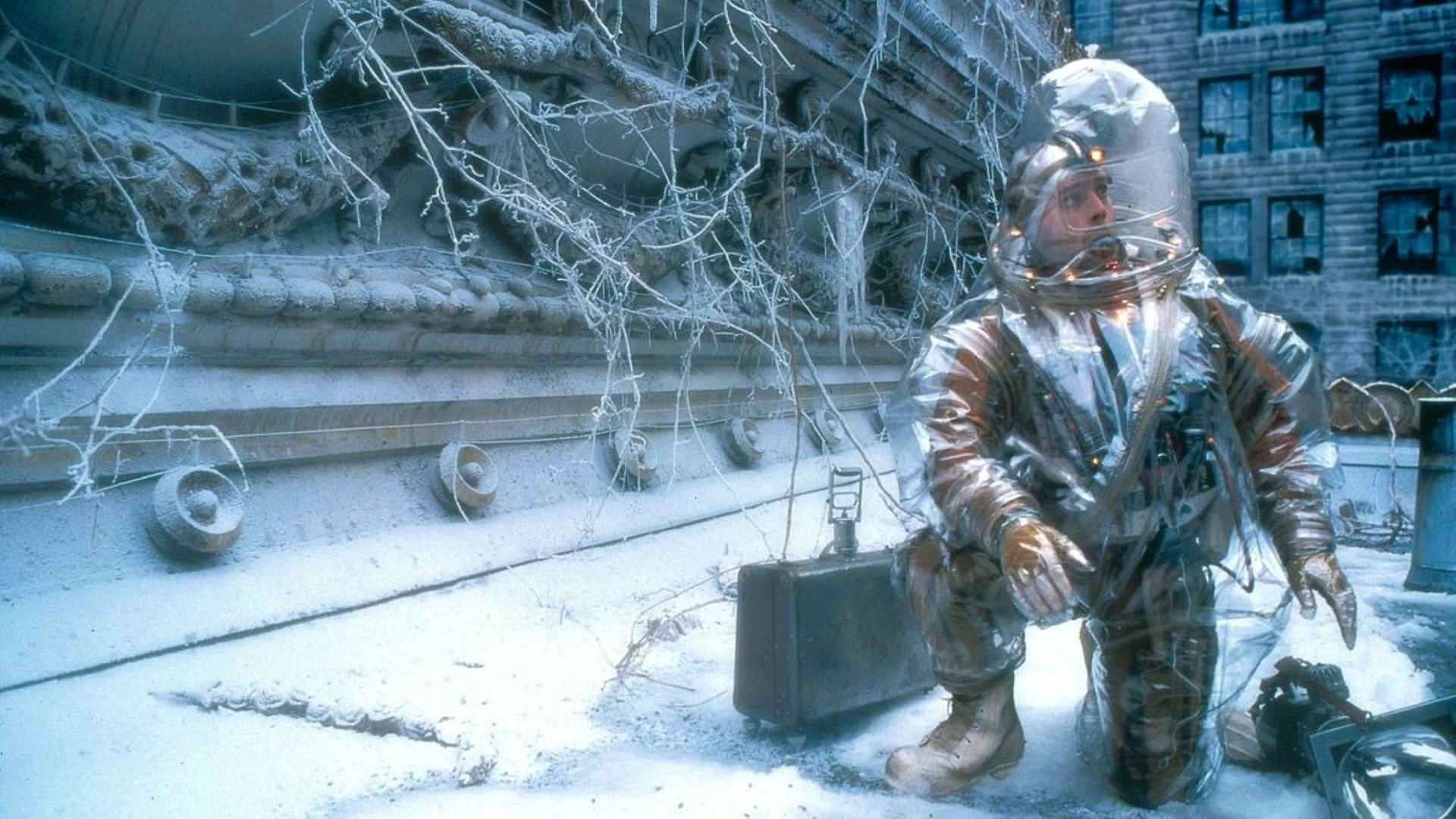
Hey there everyone! Welcome back to Movie Soapbox, the little corner of the internet that only you and I and that guy sleeping in the corner over there know about. This is the place where we find under-appreciated films, we dig into the ones that actually survived the machine intact, and we make sense of them together. Today? We are doing a full, authoritative deep dive on 12 Monkeys, a movie so ruthlessly constructed, so genuinely committed to its own internal logic, that thirty years later people are still arguing about whether the ending is hopeless or the most quietly optimistic thing Terry Gilliam ever put on screen.
Alright. If you have not seen this film, close this tab, go find it, watch it, and come back. Everything past this paragraph contains full spoilers for every beat, every loop, every gun handed through a prison vent, every moment of this film. You’ve been warned in plain English. We are going in.
The 12 Monkeys and How Did This Get Made?
Before we get into the timelines themselves, you need to understand something about what kind of film 12 Monkeys actually is, and what kind of film it almost became. A script like this one, a non-linear time travel narrative built around the question of whether free will exists at all, lands on a studio development executive’s desk and immediately attracts a very specific kind of damage. You can see the shape of the notes it must have survived: clarify the ending, the test audiences are confused, can we get Cole to actually stop the virus in the third act, do we need to make Railly more active in the resolution. The fact that this film ends the way it ends, with Cole dead on an airport floor and Dr. Peters walking onto that plane anyway, is genuinely remarkable given the budget tier it was working at. Universal Pictures, mid-nineties, Bruce Willis coming off a string of action tentpoles, and somehow Gilliam held the line on an ending where the hero fails completely and visibly. That does not happen without a cast willing to protect the material and a director with enough of a track record to make the suits nervous about the reputational cost of overruling him. You can feel the shape of the fight in the finished film. The ending is too clean in its defeat, too precisely constructed, to be an accident or a compromise. Someone protected it.
Now. The timelines. Let’s actually do this properly.
The 12 Monkeys Movie Deep Dive Walkthrough
The film gives you one linear story and buries at least five distinct timeline iterations inside it, and the reason most people leave the theater thinking 12 Monkeys is a straightforward deterministic tragedy is that Gilliam never stops the movie to explain the machinery. He trusts you to feel the loops closing without labeling them. That trust is either the film’s greatest strength or the reason your cousin still thinks Bruce Willis was crazy the whole time. It is both, actually.
Here is the chronological spine, stripped down to its bones. James Cole is a prisoner in 2035, living underground with the remnants of humanity after a virus released in 1996 killed five billion people. The scientists running this underground civilization have built a time machine, and because they have the good sense to fear their own technology, they test it on criminals. Cole is one such criminal. His mission: go back to 1996, gather information about the original viral strain before it mutated, help the scientists develop a cure. Simple enough. Except time travel in this film does not work cleanly, and Cole lands in the wrong years, and the act of his traveling starts changing the very history he was sent back to observe.
The 1917 landing happens first, chronologically. Cole arrives in the trenches of World War I by accident, gets shot in the leg, and is photographed alongside another time traveler named Jose. That photograph ends up in Dr. Kathryn Railly’s research files decades later, and it becomes one of the key pieces of evidence that convinces her Cole is telling the truth. A bullet from 1917 is still in Cole’s leg when Railly removes it in 1996. These are not Easter eggs. They are load-bearing structural elements.
In 1990, Cole’s first intentional jump, he arrives six years too early, gets arrested, gets committed to a psychiatric ward, and meets two people who will define the rest of his existence: Dr. Railly, who diagnoses him, and Jeffrey Goines, a twitchy, brilliant, profoundly unwell young man played by Brad Pitt in what is still, full stop, the best performance of his career. There is a specific kind of unhinged energy Pitt brings to Goines that he has never replicated, the kind where you can feel the actor understanding exactly how much space he has and choosing to fill every centimeter of it. Jeffrey Goines is the reason you remember this film twenty years after seeing it.
Cole eventually gets pulled back to 2035, tries again, lands in 1996, kidnaps Railly, goes looking for the Army of the Twelve Monkeys because the scientists believe Goines founded it and released the virus. He is wrong. Goines did not release the virus. The Army of the Twelve Monkeys, in what is either the film’s greatest black joke or its most precise structural irony, only ever releases the zoo animals. The actual virus is released by Dr. Peters, Leland Goines’s lab assistant, a quiet true believer who boards a series of international flights and seeds the contagion across every major hub city on the planet.
Cole dies at the airport trying to stop Peters. The police shoot him before he can finish it. Young Cole, maybe six years old, watches it happen from across the terminal. That image, a man shot in an airport, a woman in disguise running toward a small boy, is the recurring dream that haunts Cole’s entire adult life. He has been watching his own death since childhood without knowing it.
That is the surface of the film. Now here is what is actually happening underneath it.
The timeline argument comes down to this: is the loop in 12 Monkeys closed and fixed, or is it open and iterating? The conventional reading, the one that gets repeated in every surface-level review, is that the loop is closed. Cole always died at the airport. The virus always got released. The future is immutable, Cole is just a man fulfilling a destiny that was already written before he was born, and the tragedy is that he spends his whole life trying to escape something he cannot escape. Determinism, clean and cruel.
Except the film itself will not let you hold that reading without problems. And the problems are not small.
Why the 12 Monkeys Movie Can’t Be Deterministic
Consider this: young Cole can only watch older Cole die at the airport if young Cole was already at the airport. But young Cole cannot be at the airport in any original, untouched timeline, because the entire chain of events that brought older Cole to that airport only happened because Cole traveled back in time and set those events in motion. Railly only called Leland Goines because Cole convinced her the virus was real. Goines only changed his lab security because Railly called him. Peters only got access to the viral samples because the security was changed in a specific way that created a new vulnerability. None of that chain exists in a timeline where Cole never traveled back. Which means there has to be an original timeline where the virus was released differently, by a different mechanism, through a path we never see in the film, because Cole’s presence has overwritten it completely.
That is a multiple-timeline film, not a single closed loop. You cannot have young Cole watching older Cole die as a formative childhood trauma unless at least two separate timeline iterations have occurred to create the conditions for that moment. The loop is not closed. It is iterating. Every jump Cole makes creates a new branch, a Timeline2, a Timeline3, continuing outward, each one slightly different from the last because the previous jump changed something.
Timeline2 is Cole’s 1990 arrival, the first jump. Neither Railly nor Goines recognize him. The WWI photograph is not in Railly’s files yet because the WWI trip, in sequence, has not happened for Cole yet. Timeline2 ends with Cole vanishing back to 2035 and Railly never seeing him again. That branch of history runs forward into the apocalypse without interference.
Timeline3 begins when Cole makes the WWI jump and the photograph gets taken with both him and Jose in it. Now Railly’s files contain a picture of Cole from 1917. When Cole arrives in 1990 in this iteration, she recognizes him from the photo, which changes her response to him entirely. She is more open, more curious, less certain of his madness. Cole goes to 1996 in this timeline, kidnaps Railly, Railly eventually removes the 1917 bullet from his leg, the bullet becomes more evidence, Railly calls Leland Goines, the lab security changes, Peters gets his access, the virus gets released, no one stops Peters at the airport because Cole has not yet arrived at the moment where he tries to stop Peters at the airport. Young Cole is not there. Timeline3 closes with the apocalypse running on schedule and Peters boarding his flights completely unimpeded.
Timeline4 and Timeline5 are where it gets genuinely strange. By this point Cole has irrevocably altered his connection to the 2035 future he came from, some combination of his messages to the scientists and his decision not to return has changed what the scientists know and how they are directing his jumps. The Raspy Voice starts appearing.
The Raspy Voice. In the credits, listed as Louie. You need to spend time with this character because the film leaves his identity deliberately open and the three options are not equivalent.
The 12 Monkeys Theory Options:
12 Monkeys Option one: he is a fellow time traveler, someone else the scientists sent back, someone who has been living in the cracks of this timeline long enough to know Cole by a different name and to speak with the authority of someone who knows exactly what is permitted and what is not. He says he pulled out his own teeth to evade the scientists’ tracking. That is not a hallucination talking, that is a man describing a specific tactical decision made to avoid a specific technology.
12 Monkeys Option two: he is a hallucination, a symptom of the psychological damage time travel inflicts on Cole’s mind. The film is genuinely interested in the question of what repeated temporal displacement does to a human psyche, and Cole’s grip on consensus reality is not secure by the film’s midpoint.
12 Monkeys Option three: the Louie in Cole’s vent is another Cole. A Cole from a later iteration of the timeline, one who made enough jumps to accumulate enough information to understand the full shape of the problem, who ended up in 2035 not as a criminal but as someone with genuinely useful intelligence, who helped build the time machine, and who then put himself forward as the ideal candidate to go back and redirect an earlier version of himself. The silhouette in the vent is blurry. He does not want to be seen. He calls Cole by a different name. He knows things he should not know unless he has already lived through what Cole is currently experiencing.
The film does not confirm this. It does not have to. The point is that by the time you are seriously entertaining Option Three, you have already accepted that the timeline is not closed, that iterations are accumulating, that there are branches of this story running parallel to the one you are watching. And once you accept that, the ending changes.
Cole dies. Peters boards the plane. Five billion people die. That is true for this iteration of the timeline. The scientist from 2035 who sits down next to Peters on the plane is carrying information forward, a live sample of the original pre-mutation strain, which is what the underground scientists need to develop a cure. So even in the iteration where Cole fails, the mission partially succeeds. And in the next iteration, the one where the scientists now have that strain and can refine their understanding of what needs to happen at the airport, Cole’s successor has better information going in.
This is a film that looks like it is about the impossibility of changing fate and is actually about the grinding, iterative, costly, frequently fatal process of actually changing it. Not through a single heroic intervention, but through enough attempts that eventually someone threads the needle. It is the least glamorous vision of time travel ever committed to film. It is also the most honest one.
The reading that almost everyone takes out of the theater, that 12 Monkeys is a deterministic tragedy about a man who never had a chance, is the reading the film’s surface is designed to produce. Gilliam builds the emotional experience of watching a predetermined catastrophe unfold. But the architecture underneath tells a different story, one where the universe is not closed, where Cole’s death is not the final word, where the iterations keep running past the credits.
You want to call that a hopeful reading of a bleak film, fine. But understand what it cost to get that ambiguity onto the screen intact, an ending where the hero dies and the audience is meant to leave debating whether that death was the last chapter or the middle of a longer story. That is a film that survived its own production. Most don’t.
🎬 If You Liked This…
- Donnie Darko — the same time looping chaos and ambiguity and complicated debate about determinism
- Time Crimes — another amazing looping deterministic film that explores how trapped we are in time.
- Predestination — the grand daddy of deterministic indie films… this is pefectly aligned with 12 monkeys