
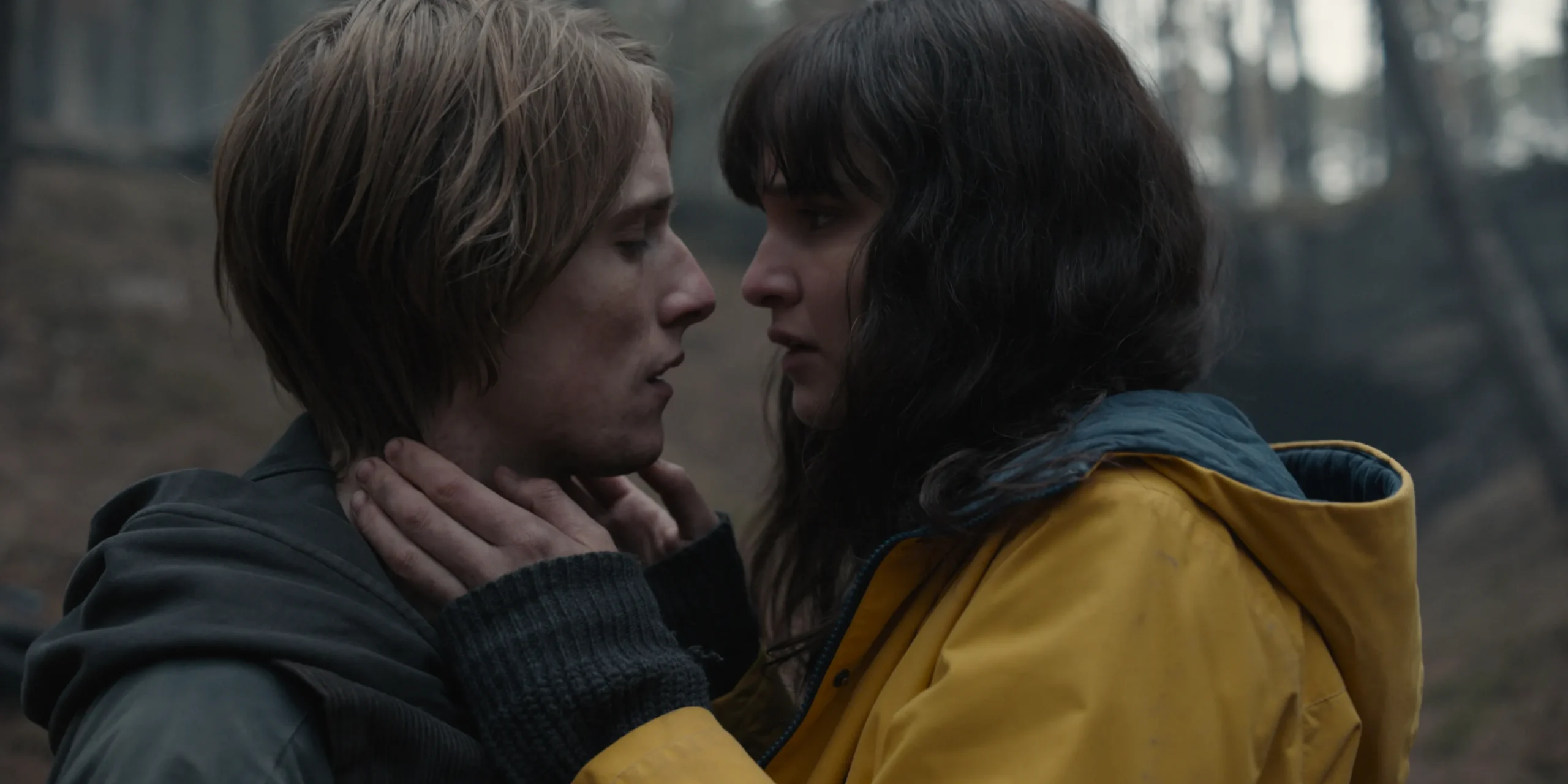
Hey there everyone! Welcome back to Movie Soapbox, the little corner of the internet that only you and I and that guy in the back who hasn’t slept since finishing season two know about. This is the place where we find the films and shows that reward the kind of attention most people stopped giving television about fifteen years ago, and we make sense of them. Today we are doing a full, episode-by-episode deep dive on Dark Season 3, a show so structurally ruthless, so committed to its own internal geometry, that the writers’ room either contained actual physicists or several people who had simply given up on ever sleeping again.
Fair warning, delivered in the spirit of a man who respects your time enough not to bury it: everything from this point forward is a spoiler. Not a “oh you might guess the twist” spoiler. A “you will learn who every character is, what they did, why they did it, and what it cost them” spoiler. If you haven’t watched all three seasons, close this tab. Go to Netflix. Watch the show. Come back. It will still be here, and it will make considerably more sense if you’ve done the work first. Dark is the greatest television show of all time… full stop. And it is worth every minute of your time.
Dark and the Making Of Discussion
Now. Here is the thing most writeups on season 3 skip because they are too busy being impressed by the mythology, and too polite to say it plainly: what you are watching in Dark’s final season is what happens when the people who made something refused, at every single decision point, to let the network sand the edges down. You can tell, just by the structural audacity of what season 3 attempts, that someone had to fight to make this. A show that introduces a third world in the final episode of its final season, and makes it feel earned rather than desperate, doesn’t get made by committee. It gets made by people who had the architecture locked in from day one and somehow, somehow kept enough institutional power to execute it. That’s rarer than anything the show’s mythology describes. The gravitational pull of the factory, even in prestige television, is always toward the explicable, the satisfying on first watch, the thing that tests well in Düsseldorf. Dark is the result of someone holding the door shut against that pressure for three full seasons. You should know that going in, because it changes how you watch it. This show is perfect. Every episode. Every shot. Every season. The entire thing, from beginning to end. It’s amazing that they pulled this thing off.
Dark Season 3 Episode 1: Welcome to World 2. Leave Your Assumptions at the Cave Entrance.
When season 2 ended, we learned that the Martha who pulled Jonas out of the apocalypse wasn’t his Martha, wasn’t from a different time, was from a different world entirely, a parallel universe running alongside Jonas’ Winden like a shadow that learned to cast its own shadows. So from here forward, anything from that alternate world gets a 2. Martha2. Jonas’ World is World1. Martha’s world is World2. Tattoo it somewhere convenient.
The key differences between the two worlds, the ones you need to metabolize fast, are these: there is no Jonas2, because Mikkel never traveled back, never became Michael, never married Hannah, never had a son. Ulrich2 and Katharina2 are divorced. Ulrich2 is living with Hannah2, who is pregnant. Ulrich2 is also having an affair with Charlotte2. Martha2 is dating Kilian2, Erik Obendorf’s brother. Franziska2 is deaf and Elisabeth2 is not, which is the inversion of World1. Regina Tiedemann2 is already dead, cancer, 2019. Aleksander Tiedemann2 runs the plant. Daniel Kahnwald2, who becomes Noah, died in 1964. Helge’s scar is on his eye instead of his ear. The list is not exhaustive. The show doesn’t wait for you.
The season opens on three figures, three ages of the same man, all sharing a cleft palate, all moving through time together like a single organism distributed across decades. These are The Unknown. They want the master key to the Winden Nuclear Power Plant, and they get it, and the season is off. The important thing about Mikkel2 not being in the woods that night is not just that he wasn’t abducted. It’s what his absence removes from the chain: no Mikkel2 means no Michael2 means no Jonas2 means a world that has a structural hole in the exact shape of the show’s protagonist. And into that hole, Jonas1 falls.
When the group at the shelter watches Mads Nielsen2’s body arrive through the portal, it’s the World2 equivalent of Mikkel’s disappearance in season 1, the event that cracks the town open. The mechanics differ. The function is identical. The show is already making an argument about fate and structure that it won’t fully articulate until the finale.
On the Martha question: Martha1 is dead, killed by Adam, done. In World2, you need to track at minimum four versions. Yellow Rain Slick Martha2 knows nothing. Face Scratch Martha2 knows Jonas is chasing her, not much else. Face Scar Martha2 has been fully converted by Eva and has already killed Jonas1 in the past. Middle Aged Martha2 has spent thirty-three years executing Eva’s designs. And Eva herself, which should not surprise you, is the oldest Martha. If it surprises you that Adam is the oldest Jonas, I genuinely cannot help you from here.
Dark Season 3 Episode 2: The Most Disorienting Hour of Television in the Entire Run
Episode 2 is doing three things simultaneously, and only one of them is foregrounded. The foregrounded thing is the chaos: Katharina visiting Ines and Mikkel in 1987, Jana and Tronte fighting because Tronte is searching harder for his missing mistress Claudia than for his own son Mads, Peter and Elisabeth in post-apocalypse 2020 searching through rubble, Martha2 in 1888 helping middle-aged Jonas try to build the first functional time machine.
The thing underneath all of that is the first real crack in the loop’s logic. Martha2 tells middle-aged Jonas that he is the one who came to her world and told her what was happening. Jonas has no memory of doing this. There is no Jonas2 who could have done it. Something has happened that the loop cannot account for, and the show plants this like a splinter under a fingernail and walks away.
The Tronte and Regina scene is where the episode earns its reputation. Tronte, who has always loved Claudia even from childhood, walks into the room where Regina is suffering and suffocates her. The only explanation offered: Claudia told him it was the only way to save him. Which means Claudia has convinced Tronte that her daughter’s death in this moment is a load-bearing event in the structure of everything she is trying to protect. The show doesn’t soften this. It doesn’t score it with obvious grief music. It just shows you a man doing an unimaginable thing because the woman he has loved his entire life told him it was necessary, and leaves you with the weight of it.
Young Noah’s conversation with Peter in the post-apocalypse earns its place in the taxonomy of great Dark moments specifically because of the verb tense problem. Noah tells Peter he will protect Elisabeth after Peter is killed. Past tense future. The show’s grammar of time is so thorough that even its dialogue has been restructured around it. It’s the same move as that line in Primer, the one about being hungry and not having eaten since later that afternoon, and if you know that line you understand exactly what the show is doing.
Dark Season 3 Episode 3: Ariadne, Star-Crossed Lovers, and a Song Nobody Can Find
Gustav Tannhaus opens episode 3. He’s blind, he’s holding the play script for the Ariadne production Martha will perform in, and the show is making its thesis statement explicit for the first time. Ariadne and the Labyrinth isn’t a metaphor running alongside the story of Dark. It is the story. Theseus navigating a maze to confront a monster, Ariadne holding the thread that might lead him back out. The labyrinth in Dark is not a place, it’s time itself, and the thread is the red string of causality that connects every character across every loop. Understand Ariadne and you understand the architecture.
The crux of the episode is Martha2 presenting Jonas with a choice he cannot actually make cleanly: Martha1’s life or their future together. And Jonas, who has been trying to save Martha1 since season 1, is being told by a different version of the woman he loves that she is not enough, that the physics of the show have an opinion about this relationship, and that opinion is not favorable. Which is, if you step back and look at it, one of the stranger things a television show has ever done with a central romance. The universe itself is the third party in this love triangle.
Elsewhere: Hannah2 identifies Ulrich’s affair by Charlotte’s perfume, which is the kind of specific domestic detail this show embeds to make you trust its larger claims. The Unknown deliver the master key to the nuclear plant. Charlotte2 discovers that the pfennig coin in the bunker and Helge’s pfennig coin are literally the same coin, microscopically identical, which is the show’s way of saying that certain objects have been traveling through time long enough to stop aging. And 1888 Jonas fails to activate the god particle, which matters because the failure is the mechanism. The song that plays over this scene, Inside by Chris Avantgarde featuring Red Rosamond, was apparently not commercially released at the time of broadcast, which is the kind of detail that feels like the show winking at you.
Dark Season 3 Episode 4: The Origin Has a Name, and It Chose Its Own
The title of episode 4 is The Origin, and the episode opens with the single most quietly devastating piece of exposition in the season. The Unknown tells Tronte that he knew his mother once, a long time ago. And then, when Tronte asks his name, The Unknown says he was never given one, but that he chose Tronte’s name for him long ago. The Unknown is Tronte’s father. Agnes, who told Tronte his father was a priest who had left, was not lying in the direction you thought she was lying. The cigarette burns Tronte described down his arms were from this man, this thing, this convergence of three ages of a single person born outside the loop’s logic.
Hannah1 is sleeping with Egon1 in 1954, and Egon gives her the necklace, the patron saint of travelers, the one that appears in every timeline attached to a different neck. In September of 1954, Ines, Claudia, and young Silja look at a magazine and discuss Tronte and Agnes’ disappearance. Hannah is pregnant with Egon’s child, and that child will eventually be Silja. Watch Hannah in these scenes: she is thrashing for purchase, for love, for some version of herself that holds together, and the show treats that thrashing with more sympathy than she usually gets.
Adam assembles his team and sends Agnes into the god particle machine, and the show gives you a moment to grieve Agnes a little, because she was the most electric presence in the cast every time she appeared, and now she’s running errands for a man who has calcified into architecture. Middle-aged Martha2 tells younger Martha2 that they are all born of him, that she gave him life and he will give them theirs. She means The Unknown. The child of Jonas1 and Martha2, the person who walks through time with his own past and future beside him, is the origin of the knot that has been destroying both worlds for eternity.
Hannah, pregnant, goes to have an abortion and meets Helene Albers, Katharina’s mother, in the waiting room. She introduces herself as Katharina. Helene decides to use that name for her own future daughter. Hannah gives Helene the necklace Egon gave her. The necklace moves again. The chain of causality tightens another notch.
Dark Season 3 Episode 5: Everything Is Coming to a Close, and the Origin Is Still Hiding
Jonas and Martha2 have slept together. Hello, The Unknown. They head to the Winden Power Plant. The loop has just been wound one more time.
Katharina, knowing Ulrich has been trapped in the asylum for years, is going to break him out. She needs her mother’s keycard. She goes to get it. The show lets you imagine, for a few minutes, what it would mean if she succeeded, if Ulrich got out, if they went to get Mikkel, if Mikkel came home. The entire structure of causality would collapse or reroute or both. The show does not let her succeed. Helene gets the upper hand, screams that she got rid of her, the abortion she had years ago that was actually Katharina’s future self visiting from another time, and throws Katharina’s body in the lake. The perpetual loop has been causing Helene’s instability all along, which is what made her a terrible mother, which is part of what produced the chain that led Katharina here, to this lake, to this moment. The circle closes like a fist.
Two Claudias circle each other in one of the episode’s stranger scenes. One is pitching the other on joining Eva’s side in order to force the repetition. The show is comfortable showing you the mechanism of its own perpetuation and trusting you to feel the horror of it.
Elisabeth1, post-apocalypse, leaves her father and heads back to the trailer. A man attacks her. Peter stumbles in and is killed trying to help her. Elisabeth kills the attacker. The show does not flinch from this either. Peter dies doing the only thing left for him to do, and the show moves forward.
The journal that Noah spent seasons trying to complete, the one with the three missing final pages, was written by The Unknown. He chronicled the events of the loop, the details required to sustain it, and sent it back into circulation. The book is the loop’s instruction manual, and the loop wrote it.
The episode ends with Martha2, the young one without the cheek cut, the one with the gun, walking out of the marble-floored Sic Mundus hall and shooting Jonas dead. Which is a sentence that, typed out plainly, does not convey the quality of dread the show earns for it.
Dark Season 3 Episode 6: Two Worlds, Two Apocalypses, One Machine
Martha2 receives a letter from middle-aged Jonas in the past: every fate in this knot is tied to the next, a thread red like blood that connects all deeds in light and in shadow. He must let her die so that she might live. The show’s grammar of sacrifice, which has been building since season 1, is arriving at its final form.
Yellow jacket Martha2, after Jonas’ shooting, goes home on the day of the World2 apocalypse. Magnus finds her there, and she tells him Bartosz was right, the world is ending today. Magnus doesn’t believe her yet. The dome begins to form over Winden. The apocalypse in World2 is not a distant threat. It is now.
Adam, speaking from his own entrenched certainty, tells whoever will listen that old Tannhaus believed he was creating a paradise and instead created eternal darkness, and that destroying it requires the apocalypse in both worlds simultaneously. This is a man who has convinced himself that annihilation is salvation, which is a very specific kind of wrongness that the show has been building toward since we met him.
Aleksander2’s secret, the Marburg murder, the name Boris Niewald that he abandoned decades ago, surfaces again. Hannah is still the keeper of that information. The show’s petty human secrets persist even as the cosmic machinery grinds.
Charlotte2 and Hannah2 compare the pfennig coins under a microscope. Same coin. Time-traveled. The physics and the domestic detail collapse into each other again the way Dark does best.
Eva explains the quantum entanglement situation to Claudia post-apocalypse: at a switch point in the loop, two overlapping realities exist simultaneously. One where Jonas goes with Martha. One where he runs away. Both are real. Both are being managed. This is the show’s first explicit acknowledgment that the loop is not just self-sustaining, it is being actively maintained by people who believe they have no choice.
Eva issues her orders. Bartosz must save himself to save the others. Claudia must guide her own past self. Egon must create his past to preserve the family tree. Noah must deliver love to his younger self. Adam, meanwhile, has Martha tied to the staircase of the god particle machine, which concentrates the energy of both apocalypses into a single point. The origin must die, but it cannot be killed by conventional means, because it was born of both worlds.
Adam’s realization arrives like a door slamming: there is no hope, no salvation, no paradise. He was wrong. Both he and Eva were wrong. This is the show’s pivot, and the show delivers it without softening it.
Dark Season 3 Episode 7: Hanno Becomes Noah, Silja Dies, and Claudia Arrives
Bartosz2, in the cave, pulls out a time-ball and tells Martha2 he knows what the origin is. Adam and the others don’t want to help her. They want to kill her. The dome forms around Winden. The apocalypse is happening now in both worlds.
Jonas, in the past, is trying to create the god particle and getting electric burns for the effort. He and older Bartosz debate purpose. Jonas says he will find the origin and destroy it. Both of them believe this. Neither of them is right yet, but Jonas is closer.
Silja goes back to 1890 to find Bartosz. Bartosz and Silja have a boy, Hanno, then a girl, Agnes. Then Silja dies. Hanno will become Noah. He finds himself, literally, when Noah arrives in 1920 looking for Charlotte and finds Hanno, his own young self, looking back at him. This is the show at its most structurally elegant: a man becoming the person he already was.
Older Elisabeth and Charlotte steal Noah and younger Elisabeth’s daughter, infant Charlotte, to give her to Tannhaus, so she can eventually marry Peter and produce Elisabeth. The bootstrap paradox of Charlotte’s parentage, which has been one of the show’s most deliberately cruel loops, is fully assembled here. Charlotte has no origin outside the loop. She exists entirely because the loop required her.
Agnes shoots Noah. Sister kills brother. A deliberate echo of Cain and Abel, the show tells you, and it is not being subtle about it.
Bartosz, in the Sic Mundus hall, tells Martha2 he knows what the origin is. Adam and Eva, he says, are the only ones who can save everyone. Martha2 disagrees: everything that has happened is their fault. Eva walks out, tells Martha2 she couldn’t have imagined becoming her older self, and then draws a dagger across her own face. That’s how the scar happened. Eva made it happen to herself, to herself, because the scar was already there in the version of herself she had become. The loop demands it. She complies.
Claudia walks into Adam’s chamber. Hello Jonas. The person Adam had killed, the person he was certain was dead, is standing in front of him. Something has changed.
Dark Season 3 Episode 8: The Third World, the Frankenstein Story, and the End of the Knot
Claudia tells Adam that his world and Eva’s world should never have existed. He thought the origin was the connection between the two worlds. He was wrong. The origin lies outside both of them. Nothing is complete without three dimensions. The triquetra. There is a third world.
In the origin world lives H.G. Tannhaus. A clockmaker who lost his son, his daughter-in-law, and his granddaughter in a car accident on a bridge in 1971. A man who spent the rest of his life trying to build a machine that would bring them back. A Frankenstein story, the show says, and it means it literally: a man who believed he was creating paradise and instead split his world into two damaged copies of itself, each one containing the echo of everyone who should have existed whole in one. Jonas and Martha are not the origin of the knot. They are symptoms of it. Tannhaus’ grief is the origin. The knot exists because a man refused to let go of the dead.
Everything Adam has done, every loop Eva has sustained, every sacrifice every character has made across three seasons, has been maintaining the knot, not breaking it. The only way to destroy it is to go to the origin world and prevent Tannhaus from ever building the machine. Which means going back to June 21, 1971, and making sure Marek and Katharina and infant Charlotte do not die on that bridge.
Jonas and Martha2 teleport into the origin world and appear in front of Marek’s car on the bridge. The car swerves. They redirect him. Marek and his family go home. Tannhaus’ machine is never built. The knot is unmade.
In the decomposition sequence, every character who existed only because the knot required them, Jonas, Martha, Claudia, Noah, all of them, dissolves. They were never born in the origin world. With the knot gone, they have no existence to return to. Jonas and Martha hold on to each other in the light for as long as they can. They are a perfect match, the show says. Never believe anything else. Then they are gone.
The final scene is a dinner party in what appears to be the corrected origin world. Hannah is there, pregnant, with Wöller. Charlotte is there with Peter. Claudia is there, older, with a photograph of herself and Regina and Bernd Doppler. Regina, Claudia’s daughter, Bernd’s daughter, exists here. She never got cancer. She never needed Tronte to kill her. She just exists, unremarkably, in a photograph at a dinner party, which is everything.
Hannah has a deja vu. She says she dreamt it was just dark and never became light again, that it was a good thing, for everything to be over, no wanting, no having to, infinite darkness, no yesterday, no today, no tomorrow, nothing. She’s a psych student’s field day, Hannah, but the show gives her this moment of unexplained mourning for a life she never lived and a son she never had. Her hand rests on her pregnant belly. She hasn’t chosen his name yet.
She chooses Jonas.
What you just watched was a show that decided its ending before it shot its pilot, held that ending through three seasons of escalating complexity, and executed it without blinking. The factory version of this show, the one that gets renewed for five seasons and loses the thread by season four, would have given you a time machine and a villain and a twist. This one gave you a clockmaker’s grief and the argument that the knot binding everyone together, the very thing all these people across all these timelines loved and feared and built their lives around, should never have existed. That is a genuinely brutal thing to say in the final hour of a show people love. They said it anyway. That’s the whole game.