
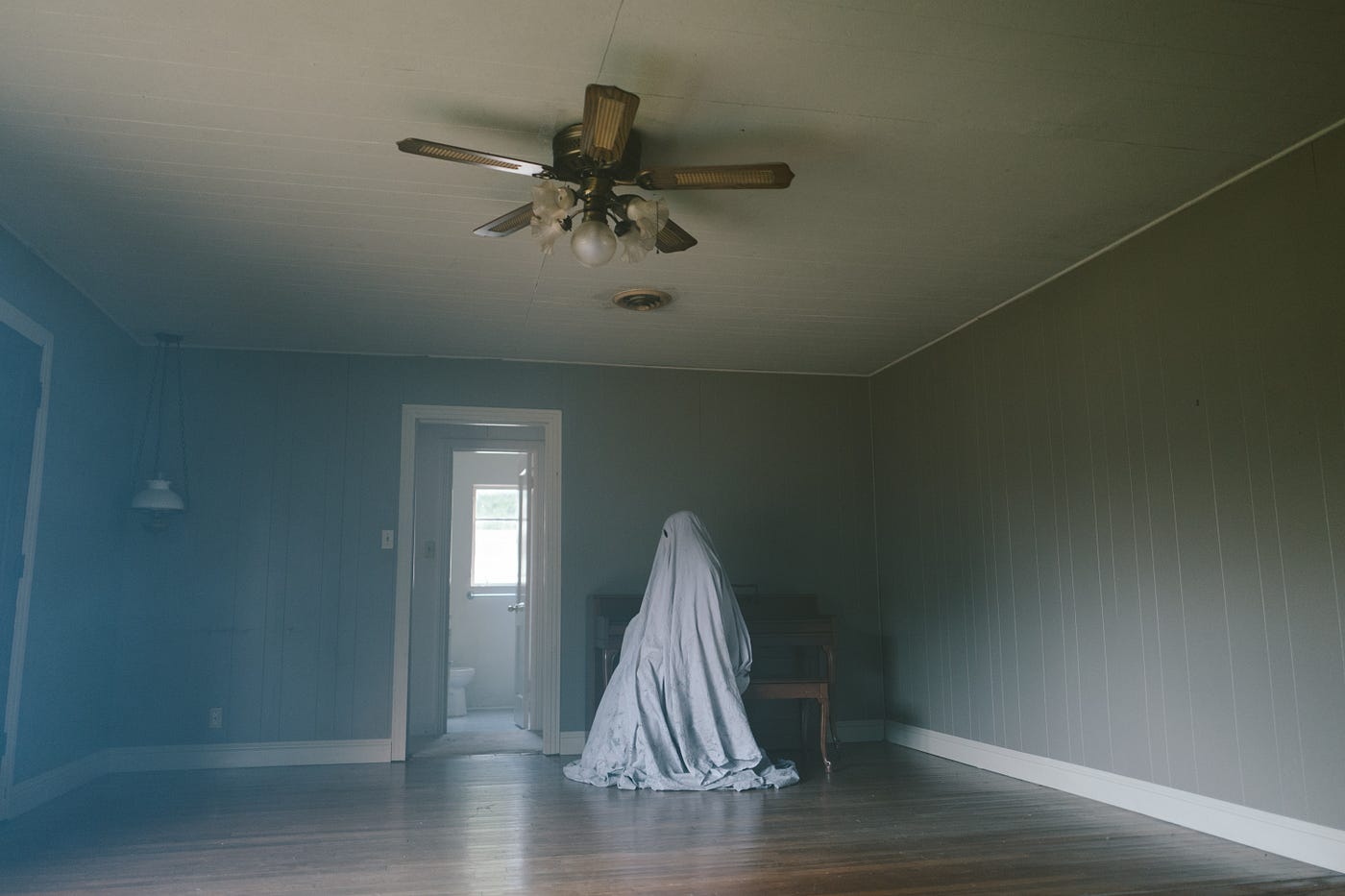
Hey there everyone! Welcome back to Movie Soapbox, the little corner of the internet that only you and I and that guy sleeping in the corner over there know about. This is the place where we find underappreciated indie films and we make sense of them. Today we are doing a deep dive on A Ghost Story, a movie so genuinely, stubbornly slow that it will run off half your audience in the first twenty minutes, and the half that stays will spend the next decade trying to explain to people why that was actually the whole point.
Before we go any further, the film gets dissected completely from here on out. If you haven’t seen it, go watch it, come back, the post will be here. This is not a movie that survives spoilers well, and I’m not going to pretend otherwise.
The Making of A Ghost Story Movie
So. David Lowery made this film for somewhere in the neighborhood of a hundred thousand dollars, shooting on a compressed schedule with two of the more quietly capable actors working at that budget tier, and the entire enterprise looks and moves the way it does because there was no committee with a coverage note waiting at the end of the day. You can feel that in every static, overstretched shot. A film like this, at this budget, lives and dies on whether a distributor trusts the material enough to let it breathe in release, or whether someone in acquisitions starts asking about pacing and suddenly you’re watching a seventy-eight minute cut that solved all the slow parts by destroying everything that worked. A24 let it run. That sentence is doing more work than it looks like it’s doing. Films like this do not typically survive the hand-off. The ones that don’t have a Rooney Mara attached to drag them through the conversation usually get the edit that makes them palatable, which is another word for ruined.
A Ghost Story Movie Walkthrough
Casey Affleck is M. Rooney Mara is C. The film gives them single-letter credits because Lowery is making a point about scale, about how this story that feels enormous and permanent to the two people living it is, cosmically speaking, a footnote. They are in a house. She wants to leave. He won’t hear it. That friction is the whole load-bearing wall of the setup, the gravitational center that everything else orbits.
Before M dies there are spectral lens flares in the house, little unexplained light events that read as haunting activity. And they are, technically. What Lowery is doing is seeding the time-loop payoff before you have any frame to receive it, so when the loop closes you feel it as recognition, not as a twist. That is craft. That is a writer who knew his ending when he wrote his opening scene, which is rarer than it should be.
M dies in a car accident just outside the house. The how is less important than the where, which is the point. The house is the character. M gets up off the morgue table wearing a bedsheet with two dark eyeholes, and if that image sounds absurd to you, I’d say the film earns it in the first thirty seconds you spend watching him stand in a corner while C eats an entire pie on the kitchen floor. That pie scene is a nearly five-minute single take of a woman eating her grief in real time while a sheet-wearing ghost watches from the doorway. A studio note would have cut it to forty-five seconds. The whole film is built around resisting that note.
C eventually moves out. M stays. The house turns over, new tenants arrive, decades pass, the house gets demolished and rebuilt as an office tower. M, unable to leave, throws himself off the building, which sends him ricocheting backwards through time to the original settlers on that land, and then forward again to land back in the house just before C moved in. And now there are two of him. The ghost that has been haunting the house through the whole film is M himself, looping, and the sounds C and M heard before he died were him, already dead, already waiting.
That is the architecture of the story. Now let’s talk about the thing that actually matters.
C hid a note in the doorframe before she left. Folded small, pressed into a crack in the wood. We know from earlier in the film that she has always done this, left pieces of herself in houses she was leaving so that if she ever came back there would be something of her waiting. M spends what appears to be hundreds of years of story-time trying to get to that note. A backhoe nearly destroys it. The office building buries it. He gets back to it eventually, digs it out, unfolds it, and disappears. Both versions of him disappear simultaneously. Whatever was on the note released him.
Lowery has said publicly that the note’s content doesn’t matter, that anything written there would have been noise at that moment in the film, something for the audience to process and debate instead of feel. I understand the argument. I don’t entirely agree with it, but I understand it, and I’ll lay out the competing reads honestly before I tell you which one I think is right.
Theories to Explain A Ghost Story
The first theory is that she was angry, wrote something dismissive, told him to let go. Possible. Doesn’t fit the texture of the character we watched for ninety minutes, but possible.
The second theory is pure sentiment, love and grief written plainly, the thing anyone might write with twenty seconds and a folded piece of paper. An “I love you, let me go.” Plausible. Probably too tidy for what this film is doing.
The third theory, and the one that actually closes the loop properly, is that she wrote a lyric from M’s song. The song that plays in the film is “I Get Overwhelmed” by Dark Rooms, and the opening lines are asking whether your lover is there, whether she woke up, whether she died in the night and left you alone. If C folded a line from that song into the wall of a house she was leaving, she was doing the thing she has always done, leaving a piece of herself behind, but this time the piece she left was a piece of him. She returned his own words to the house he couldn’t leave. That is a closed loop. That is the kind of ending that earns the five-minute pie scene.
Theory four is Lowery’s own position, which is that the content is genuinely irrelevant and the freedom came from M finally receiving proof that she thought of him when she left, whatever the note said. The act of being remembered, rather than the content of the memory. I respect it. I find it slightly evasive for a filmmaker who clearly worked out every other structural detail with precision, but I respect it.
Moviesoapbox’s Theory to Explain A Ghost Story
My read is theory three, the lyric. It fits the film’s obsession with music as the thing M used to try to hold C, with place as the thing he couldn’t release, and with C’s lifelong habit of leaving traces of herself in houses. She wrote his words back into his house. Of course that set him free. What else would have.
The real trivia that makes all of this haunting in the literal sense: Rooney Mara actually wrote something on a piece of paper. She actually put it in the wall. The production demolished the house at the end of filming and the note went with it. She is the only person alive who knows what it says, and she hasn’t told anyone. Lowery doesn’t know. Affleck doesn’t know. The only existing record of what freed M is in Rooney Mara’s memory, and she’s keeping it.
A film this committed to its own logic, made for this little money, let run to its natural length by a distributor willing to bet on restraint, should not exist in the current landscape. The ones like it that don’t have the right cast, the right sales agent, the right festival slot, get reshaped into something easier to market and harder to remember. This one made it through intact. That’s the whole story, and it’s a better story than most of what got a wide release the year it came out.
Read it as a film on grief. Read it as a time-loop puzzle. Read it as a meditation on why any of us make anything if the pages will eventually burn. All three readings are in there, none of them cancel the others, and the note in the wall is the hinge that holds all of them together. She left a piece of herself. It was enough.
🎬 If You Liked This…
- Godland — a man slowly consumed by a landscape that was never going to accommodate him, time and nature as forces so much larger than any human story that the human story becomes almost irrelevant
- Apples — a man watching his own life from the outside with the same quiet remove as Lowery’s ghost, grief and memory as things that don’t resolve, they just accumulate
- Memoria — a woman existing slightly outside the normal flow of time and perception, haunted by something she cannot locate or explain, the same formal patience and the same refusal to resolve into comfort