
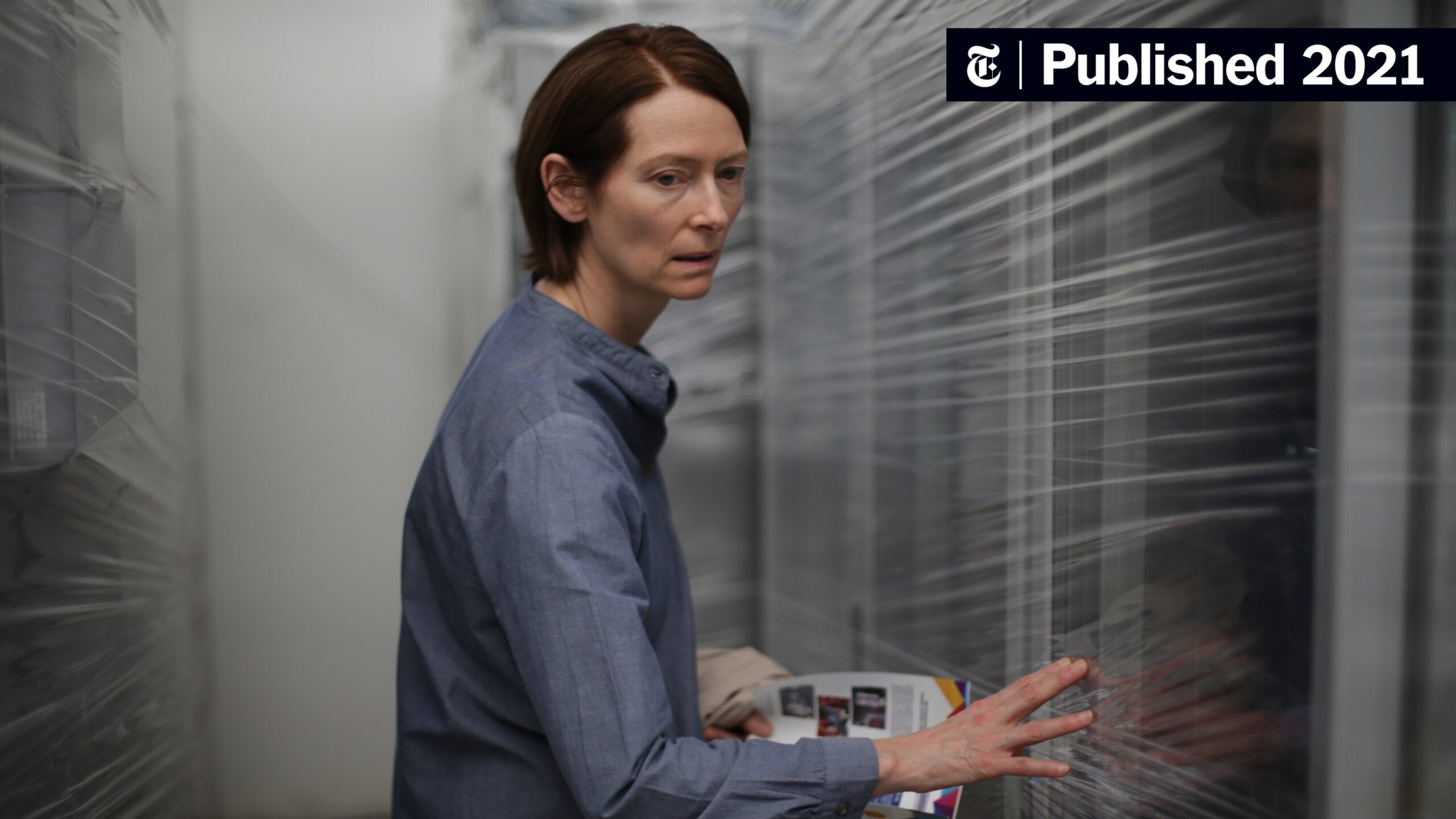
Hey there everyone! Welcome back to Movie Soapbox, the little corner of the internet that only you and I and that guy sleeping in the corner over there know about. This is the place where we find underappreciated indie films and we make sense of them, or at least we try, or at least we sit in the wreckage of having tried and decide the wreckage is kind of beautiful. Today? We are doing a deep dive on Memoria, a movie so genuinely inscrutable that even the man who made it admits he didn’t know what it was until an audience watched it for the first time in a theater and he looked at their faces.
Let’s get the trailer in front of you first. Watch it. Then we will talk about what you just watched, and why it tells you almost nothing, and why that is completely intentional.
Alright. Before we go any further, understand that what follows is a complete walkthrough of everything that happens in this film, including the ending, including the spaceship, yes there is a spaceship, and including the part where the film essentially asks you to stop watching it with your eyes. If you have not seen Memoria yet and you intend to, close this tab right now and go find it. The film’s theatrical distribution is an entire story on its own, one city at a time, one week at a time, touring indefinitely, which either sounds like the most precious art-cinema flex you’ve ever heard or the most accurate possible way to release a film about the impossibility of holding onto any experience before it drifts away from you. I’ll let you decide which. But if you have seen it, or if you’ve decided you need a map before you walk into it, stay with me. This is going to take a minute.
Memoria Movie and the Making Of
One thing you will not find in most writeups about Memoria is any real acknowledgment of what kind of film this could have become in other hands, or under other conditions, or with a distributor who’d looked at the footage and started making calls about reshoots. Apichatpong Weerasethakul has a Palme d’Or from 2010 for Uncle Boonmee Who Can Recall His Past Lives, which is the kind of credential that buys you a certain amount of rope, but it doesn’t buy you infinite rope, and the fact that this film arrived exactly as he intended it, unflattened, uncut for pacing, with its ten-minute single-shot sound sequences fully intact, is not something you can take for granted. Films at this budget tier with this level of formal strangeness routinely get a distributor note somewhere in post that says something like “audiences are losing the thread around the forty-minute mark” and suddenly you’ve got a recut that drops thirty minutes of the exact material that makes the film worth watching. That did not happen here. Whether that’s because of Swinton’s attachment, because of his festival reputation, or because whoever picked this up understood what they had, the film you watch is the film he made. That is rarer than it sounds.
Memoria Movie Deep Dive Walkthrough
The film opens on Jessica Holland, played by Tilda Swinton, sleeping. And when I say the film opens on her sleeping, I mean the camera sits there, locked off, unmoving, and watches her sleep in the dark for close to a full minute before anything happens. You are already being told what kind of film this is. Then a loud, deep, concussive bang detonates somewhere in or near or inside her skull, and she wakes.
This is not a random choice and it is not an abstract one. Apichatpong himself has experienced exploding head syndrome, a real neurological phenomenon in which a person wakes from sleep convinced they heard a catastrophically loud noise that existed only in their own nervous system. He built the entire architecture of this film around that experience, around the question of what it means to hear something real that no one else heard, and whether the distinction between those two things holds up under pressure.
A few scenes later, a bus backfires on a street and a man drops to the ground as though shot. Everyone around him flinches, grabs each other, looks for the source. So that sound was shared, collective, external. Jessica’s bang was not. Or was it? That question is the engine of the first half of the film.
Jessica connects with a sound engineer named Hernan, younger, maybe twenty-five, and together they spend time trying to reconstruct the sound in a studio, layering frequencies and materials until something approximate emerges. When they finally get close, Jessica hears the reconstructed bang and immediately goes glassy, drops into something between a faint and a trance. Then, for the next hour of the film, the sound disappears entirely. You will sit there waiting for it and it will not come, and after a while you will start to wonder if you imagined the whole first act.
Memoria Movie and the Deep Sickness in the Country
Jessica moves through Colombia the way a stranger moves through a place that keeps trying to tell her something in a language she almost but doesn’t quite speak. She visits a woman in the hospital, a friend or colleague who has been working with an indigenous community in the jungle, a community that apparently prays every evening specifically to keep outsiders away. The woman’s husband believes this praying is what’s making her ill. The woman is planning to go back the moment she’s well enough because she has deadlines. Make of that what you will.
During dinner with these people, the bang returns, three times in rapid succession, rattling Jessica so visibly that there is no longer any real ambiguity about whether this is a sound she’s sharing with the room. She is the antenna. Whatever frequency this thing operates on, she’s the only receiver in range.
She goes back to find Hernan, the young sound engineer. Nobody at the studio has ever heard of him.
Meanwhile, at a construction site where a tunnel is being dug through a mountainside, archaeologists have begun pulling ancient human remains from the rock. A young girl’s skull with a hole in the back of the cranium. Likely a sacrifice. Jessica is drawn to this, circling it, not yet understanding why.
She goes to a doctor and tries to talk her way into a Xanax prescription. The doctor is not particularly interested in medicating a problem she can’t verify exists. She prescribes them anyway.
Jessica is walking by a stream when the earthen boom finds her again, and she tilts her head the way you’d tilt a satellite dish, trying to locate the signal. A man nearby asks if she’s alright. His name is Hernan.
This Hernan is fifty-something. The previous Hernan was twenty-something. The film does not explain this and is not going to explain it, and if you spend energy demanding that it do so you are going to miss everything that happens next.
This Hernan tells her he doesn’t watch television, doesn’t listen to music, doesn’t travel, avoids anything that might add a new layer to a memory already stacked impossibly deep. He remembers everything that has ever happened to him, without erosion, without mercy. He can also, he tells her, read the residual experience of objects, rocks, ordinary things that have been touched and lived near and wept over. He refers to himself in the plural: “when we sleep, we do not dream.” He is not one person having a conversation. He is something older and more cumulative than that.
Memoria Movie Ending Discussed
Jessica goes to Hernan’s house and walks through his bedroom, touching things, feeling the air the way you’d feel for a draft. She tells him she’s sensing a memory from the bed, a child hiding under it, people arriving, fear, a mother’s hands. Hernan tells her that is his memory, not hers.
She asks him whether the bang she keeps hearing might be his memory too, bleeding into her from somewhere. He puts his hands on her arm.
What follows is a single unbroken ten-minute shot. Two people at a table. Almost no dialogue. The soundscape does all the work, and the soundscape is extraordinary, storms building and releasing, crowds arriving and dispersing, voices in panic, then silence, then something that sounds like geological time, civilizations condensed into audio and played back at table-level volume. Jessica sits there and receives it all and you watch her face and you understand that she has become permeable to something enormous.
When it’s over, Hernan tells her she is an antenna. That she can tune herself to the memories of the dead. Jessica has already guessed that Hernan is dead. She asks him directly whether it is awful. He tells her it isn’t, not specifically.
She goes to the window. She is hearing things from much further back now, frequencies she couldn’t access before. She cries, and has to physically disengage herself from the receiving.
Memoria Movie That Ending Explained
The film cuts to jungle. Dense, enormous, the kind of green that makes you feel how old the ground is under it. And in the trees there is a spaceship.
The spaceship rotates slowly, lifts, accelerates away, and as it goes it leaves behind a ring of exhaust, or heat, or something without a clean word for it, and the ring expands and then slowly fades back into the air.
Hernan sits on the porch. A radio report crackles in from the excavation site, describing newly found human remains, a person with a hole in the back of the skull. The same wound Jessica had been told about earlier, the young girl from the archaeological site, probably a sacrifice, probably very old. Hernan listens to the report. He puts his hand behind his own ear. He begins to cry.
The Cinematography and the Sound Design
The camera in this film does not move. Not meaningfully, not in the way you’ve been trained to expect movement to signal importance. A street. A parking lot with car alarms cycling. Jessica standing in a field looking at nothing. Tripod locked, record rolling, the world doing whatever it does in front of the lens. The source of this film’s power is entirely in the sound design, and if you watch it on a laptop at half volume you are watching a different, much worse film. The real work here is in what you hear while nothing appears to be happening, the layered environmental audio shifting under static frames, storms and crowds and geological groans that arrive without visual cause and leave the same way. Close your eyes in this film and it opens up. That is not an accident of execution. That is the whole design.
Memoria Theories Explained
Memoria Movie Theory #1 – The reading with the most support among people who’ve spent time with the film goes something like this: Jessica is a woman who has arrived in a country still metabolizing fifty years of conflict, a foreigner walking through a landscape saturated in collective trauma she has no framework to process, and the bang she keeps hearing is that trauma making contact with her, the sound of a wound in the earth that refuses to close. The Hernan she meets by the stream is not alive in any conventional sense. He is the country’s memory, or some piece of it, a spirit still attached to this place and its losses, and Jessica, through some quality she didn’t know she had until she got here, can receive him. The spaceship in the final sequence gets read in this light as the release of something very old, not an alien visitation but a departure, an exhale, something that has been hovering over this place since before the names of the people buried in that mountainside were forgotten.
Memoria Movie Theory #2 – A second read, quieter but worth taking seriously, follows Apichatpong’s own stated perspective more literally: that the film is about the impossibility and also the necessity of letting go, that Jessica’s journey is toward a state of pure presence, receiving without holding, an antenna that transmits but does not store. In this read, the two Hernans are the same person at different points in an existence that no longer moves through time the way ours does, and the film ends not with revelation but with release, for him, possibly for her, possibly for the land itself.
Memoria Movie Theory #3 – There is also a Colombia-specific reading that Colombian audiences arrived at when the film screened there, that this is a film about the internal politics of the country’s decades of conflict, the FARC, the paramilitaries, the government, the rural poor, the urban institutions, all of them circling a wound that predates all of their justifications for it. Apichatpong went to Colombia in 2016, just after the peace treaty with the FARC was signed, toured hospitals, spent time with archaeologists, absorbed a country trying to figure out what it was now that the shooting had technically stopped. He did not set out to make a political film. He set out to make a film about a woman in a landscape. The Colombian audience looked at it and saw their own history looking back at them. Both things are true at the same time.
Moviesoapbox’s Preferred Memoria Read
Here is what I think is actually happening, stated plainly and without apology: Jessica arrives in Colombia as a foreigner and she is, by some quality of temperament or neurology or grief she probably doesn’t have full language for yet, permeable in a way that most of us aren’t, and this country, which has been trying to process fifty-plus years of dead for decades now, finds her useful. The bang is the country’s dead making contact with a receiver that can actually pick up the signal. The young Hernan and the old Hernan are the same entity at different points in whatever existence a spirit inhabits when it’s still tied to a place, still holding memories it can’t release until someone sits with it long enough to feel them. Jessica does that. She sits there at the table and she receives fifty years of loss through her skin and she cries and she lets it move through her, and at the end of that, something lifts. The spaceship is that lifting. It is not science fiction. It is the visual form of a country’s accumulated grief finally getting enough distance to see the ground from above, and then leaving it behind.
Apichatpong went to Colombia to make a film about a stranger in a strange place, found an entire country in mourning, and made a film about what it costs to truly receive someone else’s grief rather than just observe it from the outside. Tilda Swinton stood in front of a locked-off camera for two hours and made you feel every frequency of that cost without moving her face more than a centimeter. The fact that this film exists, uncompromised, in the form he intended, is the thing worth holding onto after everything else dissolves. Most films like this don’t make it out. This one did.
Go watch it again. Sit in the dark. Turn up the sound. Let it move through you. That’s the whole instruction.