
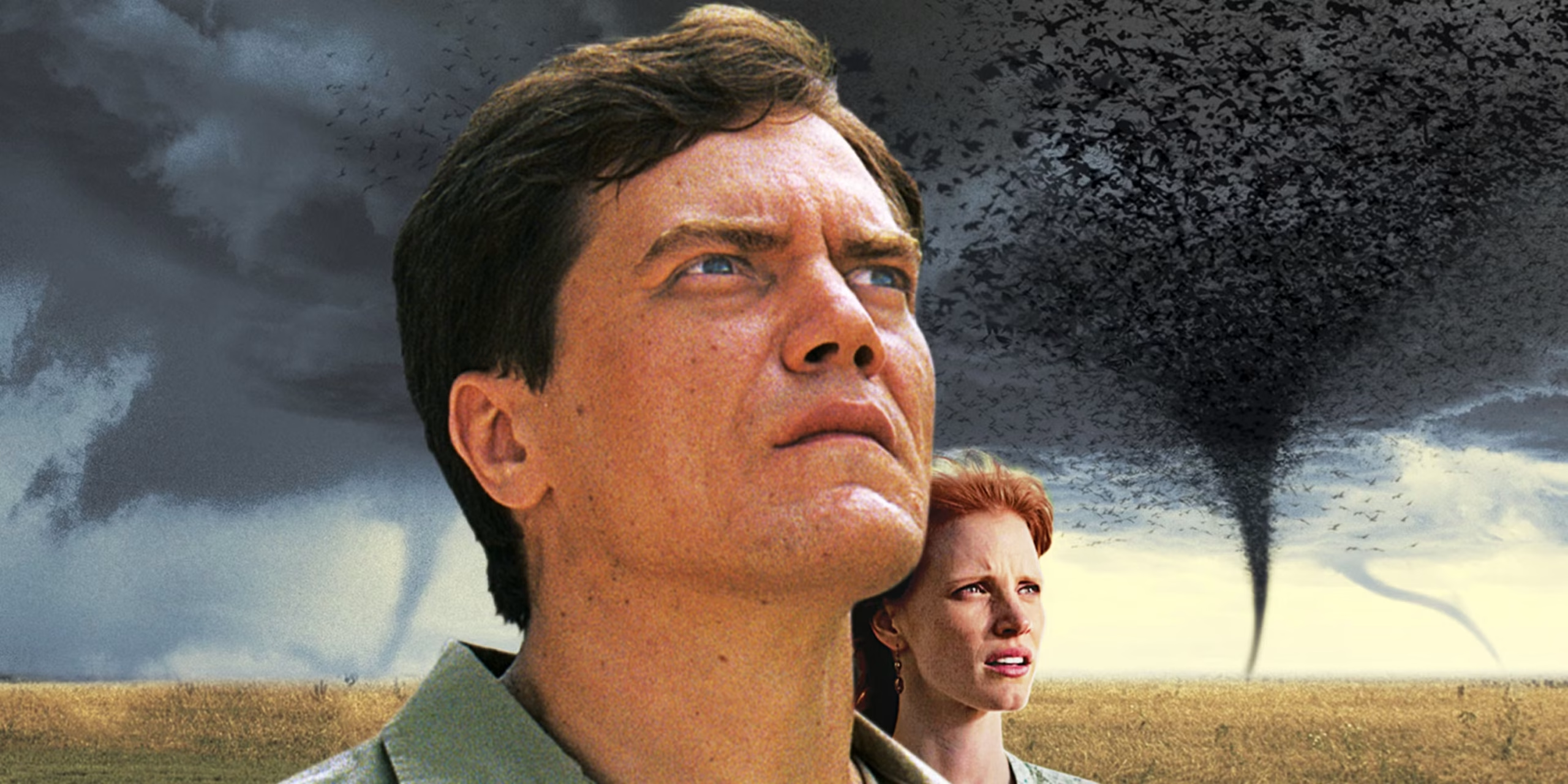
Hey there everyone! Welcome back to Movie Soapbox, the little corner of the internet that only you and I and that guy sleeping in the corner over there know about. This is the place where we find underappreciated indie films and we make sense of them. Today? We are doing a deep dive on Take Shelter, a movie so quietly, methodically destabilizing that you spend ninety minutes convinced you know exactly what kind of film you’re watching, and then the last three minutes rearrange your whole skull.
Fair warning, and I’m going to be direct about this because I actually respect your time: everything that follows is a full spoiler walkthrough of Take Shelter, including the ending, especially the ending, the ending is basically the whole reason we’re here. If you haven’t seen it, the movie is on streaming, go watch it, come back. You have my word it’s worth the detour. Still here? Good. Let’s get into it.
Take Shelter Movie Deep Dive Walkthrough
Curtis LaForche is a working man in rural Ohio, the kind of guy who shows up early, drinks a little too much after, loves his wife Samantha without making a whole performance of it, and is quietly, methodically building a life around a daughter who has recently lost her hearing. The family is strapped, the way working families are always strapped, that specific American broke where you own things but the things own you back. And then Curtis starts dreaming. Not restless sleep, not garden-variety anxiety, but full-sensory, you-can-smell-the-ozone, oil-black-rain-on-your-face visions that leave him flinching from phantom dog bites well into the next afternoon. He checks the boxes a responsible man checks, doctor, medication, counselor, trying to hold the architecture of his life together while something in the foundation shifts. He borrows against the house to expand the backyard storm shelter, loses his job over it, and watches the distance between himself and Samantha widen into something that starts to look permanent. The movie ends on a beach in Florida, where Curtis, Samantha, and their daughter watch the ocean pull back, the sky go green and wrong, and funnels drop out of a cloud mass that has no business existing. Samantha sees it too. That’s the film.
Now. Before we get into the three competing ways to read that ending, you need to understand something about what kind of film this actually is, and what it was always going to be pressured to become.
A movie like Take Shelter lands at a certain budget tier with a cast that punches above it, and the first thing that happens in a normal development process is that someone in a room with a whiteboard starts talking about “clarity for the audience.” Jeff Nichols made this at a level where he retained enough control to leave the ending genuinely open, but you can feel the shape of the version that almost existed instead, the one where the third act resolves the ambiguity cleanly, where Curtis is either definitively a prophet or definitively unwell, where the audience gets to leave the theater having been told what they just watched. Films at this budget with this kind of slow-burn dread pressure almost always get that note. The fact that this one didn’t, that Nichols held the line on an ending that refuses to collapse into a single reading, tells you something about how hard he must have fought to keep it. You can tell when a director won that argument. The ending of Take Shelter has the fingerprints of a man who said no, repeatedly, to people with more leverage than him.
Competing Theories to Explain Take Shelter
So. The three reads.
Theory Number One – Curtis is Losing His Mind
This is the reading the film builds toward for most of its runtime, and it has the strongest structural support. His mother developed paranoid schizophrenia at 35, walked away from her family, has been in managed care ever since. Curtis is 35. The film knows you’re doing that math and it wants you to do it. His visions escalate in exactly the way you’d expect a dissociative break to escalate, more vivid, more physical in their aftereffects, more resistant to medication. He is a man watching himself become his mother and trying to outrun it with a shovel and a building permit. Everything about the film’s mise-en-scène in the vision sequences supports this reading: the slightly wrong color grading, the way violence in the dreams always comes from people he trusts.
Theory Number Two – Curtis is Foretelling the End of the World
The visions are not symptoms. They are signal. The oil-black rain, the zombie-like population turning feral, the sheltering underground while something terrible passes overhead, these are not a malfunctioning brain, they are a man receiving information he has no framework to process. His breakdown in the VFW hall isn’t a psychotic episode from this angle, it’s a prophet doing the only thing a prophet can do when nobody’s listening, getting louder. And the ending is the confirmation, the storm arriving exactly as advertised.
Theory Number Three – Curtis and Samantha are Both Seeing Things
This is the thinnest reading and the film doesn’t really earn it. Shared psychosis is a real clinical phenomenon but it’s rare enough that invoking it here feels like reaching for an explanation that preserves the ambiguity without committing to anything. I’ll mention it because the forum threads always mention it. I don’t buy it.
Moviesoapbox’s Unapologetic Perspective
Here’s where I plant my flag, and I’m not going to be diplomatic about it. The apocalypse reading is the more cinematically satisfying answer, and I think it’s the one Nichols earned the right to give you, but it’s also the reading that matters least. Jeff Nichols has said this directly, the film is about marriage, about the specific damage that happens when two people stop sharing their fear with each other, about the way anxiety metastasizes in private and becomes something you act out instead of name. The beach ending isn’t there to resolve the prophet-versus-madman question. It’s there because Samantha is finally standing next to her husband looking at the same sky. They are, for the first time since the film’s first act, inside the same reality together. Whatever that reality is. Whether the storm is real or not, whether they have fifteen minutes left or decades, they are on the same page again. That’s the whole movie. That’s what it survived a development process to say.
A film this quiet, this committed to mood over mechanics, this allergic to the kind of third-act explanation that makes test-screening audiences feel smart, does not get made without a director who knows exactly what he’s protecting. Nichols knew. Shannon knew it too, which is why that performance never tips its hand in either direction, never lets you settle into a diagnosis. Films like this get made once in a while when the people making them care more about the thing than about the audience’s comfort level, and they get remembered long after the franchise slop that opened the same weekend has been quietly delisted from every platform that ever carried it.