
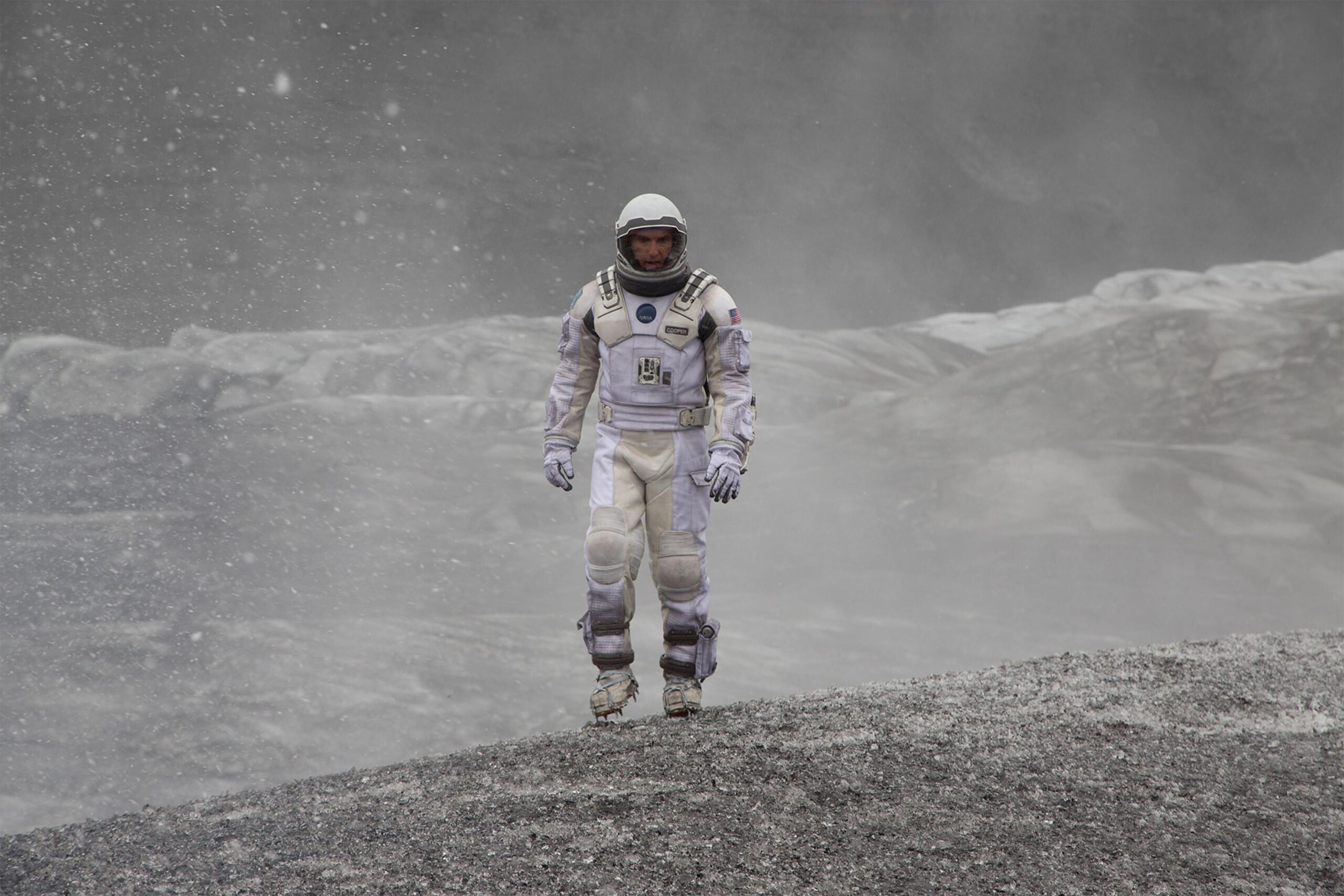
Hey there everyone! Welcome back to Movie Soapbox, the little corner of the internet that only you and I and that guy sleeping in the corner over there know about. This is the place where we find underappreciated, underseen, and under-examined films and we make sense of them. Today? We are doing a full deep dive on Interstellar, a movie so structurally ambitious and third-act-broken that the people who love it most are the ones who’ve spent the most time convincing themselves the broken parts are actually features.
Alright. Everything from this point forward is going to spoil this movie completely and without apology. Every twist, every reveal, every moment where Nolan swings for the upper deck and you have to decide whether he connected or just corkscrewed himself into the dirt. If you haven’t seen Interstellar yet, go watch it, come back, and we’ll sort through the wreckage together. You’ve been warned.
Before we get into the theories, let me tell you something about what this film actually is as an industrial object, because that context matters for everything that follows. Interstellar is a $165 million production that got made because Christopher Nolan had enough post-Dark Knight capital to walk into a room and say “I want to make a hard science-fiction film about a father leaving his daughter” and nobody in that room was going to say no to his face. That kind of greenlight is rarer than a wormhole appearing near Saturn. What you can hear in the film’s DNA, if you know what to listen for, is the sound of a filmmaker who got that yes, and then spent the entire production trying to protect a genuinely tender, grief-soaked story from the gravitational pull of its own spectacle budget. The third act doesn’t buckle because Nolan lost the plot. It buckles because the film is pulling in two directions simultaneously, toward the intimate and toward the cosmically enormous, and somewhere in the tesseract sequence those two things stopped talking to each other. You can hear the note that got accepted in the room: “we need to pay off the wormhole.” You can hear the note that didn’t get pushed back on hard enough: “and we need Cooper to survive it.” A leaner version of this film, the one that ended in the black hole and let Brand carry the final act alone, exists somewhere on a cutting room floor or in an earlier draft. That film might have been a masterpiece. What we got is still extraordinary for two hours and then asks you to perform a significant act of faith.
Interstellar Deep Dive Walkthrough
So. Let’s walk through what actually happens in this movie, because before you can argue about what it means you have to agree on what it shows you.
Earth is dying. The agricultural system is collapsing under a spreading blight. Cooper, a former NASA pilot now farming because that’s what the world needs, stumbles onto coordinates that lead him to a secret NASA installation run by Professor Brand. Turns out NASA never fully shut down. There’s a wormhole sitting near Saturn, apparently placed there by some intelligence, and Brand’s team has been sending astronauts through it to scout habitable planets. Cooper gets recruited to lead the mission that will determine which of those planets is humanity’s best shot. He leaves his daughter Murphy behind with a promise to come back, and that promise is the emotional spine of everything that follows.
The crew goes through the wormhole. They visit a water planet where a catastrophic time dilation means hours on the surface cost them decades on Earth. They visit Mann’s planet, where Dr. Mann, the mission’s most celebrated astronaut, has been transmitting false positive data because he panicked and wants to be rescued. Mann’s deception nearly kills everyone. In the chaos of escaping, Cooper detaches from the main ship to give Brand enough thrust to reach Edmonds’ planet, the one remaining viable candidate. He falls into the black hole, Gargantua. And then things get complicated.
Inside the black hole, Cooper finds himself inside a tesseract, a five-dimensional structure that lets him interact with the past, specifically with his daughter’s bookshelf, across multiple points in her timeline. He uses this to send himself the GPS coordinates that led him to NASA in the first place (the “STAY” message, the dust-floor binary map), and more critically, he uses his watch to transmit in Morse code the quantum data that TARS collected from inside the singularity, the data Murphy needs to solve the gravity equation and execute Plan A. She solves it. Humanity evacuates Earth. Cooper gets ejected from the tesseract, drifts near Saturn, gets picked up, wakes up on a space station that now bears his daughter’s name, reunites with a 123-year-old Murphy on her deathbed, and then heads off into space to find Brand, who is alone on Edmonds’ planet beginning the colonization. That’s what the movie shows you at face value. Now let’s talk about why that face value is a problem.
Interstellar Theory Explanation Number One
The Literal Theory, the reading where all of that actually happened exactly as depicted, runs into a wall that no amount of goodwill can get you over. It’s a closed causal loop with no external origin point. Cooper finds the NASA coordinates because Cooper sent them from the tesseract. Cooper survives to be in the tesseract because Cooper sent the coordinates that got him recruited for the mission. Cooper sends Murphy the quantum data that saves humanity because Cooper fell into the black hole where he got the quantum data to send. Who built the tesseract? Future humans, presumably, evolved beyond the fourth dimension, reaching back through time to save the species. Fine. But future humans only exist to build the tesseract because Cooper completed the mission that saved humanity. And Cooper only completed the mission because future humans built the tesseract. You can call that a stable time loop if you want. What you can’t call it is a story with a first cause. Nothing in this chain of events has an origin. It’s a snake eating its own tail and Nolan asks you to applaud the snake for its flexibility.
There’s a separate problem, a more visceral one. Cooper drifts in space with seconds of oxygen left and gets picked up in the nick of time. Lottery-ticket stuff. The film essentially asks you to accept a coincidence so astronomical that it would feel cheap in a Marvel movie, let alone in a film that spent two hours lecturing you about physics and consequences. You don’t get to deploy orbital mechanics with one hand and deus ex machina with the other.
Interstellar Theory Explanation Number Two
The All Possible Realities reading tries to fix this by invoking string theory and the many-worlds interpretation, suggesting that the tesseract gives Cooper not just temporal access but cross-reality access, the ability to select among infinite possible timelines for the one where everything works out. This is philosophically interesting and narratively catastrophic. If Cooper can simply choose the good ending from a menu of infinite options, the entire dramatic structure of the film collapses. Stakes require constraint. The moment you posit that the protagonist can browse outcomes like a streaming service, you’ve written a story with no actual jeopardy in it, only deferred reveals. The All Possible Realities reading makes the film feel smarter for about four minutes and then makes it feel emptier than the literal version.
Interstellar Theory Explanation Number Three
There’s a third theory that floated up from the internet’s deeper trenches, sometimes called the Long Travel Theory. The basic premise: there was no wormhole originally. A remnant group of humans escaped Earth by conventional spaceship, traveled to Gargantua over millions of years in hibernation, colonized there, evolved into five-dimensional beings, and then reached back in time to install the wormhole and set the events of the movie in motion, bootstrapping their own survival. It’s elegant as a concept. It disintegrates on a single practical note. Biological hibernation preserves a body for years, maybe decades under plausible near-future science. It does not preserve a human body for millions of years. The suspension of disbelief required to accept that has nothing to do with physics and everything to do with basic biology. You can’t extend this particular cheat that far without the audience noticing the seams.
Interstellar Theory Explanation Number Four
Which brings us to the reading that, once it occurs to you, becomes very hard to unsee. Cooper dies when he jettisons from the ship. He drifts. His oxygen runs out. And everything you see after that moment, the tesseract, the reunion with Murphy, the space station bearing her name, the ride off toward Edmonds’ planet, none of it happens. What you’re watching is a dying man’s mind arranging the world into the shape of the promise he couldn’t keep. It’s the oxygen-deprived hallucination of a father who left his daughter and is now, in the dark between the stars, constructing a version of events where he didn’t fail her. He sends himself back to say stay. He gives her the data she needs. He sees her one more time. He points himself toward the woman still doing the work he abandoned. Every narrative desire the film builds up in its first two hours, Cooper keeping his word, Murphy being saved, Brand not being alone, gets fulfilled in Cooper’s final minutes of consciousness, and Nolan is kind enough, or cruel enough, to play it completely straight.
This reading doesn’t solve every problem. Brand’s survival on Edmonds’ planet still requires the wormhole, and the wormhole still requires an explanation the film doesn’t fully earn. But the Post Mortem reading at least has a first cause. Brand gets to Edmonds’ planet because Cooper sacrificed himself to give her the thrust. She establishes the colony. Plan B survives. Humanity continues, not the billions on Earth, but the seed of it, in the ark Brand carries. Plan A fails, Cooper dies, and the movie you watched in its final act is the story a dead man told himself in the gap between one heartbeat and none.
Movie Soapbox Movie Mike’s Reading
That’s the reading Movie Mike is planting his flag on. Sorry everyone – but yeah, I really do think that Cooper dies in space. The third act is a dying man’s wish fulfillment. And the film is, if you accept this, actually more emotionally devastating than the literal version, because it means the reunion with Murphy never happened, the promise was never technically kept, and the best Cooper could do was dream that it was.
Nolan made something that could have been one of the great science-fiction films. The first two acts are close to perfect, a genuine achievement of emotional and conceptual ambition that very few filmmakers working at that budget level would have attempted or survived. The reason the third act fails under scrutiny, the causal loop, the oxygen lottery, the deus ex tesseract, isn’t that Nolan got lazy. It’s that the film needed to end and the studio needed Cooper to live, and those two requirements didn’t have a clean solution that kept the internal logic intact. So he chose spectacle and sentiment and hoped the physics would hold. They don’t. But the grief underneath them does, and that grief is the whole movie. Brand keeps going. That’s the ending that actually happened. Everything else is what Cooper needed to believe as the air ran out.
That’s it for today. Thanks for spending some time in this corner of the internet with me. If this one got your brain turning, stick around, there’s more where this came from. See you next time.
If You Liked Interstellar…
Approaching the Unknown (2016) – A solo astronaut headed to Mars with a machine that might not work. Strip Interstellar’s budget down to nothing and this is what’s left — one man, one mission, one unraveling mind.
Annihilation (2018) – Scientists enter something unknowable and it changes them at a cellular level. If Interstellar’s black hole fascinated you, the Shimmer will consume you.
Edge of Tomorrow (2014) – Sci-fi spectacle with a time mechanic that actually holds together under scrutiny. The best blockbuster nobody watched twice in theaters.